|
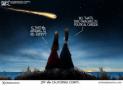
While many in the press and the public celebrate the twilight of Mubarak’s reign (as of this writing he has agreed to cede power with the September elections), too few are asking what Egypt will look like when the sun rises over Cairo the next morning.
|
|
| According to legend, it was the wayward kick of Mrs. O’Leary’s cow that began the Great Chicago Fire of 1871. Two days later, a third of the Windy City’s property value was destroyed and a third of its people were homeless. One wonders if a similar catastrophe will emerge from another seemingly minor combustion: the self-immolation of Mohamed Bouazizi, a 26-year old Tunisian street vendor whose public suicide was a protest against an oppressive government that had confiscated his livelihood and insulted his pride.
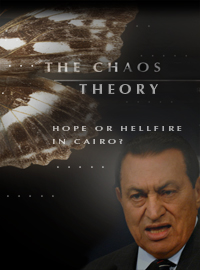
If, according to the dictates of chaos theory, Bouazizi was the butterfly flapping its wings, the fall of Hosni Mubarak’s government in Egypt – and potentially of other regimes throughout the Arab street – is the resultant hurricane. At the news of Bouazizi’s death – an act of physical suicide interpreted throughout the region as a reaction to the Tunisian regime’s spiritual homicide – a torrent of public hostility towards the authoritarian governments of the Middle East threatened to break the dams that have held back the seething rage of the region’s youth.
When this phenomenon first reached full realization with the fall of the Tunisian government, it was treated as little more than a curiosity by the western press. As part of a North African neighborhood that includes such high-visibility nations as Morocco, Libya and Egypt, Tunisia is a country that Americans can find in the headlines about as infrequently as they can find it on an atlas. But now that the contagion has spread to Egypt, the editors and producers of the west are sitting upright. As is their wont, however, they are too often substituting width of coverage for depth of understanding.
There is no doubt that during nearly three decades of Hosni Mubarak’s rule, Egypt has been a harsh and illiberal place. Mubarak has systematically suppressed political opposition, overseen a domestic police force that regularly tortures enemies, quashed free speech and ruled by fiat.
An honest accounting of his tenure would also note that he has preserved Egypt’s fragile “cold peace” with Israel, aggressively reformed the nation’s formerly socialist economy, held together an alliance with the United States and kept the forces of radical Islam from gaining too much political power. Translation: he has been a brutal thug, but one who has redeemed himself at the margins.
Yet while many in the press and the public celebrate the twilight of Mubarak’s reign (as of this writing he has agreed to cede power with the September elections), too few are asking what Egypt will look like when the sun rises over Cairo the next morning.
Thus far, the protests raging in Egypt have been salutary to western sensibilities. The youth lining the streets have spoken out for democracy and liberty, a twinned plea that can’t help but set American hearts aflutter. But from Paris in the late eighteenth century to Tehran two centuries later, the hard lesson of history is that revolutions often eat their own. Given the influence of the Muslim Brotherhood in Egypt, that will be a fate this ancient civilization will find itself hard-pressed to resist. And if it succumbs, the result will be a nation that is less free at home and more aggressive abroad.
One of the cold comforts of the 20th century was the knowledge that authoritarian (as distinct from totalitarian) regimes, unpalatable as they may be, are often the least bad option available to the United States.
Francisco Franco may have ruled Spain as a military dictator, but he was eminently preferable to the communists who would have otherwise controlled most of the Iberian Peninsula. Augusto Pinochet may have regularly violated human rights, but it’s doubtful that there would have been more freedom had Chile fallen prey to full-scale Marxism. The Shah of Iran may not have been Tehran’s Thomas Jefferson, but he was also not an implacable mullah bent on the destruction of "The Great Satan."
It is altogether likely that Mubarak has reached an inflection point where such cost-benefit calculations no longer hold. Even if he hasn’t, his departure is already a fait accompli. But if the idealistic young activists of Egypt hope to have their dreams of freedom fulfilled, they have only a few months’ time in which to do it. If they don’t, there will soon come a day when the Mubarak era is remembered as the good old days.
Few things could be less worth marching for.
|