|
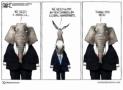
Elections are simply a means to an end. Real change will require original thinking, boldly articulated and forcefully husbanded.
|
|
| Mike Lee has an idea. Actually, to put a finer point on it, the Utah Republican who hopes to claim the U.S. Senate seat from which Robert Bennett was recently evicted, has read the Constitution, and has found an idea within it.
Lee is running for the nation’s upper legislative chamber partially on the basis of his support for what is known as the Enumerated Powers Act, a piece of legislation that would force Congress to explicitly cite from whence in the Constitution it derives its authority for any given piece of legislation. In an era where a Commerce Clause of seemingly infinite elasticity is invoked to punish Americans who don’t purchase health insurance, this is an exercise in radicalism.
Marco Rubio, aiming to be Florida’s next U.S. senator, has also given some thought to the problems bedeviling the nation. In his sights: entitlements. Rubio has thought seriously about Social Security and – as serious people do – concluded that the program’s retirement age (65 or 66 depending on your year of birth) is unsustainably low.
Rubio’s unlikely philosophical ally in this outlook is Social Security’s progenitor, Franklin D. Roosevelt. When Roosevelt signed the entitlement into law, life expectancy was low enough that the program would typically only cover the last few years of life. It was essentially a government subsidy for cheating death. But in an age of expanded health, the program has become an institutional incentive for removing productive Americans from the workplace.
Peter Schiff, who the majority of Connecticut voters seem to oppose on principle – the principle being fealty to ritualized fiscal suicide – has reimagined health care as something other than a monument to presidential ego. Schiff proposes allowing individuals to opt-out of employer-provided health care, using the money to buy their own coverage and keeping the remainder tax-free. This is a proposal unlikely to succeed in the age of Obama because it increases accountability, competition and choice rather than just talking about them.
Kentucky’s Rand Paul, realizing that a tie between competing lobbyists is not the same as a loss for either, wants to rethink energy policy. Rather than a debate about whether nuclear or solar power is more deserving of government largesse, Paul holds a view distressingly unique for a national Republican: energy production should be determined by the free market, lest Washington create more incentives to lobby the Congress than to create viable products. As a policy with no discernible constituency on K Street, it already has the mandate of heaven.
In Kansas, candidate Todd Tiahrt has proposed the creation of the Commission on the Accountability and Review of Federal Agencies (an anti-government entity saddled with an unfortunately conventional Washington name). CARFA would have as its mission to consolidate wasteful and redundant government agencies and eliminate “any agency or program that has completed its purpose, become irrelevant, or failed to meet objectives.” If this legislation were ever made law it would strike at the root of the single biggest institutional threat to freedom in the federal government: the unmolested expansion of the unelected, unaccountable administrative state.
Conservatives are rightly animated by a crop of promising candidates in 2010. But elections are simply a means to an end. Real change will require original thinking, boldly articulated and forcefully husbanded. The seeds of change are being planted.
|