| Jimmy Carter’s “Malaise” Versus Reaganesque and Trumpian “Peace Through Strength” |
 |
|
By Timothy H. Lee
Thursday, July 17 2025 |
| |
|
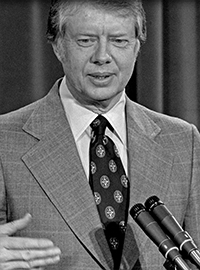
It may be true that one invites more flies with honey than with vinegar. It’s equally true, however, that one invites peace more through strength than through deference. This week marks the anniversary of Jimmy Carter’s infamous “Malaise Speech” to the nation, and it nicely highlights the gulf between presidents like Carter who placated America’s enemies and paid the price, versus presidents who engaged in more muscular foreign policy with undeniably better results. Those lessons remain important today. On July 15, 1979, Carter addressed the nation from the Oval Office in what became known as his “Malaise Speech” even though he never actually used that term. Carter intended to reinvigorate a nation stumbling through an ongoing energy crisis, high inflation and dangerous global instability, but instead projected hand-wringing, lecturing and defeatism. He somberly lamented that Americans suffered a “crisis of confidence” and had lost their faith in government, the future and the nation itself. Ostensibly an energy policy speech, Carter spent most of his time playing the role of psychologist and surveyed our emotional state without offering solutions. Americans needed leadership, but instead received a lecture on consumerism, spiritual inadequacy and national self-doubt. The address epitomized Carter’s presidency, which soon confronted the Iranian Revolution and hostage crisis. While Carter dithered and projected impotence, the Soviet Union sensed American weakness and invaded Afghanistan later that year. Ronald Reagan subsequently inherited Carter’s state of malaise, but understood that the path to recovery and greater peace was through strength – military and economic, but also moral. Rather than scold Americans, he promised national renewal and summarized his strategy toward the Soviet Union as, “we win, they lose.” Reagan openly labeled communism “evil,” rebuilt America’s military, turbocharged the American economy via supply-side agenda of lower taxes and less regulation, supported anti-communist proxies across the world and constantly portrayed the United States as the “shining city upon a hill.” By the end of the decade, Reagan won the Cold War without firing a shot. Had anyone predicted that in 1980, they would’ve been hauled off to an asylum. Decades later, unfortunately, Carter’s “malaise” mindset reemerged during the Obama and Biden administrations. Each time, American weakness encouraged aggression from our adversaries and increased global instability. Obama brought us the failed “reset” with Russia, capitulation to it on missile defense, the disastrous withdrawal from Iraq that birthed ISIS and a 2009 Cairo speech apologizing for America’s historical legacy. His reluctance to enforce his own “red line” after Syrian dictator Bashar al-Assad used chemical weapons showed both allies and foes that American foreign policy was hollow. Obama also rewarded Iran with the failed nuclear accord that merely handed billions of dollars to the world’s leading state sponsor of terrorism in exchange for fleeting and unenforced nuclear development restrictions. Throughout his presidency, Joe Biden followed that same trajectory of weakness. His catastrophic withdrawal from Afghanistan ended America’s longest war by handing the previously defeated Taliban control of the country while leaving behind vast amounts of U.S. military hardware and severely damaging America’s credibility. Vladimir Putin invaded Ukraine mere months later, correctly calculating that Biden lacked the will required for deterrence. Biden also bizarrely embraced Iranian appeasement, resuming concessions and allowing it to replenish oil revenues that in turn went to terrorist proxies like Hamas and Hezbollah. The October 7, 2023, attack on Israel was one result. Elsewhere, Xi Jinping accelerated China’s military buildup and aggressive posture toward Taiwan. Weakness, once again, proved provocative to global rogues and terrorists. In-between and after the Obama and Biden administrations, Donald Trump rejected their apologetic posture and reasserted American strength. His administration withdrew from the farcical Iranian nuclear accord while reimposing crippling sanctions that depleted its oil revenues. As a result, Iran was less able to subsidize its terrorist proxies. Trump’s peace-through-strength approach resulted in the historic Abraham Accords that normalized relations between Israel and surrounding Arab nations without any concessions to Iran or Palestinian demands. Trump’s bold military strike eliminating Iranian General Qasem Soleimani also signaled that U.S. power would be exercised as appropriate, while simultaneously avoiding drawn-out military engagements across the globe. More recently, his coordinated attacks with Israel against Iran sent an unmistakable signal and degraded its nuclear efforts. Trump restored America’s more muscular posture, and enemies are on notice. The lesson is obvious. When presidents exude weakness in the manner of Carter’s address this week in 1979, adversaries and allies alike take note. Carter’s presidency proved that weakness invites aggression, and the Obama and Biden presidencies repeated those errors. In contrast, the Reagan and Trump doctrines of peace through strength proved once again that when America unapologetically projects fortitude, defends its interests and supports our allies, we’re all better off and safer. |