| Trump Wisely Greenlights Nippon Steel/U.S. Steel Deal as Consumer Confidence Surges |
 |
|
By Timothy H. Lee
Thursday, May 29 2025 |
| |
|
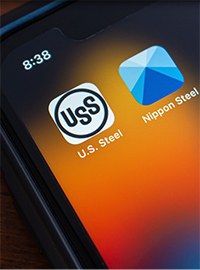
Consumer confidence achieved its highest monthly increase in four years this week, exceeding all expectations in Bloomberg’s survey of economists. That illustrates once again that when President Trump effectuates an economic agenda of deregulation and market-based policies after four dreary years of Joe Biden and Kamala Harris, American consumers welcome it enthusiastically. This week offered a fitting illustration in that contrast between the Trump and Biden administrations, as Trump announced his approval of Nippon Steel’s proposed investment in U.S. Steel. That reverses the Biden administration’s decision to prohibit the proposed acquisition, which constituted a naked elevation of partisan politics over our domestic steel industry, U.S. national security and the interests of the affected steelworkers themselves. For a man who claimed such foreign policy expertise, moreover, Biden also managed to undermine our strategic partnership with Japan while facilitating China’s ongoing effort to corner the global steel market. That partisan interest to which Biden surrendered was Big Labor’s preference that comparatively union-dominated Cleveland-Cliffs acquire U.S. Steel instead of Nippon Steel. With the 2024 election approaching when the Biden/Harris administration made its decision, they were transparently sacrificing national interest and affected steelworkers in favor of powerful labor bosses’ support. All along, however, Nippon Steel’s offer represented the better free-market option. Among other commitments, it promised to invest fully $2.7 billion in order to modernize rather than close plants in Mon Valley and Gary, Indiana. Accordingly, Nippon Steel promised to improve decaying U.S. Steel facilities and protect the thousands of well-paying jobs that one would presume remain the foremost concern for labor union leaders. Had the Biden/Harris administration successfully blocked the Nippon Steel agreement, in contrast, U.S. Steel itself cautioned that its existing plants would likely close. It also warned that it would likely even be compelled to relocate its corporate headquarters from Pittsburgh, America’s steel industry cradle. Apparently union leaders considered their own short-term welfare and continuing dues infusion more important. After all, Nippon Steel promises to avoid layoffs through at least calendar year 2026, which one would assume to be labor leaders’ primary concern. And with an eye toward the longer-term, Nippon Steel’s acquisition proposal offers the greater opportunity than Cleveland-Cliffs to allow U.S. Steel to remain more competitive against overseas competitors. Standing alone, U.S. Steel doesn’t possess the resources to upgrade its infrastructure to match those international competitors or protect those jobs that currently hang in the balance, nor can Cleveland-Cliffs provide the same assurances that Nippon Steel can. Beyond those straightforward economic concerns, by finalizing approval of the Nippon Steel proposal President Trump can also score a win for U.S. national security by the way it can strengthen our position vis-à-vis China. That benefit flows in large part from the fact that Japan itself offers a counterweight to China and remains one of America’s most reliable allies. Our two countries possess a longstanding mutual defense treaty, with Japan’s powerful navy providing a security blanket in the Pacific theater. By allowing U.S. Steel to combine with a counterpart from such a strongly allied nation, President Trump instantly fortifies our alliance as China seeks to increase its menace. If the Biden administration possessed the final word, by contrast, China would’ve only tightened its grip on the worldwide steel market. To illustrate, China’s Baowu Group holds the title as the world’s largest steel producer. If allowed to finalize their partnership, U.S. Steel and Nippon Steel would become the world’s second-largest steel producer. That will instantly place America and our ally Japan on a stronger foundation in our geopolitical competition against China. Had President Trump not reversed the Biden administration’s decision, the takeaway for investors and America’s allies and enemies alike would’ve been clear. It would’ve confirmed that American political leadership cared more about scoring domestic political points than long-term prosperity and U.S. national security. It would’ve also signaled that sclerotic economic policies prevail against free market principles of open negotiation and mutual agreement that made America the most prosperous, inventive, powerful nation in human history. President Trump thus deserves praise for reorienting the American economy toward a more deregulated, free-market approach. By supporting the U.S. Steel/Nippon Steel partnership through completion, the administration can strengthen our domestic steel industry, preserve American jobs, fortify our alliance with Japan and boost U.S. national security by contesting China’s tightening grip on global steel production. Simply put, the deal is good for America, and should be finalized without any further delay.
|