






















| Liberals Can’t Tell the Truth About Social Security Funding |
 |
|
By Ashton Ellis
Thursday, August 11 2011 |
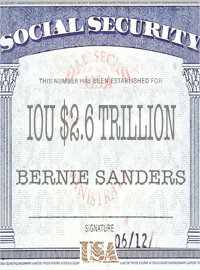
During the recently concluded debt ceiling debate, prominent liberals like Senator Bernie Sanders (I-VT) were fond of saying that reforming Social Security was unnecessary because the program “has nothing to do with the deficit.” Is that true? Here’s an excerpt from an opinion column Senator Sanders wrote on July 21, arguing that Social Security should not be included in any deficit reduction negotiations: “I heard Democrats say that Social Security has nothing to do with the deficit. That is right because Social Security is funded by the payroll tax, not by the U.S. Treasury. Social Security has a $2.6 trillion surplus today. It can pay out every benefit owed to every eligible American for the next 25 years.” In a limited, not-telling-the-whole-truth sense, Sanders is correct. By law, the tax receipts collected and paid from the Social Security Trust Fund are “off-budget,” meaning that the money collected and spent is not counted toward the current $1.4 trillion budget deficit. According to the Social Security website, part of the rationale for making the Trust Fund “off-budget” is because its funding source comes from a dedicated (payroll) tax, not an annual appropriations decision by Congress. But to say, as Sanders does, that “Social Security has nothing to do with the deficit” is to imply that the program has no relationship to the ongoing fight over out-of-control federal spending. Far from it. Since Social Security’s inception, the Trust Fund has never acted like a trust. Most of the tax receipts that come into the Trust Fund are disbursed immediately to current beneficiaries. (Liberal bloggers Thomas Ferguson and Robert Johnson euphemistically refer to this system as “pay-as-you-go.” The rest of us call it a Ponzi scheme.) Whatever money is left over is “invested” by the Managing Trustee (i.e., the Treasury Secretary) in U.S. bonds with a promise to pay a specified level of interest later. In reality, the Treasury Secretary raids the Trust Fund of its surpluses, leaving trillions of IOUs in their place. When Sanders says that “Social Security has a $2.6 trillion surplus today,” what he really means is that the Trust Fund has $2.6 trillion in Treasury IOUs. The money is gone because it’s already been spent, by the government, on other government programs. And the $2.6 trillion number is just today’s amount. According to calculations by Boston University economics professor Laurence Kolitkoff, Social Security’s total future liabilities are estimated to be $15 trillion. (To compare, Kolitkoff projects Medicare obligations to cost $80 trillion, with last decade’s prescription drug benefit tacking on another $20 trillion in unfunded promises.) To make good on Sanders’ promise to “pay out every benefit owed to every eligible American over the next 25 years,” the Trust Fund must be replenished in one of three ways. First, taxes can be increased to cover the IOUs, but this amounts to double-taxation for the same benefit. Second, federal borrowing could accelerate to finally put the Trust Fund on the receiving end of the nation’s credit line. However, issuing government bonds would, at least in the short term, yield lower interest to purchasers with the recent downgrade of the U.S.’s debt rating. Finally, budget writers could cut spending in other areas, and shift the savings to Social Security, an austerity move of cutting spending but not taxes. The truth that Sanders dare not speak is that it is fiscally impossible to “pay out every benefit owed to every eligible American for the next 25 years” under the current system because of the generational imbalance between the retiring Baby Boomers and those who came after. Boomers are by far the largest generational cohort in America, so where once they contributed payroll tax surpluses, now they will consume deficit-making benefits. Most political approaches to reform focus on the way Social Security is structured. Some of the methods for making costs manageable include means testing recipients, raising the eligibility age, diminishing cost-of-living increases and allowing workers to privately invest a portion of their payroll tax. All are controversial, and all, however necessary, do alter the promises made to Americans by their government. In the end, all serious efforts to stabilize the Trust Fund involve hard decisions about taxing, spending and the national debt. As such, they give the lie to Sanders’ (and others’) implication that Social Security is somehow removed from the debate over the federal budget. It isn’t, and it can’t be. |
Related Articles : |
