




|
|
|










| Obama’s Unexceptionalism: U.S. Plummets from Economic Freedom Index Top 10 for First Time |
 |
|
By Timothy H. Lee
Thursday, January 16 2014 |
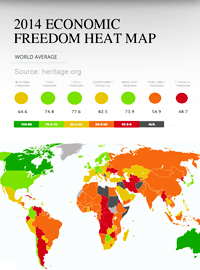
Remember how Barack Obama, following his inauguration in 2009, infamously disparaged the concept of American exceptionalism? “I believe in American exceptionalism,” he sarcastically said with his trademark self-satisfied smirk, “just as I suspect the Brits believe in British exceptionalism, and the Greeks believe in Greek exceptionalism.” Five years hence, his presidency has succeeded in degrading America toward the unexceptional status in which he held it all along. A vivid illustration of that lamentable reality arrived this week, as The Wall Street Journal and the Heritage Foundation released their annual Index of Economic Freedom. What it revealed is disturbing and alarming, to put it mildly. Following seven consecutive years of declining scores, the U.S. has finally fallen from the top ten most economically free nations in the world. That is bad enough standing alone, but the fact that global economic freedom overall rose to a new high while we’ve progressively declined exacerbates the cause for alarm. Each year for the past two decades, the Index has ranked nations in terms of economic freedom on a scale of 1 to 100 on the basis of ten categories. Those categories include (1) property rights, (2) freedom from corruption, (3) tax freedom, (4) government spending, (5) business freedom, (6) labor freedom, (7) monetary freedom, (8) trade freedom, (9) investment freedom and (10) financial freedom. In addition to merely ranking nations, however, the Index also provides statistical confirmation that greater freedom means greater prosperity. When a nation’s economic freedom is graphed on one axis against that nation’s level of per capita income, health care, economic growth, education, environmental quality and overall well-being on the other axis, the relationship is clear. More free nations are consistently wealthier and healthier, while less free nations are consistently poorer and unhealthy. That correlation is simply undeniable. For example, citizens in the six nations ranked “free” by the Index – Hong Kong, Singapore, Australia, Switzerland, New Zealand and Canada – enjoy per capita purchasing power of $45,404. In comparison, citizens living in the 28 nations ranked “mostly free” possess a per capita purchasing power of $37,799, citizens in the 56 “moderately free” nations enjoy only $16,457, citizens in the 61 “mostly unfree” nations are at $5,541 and citizens in the 27 nations labeled “repressed” at $6,231. That correlation is no less true here in America, where median income has continued to decline during the Obama presidency, even though the last recession officially ended five long years ago in June 2009. As Heritage’s Terry Miller explains, the reason for that continuing decline is clear: “It’s not hard to see why the U.S. is losing ground. Even marginal tax rates exceeding 43% cannot finance runaway government spending, which has caused our national debt to skyrocket. The Obama Administration continues to shackle entire sectors of the economy with regulation, including health care, finance and energy. That intervention impedes both personal freedom and national prosperity. But as the U.S. economy languishes, many countries are leaping ahead, thanks to policies that enhance economic freedom – the same ones that made the U.S. economy the most powerful in the world.” More freedom means more prosperity, and less freedom means less prosperity. Meanwhile, Gallup released a new poll this week under the headline, “Government Itself Still Cited as Top U.S. Problem.” Surprisingly, even the poor economy itself doesn’t trouble Americans as much as our bloated government: “Americans start the new year with a variety of national concerns on their minds. Although none is dominant, the government, at 21%, leads the list of what Americans consider the most important problem facing the country. The economy follows at 18%, and then unemployment/jobs and healthcare, each at 16%. No other issue is mentioned by as much as 10% of the public.” Thus, Americans seem to understand the destructive correlation between bigger government and declining well-being as illustrated by the 2014 Index of Economic Freedom. Recalling Ronald Reagan’s observation, government isn’t the solution to our problems, government is the problem. Although our continuing decline is inexcusable, a return to prosperity is possible and the 2014 Index of Economic Freedom confirms the path for that return. As Heritage’s Miller concludes, “This year’s Index demonstrates that the U.S. needs a drastic change in direction.” |
Related Articles : |
