




|
|
|
















| If It’s Broke, Fix It: Paul Ryan’s Plan to Make Government Programs Sustainable |
 |
|
By Ashton Ellis
Thursday, February 11 2010 |
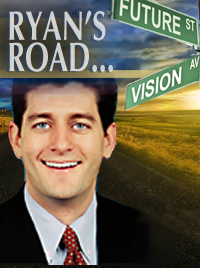
One of the most annoying things about talking policy with progressives is the ambivalence they show towards questions like, “That’s a nice idea, but does it work?” Even better, “Okay, but is that sustainable?” Pose any similar query, and you’re likely to get a blank stare or a dismissive wave of the hand. To them, the key is whether something is being done – not whether it actually works. To the extent progressives do get concerned about the working of a program, they almost always links failure to a lack of funding before proposing more taxes, more spending and more bureaucrats. For them, the only answer to every critical question about government is more government. Enter Representative Paul Ryan (R-WI). The six-term congressman occupies a unique acre on the political playing field. He is in line with the three prongs of the Republican Right: he is socially and fiscally conservative and supports a strong national defense. As the ranking member on the House Budget Committee, Ryan knows in detail the deficits facing the nation’s flagship entitlement programs like Medicare and Social Security. He knows that the costs of these programs increase by trillions of dollars in unfunded liabilities every year. Thanks to the IRS, he knows that Americans spend $193 billion every twelve months trying to comply with the tax code. And he also knows that federal regulations of the energy, finance and health care industries exact tremendous costs that sacrifice jobs and wealth creation while failing to fulfill any policy goals. But unlike many of his fellow Republicans, he can do more than articulate problems. In his sweeping proposal, “A Roadmap for America’s Future,” he paints a portrait of the country that Norman Rockwell would admire. Amid quotes from Thomas Jefferson and Adam Smith, he talks about preserving the “American character” of self-reliance, faith and family. He describes with clarity the danger of our national deficit and the expanding “culture of dependency” created by a greater reliance on government. At the same time, he also acknowledges honoring commitments to those who’ve paid into systems that are on the brink of collapse. Up to this point, Ryan could stop and be an above-average congressman. Most conservatives know their basic principles well enough to spot fiscally irresponsible policies. Many would then call for their elimination. Ryan accomplishes more by doing the yeoman’s work of making the case for a limited, yet effective government committed to preserving free markets, protecting private property and personal safety, leaving space for a robust civil society. At its core, Ryan’s “Roadmap” combines the conservative vision of the American spirit with a level-headed desire for workable, sustainable results. By acknowledging that a majority of Americans support some form of assistance with retirement and health care, Ryan expands the grow-it-or-kill-it debate to include a third possibility: fix it. After all, no serious person aware of the federal government’s current level of deficit spending thinks it sustainable. Since that’s a given, why not try to figure out a way to deliver on promises Americans have received at a price they can afford? If ever there is a Republican congressman for progressives to try and co-opt, Ryan is he. One would think that the progressive architects of the welfare state would want to get the help of a man who thinks deeply about how to make their buildings sturdy. That there isn’t a Paul Ryan clone in either congressional Democratic caucus speaks volumes about how far the Party has strayed from fiscal integrity. Now, if Republicans would just use Ryan’s “Roadmap,” they might be able to get something even more powerful than a majority this fall: a detailed, principled mandate for change. |
Related Articles : |
