




|
|
|














| Poll: Public Approval of Supreme Court Plummets |
 |
|
By Timothy H. Lee
Thursday, July 05 2012 |
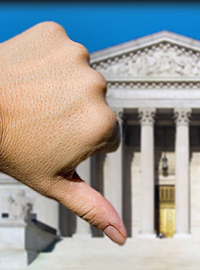
One week after the Supreme Court’s perplexing ObamaCare – pardon, ObamaTax – decision, debate continues regarding its most likely long-term legacy. Was Chief Justice John Roberts playing a game of stealth conservative chess, while the rest of us remain only capable of checkers? Or did he instead play the role of Supreme Court popularity curator, instead of neutral umpire as promised during his confirmation? Evidence mounts in support of the latter theory. From references in the dissent to the ramshackle quality of Justice Roberts’s “tax” rationale to rumors of personal interactions between the justices themselves, it appears that he altered his legal position to accommodate extra-judicial concerns. Moreover, it’s extremely difficult to conceive that Justice Roberts occupies some higher intellectual realm inaccessible to fellow Justices Scalia, Kennedy, Thomas and Alito, rendering them collectively unable to fathom some superior grand constitutional strategy. If Supreme Court esteem was indeed Justice Roberts’s goal, however, initial feedback suggests that he miscalculated terribly. This week, Rasmussen Reports released a surprising survey revealing an instantly negative public response to the Court’s ruling. In a statistically significant and reliable poll of 1,000 likely voters following last week’s decision, more people now believe that the justices merely craft their decisions to fit their own agendas, rather than conduct themselves impartially. Moreover, an increasing number now believe that the Supreme Court is too liberal, not too conservative. Just one week prior to the Court’s decision, 36% of respondents believed that it was doing a “good” or “excellent” job, while only 17% believed that the Court was doing a “poor” job. This week, however, only 33% said that the Court is doing a “good” or “excellent” job while those who said that the Court is doing a “poor” job shot up to 28%. And as for the neutrality that Justice Roberts claimed sacred during his confirmation hearings, the American public apparently isn’t buying it. Some 56% of those surveyed responded that the justices simply pursue their own political agendas and alter their legal rationales accordingly. Less than half as many respondents – just 27% – now believe that the Court’s justices maintain judicial impartiality. Moreover, public opinion toward the healthcare law itself remains negative. According to Gallup, more Americans surveyed after last week’s ruling believe that the law will harm the nation’s economy than believe it will help. Significantly, independent voters hold that position by a 47% to 34% margin, with the overall disparity at 46% to 37% (thus suggesting that Gallup even oversampled Democrats, since Republicans held that position by a 78% to 13% margin). As for Rasmussen, its generic healthcare survey following last week’s ruling shows essentially no change – the public strongly opposes the law. Some 52% favor repeal, while only 39% support the law. That is not only unchanged since the preceding week, but also since the law was passed in the first place. I continue to include myself among those conservatives who believe that the long-term legal impact of last week’s ruling will prove more positive than negative. After all, had the challenges not been brought, ObamaCare would have remained just as alive, as would federal power to impose such a monstrous law through its general taxing and spending power. But absent the challenge and last week’s decision, we would not have achieved the new and significant limitations on federal commerce clause authority, its authority to command individual state action or use of the necessary and proper clause as some sort of all-purpose utility knife for federal misdeed. Whatever one’s position on the substantive legal impact of last week’s ruling, however, it appears to have done nothing to boost public acceptance of the law. Instead, all it seems to have achieved was undermining public respect toward the Supreme Court itself. Not exactly the goal you had in mind, was it, Mr. Chief Justice? |
Related Articles : |
