




|
|
|

















| Unanimous Supreme Court and Congressional “Stop Climate Shakedowns Act” Jointly Target Abusive Climate Litigation |
 |
|
By Timothy H. Lee
Thursday, April 23 2026 |
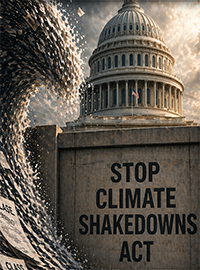
Lawsuit abuse remains among the most dangerous but underrecognized threats to the American economy and consumer well-being. It distorts markets, unfairly targets lawful conduct, enriches unscrupulous plaintiff lawyers and too often elevates courtroom theatrics over sound science and evidence. Against that backdrop, a unanimous decision from the United States Supreme Court offers a welcome and overdue corrective, along with a signal that limits to aggressive attorney tactics exist. Meanwhile, new legislation introduced in Congress titled the “Stop Climate Shakedowns Act” offers the prospect of similar correction against abusive climate litigation via the legislative branch. The Supreme Court’s unanimous ruling in Chevron v. Plaquemines Parish obviously included Justice Ketanji Brown-Jackson, which underscores just how far beyond legitimate activity the plaintiff lawyer industry has drifted. When even the Court’s most far-left voice cannot tolerate the excesses of climate litigation abuse, it highlights the gravity of the problem. The underlying case arose from lawsuits filed by Louisiana parishes seeking to extract massive sums from energy companies for alleged environmental harms caused by producing aviation fuel for America’s military effort all the way back in World War II. A jury awarded an outrageous $745 million verdict against Chevron, in a proceeding led by a judge who had accepted campaign donations from the lead plaintiffs’ law firm. The unanimous Supreme Court, however, ruled that the lawsuit should’ve been removed to federal courts with more uniform rules and constitutional safeguards, because the conduct in question related to work for the federal government during World War II. The Court affirmed the core principle that when companies act under federal direction – particularly on matters as vital as energy production during wartime – they shouldn’t be hauled before hostile state judges and juries to face retroactive liability untethered from more reliable federal rules. That principle extends far beyond Louisiana or the particulars of the underlying case. For years, an ongoing campaign of “climate lawfare” has weaponized state courts against American energy producers. Unable to achieve their ends through the democratic process, climate extremists and plaintiff lawyers turned to the courts, filing expansive and expensive nuisance claims designed to reshape nationwide energy policy via litigation. That’s not how our system of government is supposed to work, and the Supreme Court’s decision pushes back against that strategy by restoring procedural guardrails. It obviously doesn’t immunize companies from legitimate damage claims, but it does ensure that such claims are heard in more fair forums, guided by the rule of law rather than local politics or jury emotion. Significantly, Congress can solidify and build upon that welcome judicial course correction. The Stop Climate Shakedowns act – introduced by U.S. Senators Ted Cruz (R – Texas), Tom Cotton (R – Arkansas), Mike Lee (R – Utah) and Ted Budd (R – North Carolina), and Representative Harriet Hageman (R – Wyoming) in the U.S. House of Representatives – targets that same underlying climate litigation abuse. The bill aims to curb the proliferation of speculative and ideological lawsuits aimed at extracting massive settlements from law-abiding energy producers under the guise of climate accountability. In so doing, the legislation reinforces the principle that nationwide policy and economic debates belong before legislatures, not courtrooms engineered for “jackpot justice.” Indeed, the Supreme Court’s unanimity offers a wake-up alarm because it wasn’t a narrow five-to-four ideological split, but a rare moment of consensus across judicial philosophies. When climate litigation tactics become so aggressive that they can’t command a single sympathetic vote on the Supreme Court, they’re obviously not merely controversial, they’re extreme. Our legal system simply doesn’t exist to function as a vehicle for redistributive policymaking or dictating nationwide energy strategies by unelected plaintiff lawyers, sympathetic judges and biased juries. By reaffirming that foundational principle, the Supreme Court decision in Chevron represents more than a procedural ruling. It provides a welcome rebuke to litigation excess and restoration of constitutional and legal order. Now, it’s up to Congress to follow through. The Stop Climate Shakedowns Act offers the opportunity to cement those protections and ensure that America’s energy producers – and, by extension, American consumers – aren’t held hostage by abusive lawsuits seeing to impose public policy. The Supreme Court has done its part. Time for Congress to do its part. |
Related Articles : |
