





















| What Rand Paul Gets Right |
 |
|
By Troy Senik
Thursday, February 27 2014 |
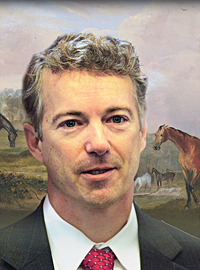
Kentucky Senator Rand Paul feels a lot like a man who has met his moment. In the aftermath of the George W. Bush Administration, the Republican Party was beset with widespread fatigue and disappointment, with many conservatives believing that the party had abandoned its foundational beliefs in limited government. It was partially that sense of disquiet that created an opening for Senator Paul’s father, former Texas Congressman Ron Paul, in the 2008 Republican presidential primaries. The elder Paul was never a serious threat to get the Republican nomination. His doctrinaire libertarianism repelled even those who were broadly sympathetic to his limited government instincts, and his age and quirky personality made him hard to conceive of as a Commander-in-Chief. What he was, however, was something of a restorative force. Prompted by Paul’s libertarian convictions, conservatives began revisiting the importance of abiding by the Constitution and limiting the scope of the federal government. Though Barack Obama got all the headlines for attracting young voters, Paul even managed to win a devoted following among that demographic — a feat out of reach for most Republicans. While Congressman Paul’s presidential campaign may have been a predictable bust in electoral terms, it was an essential component to birthing the Tea Party movement and renewing a conservative focus on first principles. It was that impulse that would lead his son to victory in the 2010 U.S. Senate race in Kentucky, where he defeated an establishment Republican, Kentucky Secretary of State Trey Grayson, in the primaries, and went on to score a narrow victory in the general election. Now into the third year of his tenure, Senator Paul has struck a delicate balance in the upper chamber. Like his father, he hasn’t shied away from a principled stand on limiting the size and scope of the federal government. Unlike the elder Paul, however, he’s steadfastly avoided pushing the issues to their philosophical extremes. Where Ron once used a presidential debate to entertain the notion of legalizing heroin, Rand has said that states should be able to make their own decisions about marijuana. Where Ron wants to abolish the Federal Reserve, Rand has focused his energies on auditing it. Where Ron sees almost all American military endeavors overseas as illegitimate, Rand has limited himself to characterizing American foreign policy as “too belligerent,” nevertheless arguing that he wouldn’t hesitate to go to war if it was necessary to protect America’s vital interests. It’s an open question how to interpret the implicit distance that Senator Paul puts between himself and his father. Perhaps it’s a reflection of genuine differences — though even those would be contrasts of degree, not kind. Perhaps it’s a smooth political calculation to sand down the edges of his convictions. Either way, there’s one salient fact about this approach: It’s working. For years, Republicans have been told that they needed to embrace a more moderate approach in order to win over new constituencies. What’s noteworthy about Senator Paul is that his unvarnished defense of limited government is widening Republican appeal in a way that no centrist in recent memory has. By emphasizing privacy rights and an approach to drug laws that embraces federalism, he is attempting to make inroads with young voters, who he has suggested have a strong libertarian streak. By calling attention to Bill Clinton’s lecherous past, he’s sending a message to women voters that the real “War on women” is coming from within their own party. And by proposing urban “enterprise zones” and inveighing against the evils of mandatory minimum sentences, he’s reaching out a hand to minority voters, a gesture that recently earned him an invitation to speak to the NAACP. One doesn’t have to agree with every position that Senator Paul espouses to appreciate the effort he’s making. Indeed, I part company with him on several issues. That said, it’s refreshing to see a conservative in public office who doesn’t begin with the assumption that half of the country is immune to his message. Politicians whose decisions affect the entire country ought to be willing to speak to the entire country. On that front — and on many others — Rand Paul represents a refreshing improvement. |
Related Articles : |
