






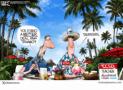
| (Crowd) Size Doesn't Matter |
 |
|
By Timothy H. Lee
Thursday, January 26 2017 |
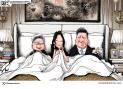
So apparently size really doesn't matter after all. Crowd size, that is. Over the past week, frenetic leftists and outraged media figures preoccupied themselves with comparing Donald Trump's inaugural crowd to Barack Obama's in 2009. The self-described "Women's March on Washington" one day after Trump's inauguration also triggered sympathetic media obsession in a way that massive conservative marches never seem to do. The Trump Administration only further fueled that frenzy by contesting the crowd size comparisons, whether out of earnest disagreement or as a rope-a-dope diversionary tactic to exhaust them. Amid that odd cacophony, this week also witnessed the release of a surprisingly unflattering summary of Obama's presidency from Gallup. It served to place the debate over crowd sizes in a more appropriate perspective. But first, two observations regarding crowd size bear emphasis. First, regarding the "Women's March on Washington," much was made of its enormity. But how many of those marching hadn't already voted against Trump? Obviously, many people who voted for Hillary Clinton or other candidates didn't participate in the march. In contrast, it's difficult to conceive of any significant number of people who marched - in many cases spending hundreds of dollars and traveling great distances to do so - but hadn't gone to the comparatively tinier effort to vote. So how impressive a show of force could the march be if those masses already voted against Trump, yet he won anyway? Second, regarding Obama's 2009 inaugural crowd, its size has similarly assumed undue significance. Among other problems, many people including yours truly attended that inauguration simply due to its historic significance, as opposed to any sort of endorsement of Obama himself. Additionally, his inaugural crowd obviously made little difference in preventing opposition Republicans from steadily achieving more electoral success at the federal, state and local levels than any time since the 1920s. Which brings us to this week's surprising Gallup release. With the completion of his term, we can now aggregate Obama's public approval over the entirety of his presidency, and compare him to his predecessors for perspective. In what will come as a surprise to Obama loyalists, he averaged a lackluster 47.9% job approval as president, which places him ahead of only Harry Truman, Jimmy Carter and Gerald Ford in the history of scientific surveys on the matter. It must particularly sting that he even places behind George W. Bush and Richard Nixon. For the record, John F. Kennedy achieved the highest job approval average throughout his presidency at 70.1%. Dwight Eisenhower placed second at 65.0%, George H.W. Bush averaged a surprisingly high 60.9%, Lyndon Johnson and Bill Clinton both averaged 55.1%, Ronald Reagan maintained a 52.8% average, George W. Bush averaged 49.4% and Richard Nixon averaged 49.0%. After that long list comes Obama all the way down at 47.9%, barely surpassing Ford's 47.2%, and then Carter at 45.5% and Truman at 45.4%. As Gallup notes, Obama's low job approval remained remarkably consistent as well: After his first year, he received sustained majority approval only once more during his first term in office. Fortunately for him, that came during his 16th quarter in office - around the time he was re-elected in the fall of 2012. Shortly after his second term began, his support dipped back into the 40s and did not return to the majority level again until his final year in office. That's quite a contrast with the demigod image cultivated by an affectionate media during his candidacy and throughout his presidency. So why is that important, beyond mere historical novelty? Because it shows that Americans rejected his higher-tax, higher-spending, hyper-regulatory agenda, particularly since the public generally continued to like him personally. It serves to refute current and future attempts to portray Obama's presidency as halcyon, because in reality it was an era of public rejection of his policies and progressively increasing support for the opposition Republicans' alternative agenda. Today, Obama apologists console themselves by highlighting that he finally managed to get back above water in the closing weeks of his presidency, when it didn't matter anymore. By that point, the American electorate had opted for his detested antithesis in Trump, even though Obama pleaded during a bitter campaign that his very legacy was on the line, and that he would take it as a personal rejection if Hillary Clinton did not win. And now, President Trump has already begun reversing Obama's evanescent legacy. But hey - he certainly drew an impressive first inaugural crowd. He'll always have that. |
Related Articles : |
