















| Republicans and Those 'Attacks' On the FBI |
 |
|
By Byron York
Wednesday, February 07 2018 |
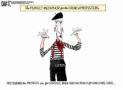
The news is filled with reports that Republicans in Washington are "attacking" the FBI over the Trump-Russia investigation. The Washington Post recently compiled a collection of statements by GOP lawmakers under the heading, "Republicans launch attack after attack on the FBI." The New York Times ran a news analysis headlined, "Trump's Unparalleled War on a Pillar of Society: Law Enforcement." Those words have been echoed many, many times by various talking heads on television. But have Republicans really been attacking the FBI? The bureau is a big organization—about 35,000 people. It does many different things. A more accurate way to describe what Republicans are doing is that they are condemning the FBI leadership's handling of two of the most heavily politicized investigations in years—the Trump-Russia probe and the Hillary Clinton email investigation. All that proves is that when law enforcement wades into politics, it becomes the target of sometimes intense political criticism. That is an entirely different thing from attacking the FBI as an institution or attacking the role it plays in government. The FBI does enormously valuable, sometimes heroic things. It breaks up terrorist rings and catches killers and bank robbers and kidnappers and embezzlers and all sorts of bad actors in our society. It investigates complex crimes that victimize large numbers of Americans. Its agents sometimes give their lives to protect the public. The FBI has a Hall of Honor that recognizes agents who have been killed in the line of duty. Thirty-six agents have been killed "as the result of a direct adversarial force or at or by the hand of an adversary." The most recent was murdered in 2008 while executing an arrest warrant on violent drug traffickers in Pennsylvania. Another 30 FBI employees are honored for having died in the performance of their duty, although not necessarily in direct confrontation with a criminal. The most recent are several who contracted serious illnesses while aiding recovery efforts in Washington, New York and Pennsylvania immediately after the September 11 terrorist attacks. That kind of selflessness and dedication is clearly not what Republicans are criticizing. What Republicans are condemning is the FBI leadership's conduct in the Trump and Clinton probes. For example, in the case of the much-discussed House Intelligence Committee memo released last week, Republicans (accurately) portrayed an FBI leadership that made common cause with an opposition research project paid for by the Hillary Clinton campaign right in the middle of a 2016 presidential election—and then ferociously resisted congressional oversight. An agency that does that can expect some criticism, if its actions ever come to light. "It's quite obvious that the Intelligence Committee is only questioning the decisions made by a small number of FBI officials at the highest levels," said committee spokesman Jack Langer. "In fact, we've been hearing from a large number of FBI employees, both active and retired, who have asked us to continue the oversight work we're doing." For all the good it does, the FBI has made some horrendous mistakes. After the post-9/11 anthrax attacks, for example, the bureau focused its search for the perpetrator on an Army scientist named Steven Hatfill. There was a lot of pressure on the FBI to solve the case, and there was a lot of headquarters involvement. But Hatfill was innocent. Nevertheless, the FBI chased him relentlessly, destroying his reputation and ability to make a living. Only after years did the FBI turn toward another suspect, who killed himself before charges could be filed. The FBI had to pay Hatfill millions in damages. The bureau, led by then-director Robert Mueller, didn't seem terribly sorry about it. When the Justice Department "formally exonerated Hatfill, and paid him $5.82 million in a legal settlement," columnist Carl Cannon wrote last year, "Mueller could not be bothered to walk across the street to attend the press conference announcing the case's resolution. When reporters did ask him about it, Mueller was graceless. 'I do not apologize for any aspect of the investigation,' he said, adding that it would be erroneous 'to say there were mistakes.'" Today Mueller is, of course, the special counsel investigating the Trump-Russia affair. But one could list a number of other non-heroic episodes under different directors in the bureau's history, starting with the first, J. Edgar Hoover. So the FBI has deserved its share of criticism over the years. And that goes double when the bureau intrudes into politics. So no, Republicans are not attacking the FBI writ large. But when the nation's premier investigative agency, with all its formidable law enforcement powers, jumps in the middle of hot political disputes, no one should be surprised when things get political. Byron York is chief political correspondent for The Washington Examiner. |

Related Articles : |
