













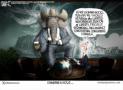

| Comey's Handling of Hillary Clinton Shows Us He's No Hero |
 |
|
By David Harsanyi
Friday, April 20 2018 |
After being pressed by former top Bill Clinton political aide George Stephanopoulos on ABC News, James Comey admitted that he had "screwed up a couple of things." The former FBI director wasn't talking about his failure to notify then-President elect Donald Trump that unsubstantiated rumors paid for by his political opposition were helping fuel the creation of a special counsel. No, Comey was admitting that he had made mistakes regarding the 2016 investigation of Hillary Clinton. And no, he wasn't begrudgingly apologizing for failing to recommend criminal charges against the candidate. It's an article of faith among Democrats and many Trump critics that the Comey letter, sent to Congress on Oct. 28, was reckless and unprofessional, and likely triggered the downfall of Clinton. Blaming a letter rather than her supercilious nature, malleable positions or terrible campaign strategy continues to feed the perception that the election process was somehow compromised. There are many reasons this is wrong, and Comey, perhaps inadvertently, explains the most obvious. For starters, we don't know that the letter changed the dynamics of the 2016 race. Just as most people understood the moral implications of electing Donald Trump, anyone paying attention recognized the corrupt nature of his Democratic opponent. Then again, if the letter reinforced those perceptions, it was well-deserved. But the fact is, by Oct. 28, Comey had no choice but to inform Congress that there was new evidence. It was neither an act of bravery nor an act of partisanship. Comey had already promised congressional investigators — under oath — that he would let them know if new evidence were to emerge. And that's what he did. Not only would it have been corrupt to hide the fact that classified emails were found on the computer of the sex-addict erstwhile husband of Clinton's top adviser; it almost certainly would have been leaked by local law enforcement and had a similar effect on the election (perhaps a worse one). Then, however, it would have rightly looked as if the FBI were attempting to cover up a potential crime for political reasons. Yet in essence, Democrats, the same people lecturing everyone about the sanctity of our institutions, have been arguing for more than a year that Comey should have held that evidence pertinent to an ongoing congressional investigation because it might have hurt their preferred candidate's chances. Which brings me to all the talk last week about Comey's admission in his book, "A Higher Loyalty," that poll numbers tempered his treatment of the letter because he wanted to avoid creating the perception that Clinton would be an "illegitimate president." Comey sanctimoniously writes, "Other than mistakes in the way I presented myself in the July 5 public statement in front of the television cameras, ... if I could do it all again, I would do the same thing." This admission is far more telling than the one making all the news. While Comey doesn't regret the letter — a letter that incidentally was carefully worded to avoid implicating Clinton — he regrets the way he laid out the case that Clinton and her staff had broken the law, even though he refused to recommend that the Justice Department hold them accountable. In the ABC News interview, Comey frames Clinton's handling of classified information as merely "sloppy" — not even "extreme sloppiness" and being "extremely careless" were illegal, he claims. But this was not the entirety of Comey's framing in July 2016, when he stated, "Although there is evidence of potential violations of the statutes regarding the handling of classified information, our judgment is that no reasonable prosecutor would bring such a case." Carelessness was not the reason to avoid recommending charges; the inability to prove criminal intent was. The idea that she would send unsecured classified documents through that server for years because of carelessness — according to Comey, Clinton transmitted 110 emails containing clearly marked classified information; 36 email chains contained secret information, and eight chains contained top secret information — is absurd. The idea that Clinton and her staff would then attempt to destroy all the evidence related to that server — they "cleaned their devices in such a way as to preclude complete forensic recovery," as Comey put it — is plain silly. It is far more plausible that the FBI director believed he was insulating the future president from criminal charges, as well as preserving his reputation by being tough on her. There was certainly no way the partisan attorney general was going to prosecute the person most people assumed was going to be the next president of the United States. Comey did the best he could navigating these turbulent political waters. And what's become clear is that rather than engaging in the pursuit of justice, Comey was engaging in the age-old Washington pursuit of self-preservation. David Harsanyi is a senior editor at The Federalist and the author of the forthcoming "First Freedom: A Ride through America's Enduring History with the Gun, From the Revolution to Today."
|

Related Articles : |
