

















| The High Cost of Abdul El-Sayed |
 |
|
By Byron York
Wednesday, October 14 2026 |
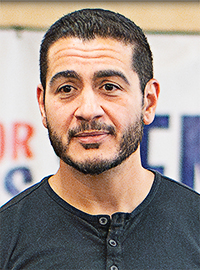
Abdul El-Sayed, the Democratic Senate candidate in Michigan, expresses irritation when he is asked about his association with Hasan Piker, the streamer/provocateur who said America deserved 9/11. "I'm not here to disavow people's views," El-Sayed said back during the Michigan Democratic primary campaign. "I'm here to have a conversation about how to get money out of politics, put money back in pockets and pass Medicare for all." Give El-Sayed credit for staying on message; those are the three main themes of his campaign. On his website, El-Sayed groups several positions under each one. Under "Money Out of Politics," for example, he lists his support for terrible ideas like abolishing ICE and setting up a structure to bring waves of immigrants more quickly to the United States. He also vows to end the war in Iran, to "reform" the Supreme Court, to pass restrictive new campaign finance laws, to abolish the filibuster and more. Under the theme "Money in Your Pocket," El-Sayed put his views on AI, on farming, on trade, on education, on housing, on data centers and more. Much of it is standard Democratic boilerplate. The last item, "Medicare for All," gets a category by itself. If there is one policy proposal that El-Sayed seems to base his entire campaign on, it is Medicare for all. "I will fight to expand Medicare to cover all necessary healthcare, including vision, dental, and hearing, and extend it to every single American from cradle to grave without premiums, copays, or deductibles," El-Sayed says. "Medicare should be automatic, for everyone, and accepted everywhere." On "Meet the Press" Sunday, El-Sayed made the promise again. "Medicare for All is guaranteed health insurance from cradle to the moment you pass away," he said. "It comes without premiums or copays or deductibles. And it guarantees you care where you need it. No premiums! No copays! No deductibles! El-Sayed's Democratic audiences apparently love to hear that sort of thing. But anyone, even those not naturally skeptical, has to wonder how El-Sayed would create this wonderful system. In the years since Medicare for All became a progressive cause, there have been several estimates for how much it would cost. The Wall Street Journal editorial page cites one study done back in 2018, when Democratic Sen. Bernie Sanders introduced a Medicare for All bill, which put the price at $32.6 trillion over the program's first decade. Other estimates have found similar numbers, while others have said the price might go to $36 trillion or higher. El-Sayed has never offered a detailed proposal on how he would pay for the new system. In an interview with NewsNation last month, he was asked whether Medicare for All would involve raising taxes on Michigan families making around $100,000 a year. "The hope is no," El-Sayed answered, which was not a terribly confidence-inspiring response. He went on to claim that in the big picture the new system would reduce what Americans pay for health care. But even though he has been short on details, El-Sayed has had one all-purpose answer to the question of how he would pay for his high-priced proposals. He says it slowly and clearly, apparently so everyone will know he really means it: "Tax. Billionaire. Wealth." "It's that simple," El-Sayed said at his recent debate with Republican opponent Mike Rogers. "We could return $4.6 trillion simply by taxing billionaires." It was striking that El-Sayed used the word "return," indicating that the money was the government's in the first place, and then billionaires took it, and then, led by Abdul El-Sayed, the money would be "returned" to its rightful place in the federal coffers. In any event, El-Sayed cannot solve the massive math problem that his proposal raises. Start with this fact: The total, combined net worth of every billionaire in America adds up to somewhere around $8 trillion to $9 trillion. That is everything they own – money, property, investments, etc. And then look at those estimates of the cost of Medicare for All – around $32 trillion over its first decade. Do the math. What that means is that the government could confiscate every penny that every billionaire in America has, and it would not be enough to pay for more than a few years of Medicare for All. And then, there would be no more billionaires with wealth to confiscate. Of course, no Democrat has had what it takes to propose confiscating billionaires' wealth. Instead, they just propose to tax the heck out of it. El-Sayed is a fan of Sen. Sanders' and Democratic Rep. Ro Khanna's Make Billionaires Pay Their Fair Share bill, which would impose a 5% annual wealth tax on billionaires. Not on their annual income, but on their entire net worth. By some estimates, that would bring the federal government about $4.6 trillion over 10 years, which appears to be where El-Sayed got his figure for money that would be "returned" to the government. It's crazy. The wealth tax raises huge problems of how it would be calculated and how it would be collected. It raises the even bigger problem of serving as a powerful inducement for billionaires to leave the United States. And in the long run, it raises the problem of reducing the number of billionaires who are able to pay the billionaire tax. On top of that, it is probably unconstitutional. What would happen if Medicare for All were enacted as El-Sayed hopes, is that the government would have to raise taxes on Americans who are not billionaires. After all, that's where the real money is. Remember that the net worth of all U.S. billionaires put together is $8 trillion to $9 trillion. The collective net worth of everybody else, all American non-billionaires, is somewhere around $180 trillion. Does anybody believe that a Sen. El-Sayed would not start looking at them to pay for his dreams? Byron York is chief political correspondent for The Washington Examiner. COPYRIGHT 2026 BYRON YORK |
Related Articles : |
