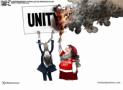
America as we know it was built largely upon and because of our rail industry, and today it remains…
CFIF on X CFIF on YouTube
So-Called "Railway Safety Act" Constitutes a Political Handout to Big Labor That Does Nothing to Improve Safety At All

America as we know it was built largely upon and because of our rail industry, and today it remains a pillar of our economy.

Unfortunately, a destructive proposal before Congress misleadingly named the "Railway Safety Act" (RSA), part of broader surface transportation reauthorization, threatens great harm to our railroads.

Simply put, the bill has nothing to do with improving safety, but has a lot to do with advancing the political agenda of Big Labor.  At a moment when inflation burdens American families and fragile supply chains remain vulnerable to disruption, the last thing our economy or rail sector need is another costly federal mandate imposed upon one of the nation’s most important transportation sectors.

As an initial matter, as noted by The Wall Street Journal, the…[more]

May 20, 2026 • 04:28 PM
CFIF Submits Formal Comment on NIST Proposed Rule Regarding Bayh-Dole Act of 1980 Print
By CFIF Staff
Monday, April 12 2021

Last week, the Center for Indvidiual Freedom (CFIF) submitted a formal Comment with the U.S. Commerce Department's National Institute of Standards and Technology (NIST) on its Proposed Rule regarding the Bayh-Dole Act of 1980, which granted universities, nonprofit organizations and small business the right to patent and license inventions funded partly by federal funding. 

The Economist magazine called the Bayh-Dole Act "Possibly the most inspired piece of legislation to be enacted in America over the past half century," and rightfully so.  It unleashed a tidal wave of hundreds of thousands of patents issued to American universities and research institutes since then. 

On that basis, CFIF supports the Proposed Rule to the extent that it advances the provisions and intent of Bayh-Dole, with the caveat that insertion of the terms "exclusively" and "of the contractor" in the Proposed Rule's text may open the door for advocates of drug price controls to suggest that business decisions of pharmaceutical innovators regarding the pricing of commercial goods and services arising from the practical application of inventions may serve as one basis for exercising march-in rights.  Neither the text nor the intent of the Bayh-Dole Act allow that, as namesake Senators Bayh and Dole themselves pointed out in a joint statement to The Washington Post

On that basis we urge that the Proposed Rule omit those terms.  We must ensure that Bayh-Dole's four-decade legacy of incredible success continues, without the looming threat that activists may attempt to use it to impose destructive drug price controls on American consumers.

Read CFIF's comment here (PDF).

Notable Quote   
 
"Most Americans are well aware that living in debt -- consuming beyond what one can afford -- without a sustainable budget plan is haphazard; those who do so are often deemed to lack foresight. Collectively, Americans carry roughly $18.8 trillion in household debt. America's national debt, meanwhile, is more than double that amount.The amount owed by the U.S. government exceeds $290,000 per household…[more]
 
 
— Vladlena Klymova, Policy Analyst at the Taxpayers Protection Alliance
 
Liberty Poll   

Given the late implosion of U.S. Senate candidate Graham Platner in Maine, do you think voters, responsible media and the political parties will begin to seriously investigate political candidates earlier in the process?