




|
|
|















| Utah Congressional Candidate Morgan Philpot: Pushing Back Against Federal Restrictions on Land Use |
 |
|
By Ashton Ellis
Wednesday, September 15 2010 |
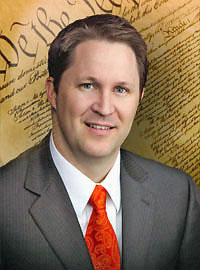
Many politicians claim to know the difference between the U.S. Constitution and “The Communist Manifesto,” but very few take the time to judge legislation by whether it moves society closer to one or the other. Morgan Philpot is one of the latter. As a state legislator in Utah, Philpot earned attention by holding up a copy of each document on the House floor and asking his colleagues which of the two favored the bill under consideration. Though some considered it a stunt, Philpot was serious. To him, it was amazing to see how little people thought about constitutional authority. Initially, that included him. “I was pretty young when I was first elected; about 28 years old. I didn’t have a solid foundation on American government, so I read the U.S. Constitution and ‘The Federalist Papers’ as soon as I could. Then I figured it made sense to know what the other side was reading so I picked up a copy of Karl Marx’s ‘Communist Manifesto.’ I started carrying them both in my coat pocket to refer to.” Almost immediately, he noticed the tendency of many politicians and bureaucrats to move public policy in the direction towards centralized government. The end result of such a push would replace the Founders’ vision with one approved by Marx. Philpot’s revolt against top-down government strengthened after he left the legislature to attend Ave Maria Law School. After graduation, he returned to Utah to work as a business attorney and serve as the state Republican Party’s Vice Chair. Then the Marxists took over Washington, D.C. Like millions of other conservatives, Philpot saw the liberal majority in Congress ram through an agenda that accelerated the federal government’s growth at the expense of individual freedom. Fed up with the feds, Philpot ran for and won the Republican nomination in Utah’s second congressional district. Along with headline legislation like ObamaCare, stimulus spending, cap-and-trade and the out-of-control budget deficit, another, quieter federal power grab sprang to life under the Obama Administration: restricting access to public lands. Few Americans have ever heard of the Bureau of Land Management (BLM), an independent agency within the Department of the Interior. BLM is the primary administrator of federally-owned land in 12 western states, with current holdings of about 264 million acres. In 2009, Interior Secretary Ken Salazar issued a private, 21-page memo called the “Treasured Landscapes” document. It outlines a strategy for BLM to “rationalize its land holdings by eliminating existing ‘checkerboard’ land-holding patterns where possible, and by acquiring parcels adjacent to its current holdings, if important to preserve ecosystem integrity.” In plain English, the document empowers BLM to seize private land through eminent domain. And thanks to the Supreme Court’s ruling in Kelo v. New London (2005) reinterpreting the Fifth Amendment’s Takings Clause, public use now means public purpose. The change means that public lands once used for recreation and development can now be closed off to the aforementioned public for the sake of preserving the Environmental Left’s cause du jour. In Philpot’s view, Utah doesn’t need more land taken over by the feds. “The federal government already owns 67% of Utah’s territory, meaning that the citizens of Utah can only claim 33% of the land within their borders. That’s outrageous.” Philpot argues that increased federal restrictions like the ones mentioned in the “Treasured Landscapes” document will further hinder Utah’s ability to build a healthy state economy. Already there is a movement at BLM to shut down ranching, mining and recreational activities in areas where they have been in use or approved. At almost every campaign stop, Philpot simplifies the issue to one of sovereignty. “It’s time the citizens of Utah ask, ‘Who owns Utah?’” For a man as well-versed in the Founders’ vision of a federal system with strong state governments, the chances are very good that as a congressman Philpot wouldn’t have any qualms telling BLM when its policies look more like communism than the Constitution. |
Related Articles : |
