




|
|
|
















| Republican Governors Leading Nationwide Charge on Education Reform |
 |
|
By Troy Senik
Thursday, July 12 2012 |
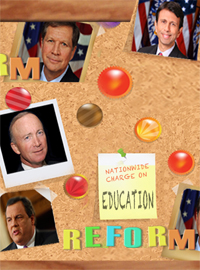
Over the past three years, the Tea Party’s gifts to conservative politics have been legion, but none have been so acutely commendable as the grassroots movement’s ability to fundamentally reshape the parameters of political conversation on the right. Since the beginning of the Progressive Era roughly a century ago, the slow, relentless march of the state has often been implicitly accepted as something of a fait accompli. While conservative activists and intellectuals have consistently agitated for rollback, their politicians have been less than enthusiastic. By now, the litany is painfully familiar. Dwight Eisenhower consolidated the New Deal rather than upending it. Richard Nixon left the legacy of Lyndon Johnson’s Great Society basically intact. Under George W. Bush, the nation even added a cabinet department, though Bush himself had initially opposed the creation of the Department of Homeland Security. Thanks to the Tea Party’s clarion call to first principles, however, things are changing. Imagine if you had transported someone from the middle of the last decade to one of the primary debates from the current cycle. They’d be positively shocked to hear major candidates discussing the abolition of cabinet departments, the defects of a central bank and the need to reassert the Tenth Amendment, topics you’d expect to be more hotly contested in 1912 than in 2012. For liberals, of course, conservatives who want to seriously rethink the stretch of government are throwbacks, so reactionary that when faced with the challenges of the modern world they resort to relitigating the Wilson Administration. The right knows better. Bad ideas aren’t made any better by endurance. Tenure ought not apply to stupidity. So it was that when several Republican candidates began making noise last year about their desire to eliminate the federal Department of Education, liberals were aghast. Slate’s Dana Goldstein wrote, “We are seeing the GOP acquiesce to the anti-government, Christian-right view of education … in which public schools are regarded not as engines for economic growth or academic achievement, but as potential moral corrupters of the nation's youth.” In The New Republic, Mark Schmitt saw the view as emblematic of “the Republicans’ ‘say anything’ brand of politics.” Ben Adler, a blogger at The Nation who knows how to play to type, opined, “When Republicans say they want to dismantle ‘the bureaucracy’ they are really saying they want to dismantle the government and the American people’s ability to solve our collective problems through the democratic process.” All nonsense, of course. Despite the pronouncements of Mr. Adler and his ideological kinsmen, the Republican candidates have no beef with education itself – just with federal intrusion into a field that ought to be decentralized as much as possible. As Mitt Romney – hardly the most fire-breathing conservative in the field – noted in a September debate, “Education has to be held at the local and state level, not at the federal level. We need to get the federal government out of education.” Thankfully, the states aren’t marking time until Washington recedes. Throughout the nation, a host of reform-minded governors have been upending the educational status quo. In April, Louisiana Governor Bobby Jindal signed into law a sweeping reform package that greatly expanded school choice, reduced the tenure system’s insulation of failing teachers, devolved power to principals and superintendents and opened the door for merit pay. Mitch Daniels signed a similarly bold plan in Indiana last year, with a few unique innovations (there was no cap on voucher amounts for high school students, so even the poorest children could attend elite prep schools if they were academically eligible; collective bargaining for teachers was limited to wage issues, eliminating the ability for negotiations to effect everything from curriculum to pedagogical methods). And the beat, as they say, goes on. Late last month, New Jersey Governor Chris Christie signed a bill implementing deep reforms to tenure and making it easier to fire underperforming teachers (previously a near-impossibility in the Garden State). Earlier this month, Ohio Governor John Kasich teamed up with officials in Cleveland to bring merit pay, tenure reform and more flexible hiring procedures to the city of nearly 400,000. The reformist impulse is even becoming bipartisan, with Chicago Mayor Rahm Emanuel shepherding new policies in the Windy City that look strikingly like Christie’s and Kasich’s. Unsurprisingly, the correlate of this steady change has been a decline in union power. Last week, the National Education Association – the nation’s largest teacher’s union – announced that it had shed over 100,000 members just since 2010, and predicted that it would lose more than double that in the next two years. This is the beginning of a very healthy trend. Though liberals are fond of claiming that conservatives desire the diminution of union power out of some inexplicable animus for the working class, the truth is far more benign. Conservatives wish to see the influence of unions decline because they are blunt instruments that tend to reward all employees no matter how they serve their customers (in this case, parents and students). Thus, the vision of education that conservatives entertain – and that figures like Jindal, Daniels, Christie and Kasich are midwifing – is not one that necessitates teachers scrimping by as class sizes rise and resources fall. It’s one in which excellence in the classroom is rewarded and failure is punished. If consistently applied, great teachers should expect to be making substantially more a decade from now than they are today. And incompetent teachers should expect to change professions. In this, the apex of the era of government irresponsibility, that notion may seem almost quaint. Thanks to the efforts of the Tea Party, however, quaint seems to be in fashion these days. And the nation is better for it. |
Related Articles : |
