




|
|
|











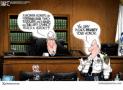

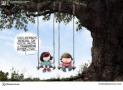
| Jubilation over the “Health Care Reform” Bill that Isn’t a Bill and Isn’t Going To Be the Bill |
 |
|
By CFIF Staff
Thursday, October 08 2009 |
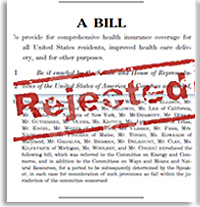
Americans are rejoicing in the streets this week. Oh, they aren’t? In Washington, then. No? Well surely the Democrats on Capitol Hill and at 1600 Pennsylvania Avenue are. The reason for this jubilation? The Congressional Budget Office (CBO) and the staff of the Joint Committee on Taxation (JCT) have come down Calculator Mountain bearing stone tablets certifying that the Baucus Senate Finance Committee “health care reform” bill will not raise the deficit! We, at great risk of being labeled Un-American and worse, are imposing considerably more self-restraint for what we think are substantive reasons, such as the stone tablets are but fairy dust sprinkled on a mirage. Let’s proceed with a modicum of fact and logic here. There is no “Baucus bill.” There is a conceptual framework, a working set of principles, some specifics, but there is no “bill.” The so-called “CBO scoring” says there is no bill: “[The] analysis is preliminary in large part because the Chairman’s mark, as amended, has not yet been embodied in legislative language.” (For that reason and others, there are significant caveats to the report, which will be mostly ignored by proponents of same.) There is no “Baucus bill” for the same reason that there are not “bills” for the other versions of “health care reform” floating around Congress. Democrats do not want the American people or the CBO or the hoards of private analysts, representing viewpoints from left to right, to see that language. Multiple attempts have been made to obtain complete public disclosure of the various proposals for at least 72 hours before votes are taken. All of those attempts have been beaten back. That is not because people will not understand the gobbledygook that is legislation, but that too many experts will understand it, and those who do will explain it to others and pretty soon, well we just can’t have that much public knowledge floating around the country, can we? Surely not for legislation that will have a dramatic, long-term, consequential, dare we say life-changing, effect on every man, woman and child of us. Just as the “Baucus bill” is not a bill, neither is the “Baucus bill” going to be the bill that both houses of Congress will eventually decide upon. Call it the front runner, if you will, but it’s not going to be the final bill. At current count, there are five bills-that-aren’t-bills, three in the House and two in the Senate. Take out or change or add to any part of any of the five and then any current projections are off the table. The CBO scoring is an economic analysis, solely an economic analysis. It is built upon assumptions, tempered by caveats. Let us quote one: “These projections assume that the proposals are enacted and remain unchanged throughout the next two decades, which is often not the case for major legislation.” That is CBO humor for “not in our lifetimes” has there been such a case. Another: “The projected savings for the proposal reflect the cumulative impact of a number of specifications that would constrain payment rates for providers of Medicare services. In particular, the proposal would increase payment rates for physicians’ services for 2010, but those rates would be reduced by about 25 percent for 2011 and then remain at current-law levels (that is, as specified under the SGR) for subsequent years.” What’s worse, the health-care implications of that premise being correct or the economic implications of it being wrong? Another: “Reducing Medicare and Medicaid payments to hospitals that serve a large number of low-income patients, known as disproportionate share (DSH) hospitals, by almost $45 billion – composed of roughly $22 billion each from Medicaid and Medicare DSH payments.” How exactly does that provide more health care to the poor? Oh, right, we’re just ignorant yahoos who don’t understand that which the Congress won’t show us. Want more? “Under the proposal, increases in payment rates for many other providers would be held below the rate of inflation (in expectation of ongoing productivity improvements in the delivery of health care).” Expectation? Based on what documented reality? Before you rest ever so easy that the Baucus bill that isn’t going to be the final bill isn’t going to increase the deficit, you may want to contemplate how the CBO-estimated cost of $829 billion over the next 10 years will be paid. With cuts and taxes and fines that are front loaded and benefits that are back loaded. The “Baucus bill” is not an exercise in reality. The CBO scoring of it is not an exercise in reality. Discussing it is not an exercise in reality, other than to demonstrate how a really critical game is being played, and that is about as dirty as any, ever. The reality to be feared is the final bill that is going to be assembled like Frankenstein in some really dark rooms in the dark of night. The reality to be feared is if the monster escapes. 
|
Related Articles : |
