




|
|
|





| Robert Bales, Trayvon Martin and the Cult of Involuntary Martyrdom |
 |
|
By Troy Senik
Wednesday, March 28 2012 |
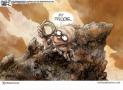
Over the past few weeks, two stories of untimely deaths – one foreign and one domestic – have dominated the media landscape. The first is the shocking tale of Army Staff Sergeant Robert Bales, who, seemingly at random, snuck away in the dead of night from his base in Afghanistan to wreak havoc among the local population, ultimately murdering 17 civilians in cold blood, including four women and nine children. The second is the death of Trayvon Martin, the 17-year old African-American shot to death by a neighborhood watchman in an Orlando suburb. While the fact that Martin was unarmed is not in dispute, almost everything else about the case is – including which of the two men bore responsibility for the physical assault that preceded the shooting. Superficially, the stories bear little resemblance to one another. But there is a key similarity in the media’s treatment of both cases. Both Bales and Martin have been conscripted into becoming metaphors for broader ideological battles. And in the process, the uncertainty surrounding both cases has been swept away as an impediment to the narrative. In the case of Bales, the press has labored to find a deeper insight into the war in Afghanistan. Last week, the Christian Science Monitor ran a lengthy piece looking at the Bales incident as a possible representation of the stress of repeated deployments. In a column earlier in the week, the usually discerning Ralph Peters wrote, “It appears that the staff sergeant who murdered those Afghan villagers had cracked under the stresses of a war we won’t allow our troops to fight.” Chris Miller, writing in the New York Daily News, added, “It is true no one made him pull the trigger, so he should bear personal responsibility for his actions…but America shares in the collective responsibility for this incident. If you send young men and women off to war, they will not come back the same.” Nonsense, one and all. Bales, by all discernible evidence, simply snapped. Even if his rampage was precipitated, in part or in whole, by post-traumatic stress disorder or the head injury he suffered in combat, it tells us nothing about the broader war effort. But the truth is that we simply don’t know whether those factors – or untold others – were even at play. And those armchair analyses do a disservice to the thousands upon thousands of men and women in uniform who, despite repeated deployments and whatever shortcomings may afflict our Afghanistan strategy, have served with the quiet restraint and duty that we rightly recognize as the hallmark of the United States Military. Bales’ crimes defy logical dissection. Even if we are someday able to discern an explanation for them, we will never be able to unearth a justification. In the vacuum created by that nihilism, the media has attempted to graft a broader meaning, facts – or the lack thereof – be damned. A similarly cavalier attitude has characterized coverage of Trayvon Martin’s death. What little we know for sure can be summarized as follows: Martin, returning at night from a local convenience store to the home of his father’s girlfriend, caught the attention of a (by most accounts self-appointed) neighborhood watchman, George Zimmerman. Zimmerman phoned the police to report a suspicious person, pursued Martin on foot, apparently got into a physical altercation with him, and ended up firing a fatal round into Martin’s chest in what he claims was an act of self-defense. In this case, as in Bales’, the available details are scant – and the interpretative possibilities are wide-ranging. Zimmerman’s most ferocious critics allege outright racism, to the point of trying to construe an unintelligible remark from his call to the police as a racial slur (the audio is so badly garbled that it’s virtually impossible to hear what he’s saying). His defenders, meanwhile, have suggested that Martin may have initiated the physical confrontation, dropping Zimmerman to the ground with a punch and repeatedly slamming his head against the sidewalk. Yet despite the many uncertainties and ambiguities the case presents, the media has already come to its conclusion: that Martin’s death represented a racial flashpoint for America. Abject stupidity has been the result. MSNBC’s Andrea Mitchell compared the incident to the grisly 1955 murder of 14-year old Emmett Till in Mississippi, a crime that was both premeditated and explicitly driven by racial hate. Barack Obama, never missing a chance to propound the belief that we are all just satellites in his orbit, declared in the White House Rose Garden, “If I had a son, he’d look like Trayvon,” as if the injustice he intuited was compounded because it befell someone fortunate enough to resemble him. Geraldo Rivera speculated on Fox News that the fact that Martin wore a hoodie was “as much responsible for [his] death as George Zimmerman was,” despite the fact that Zimmerman mentioned the item of clothing in his call to police only once and without editorializing – and then only in response to a direct question from the operator about what Martin was wearing. It barely merits mentioning that the media has an inherent bias against the quiet, solemn attitudes that these two stories merit. They imagine that by elevating the cases of Robert Bales and Trayvon Martin to metaphors for contentious political issues, they are somehow honoring the dead, and finding meaning where there is otherwise the chaos of ambiguity. In reality, they are diminishing the individual lives lost by subverting them to the needs of an endless news cycle that will forget them as soon as their stories grow stale. The victims of Robert Bales were not metaphors for the futility of the war in Afghanistan and Trayvon Martin was not a martyr for American race relations. They were simply lives cut short for reasons we don’t yet (and may never) understand. If the media has nothing constructive to say about that fact – which it is becoming increasingly apparent is the case – it would be far better for them to remain silent, leaving the deceased to the peace of the grave. |

Related Articles : |
