|
“Never let a serious crisis go to waste,” White House Chief of Staff-to be Rahm Emanuel told the Wall Street Journal’s CEO Council last November, “… [it’s] an opportunity to do things you think you could not do before.” In the nearly eight months that have passed since Emanuel made that statement, his words have been a cause for hyperventilation on the right – but that doesn’t mean he was wrong.
American government is lethargic by design. The Founding Fathers shaped the separation of powers and the system of checks and balances with an understanding that even the best ideas coming out of government would still be pretty bad. The worst ones would be outright dangerous. The Founders’ solution was to design a system that acknowledged, in James Madison’s words, that “enlightened statesmen will not always be at the helm.”
And so it is that the pace of the federal government is typically glacial. If you’re a pragmatist who thinks government’s place is to roll up its sleeves and solve problems, this is an inconvenient truth. But if you recognize that even the most earnestly devised government solution is usually rife with unintended consequences and thinly veiled political agendas, then the Madisonian design begins to look like a bulwark for liberty.
But the exception that proves this rule is the crisis scenario. Franklin D. Roosevelt was able to enact the sweeping change of the New Deal because of the pressures of the Great Depression. Lyndon B. Johnson midwifed the Great Society by tying it to the legacy of his slain predecessor. And Ronald Reagan rolled back the influence of the state after the economic trauma of Jimmy Carter’s presidency. So Rahm Emanuel is on to something.
This phenomenon is not limited to the domestic sphere. Abraham Lincoln was only able to make the abolition of slavery a goal of the Civil War after nearly two years during which the war’s explicit purpose was simply to preserve the Union. FDR’s material contributions to defeating the Axis powers were limited to lending hardware to the Allies until the attack on Pearl Harbor sent the U.S. headlong into World War II. And the country wasn’t galvanized to take the threat of radical Islam seriously until the tragedy of September 11, 2001.
Barack Obama seems to have taken his chief of staff’s admonition to heart, but incompletely. On the domestic front, he has used the financial crisis as an alibi for a dramatic expansion of government, which he warns is the only true path to economic recovery (this despite the government’s atrocious record in usurping private markets’ role in allocating capital). The stimulus package, the massive energy tax known as “cap and trade,” and the proposed government takeover of health care were all fathered by this false promise.
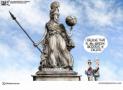
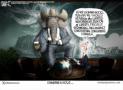
On foreign policy, however, Obama has now made painfully clear that he is going to let a crisis go to waste. The result will be one of the greatest international blunders in recent presidential history.
With the reelection of Iranian President Mahmoud Ahmadinejad marred by allegations of electoral fraud, the country’s dissidents have taken to the streets in awe-inspiring numbers. They have agitated for their God-given rights and waved signs in English, desperate for their message to take root globally. They have been imprisoned and even martyred for their convictions. And through it all, the President has alternately been silent or so glib that one wishes he’d remain silent.
Last week, in the early days of the uprising, Obama said “It’s up to Iranians to make decisions about who Iran’s leaders will be.” Correction, sir, it should be up to Iranians. Right now, it’s up to the people with nightsticks, tear gas and guns. In defending his tepid response to the protesters, the President said, “the last thing that I want to do is to have the United States be a foil for those forces inside Iran who would love nothing better than to make this an argument about the United States.” But as the Commander-in-Chief himself admitted in a press conference earlier this week, the Iranian regime has already seen fit to use the U.S. as a foil, Obama’s machinations notwithstanding.
For the first time since the Islamic Revolution in 1979, the rule of the Mullahs has been seriously morally undermined. And while a stronger stance from Obama may not have meant a flowering liberal democracy in Tehran by next Tuesday, it would have emboldened the reformers into becoming a permanent political force – and hastened the day when Iran will stand alongside its former enemy Iraq in the growing community of Middle Eastern democracies.
Obama is not entirely to blame for the failure to capitalize on a potentially transformative moment. For too long, the federal government has been insufficiently interested in finding ways to aid the young freedom-minded activists that are growing to a critical mass in Iranian society. But what he is guilty of is an intellectual inflexibility of the type for which his compatriots are fond of indicting President George W. Bush.
Obama has stubbornly insisted on the sovereignty of “The Islamic Republic of Iran” (a choice of words that validates the radical regime in power), because he believes it can be a negotiating partner. But throughout his short presidency, the regime has repeatedly rejected his overtures for diplomacy. Despite these recurring failures, the President’s words betray a man who is still more comfortable with a tyrannical status quo than a bold step forward in the region.
Up until a few weeks ago, that was simply a naïve position. Now it’s one that makes it more dangerous to be a defender of democracy in Tehran. Americans should think long and hard about any president who puts those who would die for liberty in such a position.
|