








| A Decade Ago, the Start of the Trump Era |
 |
|
By Byron York
Wednesday, June 18 2025 |
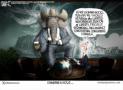
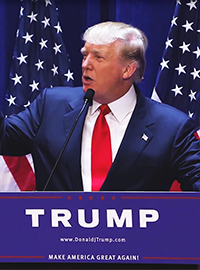
This time 10 years ago, much of the political commentariat, both Democratic and Republican, was having a grand old time making fun of Donald Trump. The real estate/marketing/TV star entered the GOP race for president on June 16, 2015 – you remember the famous coming-down-the-escalator scene. Watching Trump's announcement, a lot of pundits couldn't stop laughing. The news was a "gift from heaven," said Jon Stewart, then host of "The Daily Show." Stewart, who had announced he was stepping down but had not yet left, said, "Thank you, Donald, thank you, Donald Trump, for making my last six weeks my best six weeks. He is putting me in some kind of comedy hospice where all I'm getting is just straight morphine." Stewart later added, "Let's dance, clownstick!" "Clown" became a favorite word in the field of political analysis. The New York Daily News put Trump on its cover the next day with the headline "Clown Runs for Prez," adding "Trump throws rubber nose in GOP ring." (The news story began, "The carload of Republicans running for president now has a clown.") Some Fox News commentators called Trump a clown, too, most notably the late conservative columnist Charles Krauthammer, who called him a "rodeo clown." (Krauthammer later quipped that he came to regret the "rodeo" part of the insult.) More serious analysis adopted the "clown" line, too. "If Trump follows through," noted Politico, "his candidacy poses awkward dilemmas for a Republican Party trying to shed the clown-car image of fringe candidates that suck up media oxygen." Of course, everyone, comedians and pundits alike, predicted that Trump would fail, that is, that he would not become president of the United States. "Here's the sad news," comedian Conan O'Brien said. "Season 15 of 'Celebrity Apprentice' will not air. But not to worry. With Trump running for president, you'll still get to see an irrelevant B-list celebrity not get a job." On MSNBC, veteran journalist Mike Barnicle was asked his reaction to Trump's announcement and started this way: "Can we stipulate for the purposes of this conversation that Donald Trump will never be president of the United States?" Barnicle's oh-so-confident statement was repeated many, many times throughout the commentary world. To add just one example, the Washington Post's Chris Cillizza wrote, "Donald Trump will never be president. He knows that. We know that." Amid all the ridicule being heaped on Trump, one publication, the venerable conservative National Review, outdid everyone else. Its coverage of the Trump announcement, headlined, "Witless Ape Rides Escalator," called Trump a "ridiculous buffoon with the worst taste since Caligula" and "a reality-television grotesque with his plastic-surgery-disaster wife, grunting like a baboon about our country's 'brand' and his own vast wealth." And so on. Obviously, it all sounded ridiculous in later months when Trump rose in the polls, captured the Republican nomination, and won the presidency. But even in the early months, the writers and speakers mentioned above could have saved themselves some embarrassment by checking in on things in Iowa, where by the spring of 2015, Trump had hired respected staff, spent a lot of money, was drawing big crowds, and had spent more time in the state than rivals Ted Cruz, Jeb Bush and Marco Rubio combined. "By the various measurements journalists use to evaluate campaigns – crowds, staff, money, candidate time on the ground – if the Trump campaign were being conducted by anyone else, journalists would take it quite seriously," I wrote in May 2015. After his campaign launch, Trump went on to lead the GOP polls straight through until primary and caucus voting began. And then he won the White House. And now, as he is in his second term, it is not too early to say that Trump's trip down the escalator in June 2015 marked the beginning of the Trump era, the most consequential period in our politics in (at least) the last 50 years. It was also the beginning of the end of the Republican Party as it was led by the heirs of Ronald Reagan – George W. Bush, John McCain, Paul Ryan, Mitt Romney and others. The experience of 2015-16 should have made Trump's media adversaries a little more circumspect in their pronouncements. It didn't. Instead, their early mocking of Trump led to years of full-scale rhetorical combat between the new president and the journalists who covered him. Now, some in the media are trying to suppress their instinct to engage in battle with Trump and instead understand what he is doing and what his supporters think about it. For many, it is still a very, very difficult task. But it is the right thing to do. Byron York is chief political correspondent for The Washington Examiner. COPYRIGHT 2025 BYRON YORK |
Related Articles : |
