Some Good News
The Dow Jones Industrial topped 10,000 during trading today. This is the first time the Dow has hit 10,000 or above since October 7, 2008.

The Dow Jones Industrial topped 10,000 during trading today. This is the first time the Dow has hit 10,000 or above since October 7, 2008.
Congress almost enjoys wasting time and money. When they’re not orchestrating a wholesale takeover of the health care industry, they’re naming post offices or introducing worthless bills.
Take H.R. 2811, introduced by Rep. Kendrick Meek (D-FL). The legislation would “include constrictor snakes of the species Python genera as an injurious animal.” This is not a joke. Not only does Rep. Meek waste our money but he apparently enjoys making the Congressional Budget Office (CBO) suffer. The CBO put a price tag on the bill and estimated that it will not significantly impact federal spending. Hurray.
Maybe Rep. Meek saw this movie too many times?
Washington Times – Sen. Graham Endorses Climate Bill
Political Wire – Specter Staring at Fatal Re-Election Numbers
Washington Post – Health Care Winners and Losers
WSJ – Sen. Graham Puts Democrats on the Spot
The Hill – Health Care Fatigue Spreads on Hill
NY Times – The Battle in Virginia
Politico – Rangel Probe Taking its Toll
Washington Times – An Administration of Radicals
Federal Debt: $11.920 trillion
The Senate Finance Committee just approved Sen. Max Baucus’ version of health care “reform.” The vote was 14-9, with all Democrats voting for the bill. The only Republican voting for the bill was Olympia Snow (R-ME).
The bill will now be reconciled with the Health, Education, Labor, & Pensions (HELP) Committee bill.
There has been a great deal of debate over the relationship between tort reform (capping non-economic damages in lawsuits) and health care.
Well, the Congressional Budget Office (CBO) has provided some research to support the notion that tort reform would actually cut health care costs and reduce the budget deficit.
[I]mplementing a typical package of tort reform proposals nationwide would reduce total U.S. health care spending by about 0.5 percent (about $11 billion in 2009). That figure is the sum of a direct reduction in spending of 0.2 percent from lower medical liability premiums and an additional indirect reduction of 0.3 percent from slightly less utilization of health care services…. Enacting a typical set of proposals would reduce federal budget deficits by roughly $54 billion over the next 10 years, according to estimates by CBO and the staff of the Joint Committee of Taxation.”
Courtesy of the Washington Post, this illustrates that in spite of massive spending, in spite of new mandates and in spite of new insurance regulations, an average family of four could still end up paying over one-fifth of their income on health care costs under the Baucus Bill.
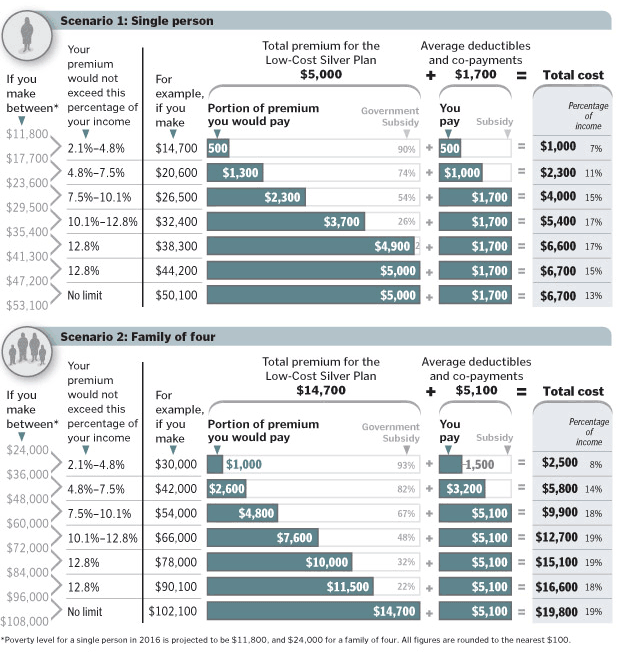
The Senate Finance Committee will vote today on the latest version of health care “reform,” the Baucus Bill. Senator Baucus is expected to strike the gavel around 10:00 am (EST), with a vote expected later in the afternoon.
Make sure to call your Senator and tell them to vote “No” on the Baucus Bill. The Congressional Switchboard number is 202-224-3121.
Here are the members of the Finance Committee, Senators that could decide the fate of health care in the U.S.
Associated Press – Dems Scramble after Warning from Health Insurers
WSJ – Senate Finance Committee to Vote on Health Care Bill
Washington Post – Can Deeds Come Back in VA?
Political Wire – Sen. Reid’s Re-election Now a Toss Up
WSJ Editorial – Health Care Industry Learns the Price of Appeasing Congress
National Review Online – ObamaCare Dissected
NY Times – Congress Split on Effort to Tax Health Plans
Federal Debt: $11.915 trillion
The Congressional Budget Office has released its preliminary cost estimate for the Baucus Bill. Here is the link. The CBO estimates the total cost over ten years will be $829 billion.
UPDATE:
Most of the actual expenditures and mandates do not take effect until 2013-14. In other words, CBO’s 10-year preliminary cost estimate only accounts for six or seven years worth of the expensive provisions.
The House of Representatives protected one of its own today by voting only to refer Rep. Charles Rangel to the House Ethics Committee; he will remain the Chair of the powerful House Ways and Means Committee.
Rangel, as the NY Times has revealed, has taken many liberties in his position of power. The Times discovered that Rangel has four rent-controlled apartments, and actually uses one as his campaign office, likely in violation of House rules. In addition, Rangel recently revealed that he failed to disclose assets from his swanky beach home in the Dominican Republic, leading to over $10,000 in back taxes.
Being an elected official has been prosperous for the New York Congressman, as Rangel lists his net worth in the millions. Apparently there are perks to writing the nation’s tax laws, and subsequently failing to follow them. His published ethical improprieties are just the tip of the iceberg, which is why newspapers across the country are calling for Rangel to step down. See here and here.
Today, Representative John Carter from Texas introduced a resolution that would have referred Rangel’s case to the House Ethics Committee and stripped Rangel of his Chairmanship. The vote failed 153-246, with six Republicans voting with Rangel (King (NY), Rohrabacher (CA), Paul (TX), Murphy (PA), Jones (NC) and Young (AK).
So, as of today the New York Times and the Washington Post are investigating Rangel but Congress is not. It looks like it will take an indictment or two to get things rolling in America’s most expensive sausage factory.
Rep. Steny Hoyer – House Schedule
Political Wire – Obama Approval on the Rise
Washington Post – Paging All Doctors
Rep. Tom Price – The Ugly Side of Mandates
NY Times – Did TARP Increase Lending
The Hill – Baucus Not Worried About CBO Score
Politico – Dems: ‘Don’t Tax Cadillac Plans’
Dana Milbank – The Forest, the Trees and ACORN
Federal Debt: $11.926 trillion
In a recent interview with Charlie Rose, Speaker Pelosi not only hinted at a Value-Added Tax (VAT) to pay for health care “reform,” she practically endorsed the idea as a way to equalize tax treatment between the U.S. and Europe.
Pelosi stated, “Somewhere along the way, a value-added tax plays into this. Of course, we want to take down the health care cost, that’s one part of it. But in the scheme of things, I think it’s fair to look at a value-added tax as well.”
The implementation of a VAT would assuredly break President Obama’s pledge that no one making under $250,000 would see a tax increase of any kind. A VAT is essentially a massive sales tax (over 20% in some countries) on all consumers. What’s worse, a VAT is typically not transparent, that is, prices go up but consumers don’t see the tax when they’re at the checkout counter.
See below for Obama’s pledge. Studies on the regressive and horrible idea of a VAT here and here.
Rarely does Congress ever get anything right. Two weeks ago, the Senate Finance Committee decided to hold a vote on the Baucus Bill before the Congressional Budget Office (CBO) had a chance to put a price tag on the legislation.
Well, today the committee has decided that it should wait at least 24 hours before voting on the bill, in order to allow the CBO a chance to examine the legislation. Most of the senators still haven’t read the entire monstrosity, but at least they’ll know the price tag.
Rep. Steny Hoyer – House Schedule
WSJ – FCC Chairman to Explain Internet Policy
Washington Post – A Spark in Republican Recruiting
WSJ – Apple Leaves Chamber of Commerce
Political Wire – Corzine Leads in New Jersey
NY Times – Coverage v. Cost on Health Care
The Hill – House Republicans Call to Investigate ACORN
Politico – Newt Thinks Pawlenty Should Run
Federal Debt: $11.822 trillion
Medicare, the Patron Saint of all that is right with government health care, generally has a positive image. Despite its massive pending fiscal fallout looming in 2017, seniors are mostly satisfied with the program. However, tales of Medicare’s greatness are vastly exaggerated.
Michael Moore, for example, made millions (thanks capitalism!) depicting insurance companies as villains denying coverage to the poor and sick. Government health care, we are told, cares only about compassion and serving those loyal taxpayers who have forked over 12.4% of their salary during their lives to a bankrupt federal program.
Well, according to the American Medical Association (p.2), Medicare actually has the highest percentage of claims denied. Yes, even the benevolent government-run system that so many liberals in Congress seek to emulate loves denying coverage to taxpayers and patients.
Per the AMA 2008 Nationl Health Insurer Report Card: Medicare denied 6.85% of claims, compared to a 2.9% denial rate by Humana and a 2.68% denial rate by United Health Care.
The next time you hear someone proclaim the virtues of a public option, remind them that if Medicare is any example, our health care system is in for even more trouble.
Over the weekend, I had the misfortune of shopping in the same grocery store with the Chairman of the Senate Finance Committee, Max Baucus. Senator Baucus is currently front-and-center in the debate over health care reform, and the bill that passes through his committee could be the final version that the President signs.

This was regrettably my second encounter with the senior Senator from Montana. The first was on a flight out of Minneapolis. The Senator, not surprisingly, was seated in first class.
During the Senator’s shopping experience I passed him in the wine section. Chairman Baucus, like many shoppers, was in the French wine section of the store. As capitalists, we can all appreciate the value of choice. Senator Baucus believes that French wine is the best value for the price and no one should stop him from making that choice. “Buy American” means little to Senator Baucus, even though his voting record might indicate otherwise.
For example, even though the Senator prefers choice in his wine purchasing, last week he denied Senator Ron Wyden’s health care free choice amendment from coming up for a vote in committee. Senator Wyden’s amendment would have allowed consumers to shop across state lines for cheaper insurance. For Senator Baucus, “choice for wine: yes; choice for health care: no, unless you’re paying me to vote otherwise.”
In addition, although Senator Baucus prefers foreign wine, he evidently doesn’t like foreign sugar. In 2005, Senator Baucus voted against the Central American Free Trade Agreement (CAFTA). CAFTA would have normalized trade relations with the Dominican Republic and other Central American countries, driving down prices for American consumers. Yet, Senator Baucus chose to vote with the sugar industry in his home state of Montana (sugar beets) and deny consumers a chance to purchase lower-priced foreign imports.
So, when it comes to choice and competition, Senator Baucus enjoys the freedom of the market in his personal life, but he’ll do his best in Congress to ensure that you don’t have it in your life. That’s hypocrisy, pure and simple.
Political Wire – Moderate Dems Fall in Line
Cato Institute – How Government Really Works
Club for Growth – A New “Public Option”
WSJ – Biden Continues to Tout Stimulus
The Hill – Reid, Baucus Split Over Public Option
Politico – Skepticism over Second/Third Stimulus
Washington Post – Is Conservatism Brain-Dead?
New York Times – Supreme Court to Hear Business Regulation Cases
Federal Debt: $11.819 trillion
 CFIF Freedom Line Blog RSS Feed CFIF Freedom Line Blog RSS Feed CFIF on X CFIF on X CFIF on YouTube CFIF on YouTube |
