Archive

Posts Tagged ‘Congress’
July 25th, 2012 at 5:55 pm
REINS Act Gets New Champion

The important reform bill, the Regulations of the Executive In Need of Scrutiny (REINS) Act, is getting new champion with the retirement of Rep. Geoff Davis (R-KY).

From an emailed press release announcing the change:

“Todd Young is one of the hardest-working and most diligent new members of Congress.  He has enthusiastically championed the REINS Act at home and in Washington,” said Congressman Davis.  “Congress has excessively delegated its constitutional responsibility for making the law of the land to unelected bureaucrats for too long.  The REINS Act is one of the most important structural reforms to restore this accountability.  I am confident that Congressman Young will be a tireless champion for the REINS Act going forward.”

Calling Young “tireless” is a good word choice.  According to the Congressman’s official bio, he put himself through night school to get an MBA from the University of Chicago and a law degree from the University of Indiana.  Prior to that, he enlisted in the Navy en route to securing an appointment to that branch’s academy.

Young will need that doggedness to pass the REINS ACT into law.

Currently, there is no congressional oversight of bureaucratic “major rules” costing the economy $100 million a year or more in compliance costs.  The REINS Act would change that by requiring administrative agencies to submit proposed major rules to Congress for an up-or-down vote in both chambers before becoming law.  The aim is to stop rogue agencies like EPA or HHS from legislating through rulemaking what they can’t get Congress to pass through the normal lawmaking process.

What are Young’s prospects?  This year, Rep. Davis convinced the GOP-dominated House to pass the bill, but like every House reform, the REINS Act died from inaction in the Democratic Senate.  But if after the November elections the GOP can hold the House and gain the Senate with conservative reformers – or Republican incumbents scared straight by conservative primary challengers – then expect to see the REINS Act make great strides towards passage.

Our constitutional system needs Congress to get back in the game on regulation, if for no other reason than to reestablish accountability between the laws that govern us and the people we elect to pass them.

Good on Davis for picking Young to succeed him.  Now voters in the several states need to send another crop of conservative reformers to the Senate to help him out.

July 7th, 2012 at 4:21 pm
IPAB Should Be Next ObamaCare Target

Wesley J. Smith reminds us why with ObamaCare’s individual mandate safe for now, conservative litigators should focus on striking down the Independent Payment Advisory Board, the unelected, unaccountable group of “experts” charged with controlling costs under ObamaCare.

There’s not much time left:

According to the terms of the Affordable Care Act, IPAB must submit its first draft recommendations to the health and human services secretary by September 1, 2013. Its first Medicare cost-cutting goals must become law by August 15, 2014.

Why did I write “must” become law” instead of “may”? IPAB’s unique “fast track” authority divests Congress of discretion regarding the amount of money to be cut from Medicare once IPAB has submitted its “advice.” Get a load of these legislative handcuffs:

  • By January 15, 2014, IPAB must submit a proposal to Congress and the president for reaching Medicare savings targets in the coming year.
  • The majority leaders in the House and Senate must introduce bills incorporating the board’s proposal the day they receive it.
  • Congress cannot “consider any bill, resolution, amendment, or conference report … that would repeal or otherwise change the recommendations of the board” if such changes fail to meet the board’s budgetary target.
  • By April 1, all legislative committees must complete their evaluation. Any committee that fails to meet the deadline is barred from further consideration of the bill.
  • If Congress does not pass the proposal or a substitute plan meeting the IPAB’s financial target before August 15, or if the president vetoes the proposal passed by Congress, the original Independent Payment Advisory Board recommendations automatically take effect.

Not only that, but Congress cannot consider any bill or amendment that would repeal or change this fast-track congressional consideration process without a three-fifths vote in the Senate. And to put the icing on the autocratic cake, implementation of the board’s policy is exempted from administrative or judicial review.

Unlike the rest of ObamaCare, IPAB cannot be repealed easily because its enabling statute “entrenches” it from being altered by later Congresses.  Thus, banking on a President Romney and a Republican Congress to get rid of it won’t work.

I’ve written before about the federal case in Arizona challenging IPAB.  It was on hold awaiting the Supreme Court’s decision on the individual mandate.  With the mandate redefined as a tax, the IPAB litigation will proceed, perhaps with a Supreme Court hearing as early as spring 2013.

Keep an eye on this one.  It’s easy to see how an unaccountable board of bureaucrats empowered to control costs could morph into a health care rationing board.

July 6th, 2012 at 4:10 pm
Eliminating Dodd Frank Bureau Takes a Small Step Forward

If Republicans win control of Congress and the White House in November, expect conservatives to zero in on trying to eliminate the Consumer Financial Protection Bureau.

Created by the Dodd-Frank legislation, CFPB is largely exempted from congressional oversight because it is housed in the unaudited Federal Reserve.  It’s also able to self-fund through fees it sets and assesses on financial institutions.

But though it’s technically an independent agency, CFPB is turning out to be – surprise! – remarkably in synch with the Obama campaign’s anti-capitalist positions.

Piecing together several months-worth of visitor logs, Mary Kissel at the Wall Street Journal presents strong circumstantial evidence of improper coordination between political branch officers and supposedly neutral bureaucratic administrators.

CFPB chief Richard Cordray has been to an Obama cabinet strategy session.  He briefed the press about student loan policy alongside White House Press Secretary Jay Carney and Education Secretary Arne Duncan.  He’s also held calls with the White House Chief of Staff for Policy.  His subordinates are in frequent contact with White House advisors.

Conservative opponents of CFPB’s unprecedented powers and structure like Rep. Patrick McHenry (R-NC) are taking notice.  McHenry sent a letter requesting more details from CFPB officials about its working relationship with the White House.  Though that may seem quaint, remember that Darrell Issa’s investigation of Fast and Furious has largely proceeded by letters of inquiry met with silence, denials, and ultimately admissions.

Kissel puts the process into perspective:

Rep. McHenry’s requests will, in all likelihood, be stonewalled too. But that doesn’t mean that the Congressman’s letter is a waste of time. The 2010 Dodd Frank law gave the consumer bureau an unprecedented—and perhaps even unconstitutional—immunity from traditional checks and balances. If Republicans win a Congressional majority come November and want to eliminate the agency, they have to start demonstrating now to the public why that’s necessary. Letters like Rep. McHenry’s are a good start.

It’s good to know someone is doing the yeoman’s work of reining in a small but important part of the federal bureaucracy.  If McHenry’s letter helps build a case for dismantling CFPB, conservatives will be thanking him for taking steps like this.

July 3rd, 2012 at 1:42 pm
Appeals Court Says EPA Can Regulate Greenhouse Gases, Congress Flatfooted

In one of my other incarnations I teach public policy and legal interpretation at Pepperdine University’s School of Public Policy.  One of the cases we discuss every fall is Massachusetts v. EPA, a controversial standing decision by the Supreme Court that allowed the Bay State and others to bend the rules for suing the EPA for not regulating greenhouse gases.

This was in the halcyon days of the George W. Bush Administration when conservative EPA appointees had the temerity to point out that the Clean Air Act gave the agency no authorization to interpret carbon dioxide as pollution to be regulated.

No bother, said then-Justice John Paul Stevens in his majority opinion that included Justice Anthony Kennedy, author of last week’s immigration decision in Arizona v. U.S.  In the EPA case, Justice Stevens said that states like Massachusetts are due “special solicitude” when litigating at the federal bar, especially when their sovereignty is threatened by eroding coastlines thanks to future speculated rises in sea levels from global warming.  (I’ll bet Arizona Governor Jan Brewer would have liked Justice Kennedy to remember her state’s “special solicitude” regarding the integrity of its borders.)

Now we’ve got a different Administration and a different outcome.  The Obama EPA was all too happy to make the carbon dioxide endangerment finding the Supreme Court made possible.  The energy industry sued claiming EPA lacked jurisdiction, and last Tuesday the D.C. Court of Appeals upheld EPA’s unenumerated power to redefine pollution.

Unless the Supreme Court intervenes and overrules the D.C. Circuit, the fight will now move to how EPA uses its newfound regulatory power.  What are the likely outcomes?  The New York Times summarizes two of the main arguments:

“This decision ensures that a regulatory approach to emissions cuts will take place, whether or not Congress acts legislatively,” said Paul Bledsoe, a senior adviser at the Bipartisan Policy Center, a nonprofit group that specializes in energy and environmental issues. “The question is, does the industry push Congress to develop a more efficient, less costly approach now that regulation is inevitable?”

But Representative Fred Upton, the Michigan Republican who is chairman of the House Energy and Commerce Committee, said that Congress’s refusal to approve greenhouse gas limits constituted a decision and that lawmakers should act now to reverse the E.P.A. emissions rules. Carbon regulation “threatens to drive energy prices higher, destroy jobs and hamstring our economic recovery,” he said.

So, an overweening federal agency emboldened by implied powers of regulatory control is going to act “whether or not Congress acts legislatively”?  My sympathies are with Chairman Upton’s point that no decision is a decision, but that’s clearly not a roadblock to activist bureaucrats with case precedent on their side.  It’s time for Congress to get back in the game and rein in the administrative state with clear and direct commands.  They know how to write those kinds of statutes.  It’s time they did more of it.

June 28th, 2012 at 2:02 pm
SCOTUS Does Obama’s, Congress’ Dirty Work

There’s a lot to say about Chief Justice John Roberts’ opinion rewriting ObamaCare’s individual mandate as a tax in order to save the law from being ruled unconstitutional.  One of the best – and most succinct – analyses comes from the CATO Institute’s Michael F. Cannon:

The Supreme Court ruled that ObamaCare’s individual mandate is not constitutional under the Commerce Power, which was how Congress framed the mandate to avoid a political backlash from calling it a tax. Congress and the president swore up and down that the mandate was not a tax. Yet the Court upheld the mandate as a valid use of that disavowed taxing power. What Congress said the individual mandate is, the Court said is not constitutional. What Congress said the mandate is not, the Court ruled is constitutional. Everybody got that?

Where does that leave us?

The Supreme Court just enacted a law that Congress never would have passed.

The Court just told Congress it is okay to lie to the people to avoid political accountability.

June 27th, 2012 at 12:52 pm
ObamaCare Prediction: SCOTUS Kills Entire Law

Though we learned with the Arizona illegal immigration decision that tough questioning from justices does not mean a Supreme Court slap-down – indeed, Justice Sotomayor was particularly hard on the feds’ position but ultimately upheld its arguments, as did Justice Kennedy and Chief Justice Roberts – I’m betting (with Quin’s money, of course) that Justice Scalia’s quip about the page length of ObamaCare provides a window into tomorrow’s outcome.

During oral argument Scalia brushed aside the suggestion that should the Court rule the individual mandate unconstitutional it would need to reconstruct the law by piecing together the parts that are still valid.  Scalia’s response was, “You want us to go through 2,700 pages?  Is this not totally unrealistic… to go through one by one and decide each one?”

I think the Court will strike down the individual mandate because it forces Americans to participate in commerce, an unprecedented power grab by the federal government.  (Ironically, had the Obama Administration framed the penalty for not buying insurance as a tax, most constitutional scholars on the right and left agree the mandate would survive.  However, the reason government lawyers haven’t framed it that way is because Obama and the Democrats in Congress repeatedly and explicitly said no one’s taxes would go up if ObamaCare passed, meaning that calling the mandate a tax during litigation would likely make the entire law even less popular with the public.)

Because of all this, I think the Court will do everyone a favor by holding the individual mandate unconstitutional and finding that the rest of the law is not severable from it.  (Which is easy to do since in the rush of ramming the bill around the normal legislative process Congressional Democrats forgot to put in a simple severance clause that would let the rest of the law stand if the mandate falls.)

Thus, everyone gets a blank slate and the Court is not patching together a form of the health reform law that no one voted on or signed.

For what it’s worth, there’s my (or rather Quin’s) two cents.

June 26th, 2012 at 12:42 pm
Domestic Drones Turned Into Terrorist Missiles?

Previously, I’ve agreed with Charles Krauthammer’s concerns about unmanned aerial vehicles (UAVs or drones) being allowed into domestic airspace because of the threat to privacy from so-called “eyes in the sky.”

Now, Todd Humphreys, a professor at the University of Texas at Austin, is showing how tech savvy terrorists can, and very likely will, exploit a “gaping hole” in the government’s flight security structure.

Last Tuesday, in the barren desert of the White Sands Missile Range in New Mexico, officials from the FAA and Department of Homeland Security watched as Humphrey’s team repeatedly took control of a drone from a remote hilltop. The results were every bit as dramatic as the test at the UT stadium a few days earlier.

DHS is attempting to identify and mitigate GPS interference through its new “Patriot Watch” and “Patriot Shield” programs, but the effort is poorly funded, still in its infancy, and is mostly geared toward finding people using jammers, not spoofers.

According to Humphreys, “Spoofing [a drone’s GPS receiver] is just another way of hijacking a plane.”

For about $1,000 and with a little bit of technical training a terrorist could take control of any civilian-operated drone and wreck havoc.  Without a human pilot at the controls, the drone’s onboard computer will simply follow whatever commands it is given, regardless of where they originate.

And while some terrorists may be interested in taking over surveillance drones for intelligence gathering purposes, the real danger is if a drone as large as a cargo plane – which FedEx plans to use when domestic drones are approved – is overtaken and flown into planes carrying people or into crowded buildings.

As Humphreys says, “In 5 or 10 years you have 30,000 drones in the airspace.  Each one of these would be a potential missile used against us.”

So not only would a terrorist hacker not need to buy a drone in order to fly one, he wouldn’t even need to go through an invasive TSA screening to reenact the 9/11 tragedy.

Because of pressure from the military and drone manufacturers, Congress is requiring the Federal Aviation Administration to fast-track regulations as part of the FAA’s reauthorization act.  Significant rules that will impact every American are to be conceived, written, and finalized within weeks of each other, and an entire regulatory scheme is mandated to be implemented in less than a year.

If you think that kind of statutory mandate translates into greater bureaucratic efficiency, think again.

The time-crunch – and the deliberate lack of oversight from Congress by pushing the rule writing onto an agency – means that everyday Americans will not be privy to the decision making process that will dramatically impact their safety in the air and on the ground.

Congress needs to rein itself and this process in.  With arguably illegal waivers being given to certain groups to avoid provisions of ObamaCare and No Child Left Behind, we’ve seen how arbitrary and capricious federal regulators can be when it comes to expedited rulemaking.  There’s no reason to expect a more coherent approach from an FAA trying to balance competing interests like privacy, profit, and public safety on an irrational deadline.

We need open debate and deliberation from our elected officials about the costs and benefits of domestic drones.  If Congress won’t engage the issue because it’s too politically painful, then the American people shouldn’t suffer a lapse in safety and privacy because their representatives would rather pass the buck than take responsibility.

June 20th, 2012 at 5:31 pm
House GOP Votes AG Holder in Contempt

As an update to my previous post, here’s the latest from The Hill:

A House panel voted Wednesday to place Attorney General Eric Holder in contempt of Congress for his failure to comply with a subpoena, defying an assertion of executive privilege from President Obama.

The House Oversight and Government Reform Committee, led by Republican Chairman Darrell Issa (Calif.), approved a resolution along party lines to place Holder in contempt after battling him for months over access to internal agency documents about the gun-tracking operation Fast and Furious.

All 23 Republicans on the committee voted for the contempt resolution, while all 17 Democrats voted against it. Every member of the panel was present for the vote.

There are still many off-ramps on the road towards Eric Holder being perp walked into federal prison for being found guilty of contempt of Congress.

Next week the full House will vote on the Oversight Committee’s contempt citation.  If it passes, the U.S. Attorney for the District of Columbia will convene a grand jury to decide on an indictment.  If that is successful, then Holder would have to be found guilty by another jury.  Only then would he be eligible to serve the one-year sentence for refusing to comply with Issa’s repeated requests for documents related to the Fast and Furious scandal.

The process is lengthy, and anyway is beside the point.  The reason Issa and the Republicans are pushing the contempt process forward isn’t to see the U.S. Attorney General go to prison.  It’s to apply the necessary pressure on a recalcitrant Obama administration to release information about one of the dumbest and most tragic federal misadventures in recent memory.

Hiding behind eleventh hour claims of executive privilege won’t make that task any easier.  If Holder and President Barack Obama want to avoid letting Fast and Furious become this administration’s Iran Contra, Holder better personally deliver assurances to Issa that he’s ready to fully cooperate.

And if he can’t because there’s damning information about a DOJ-White House cover-up, get ready for a Watergate role reversal with Republicans in Congress making a Democratic president’s life miserable.

June 20th, 2012 at 1:46 pm
Executive Privilege Means Obama Owns Fast & Furious

Today marks a dramatic turn in the Fast and Furious scandal with the Obama White House announcing this morning that the documents sought by House Republicans are protected from disclosure by executive privilege.

For the first time since news broke of the Department of Justice gun-walking fiasco, the President of the United States is claiming an interest in DOJ’s internal deliberations about a program that purposefully armed Mexican drug cartels and ultimately allowed a drug runner to murder a U.S. Border Patrol agent.

In the short term, the president’s announcement may make House Oversight Chairman Darrell Issa’s contempt vote closer than it would have been, if some members decide that an executive privilege claim inoculates Holder from punishment.  My guess is that Obama’s announcement will embolden Republicans on the committee to go ahead with the contempt vote and give Democrats a talking point after they lose.

In the long term, today’s executive privilege claim finally elevates Fast and Furious into a surefire campaign topic for the fall.  As long as the scandal was defended as a policy decision gone bad – especially one that was until today linked to the previous Republican administration – it was unlikely that conservatives would make Fast and Furious into a campaign theme.

But now that’s changed for two reasons.  First, as of today DOJ has rescinded its claim that Bush’s Attorney General Michael Mukasey knew about Fast and Furious, thus admitting that the idea and its consequences belong completely to the Obama administration.  Second, Obama’s claim of executive privilege means that he is now claiming ownership of the program.

I suspect that the documents being withheld would make the case for the resignation or impeachment of Eric Holder or another high-ranking DOJ official.  Claiming executive privilege helps delay the reckoning, but it opens the door for Mitt Romney and others – most notably Issa and other congressional investigators – to ask White House officials directly – and President Obama indirectly – about the president’s knowledge, involvement, and approval of Fast and Furious.

Game on.

June 19th, 2012 at 1:55 pm
Rep. King: Obama’s DREAM Act Decision Violates the Rule of Law

Buried in a Roll Call story on the political fallout from President Barack Obama’s decision to unilaterally impose DREAM Act-like amnesty for up to 800,000 illegal immigrants is the reaction by Rep. Steve King (R-IA):

“Americans should be outraged that President Obama is planning to usurp the Constitutional authority of the United States Congress and grant amnesty by edict to 1 million illegal aliens,” King said in a statement. “There is no ambiguity in Congress about whether the DREAM Act’s amnesty program should be the law of the land. It has been rejected by Congress, and yet President Obama has decided that he will move forward with it anyway. President Obama, an ex constitutional law professor, whose favorite word is audacity, is prepared to violate the principles of Constitutional Law that he taught.”

King is right.  The DREAM Act – a proposal to exchange American citizenship for completing college or serving in the military – cannot pass Congress because “the American people have rejected amnesty because it will erode the Rule of Law.”

Contra the Obama administration’s apparent belief, conservative opposition to amnesty does not rest on intrinsic racism.  The problem with illegal immigration isn’t immigration.  It’s that it is illegal immigration.  That the president is choosing to implement a policy without a law to base it on drives home the point that liberals see laws as formalities that can be ignored.  Conservatives like King and yours truly see them as the guarantees of a free and orderly society.

Like so many other fundamental disagreements being argued this cycle, this issue needs a lot of attention.

June 7th, 2012 at 4:56 pm
Senate Angling for Lame Duck Deal on Taxes, Spending

Politico reports that a group of Democratic and Republican senators are “quietly pushing to have a major tax and budget package ready by September so a bill can be introduced immediately after the November elections and passed by Christmas.”

In other words, during a lame duck session.  Only in the U.S. Senate could people seriously think that a multi-trillion dollar deal negotiated in secret and passed by a Congress that no longer reflects the electoral will of the people somehow counts as statesmanship.

This isn’t to say a lame duck Congress should never hold consequential votes.  A terrorist attack, a foreign military invasion, or an asteroid hitting the earth all qualify as legitimate reasons to let retiring and dethroned members decide national policy.  But the fear of falling off a “fiscal cliff” that’s been approaching for years – unsustainable deficits, exploding entitlements, budget sequesters that gut the Defense Department, expiring Bush tax cuts that raise rates on individuals – certainly does not.

It’s been said, rightly, that major reforms need bipartisan support.  But that’s only half of the equation.  Major reforms of the magnitude now being contemplated need to be road-tested on the campaign trail.  The 2012 election is one of the most important electoral moments in the modern era.  If there are good ideas brewing in the Senate, members should establish some consensus and make it part of the public debate.  Otherwise, enjoy the perks of office and let the next Congress, and the next President, decide.

May 31st, 2012 at 5:53 pm
First Commercial Flight to Space Successfully Completed Today

ABC News reports that the SpaceX Dragon, the first private spacecraft to service the International Space Station, successfully returned to Earth this morning at 8:42am Pacific Daylight Time, off the coast of San Diego.

The mission wasn’t glamorous.  The unmanned Dragon “carried extra supplies, experiments and garbage that the space station astronauts had loaded on board.”  However, the success of the flight indicates that May 31, 2012 might become a milestone in commercialized space travel.

Until now, all flights to the space station have been made by the U.S., Russian or European space agencies. NASA hopes SpaceX and other commercial firms will take over space jobs previously done only by governments.

[Space entrepreneurs] say space could be a bit like the old West: Governments sent explorers, such as Columbus or Lewis and Clark, to open the frontier, and then private settlers followed.

PayPal founder Elon Musk started SpaceX in 2002 and is moving his company closer to becoming the private sector alternative to ferry U.S. astronauts to the ISS.  (With the shuttle fleet mothballed, the Russians are doing the job now at price-gouging levels.)  Jeff Bezos of Amazon.com started Blue Origin to build, test, and deploy reusable spacecraft.  Richard Branson’s Virgin Galactic wants to make orbits around Earth the high-flying equivalent of a five-star cruise.

With the economy in the tank and NASA failing to find an extraterrestrial mission Congress will fund, it’s time to let these and other capitalistic cowboys take their shot at taming the final frontier.

May 16th, 2012 at 7:11 pm
Congress Votes Down Obama’s 2012 Budget: 513 – 0

You read that right.

After the House voted down President Barack Obama’s budget proposal 414 – 0 in March, today the Senate defeated it 99 – 0.  There are 51 Democrats in the Senate (and two Independents that caucus with them).  Not one voted for their president’s budget.  There are 190 Democrats in the House.  Not one voted for their president’s budget.

There are only 535 members in Congress.  As of today, 513 are on record opposing Barack Obama’s 2012 budget.  No one is on record supporting it.

By contrast, Paul Ryan’s budget passed the House on March 29th with 228 Republican votes, and only 10 party members against.  Today, 41 of 47 Republicans voted for Ryan’s budget; short of the 51 needed for passage.

Only one party is trying to govern.  The other is refusing to.  The American people should take notice and vote accordingly.

April 20th, 2012 at 12:01 am
Ramirez Cartoon: Amateurs
Posted by Print

Below is one of the latest cartoons from two-time Pulitzer Prize-winner Michael Ramirez.

View more of Michael Ramirez’s cartoons on CFIF’s website here.

April 17th, 2012 at 12:34 pm
Janet Napolitano’s Fast & Furious Perjury

Homeland Security Secretary Janet Napolitano may have perjured herself twice in testimony before Congress about what she knew about the Fast & Furious scandal, and when she knew it.

In a new book by Human Events political editor Katie Pavlich, sources tell the author that Napolitano was lying when she told Congress – twice – that she never discussed the illegal gun-walking scandal with Attorney General Eric Holder and Dennis Burke, the U.S. Attorney for Arizona.

According to Pavlich’s sources…

  • “There are five emails linking [Napolitano] to [Attorney General Eric] Holder.  They go back two days after it happened – the first email was two days after Brian was killed.” (Referencing the murder of Border Patrol Agent Brian Terry’s by Mexican drug cartel members armed with at least one Fast & Furious gun.)
  • “…Napolitano was briefed regularly by an agent from another of her agencies, Immigration and Customs Enforcement, known as ICE.” (ICE was involved in Fast & Furious because it has jurisdiction over the U.S.-Mexico border and thus had to sign-off on guns walking over the border.)
  • “There was an ICE agent assigned specifically to be the co-case agent of Fast & Furious.  He had to [file] an ICE report that either mirrored or referenced every ATF report that was done.”

Based on the preview, Pavlich’s book seems like a must-read for anyone appalled by the disregard for the rule of law and basic safety manifested by the Secretary for Homeland Security and the Attorney General.

When all the facts are known, the fall-out from the Fast & Furious fiasco will likely be huge.  From Human Events:

Pavlich makes a strong case that when people are finally charged with crimes, Napolitano will have to answer for her perjury to Congress.

“Let me tell you something about Janet,” another source said to the author. “Janet will be lucky not to go to prison.”

March 8th, 2012 at 8:11 pm
Sunset Every Federal Law

Philip K. Howard, author of Life Without Lawyers, has a thought-provoking essay in the Atlantic about how to repeal old laws in order to make room for new policies that will unleash American ingenuity and discretion:

Fixing what ails America is impossible, indeed illegal, without a legal spring cleaning. The goal is not mainly to “deregulate” but to restate programs in light of current needs and priorities.

As a practical matter, this requires Congress to authorize special commissions to make proposals, area by area. Using the base closing commission model, these proposals would be submitted to Congress for an up or down vote.

Going forward, Congress should incorporate sunset provisions in all laws with budgetary impact. The goal is not to end good programs but to impose a discipline that is essential for a functioning democracy that must constantly make tough tradeoffs.

Howard’s point about including sunset clauses into all new laws with budgetary impact would be a HUGE step in the right direction.  In Texas government, where I once worked as a legislative staff member, every state agency is subject to elimination pending the outcome of a once-a-decade review.

Each session the legislature is given the option to continue, modify, or eliminate state agencies falling within a policy area (e.g. all agencies having jurisdiction over education).  In practice, very few agencies are eliminated completely, but the many are consolidated and streamlined.  In every case, legislators get a chance to think through issues like whether the agency is meeting its mission; if not, why not; and if so, is there a better way?

There’s a case to be made that reforms that do little more than add to the existing body of law are, in practice, de-forms of public policy.  We don’t need more laws; we need less of the ones we have, and better versions of those.

March 2nd, 2012 at 8:21 am
Congressional Conservatives Must be More Confrontational

Hans von Spakovsky of the Heritage Foundation makes a compelling argument in a Fox News op-ed that conservatives in Congress must adopt a more confrontational posture in resisting President Barack Obama’s unconstitutional, non-recess appointments to the National Labor Relations Board and the Consumer Financial Protection Bureau:

There is also no evidence that the House or Senate will take any of the other actions available, such as cutting the NLRB’s budget or passing legislation banning any federal funds from being used to enforce any orders or regulations issued by the Consumer Financial Protection Bureau until the president voids his unconstitutional appointments. The House needs to do more than just hold hearings to enforce its constitutional decision not to consent to a Senate recess.

As for the Senate, it operates almost entirely on “unanimous consent.”

Moreover:

It would take only one senator standing up for constitutional principles and the rule of law to get the ball rolling and shame his colleagues into joining him to fight the president’s tyrannical actions.

He could hold up all of the president’s nominations and bring the Senate to a standstill through quorum calls and continuous objections to unanimous consent motions.

Challenging the President’s lawless attempts to fill powerful regulatory agencies with liberal ideologues should be a no-brainer for any Republican in Congress.  That none of von Spakovsky’s straight-forward recommendations is gaining traction shows that some GOP Members of Congress haven’t learned the Tea Party lesson yet – either defend the Constitution early and often or get ready for a primary challenge.

December 9th, 2011 at 4:42 pm
Generic Congressional Ballot Undermines Obama Campaign Strategy
Posted by Print

Here’s something that continually puzzles me.

Media figures, often suggesting hope as much as sober analysis, counter Barack Obama’s terrible standing in opinion polls by pointing out that Congressional Republicans are even less popular.  The first problem, of course, is that Obama’s opponent in November 2012 won’t be named “Congressional Republicans.”  Secondly, animosity toward Congress is typically uncentered, as illustrated by the fact that incumbents maintain phenomenal reelection records even in anti-incumbent years.  In other words, people walking into the voting booth seem to think, “Congress is full of bums, but my Representative is OK.”

But here’s another point nobody seems to highlight.  If Congressional Republicans are so unpopular, or constitute such a nice foil for Obama, why is it that they consistently outperform Congressional Democrats in public esteem?  Take a look at this accumulated record of Rasmussen polling on the matter.  Since January 2010, the earliest date Rasmussen lists, Congressional Republicans have not trailed Congressional Democrats in voter preference even once.  Obama can’t seek a job extension based upon his performance record, but the reality is that this particular strategy might not be any more promising.

November 21st, 2011 at 9:45 am
Ramirez Cartoon: The Most Ethical Congress In History
Posted by Print

Below is one of the latest cartoons from two-time Pulitzer Prize-winner Michael Ramirez.

View more of Michael Ramirez’s cartoons on CFIF’s website here.

November 9th, 2011 at 9:05 am
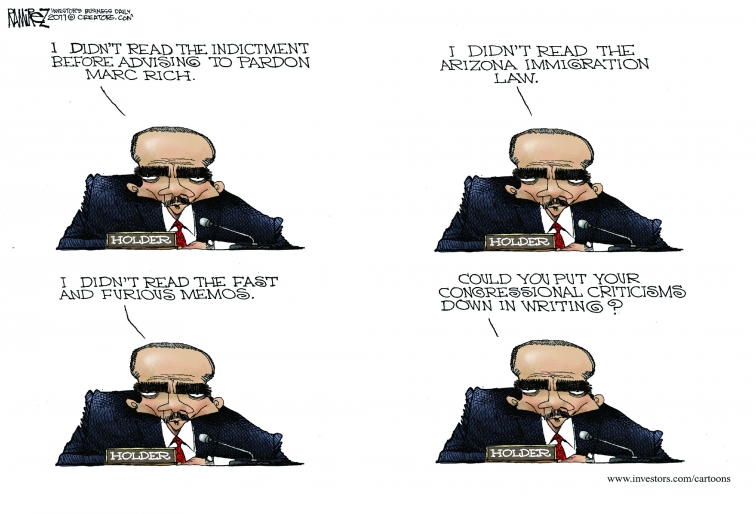
Ramirez Cartoon: Holder’s “Fast and Furious” Defense
Posted by Print

Below is one of the latest cartoons from two-time Pulitzer Prize-winner Michael Ramirez.

View more of Michael Ramirez’s cartoons on CFIF’s website here.