Ramirez Cartoon: It’s the Economy Stupid…
Below is one of the latest cartoons from two-time Pulitzer Prize-winner Michael Ramirez.

View more of Michael Ramirez’s cartoons on CFIF’s website here.

Below is one of the latest cartoons from two-time Pulitzer Prize-winner Michael Ramirez.
View more of Michael Ramirez’s cartoons on CFIF’s website here.
It’s hard to appreciate the consequences of government policies when you’ve never had to make a payroll. Noting that the Obama Administration has no person in senior management with business experience, AOL contributor Marty Robins says the most troubling deficit in Washington, D.C. is a lack of ideas from people who’ve actually had to work in a free market economy.
What we need more of in Washington are those who combine a broad understanding of the nuances and “macro” implications of public policy with an appreciation of what makes the private sector tick on a “micro” level, and what constitutes good and bad assistance and incentives.
We need those who have successfully built or built up businesses and been personally invested — in a financial and an emotional sense — in such efforts, so that they can appreciate what government can and cannot do.
In CFIF’s Liberty Update last week, we highlighted how President Obama isn’t so much “pulling us out of the ditch,” but rather setting our nation’s car on fire. Instead of spending his time claiming credit for our inevitable cyclical rebound, Obama should recognize that his policies of higher spending, taxation, regulation and debt are only subduing it. To illustrate, we contrast the remarkable gross domestic product (GDP) growth during the Reagan recovery delivered by tax cuts, reduced regulation and a stronger dollar versus our current stagnation and possible “double-dip” recession.
Comparing unemployment trends then versus now provides another vivid illustration of the toxic effect of the Obama-Pelosi-Reid economic agenda. From December 1982 to June 1984 – the first 18 months of the Reagan recovery – U.S. unemployment plummeted rapidly from 10.8% to 7.2%. In contrast, over 13 months since our current economic rebound commenced in July 2009, U.S. unemployment has stagnated from 9.4% to its current 9.5%. Of course, it is theoretically possible that unemployment will plummet by three percentage points over the next five months to match the Reagan recovery, but not even Joe Biden is silly enough to predict that.
It’s no mystery how to unleash America’s economic vigor and bring recovery: less government and more economic freedom. It’s just a matter of electing leaders who will actually pursue it.
The latest survey of 53 economists by The Wall Street Journal offers a clear message. Namely, no more government “stimulus,” and extend the soon-to-expire Bush-era tax cuts for everyone, not just those earning under $250,000 annually.
Of 48 polled economists, 30 flatly rejected calls for any form of additional fiscal or monetary “stimulus.” Only 6 economists encouraged more Obama-Reid-Pelosi style fiscal stimulus, only 5 suggested additional monetary stimulus from the Federal Reserve and just 7 suggested both. On the issue of taxes, fully 32 of the polled economists called for extending all of the current lower tax rates, in a sharp rebuke to Obamanomics. Only 3 economists supported an end to the Bush-era tax cuts, and only 11 agreed with Obama and Timothy Geithner in their campaign to raise taxes on those individuals and small businesses reporting income over $250,000. Unlike Obama and Geithner, economists recognize the destructive effect that raising taxes on individuals and small businesses in the top income segments will have.
As Stephen Stanley of Pierpoint Securities summarized, “the economy needs government to get out of the way.” Well said.
Below is one of the latest cartoons from two-time Pulitzer Prize-winner Michael Ramirez.
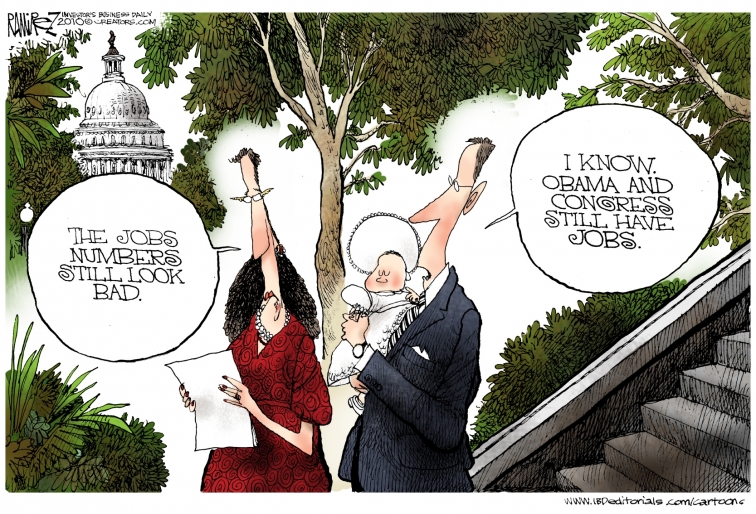
View more of Michael Ramirez’s cartoons on CFIF’s website here.
On this date in 1981, President Ronald Reagan signed the Economic Recovery Tax Act of 1981 at his Rancho del Cielo property in Santa Barbara, California. Sponsored by Congressman Jack Kemp (R – New York) and Senator William Roth (R – Delaware), the bill amended the Internal Revenue Code in order “to encourage economic growth through reductions in individual income tax rates, the expensing of depreciable property, incentives for small businesses, and incentives for savings.”
Did it ever.
By reducing tax rates and unleashing American dynamism, the U.S. witnessed two consecutive years of remarkable growth. For the eight quarters spanning 1982 and 1983, we saw gross domestic product (GDP) growth of 5.1%, 9.3%, 8.1%, 8.5%, 8.0%, 7.1%, 3.9% and 3.3%. Compare that to our current cyclical recovery, in which the Obama-Pelosi-Reid agenda of higher spending, regulation and taxation has subdued our rebound to 1.6%, 5.0%, 3.7% and 2.4% (soon to be revised downward to an estimated 1%). Obama, Pelosi and Reid like to claim credit for our inevitable cyclical recovery from the last downturn, but the truth is that they’ve only managed to stifle it while adding trillions to our debt.
They should instead take a trip down memory lane and correct course according to the crystal clear Regan example.
Below is one of the latest cartoons from two-time Pulitzer Prize-winner Michael Ramirez.

View more of Michael Ramirez’s cartoons on CFIF’s website here.
Everyone except Paul Krugman at least acknowledges that paying for the recently extended unemployment benefits Congress just authorized is a serious issue; even if some consider it outweighed by other concerns.
In addition to increasing the national debt, extending unemployment benefits may also increase unemployment itself. As Thomas Cooley explains in Forbes, studies show that unemployment benefits can reduce the urgency to find a new job. However, Cooley mentions another phenomenon that bears further meditation:
Economists Lawrence Katz and Bruce Meyer, in a 1990 study, showed that an increase of one week of benefits increased the duration of unemployment by about 0.2 weeks. Note that some benefits have been extended up to 99 weeks. A back-of-the-envelope calculation means that going from 26 weeks of benefits to 99 would increase unemployment duration by about 14 weeks very close to the increase in duration shown in Figure 3. Recently, however, in a testimony to the Joint Economic Committee (April 29, 2010) the very same Katz said that the effects are small. The difference between the 1990 study and his current finding is that, according to his research, permanent job losses as opposed to temporary layoffs have played a bigger part in this recession. (Emphasis mine)
Unlike Krugman, I’m not one to quibble with logic and empirical data. But the current unemployment situation is different from the usual circumstance of entities within a sector reshuffling the staff rosters. Such events cause minor displacements – though not to individual workers and their families – and can be smoothed out when laid off workers find comparable employment in the same or similar industry.
This recession is different. As the bolded text above shows there appears to be an economy-wide reduction in workforce afoot. Employers are discovering unknown efficiencies with contingency workers. In many cases, former full-time, full-benefit workers are being hired back as independent contractors for project work with no benefits.
Once employers get used to getting more production for less compensation, those former full-time, full-benefit jobs won’t be coming back. That poses a serious quandary for limited government conservatives. Should government provide a benefits supplement for those working multiple jobs, but still failing to pay the bills, even if it means adding to the deficit? On the other hand, should benefits be cut to stop the fiscal bleeding with the hope that the former recipients find a way to make ends meet?
Whatever path is chosen, conservatives need to think hard about how to combine stopping the government spending with policies that enable sustainable private sector job creation.
During a television appearance over the weekend former Clinton Treasury Secretary Robert Rubin stumbled onto a hard truth for liberals when it comes to proving they can be trusted to reduce the deficit.
“If you could do it and it was credible and people believed it and it was real, I think that could do a lot for confidence.”
Let’s reword that a bit: If a deficit reduction plan was credible – meaning people believe it can work based on its assumptions and terms – and real – meaning the people proposing it are committed to implementing it – then the public would have confidence that the government could reduce the deficit.
Put another way: Credibility + Reality = Confidence
Applying that formula to ObamaCare and the Recovery Act shows just how much liberals fail to make the grade.
So far, the liberals running Washington, D.C. have shown themselves anything but credible and based in reality. No wonder nearly two-thirds of Americans have no confidence in them.
The recession is not getting better. In a “snap” analysis by Reuters the following lowlights from the jobs front is not encouraging.
* Temporary jobs dropped by 5,600, reversing a streak of strong gains that economists had viewed as a hopeful sign that hiring would pick up.
* Normally, companies load up on temps at the beginning of a recovery when they are waiting for confirmation that growth is gaining momentum. This recovery has been unusual in that temporary hiring did not herald a jump in private hiring.
* Private hiring totaled a lackluster 71,000 in July, below expectations for 90,000 in a Reuters poll. June’s tally was revised down to just 31,000 from an initially reported 83,000.
* Government hiring was another worrisome sign. The loss of 202,000 positions reflected the loss of 143,000 temporary Census jobs.
* The total also included 38,000 jobs lost in local government. For most municipalities, the fiscal year began on July 1, and government associations have been warning that huge budget gaps would force aggressive job and spending cuts. July’s report suggests local governments got a quick start.
With the evidence mounting of a prolonged economic downturn, it’s time for someone – Republicans, Tea Parties, etc. – to start making the moral case against the liberal approach to (mis)managing the economy. People are losing their ability to support themselves independently, making welfare a more attractive – and necessary – option for increasing numbers of middle class workers. Not only is expanding the welfare state unsustainable, it harms the entrepreneurial spirit that makes economic recovery possible.
In order for America to get back to work, the incoming wave of office holders this November needs to remove the barriers to productivity that are killing employment growth.
Already navigating a turbulent economic sea, Americans are bracing for the single largest tax increase in history this January 1.
Democrats fighting for their political lives believe they have a winner soaking “the rich,” but we’ve noted the destructive effect that raising taxes on the top bracket will have on the struggling economy. Not only will they hit small businesses (which create most new jobs in America) particularly hard, but individuals in that bracket carry a disproportionate burden of consumer spending, which makes up 70% of our overall economy. In this video clip from CNBC, even often left-leaning Don Peebles considers tax increases for the highest income bracket a destructive idea:
If we spend more money paying taxes, then we will have less money to invest, less money to employ workers… We can’t take a bad situation and make it worse by taxing people more at a difficult time.”
Liberals cannot win this debate on the substance, so they instead hope to win on the rhetoric by framing the issue as “the Bush tax cuts.” But Bush will have been gone from the White House for two full years by the time the tax increases hit. We’re not debating new tax cuts, and Bush is long gone. Rather, what we’re talking about are looming tax increases. Namely, Obama’s tax increases.
Is there any periphery bounding the absurdity of the desperate political left?
The Obama Administration’s 2009 “stimulus” continues to prove itself a failure. It promised that unemployment would peak in October 2009 at 8%, and would be down to 7.3% by now. Instead, we remain mired near 10%. Further, second quarter gross domestic product (GDP) was revised downward just last week to 2.4%, a slowdown from 3.7% in the first quarter and 5.0% from the fourth quarter of 2009. Meanwhile, we’re $1 trillion deeper in debt, and the administration admitted last month that its second year deficit will reach an astounding $1.5 trillion, exceeding even its first deficit of $1.4 trillion.
Yet according to former Secretary of Labor Robert Reich, “the administration’s original sin was not spending enough.” Commenting in today’s Wall Street Journal, Reich bizarrely adds that the Democrats’ 2009 filibuster-proof Senate supermajority somehow constituted “a fragile 60 votes” constraining Obama’s ambitions, and says that the problem with ObamaCare was that it was “not nearly large or bold enough.” Not large enough? Take a look at this ObamaCare flow chart, which looks more intricate than a nuclear reactor.
So how much would have been enough to satisfy Reich, anyway? Two trillion? Three trillion? Ten? It all recalls the popular bumper sticker – “Don’t Tell Obama What Comes After ‘Trillion.'”
Seems like someone at the Associated Press read our commentary “Raising Taxes on ‘The Rich’ Will Harm the Economy” from last week’s Liberty Update. Either way, we couldn’t help but note an AP headline “Economy Weakens as Wealthy Spend Less” released today.
The AP story begins, “Wealthy Americans aren’t spending so freely anymore. And the rest of us are feeling the sqeeze.” The story goes on to lament that the economy appears to be slowing as “the rich” spend less:
Think of the wealthy as the main engine of the economy: When they buy more, the economy hums. When they cut back, it sputters. The rest of us mainly go along for the ride.”
Noting that the Obama Administration seeks to increase tax rates on that critical income segment, the AP report states ominously that, “the wealthy may be keeping some money on the sidelines due to uncertainty over whether or not they will soon face higher taxes.”
The good news is that there’s still time for the Obama Administration to wake up and smell the same coffee the AP is smelling.
We note in our Lunchtime Liberty Update this week that the Obama Administration’s class warfare campaign targeting “the rich” will inflict further harm on our economy. Not only would such tax increases hit small businesses (which create most new jobs in America) particularly hard, it would also penalize the income segment that accounts for 1/3 of consumer spending, which itself accounts for 2/3 of the nation’s economy. Confiscating even more of those dollars may sound fine on a teleprompter, but it will bring destructive consequences in the real world.
Now, a new study by Barclays Capital highlights another potential harm. According to their analysis, Obama’s plan will cause a 9% drop in the S&P 500 and a 900-point drop in the Dow Jones Industrial Average. As noted in this morning’s edition of The Hill, that would result from the Obama Administration’s focus on taxing upper income segments:
The Barclays report attributes the potential stock drop to President Obama’s plans to increase taxes on wealthy individuals, who are the country’s chief investors. The report claims high earners are likely to shift their investment strategies because of the coming tax increase. ‘According to the Fed’s 2007 Survey of Consumer Finances, 75 percent of stock market wealth is held by families in the top percentile of income,’ the Barclays report states. ‘From a behavioral standpoint, if the government follows through on its plan to raise dividend and capital gains taxes for the highest income earners, it could influence the asset allocation decisions of an important investor class and potentially bring about a shift away from equities, with negative knock-on effects for the economy.'”
For political observers looking for a glimpse into former e-Bay CEO and current gubernatorial candidate Meg Whitman’s (R-CA) job creation plan, a 34 page glossy magazine is available for free download (pdf) or delivery. As both a PR document and a policy manual, the plan is impressive. After listing the parade of economic horrible facing the Golden State, Whitman moves into prescription mode promising to promote tax cuts and streamline regulations that impede business.
Implementing any of these measures would help California. Enacting all of them might actually save the state from financial collapse. However, there is one addition I’d like to see that’s currently missing.
Tell the voters that governments can only create one type of job directly: a government job. Whether it is a formal state position, a job that is made necessary to comply with a regulation or one to get a government contract, all of these jobs redirect talent and resources towards expanding the tax burden by increasing government spending.
A more sustainable model is implementing the kinds of policies Whitman is pushing; policies that create a tax and regulatory environment favorable to private sector job creation. The more private sector jobs created means more people have more money, allowing government to lower tax rates while providing the same level of services.
In reality, Whitman as governor can’t create directly a single private sector job without picking winners and losers. Instead, the most (and the best) she can do is create the conditions for success that allow private business to flourish and add workers. Who better to educate the public on that point than a person with top-level business executive experience?
Earlier this month, we noted the sad irony that leaders from welfare states like Germany now lecture President Obama about fiscal discipline. At the recent G-20 summit in Toronto, Obama attempted to strongarm other industrialized nations into more of the deficit-inflating “stimulus” spending that has failed here, but to no avail. Germany has actually announced budget cuts, whereas Obama admitted that this year’s $1.5 trillion deficit will exceed even last year’s $1.4 trillion pit.
Yesterday, German labor market data provided additional evidence that they were right, and Obama was wrong. For the thirteenth consecutive month, German unemployment fell, and Germany has now recovered its jobs lost during the recession. Meanwhile, U.S. unemployment remains near its recessionary high at 9.5%, compared to Germany’s 7.6%. Obama continues to employ his mindless “jobs saved or created” talking point, but Germany suggests that fiscal discipline and spending restraint are the better course.
Perhaps Obama can go on the German version of “The View” and explain to them why his agenda works better despite the stark evidence.
Below is one of the latest cartoons from Pulitzer Prize-winner Michael Ramirez.

View more of Michael Ramirez’s cartoons on CFIF’s website here.
Senate Majority Leader (for the time being, at least) Harry Reid (D – Nevada) mistakenly believes that he’s got a winning card with his scheduled vote today on yet another unemployment benefit extension. Reid, along with co-conspirators Nancy Pelosi and President Obama, predictably mischaracterize Republican opposition to the vote that will immediately follow the introduction of replacement West Virginia Senator Carte Goodwin.
But here are some facts. First, Senate Republicans only request that unemployment benefit extensions be offset with cuts in other forms of runaway federal spending. Second, Harry Reid’s proposed extension will add $30 billion to this year’s projected $1.4 trillion deficit. Third, unemployment benefits already stretch for 99 weeks – almost two full years. Fourth, there have already been seven extensions in unemployment benefits during the period in which Obama’s $1 trillion “stimulus” spending has instead managed to stifle what should be a robust cyclical rebound by this point. Fifth, even Obama’s own economic advisers have proclaimed that jobless benefits actually perpetuate and exacerbate unemployment itself.
Here’s the better policy prescription: prevent upcoming tax increases, slow the federal government’s breakneck spending expansion and reduce the threat of anti-growth regulatory uncertainty. When we implemented those prescriptions during the Reagan Administration, we witnessed astounding two-year gross domestic product growth of approximately 7% over eight consecutive quarters in 1983-1984. How much longer will it take Harry Reid, Nancy Pelosi and Barack Obama to finally learn that simple lesson?
This should be a period of robust cyclical recovery from the past recession, but we received yet another troubling sign from the Federal Reserve yesterday. For the month of June 2010, American manufacturers utilized only 71.4% of productive capacity, down from 71.7% utilization in June.
What this means is that instead of cranking up and increasing velocity, manufacturers decelerated from May to June. Moreover, this 72% capacity utilization compares with the post-war historical average of 81%. Translation: there exists a lot of slack in our economy at a time when we should be expanding. This news comes on the heels of reports that American companies are hoarding a record $2 trillion rather than spending it on expansion or job creation, and adds to the sense that Obamanomics are subduing our recovery, not stimulating it.
America’s technology sector can provide a wellspring of economic dynamism and new employment. As long as government doesn’t poison that potentially abundant font, that is.
At a seminar today entitled “Technology and Economic Recovery” hosted by Americans for Technology Leadership, panelists Shahin Kohan, Dr. Joseph Fuhr and Karen Kerrigan explained that our information technology (IT) sector offers a much-needed vehicle by which we can overcome economic stagnation. Dr. Fuhr explained that IT spending is expected to grow 2.3% per year between today and 2013, compared to expected gross domestic product (GDP) growth of just 0.5% during that span, and that employment in the IT industry will grow by over 1 million jobs compared to expected employment shrinkage in other fields.
For her part, Ms. Kerrigan, who serves as President and CEO of the Small Business & Entrepreneurship Council and founded Women Entrepreneurs, explained the destructive consequences of federal overregulation and taxation for small enterprises that create most new jobs in America. Ms. Kerrigan pointed out that the prospect of even more suffocating regulations and taxation on small business and technology entrepreneurs only discourages innovation, expansion and hiring. Mr. Kohan, an apparel entrepreneur from Los Angeles who is CEO of Focal Technology Solutions, Inc., illustrated ways in which new technology can assist creative entrepreneurs in a highly competitive worldwide market, along with terrifying examples of how state, local and federal bureaucracy can destroy American jobs and businesses.
The message was simple: give technology enterprises freedom, and innovation, and critical job growth will soon follow.
 CFIF Freedom Line Blog RSS Feed CFIF Freedom Line Blog RSS Feed CFIF on X CFIF on X CFIF on YouTube CFIF on YouTube |
