Archive

Author Archive
April 9th, 2012 at 5:24 pm
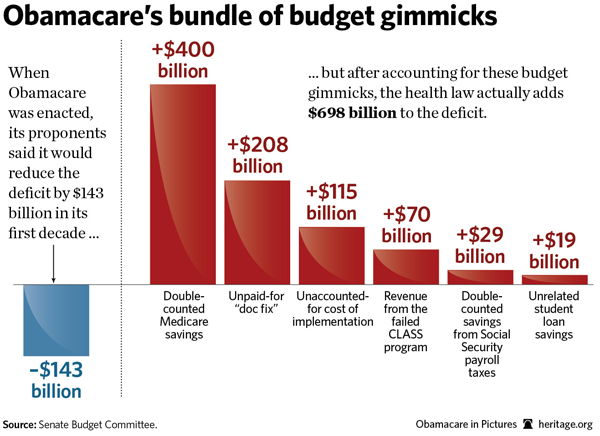
Chart: ObamaCare’s True Costs

The Heritage Foundation breaks down the numbers of what ObamaCare was promised to save, and what it actually costs:


Combine this spending monstrosity with the $787 billion stimulus bill and you’ve got nearly $1.5 trillion added to the federal deficit before any other Obama Era policy has been discussed.  Lard on the costs of EPA regulations, the uncertainty of Dodd-Frank’s implementation, and the specter of all the Bush tax cuts vanishing next January and it’s no wonder the American economy is stagnant.  The liberals in Washington, D.C. are spending and regulating us into oblivion.

April 9th, 2012 at 1:03 pm
Obama’s Spending vs. Canada’s Cuts

It’s been said by some supporters of President Barack Obama’s $787 billion stimulus spending spree that we can’t really know if it failed because we can’t ‘re-run’ the last three years to see if something else might have worked.

But according to economist John Lott, we don’t have to.

In a wide-ranging interview with The Daily Caller about his new book, , Lott compares the different approaches by the liberals in Debacle: Obama’s War on Jobs and Growth and What We can Do Now to Regain Our Future the Obama White House and the conservatives running Canada’s government.  The results aren’t pretty.

How do we know the stimulus package made the economic situation worse?

Compare the U.S. and Canada. Their unemployment rates increased in lock step from August 2008 until six months later, in February 2009, when the stimulus was passed in the United States. During those six months, the U.S. unemployment rate rose by 2.1 percentage points, from 6.1 percent to 8.2 percent, and the Canadian rate grew by 1.9 percentage points, from 5.1 percent to 7 percent (using the BLS [Bureau of Labor Statistics] measure to make the Canadian measure of unemployment comparable to the U.S. rate). The graph that we have showing this is actually stunning.

Canada adopted a much smaller and quite different “stimulus” program that emphasized cutting tax rates and regulations and that produced dramatically smaller deficits. On a per-capita basis, Canada’s stimulus was about a third that of America’s, costing $979 per person compared to our $2,730. The conservative Canadian government chose not to introduce any big programs.

Obama, meanwhile, adopted big-ticket Keynesian programs, believing that government spending for its own sake creates wealth. But Democratic emphasis on “green” energy, government-approved investments and technology and higher salaries for public-school teachers merely moved money away from where Americans and companies would have otherwise spent it.

Obama’s stimulus also raised the effective marginal tax rates that some individuals face, discouraging work; Canada, by contrast, cut some marginal rates. Obama kept the corporate tax rate stuck at 35 percent, while Canadians cut their corresponding rate from 21 percent in 2007 to 16.5 percent this year — with a further cut to 15 percent planned for next year. By last year, Canada had the lowest overall tax rate on business investment of any major industrialized country.

Canada also didn’t run the huge stimulative deficits that we ran here in the U.S. They didn’t saddle their kids with a huge debt that they were going to have to pay off.

But if Obama’s program — including a massive 21 percent hike in spending from 2008 to 2011 and corresponding massive deficits — worked so well, why has our unemployment rate risen more since those policies were adopted than have the rates of the European Union, South America, Japan, Australia or New Zealand?

April 4th, 2012 at 7:02 pm
More Bad Solyndra News

Politico reports that an Inspector General’s investigation concluded the Department of Energy’s loan to Solyndra corrupted a process to serve a political agenda.

The Treasury Department’s review of Solyndra’s $535 million federal loan guarantee was “rushed” through in about one day in March 2009, “based on an expedited review request from DOE so that a press release could be issued,” according to a Treasury inspector general report that gives further evidence of the early Obama administration’s eagerness to announce progress in funding clean energy.

The report also found that DOE didn’t consult with Treasury on the terms and conditions of the loan deal before or during the Energy Department’s own review process, including the review of Solyndra’s credit worthiness.

Nor did DOE include Treasury in negotiations that later allowed private investors to skip past taxpayers in the repayment line in the event – which turned into a certainty – that Solyndra went bankrupt.

The corruption in the Solyndra loan process is unique in that – so far – no one inside the government has been accused of being bribed for making so many financially ruinous decisions with taxpayer money.

The only explanation is the triumph of ideology over process.

In the Teapot Dome scandal members of the Harding administration got kickbacks for no-bid contracts on oil drilling.  The HUD scandals of the late 1980’s made some officials, lobbyists, and construction companies rich at the expense of the poor.  But with Solyndra and other failed alternative energy busts, Obama’s DOE blew billions of dollars on nothing more than a bankrupt ideology; namely, the fantasy that green technology can be subsidized into sustainability.

At least with bribes you can follow the money.  The Obama administration’s version of corruption is something arguably new.  The only way to ensure its eradication is to fire the people who hire the ideologically-driven bureaucrats.

April 4th, 2012 at 6:38 pm
Fifth Circuit Tells DOJ To Do Obama’s Constitutional Homework

President Barack Obama’s controversial warning to the Supreme Court that a vote to overturn ObamaCare would be “unprecedented” is getting push-back from the federal judiciary.

During oral arguments on a different ObamaCare provision than those argued before the Supreme Court last week, Fifth Circuit Judge Jerry Smith asked a Department of Justice lawyer for clarification.  “Does the Department of Justice recognize that federal courts have the authority in appropriate circumstances to strike federal statutes because of one or more constitutional infirmities?”

To drive home the point, Judge Smith ordered DOJ to provide a written explanation of its views “no less than three pages, single spaced.”

The only problem with the homework assignment is that it wasn’t directed to the right person.  President Obama, that one-time constitutional law professor at the University of Chicago, should be the one sitting at the keyboard relearning first year law.

At least then he’d be aware that what’s truly unprecedented is his belief that federal courts are rubber stamps for his liberal agenda.

April 3rd, 2012 at 6:38 pm
Obama’s Campaign Spending Also Unsustainable

The Daily Caller makes hilarious use of Karl Rove’s analysis comparing the spending rates for the Bush and Obama reelection campaigns.

But there’s plenty of evidence that the campaign isn’t bringing in as much money as it wants.

For example, data from the campaign’s earlier quarterly reports to the Federal Election Commission show that Obama’s spending is growing faster than revenues.

“The Obama campaign’s high burn rate doesn’t come from large television buys, phone banks or mail programs that could be immediately stopped … [but] from huge fixed costs for a big staff and higher-than-expected fund-raising outlays,” according to a March 14 article by Karl Rove, chief political strategist for George W. Bush.

In the second quarter of 2011, Obama’s “campaign spent 25% of what it raised… while Mr. Bush’s campaign spent only 9% in the second quarter of 2003,” Rove said. Since then, the spending pace has accelerated, he said, pointing out that in January “the Obama campaign spent 158% of what it raised, while the Bush campaign spent 60% in January 2004.”

Also, his supporters initially predicted a $1 billion reelection fund, but campaign staffers are quick to deny that is a goal.

Rove argues that one reason the re-election campaign might be running lighter-than-expected on cash is that many of Obama’s 2008 supporters are not opening their checkbooks this time around.

Spending growing faster than revenues (158%!).  Huge fixed costs triggering obscene debt.  An unsustainable burn rate.  Grandiose predictions cratering on fiscal reality.  Contributors unwilling or unable to pony up more cash.

Whether it’s managing the federal government or his own campaign, Barack Obama is as unbalanced with money as he is with policy.

April 2nd, 2012 at 2:05 pm
Good Riddance, Arlen Specter

It’s been a rough re-launch into the public consciousness for former Senator Arlen Specter (R/D-PA) since switching parties and losing the Democratic primary in 2010.

While hocking his memoirs during media appearances Specter has made off-color comments about Ronald Reagan, Sarah Palin, and Rick Santorum, insulted at least one radio host, and drawn attention to his book’s portrayals of former fellow senators Ted Kennedy (D-MA) as a “walrus” and John Thune (R-SD) as looking like a movie star “in or out of clothes.”

The Blaze website has a helpful compilation of Specter’s lowlights during his media blitz, including Glenn Beck’s radio show co-host reading excerpts from Specter’s book; such as the nugget about the time another senator cut in front of Specter to get a ‘free’ (i.e. taxpayer-funded) massage in the Senate gym.  Arlen’s take-away from the experience: collegiality is dying in the upper chamber.

Ronald Reagan once said, “Politics is not a bad profession.  If you succeed there are many rewards, if you disgrace yourself you can always write a book.”  In Specter’s case, Reagan’s observation still holds true.

April 2nd, 2012 at 1:24 pm
The 6 Groups Responsible for California’s Budget Mess

Joe Mathews blogs at NBC Bay Area on the people and institutions most at fault for California’s budget fiasco.

The system makes the decisions, not lawmakers. And that system — the formulas and court decisions and constitutional spending mandates and tax restrictions — does not exist in any particular place that can be protested.

That’s the strange genius of this system, which is really a set of complex formulas. You can’t picket a formula’s house.

Indeed, protesting at the Capitol may be counterproductive — because it advances a false public narrative that the legislature is the problem here. The problem is the people of California, especially voters of the present and of the past.

Two years ago, in this piece for Fox & Hounds Daily, I suggested five alternative locations for protests: highways, gas stations, the prison guards’ union, retirement communities, and unsold homes.

Since then, I have one additional idea: California cemeteries.

Many of the spending mandates and tax restrictions that are strangling the budget, and higher education in particular, were put in place long ago by voters.

So long ago that many of those voters are dead. What better way to represent this problem of the dead governing the living than by taking the protest to those voters?

And what better way to show the crisis of California’s politics than to act as if politically-imposed spending formulas can’t be politically reformed?

March 30th, 2012 at 3:10 pm
Too Big to Read May Make ObamaCare Fail

Remember in 2009 when conservatives in Congress presented an alternative to ObamaCare that would have guaranteed bipartisan support for some of the outcomes the Obama White House and its liberal allies wanted?  Had the liberals concentrated on targeted reforms instead of a gargantuan“comprehensive solution” not only would the ultimate bill have been much shorter, it would have been much easier to read and comprehend.

That’s a point worth considering since judging by the comments from the Supreme Court this week, passing health reform piecemeal would have been a far better strategy for those wanting to salvage the legislation.

Due to ObamaCare’s massive size, Byron York notes that none of the Justices actually admitted reading the entire law.  “I haven’t read every word of [the law], I promise,” said Justice Stephen Breyer on Wednesday.  Justice Antonin Scalia’s comments to an attorney defending the law were more pointed: “You really want us to go through these 2,700 pages?”  “You really expect the court to do that?”

The problem for ObamaCare’s defenders is that the Justices’ refusal to read the entire law means that they are much less likely to rule the individual mandate unconstitutional and keep the rest.  Instead, they’ll just invalidate the whole thing and have Congress start over.

If that happens, the liberal mania for “comprehensive” solutions for everything from illegal immigration to financial transactions and health care will be dealt a much-deserved blow.  You can’t interpret what you can’t define.

If the Court strikes down ObamaCare in its entirety liberals will have only themselves to blame.  Had they listened to conservatives, some of the popular aspects of ObamaCare – guarantees of coverage and subsidies for premiums – would likely be in place with bipartisan support.  Now, they may have nothing to show for what could ultimately end up being a massive waste of time and money.

March 30th, 2012 at 1:24 pm
Being Joe Biden

How’s this for honesty from America’s Vice President:

Vice President Joe Biden offered a frank assessment of his career in remarks at a Democratic fundraiser in Chicago last night, according to the Washington Examiner.

Said Biden: “I never had an interest in being a mayor ’cause that’s a real job. You have to produce. That’s why I was able to be a senator for 36 years.”

H/T: Political Wire

March 27th, 2012 at 2:55 pm
Mainstream Alternatives to Electric Cars

It looks like Energy Secretary Steven Chu’s 2008 musings about manipulating gas prices so people would be forced to buy electric cars was bad politics and bad economics.  The statement was bad politics because it confirms that liberals like Chu are willing to distort energy prices – Keystone XL, anyone? – to serve the environmental left’s ideological agenda.  It turns out to be bad economics because consumers have several more options available than purchasing a Toyota Prius.

In a hyper-link-heavy post, Time reporter Brad Tuttle – who makes no reference to Chu – explains that as the national average for gasoline has risen to $4 a gallon, Americans are responding by buying small inexpensive fuel-powered cars like the Ford Fiesta (40 mpg) and Chevy Cruze (36 mpg); hanging onto old cars longer by delaying non-essential repairs; and in the case of the 21-34 age group, preferring ride-sharing and public transit to car purchases.

Of course, none of these Econ 101 responses to rising prices will convince Secretary Chu and President Barack Obama to stop meddling in the market.  The White House is pushing an increase in the tax incentive to buy hybrids like the Prius, Chevy Volt, and Nissan Leaf from $7,000 to $10,000.  But this incentive disproportionately benefits hybrid buyers.  As Troy has noted, Volt owners average $170,000 in annual income; not exactly the people needing tax incentives to help make car purchases.

Still, it’s nice to see that no matter how much the experts in Washington twist policy into an endless barrage of mandates and tax breaks, consumers in a (relatively) free market are able to make their own decisions.

March 26th, 2012 at 1:53 pm
Etch-a-Sketch vs. More Flexibility

In just a few days two presidential campaigns may have coined the slogans we’ll all be hearing ad nauseum this fall.

Last week, a top Mitt Romney advisor likened his boss to an Etch-a-Sketch, able to be shaken and reset while moving from the primaries to the general election.  Over the weekend, President Barack Obama told his Russian counterpart that “This is my last election.  After my election I have more flexibility.”

Each statement betrays a fundamental suspicion about each candidate.  Romney has no core principles.  Obama’s will emerge only after he’s insulated from facing voters again.  The comments feed the narrative that both men will say anything to get elected.

If Romney is the GOP nominee, Jennifer Rubin already has proposed talking points attacking the ‘more flexibility’ president. (E.g. “He says he’ll only raise taxes on the rich, but after the election he’ll have ‘more flexibility.'”)

We can also assume more comments like Vice President Joe Biden’s that Romney won’t be allowed to be all things to all people.

Unless Rick Santorum can turn his 22 point win in last Saturday’s Louisiana caucuses into a Wisconsin win tomorrow, we may be in for an Etch-a-Sketch vs. More Flexibility campaign.

March 24th, 2012 at 11:06 am
Mark Steyn: America About to Go Broke

Mark Steyn puts the federal government’s spending spree in a global perspective:

When you’re spending on the scale Washington does, what matters is the hard dollar numbers. Greece’s total debt is a few rinky-dink billions, a rounding error in the average Obama budget. Only America is spending trillions. The 2011 budget deficit, for example, is about the size of the entire Russian economy. By 2010, the Obama administration was issuing about a hundred billion dollars of Treasury bonds every month – or, to put it another way, Washington is dependent on the bond markets being willing to absorb an increase of U.S. debt equivalent to the GDP of Canada or India – every year. And those numbers don’t take into account the huge levels of personal debt run up by Americans. College debt alone is over a trillion dollars, or the equivalent of the entire South Korean economy – tied up just in one small boutique niche market of debt which barely exists in most other developed nations.

March 24th, 2012 at 8:52 am
More Solyndras in Energy Department Loan Scandal?

The Wall Street Journal reports that of the 32 loans made under the Energy Department’s renewable energy loan program, 10 have been put on an internal watch list for being “high risk investments”.  Though the Department redacted the identities of the companies on the list, at least one is Solyndra, the failed California solar panel company that went bankrupt last year, and left taxpayers with over $535 million in losses.

The Journal indicates that another member of the watch list may be Prologis Inc., a company approved for $1.4 billion in federal loans about six months ago.  Now, the firm says it won’t meet an upcoming deadline.

Here’s why:

Prologis originally intended to use Solyndra’s solar panels. Energy Secretary Steven Chu intervened last summer to help move the loan forward and called the Prologis project “remarkable” when it closed Sept. 30.

What’s remarkable is that Chu’s name isn’t on a White House watch list for seriously mismanaging billions in taxpayer money on failed ventures.

March 23rd, 2012 at 12:43 pm
California Passes Blank Budgets, Fills in the Details Later

Remember when Nancy Pelosi said of ObamaCare that Congress would need to “pass the bill so [the public] can see what is in it”?  Two years ago, Pelosi & Co. refused to make the contents of ObamaCare public until just before voting was allowed on the bill.

Well, it looks like Pelosi’s fellow liberals in California state government are doing her one better.  From the Los Angeles Times:

In an annual quirk of California government, lawmakers approved 78 budget bills on Thursday — and they were all blank.

The bills function as shells. As negotiations continue and tax revenues are tallied, they will be amended with actual budget details, then quickly passed by the Legislature and signed by the governor.

Calling this practice a quirk obscures the fact that California’s big-spending liberals are deliberately perverting the legislative process to hide their intentions.  Just like ObamaCare, California’s majority Democrats negotiate with themselves behind closed doors and demand an up-or-down vote on budget bills within hours of making them public.

This kind of process-destroying behavior cannot be allowed to continue.  The public needs accurate information to judge policies and politicians, not shell games that cost billions.

March 23rd, 2012 at 12:16 pm
House Republicans Vote to Repeal IPAB

With the Supreme Court getting ready to hear arguments about the (un)constitutionality of ObamaCare, House Republicans yesterday voted to repeal the Independent Payment Advisory Board (IPAB), one of ObamaCare’s provisions that may be left unaffected by the Court’s decision.

As the Washington Times reports, this is “the 26th time the House has voted to partially or completely repeal the sweeping overhaul” of the health care industry.

Like the other 25 times, this House vote won’t be seconded by the Democratic controlled Senate.  But in an election year that’s hardly the point.  What matters right now is that House Republicans continue to highlight how elements like IPAB destroy freedom and choice in health care by letting 15 unelected bureaucrats instead of the free market decide the price of services.

On to number 27!

March 20th, 2012 at 1:46 pm
Real Job Creation is When Entrepreneurs Become Employers

The Kauffman Foundation for Entrepreneurship’s newest report on business creation rates across the United States offers some intriguing insights for policymakers.

According to Robert Litan, the foundation’s vice president of research and policy, “The Great Recession has pushed many individuals into business ownership due to high unemployment rates.”  “However, economic uncertainty likely has made them more cautious, and they prefer to start sole proprietorships rather than more costly employer firms.  This ‘jobless entrepreneurship’ trend negatively effects job creation and the larger economic recovery.”

No doubt, regulatory barriers and confiscatory rates of taxation are causing start-ups to make the same kind of cost-saving hiring decisions as larger, more established firms.  Across nearly every industry these days companies are hiring people to independent contracts rather than salaries, converting many ‘company men’ into standalone consultants.

While becoming an accidental entrepreneur may not be the first career choice of many people – and according to the Kauffman study the college educated cohort saw the steepest decline in their willingness to start their own business – the movement of millions of people into the ranks of the self-employed could have huge consequences for policymakers.

For starters, this army of new business owners is much more likely to demand rollbacks of costly regulations and profit-killing tax rates on corporations.  Your perspective changes when you go from receiving a paycheck to making a payroll.

Remember, the people that lose a job and start a business are the people whom the government should want to help the most.  They aren’t looking for a hand-out or even a hand-up, just space to make a contribution that others in the free market will reward.

This constituency is a natural growth area for the conservative movement.

The best part about the Kauffman report is that entrepreneurial activity can be found in important electoral pockets.  Consider:

  • Entrepreneurial growth was highest among 45- to 54-year-olds, rising from 0.35 percent in 2010 to 0.37 in 2011
  • The top five highest entrepreneurial rates among the fifty states were:

(1) Arizona with 520 per 100,000 adults creating businesses each month during 2011;

(2) Texas with 440 per 100,000 adults;

(3) California with 440 per 100,000 adults;

(4) Colorado with 420 per 100,000 adults; and

(5) Alaska with 410 businesses started per 100,000 adults

The key to our economic recovery rests on policymakers understanding that Americans want to work.  I submit that any politician willing to make the necessary changes to tax and regulatory rules so that start-up owners can become employers as well as entrepreneurs will find a loyal constituency, and one well worth fighting for.

March 16th, 2012 at 12:43 pm
Former CA U.S. Senate Candidate Moves to Texas

Former California Assemblyman and 2010 Republican U.S. Senate candidate Chuck DeVore explains why he gave up on the Golden State and moved to Texas in an article for National Review.

Here’s just one example of the differences between the states:

In his State-of-the-State address this January, California governor Jerry Brown said, “Contrary to those declinists who sing of Texas and bemoan our woes, California is still the land of dreams. . . . It’s the place where Apple . . . and countless other creative companies all began.”

Fast forward to March: Apple announced it was building a $304 million campus in Austin with plans to hire 3,600 people to staff it, more than doubling its Texas workforce.

California may be dreaming, but Texas is working.

March 15th, 2012 at 8:07 pm
Obama Campaigns on Taxpayer’s Dime

Check out this video clip of President Barack Obama speaking to what looks and sounds like a campaign crowd in a community college outside Washington, D.C.

The problem is that federal officeholders – like the U.S. President – aren’t supposed to campaign on the taxpayers’ dime.  That’s why presidential campaigns like Obama for America exist.  The press picked up on this and asked White House Press Secretary Jay Carney to comment.  His response: “It’s a policy statement” to call Republicans who won’t subsidize alternative energy boondoggles like Solyndra “members of the flat-earth society.”

And the O-Man wonders why Republicans don’t like him?

March 14th, 2012 at 8:29 pm
Obama’s Regulations Are 5x Costlier than Bush’s

President Barack Obama may never tire of blaming his predecessor for every current economic problem, but a new study by the Heritage Foundation shows that when it comes to the cost of federal regulation, Obama is king.

The numbers don’t lie, Mr. President.  Job growth is anemic, the employment rate is stagnant, but your regulatory agenda continues to add billions of dollars in costs to the only real job creators – employers.  After three years of your policies imposing five times the costs of compliance than under the Bush regime it’s time for something radically different.

March 13th, 2012 at 2:33 pm
New HHS Rule is Roadmap to Nationalized Healthcare

Reuters explains how a new Health and Human Services regulation announced today on the state-directed health insurance exchanges lays the groundwork for a total government takeover of the healthcare industry.

In a 642-page final rule, the government provides guidance on how states should establish exchanges, qualify health plans for participation and determine the eligibility of both individuals and small businesses that want to use exchanges to provide health coverage to their employees.

Industry and consumer groups welcomed the regulations, saying they provided states with the flexibility necessary to meet consumer needs for choice and quality protections. They also said the regulations shift policy focus to the state level, where the new rules must be implemented.

That is, until States drown in a sea of future regulations interpreting and implementing this “final” rule.  At that point, States will be happy to cede control over policy details to federal bureaucrats so long as the money keeps flowing.

As an example, just look at the rush by States to accept extra-legal requirements like the Common Core curriculum standards from the Department of Education in exchange for No Child Left Behind waivers.  Implementation of ObamaCare will be no different.  Unless the law is repealed, elements like health care exchanges and IPAB will eventually turn over all healthcare decisions to central planners; first in state capitols, then in Washington, D.C.