Archive

Author Archive
April 20th, 2016 at 4:01 pm
Xfinity Announcement Demonstrates Folly of FCC Set-Top Box Regulatory Proposal
Posted by Print

Alongside other free market organizations, CFIF adamantly opposes a new proposal by the Obama Administration’s Federal Communications Commission (FCC) to regulate cable television set-top boxes.

More specifically, Obama’s FCC seeks to impose a 1990s-vintage, one-size-fits-all mandate to make cable TV set-top boxes artificially compatible with third-party devices.  As we have detailed, the proposed regulation constitutes crony capitalism in its worst form, it poses a threat to consumer privacy, it undermines the creative community and jeopardizes intellectual property protections by potentially facilitating piracy.  In addition to those problems, it also constitutes an anachronism in the sense that it freezes in place an outdated set-top box  model that is already being left behind by technological advance and private sector innovation.  Cable companies and other entertainment industry players are already abandoning traditional cable boxes in favor of devices owned and maintained by individual consumers as they choose.

Today’s announcement of the new joint Xfinity TV Partner Program between Comcast, Samsung and Roku provides just the latest example illustrating that dynamic.  Stated simply, consumers can access their cable subscription via the Xfinity TV Partner app that will be compatible with RokuTV and Roku devices.  Thus, without the need for a set-top box at all, customers can now access live, on-demand, cloud, DVR and other televised content on smart TVs and other IP-enabled technology.

What this shows is that the video entertainment and app markets continue to evolve alongside consumer demand, rendering the FCC’s set-top box proposal obsolete before it can even be imposed.  The new regulation would disrupt market innovation of this sort while threatening the privacy and piracy perils noted above.  Simply put, the marketplace is working, and this latest FCC “solution” to a non-existent problem will only create more problems.

As we have emphasized, and as any American who watches television well knows, there is no realm of contemporary life that manifests innovation, consumer choice, quality, affordability and sheer enjoyment than the video entertainment sector.  The variety and excellence of today’s video choices continues to expand at breakneck speed and literally on a daily basis.

Today’s news serves to confirm that reality, and demonstrates why leaders in Congress, the innovation community, consumer groups and everyday American consumers should stand together and oppose this latest FCC overreach.

April 20th, 2016 at 11:10 am
Piracy, Data and AllVid: If Past is Prologue, Creators Should Worry a Google Delivered Pay-TV Service Would Promote Pirated Content
Posted by Print

This is an amazing time for the film and TV industry, as audiences have never possessed more entertainment choices on more platforms.

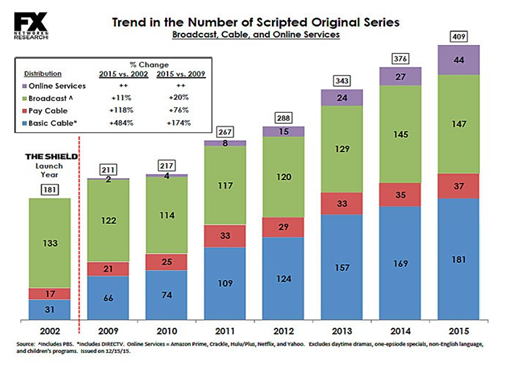
To illustrate, FX Networks recently conducted a study demonstrating that the total number of scripted series (think dramas and comedies, not reality-TV) across cable, satellite and online increased to 409 in 2015. That represents a 94% increase from 2009, with a 174% growth in scripted series on basic cable (181 vs. 66). What’s more, all this great content is widely available online. SNL Kagan recently released a report finding that “98% of premium films and 94% of premium TV series were digitally available on at least one of the online services that were reviewed.”

Given this explosion of creativity and innovation, a sense of growing and justifiable bewilderment in the creative community exists over a recent FCC proposal, commonly referred to as “AllVid,” that would force creators, networks, and pay-TV providers to give away their products and services for tech giants like Google to exploit for their own commercial purposes. The beneficiaries of this government handout would be free to repackage video content as they see fit, drop programming or bury it on the channel guide, add their own advertising and strip out existing ads, and mine viewer data – all without negotiating with cable programmers or distributors or adhering to privacy laws and regulations that apply to traditional providers.

Further, there is nothing in the proposed rule to stop tech companies from combining legitimate content with video from piracy sources. “Walking Dead” producer Gale Ann Hurd articulated these concerns well in a recent USA Today op-ed stating:

[The proposal] would also allow Google — and for that matter set-top box manufacturers from all over the world, including China (where rogue boxes are being built by the millions) — to create and market applications or boxes with software that will treat legitimate and stolen material exactly the same, and may in many cases help to steer consumers to piracy.”

Her concern regarding piracy-laden devices is legitimate. As just one recent example, the UK’s Police Intellectual Property Crime Unit arrested six people for selling Android set-top boxes modified to deliver illegal movies and TV shows. And Hurd’s concerns about boxes manufactured in China are made plain in this Forbes article.

Proponents of AllVid claim they merely want to show consumers “all their video,” meaning they want to mix and match content from YouTube and other online sources with pay-TV. Setting aside the fact that existing technologies like Roku and Apple TV already provide that capability, the creative community is understandably nervous about stolen content appearing alongside legitimate video if Google gets its way with the set top box proposal. As Hurd points out, “Google’s search engine does this today. Here’s what happens when I search “www.google.com/?gws_rd=ssl#q=watch+Fear+the+Walking+Dead">watch www.google.com/?gws_rd=ssl#q=watch+Fear+the+Walking+Dead">Fear the Walking Dead.

The role search plays in facilitating piracy is significant, so those concerns about the mixing of stolen online video with legal pay-TV content are well founded. According to one survey, 74% of consumers say they used a search engine when they first viewed pirated content. And researches at Carnegie Mellon University conducted an experiment conclusively demonstrating that search rankings drive consumer behavior. The more prominently pirated content appears in search results, the more likely consumers are to choose it.

Worse, TorrentFreak recently reported that Google Now is pushing links to piracy sites, even when consumers don’t engage in any search at all. As TorrentFreak explains:

Google can’t read people’s minds but it does harvest data from Google accounts in order to provide its Now services. That includes your search and location history, sites you’ve visited and the content of Gmail messages. It can also access your phone contacts, calendar entries and even certain apps.”

In this instance, after Google Now determined that user Ryan Raab had “shown an interest” in the movie “Deadpool,” it proactively delivered a link to one of the largest torrent sites in the world, 1337x (see the screenshot below).  The troubling nature of this behavior can’t be understated. Based on data collected across multiple services, Google’s algorithm unilaterally suggested Raab access stolen content – without any action on his part. The FCC’s proposal would only increase the likelihood that Google continues to engage in such irresponsible conduct.

Creators like Hurd have fought hard to keep the pay-TV environment piracy-free. But the FCC – in its eagerness to foment “innovation” – seems determined to compromise the integrity of the creative ecosystem that has produced an explosion of creativity and innovation. AllVid supporters see content merely as bait – a digital lure to attract their ultimate prize: data. If Google and the FCC succeed, creative content could be taken without negotiation or compensation and used by large tech companies to collect consumer viewing data – thereby undermining the economics of creation and consumer trust in one fell swoop.

Or as Hurd puts it, “I’m afraid that all of us who create, market and broadcast legitimate content will be like the zombies on my show: the walking dead.”

April 11th, 2016 at 1:06 pm
This Week’s “Your Turn” Radio Lineup
Posted by Print

Join CFIF Corporate Counsel and Senior Vice President Renee Giachino today from 4:00 p.m. CDT to 6:00 p.m. CDT (that’s 5:00 p.m. to 7:00 p.m. EDT) on Northwest Florida’s 1330 AM WEBY, as she hosts her radio show, “Your Turn: Meeting Nonsense with Commonsense.”  Today’s guest lineup includes:

4:00 CDT/5:00 pm EDT:  Sam Kazman, General Counsel at the Competitive Enterprise Institute – CEI’s Subpoena from US Virgin Islands Attorney General on Climate Change Policy;

4:15 CDT/5:15 pm EDT:  Jim Phillips, Senior Research Fellow for Middle Eastern Affairs at The Heritage Foundation – Is ISIS developing a dirty bomb?

4:30 CDT/5:30 pm EDT:  Michi Iljazi, Communications and Policy Manager for the Taxpayers Protection Alliance – Corporate Inversions, Hillary Clinton’s Attacks on Business, US Postal Service, and Tax Day;

4:45 CDT/5:45 pm EDT:  Kevin Corinth, Research Fellow in Economic Policy Studies at the American Enterprise Institute – Smartphones for the Homeless

5:00 CDT/6:00 pm EDT:  Jeffrey J. Selingo, Author and Higher Education Expert – “There is Life After College: What Parents and Students Should Know About Navigating School to Prepare for the Jobs of Tomorrow”; and

5:30 CDT/6:30 pm EDT:  Timothy Lee, CFIF’s Senior Vice President of Legal and Public Affairs – Puerto Rico, Internal Revenue Service and the Second Amendment.

Listen live on the Internet here.   Call in to share your comments or ask questions of today’s guests at (850) 623-1330

April 8th, 2016 at 10:31 am
Puerto Rico: Representatives Say They Oppose Bailout, But That’s Exactly What “Super Chapter 9” Bill Means
Posted by Print

CFIF opposes the dangerous proposed “Super Chapter 9” bankruptcy legislation for Puerto Rico (under the title “Puerto Rico Oversight, Management, and Economic Stability Act” or “PROMESA”), which was recently released by the Committee on Natural Resources in the House of Representatives.

Believe it or not, that proposed bill constitutes an even more dangerous version of the Obama Administration’s unprecedented bailout proposal, leaving American savers and retirees to pay the price for the fiscal irresponsibility of politicians in Puerto Rico.  It also would create a dangerous precedent encouraging high-spending states like Illinois to seek the same bailout from Congress, it would raise borrowing costs for states, it would undermine the value of retirement funds across America and it would remove any incentive for fiscally irresponsible states to enact meaningful reform.

Unfortunately, some in Congress claim to oppose a bailout for Puerto Rico without recognizing and acknowledging that the proposed legislation means exactly that.  Representative Rob Bishop (R – Utah) offers a leading example, saying that, “there will be no bankruptcy, there will be no bailout.”

Fortunately, Mainstreet Bondholders, a project of the 60 Plus Association, provides a useful corrective appropriately entitled “Read the Bishop Bill – This Is Super Chapter 9”.  It itemizes in easily-understood bullet-point terms how, “Insisting that this bill is not Chapter 9, and simply renaming it something else, does not change the substance of the legislation.  Make no mistake – this is exactly what the Obama Administration asked for when it lobbied for Super Chapter 9!”  It is worth the quick read.

Those who support the proposed legislation, including Rep. Bishop, may have their hearts in the right place.  But that doesn’t change the fact that the bill would bring precisely the sort of bailout on the backs of Americans they purport to oppose.

We at CFIF therefore ask all Americans to contact their elected representatives in Congress to express their unequivocal opposition to the House’s “Super Chapter 9” bailout plan for Puerto Rico and its spendthrift politicians.

April 4th, 2016 at 3:53 pm
Bipartisan House Request to GAO: Investigate FCC’s Set-Top Box Proposal
Posted by Print

We at CFIF recently highlighted a dangerous new regulatory proposal from the Obama Administration’s rogue Federal Communications Commission (FCC):  Its set-top box proposal that simultaneously embodies crony capitalism, regulatory overreach and technological sclerosis:

The latest manifestation is a new initiative from Obama’s overactive FCC to impose a one-size-fits-all mandate to make cable television set-top boxes artificially compatible with third-party entertainment devices.  In other words, even as cable companies themselves voluntarily move in the direction of abandoning traditional cable boxes and toward devices owned and maintained by individual customers as they so choose, the FCC wants to impose 1990s-style regulation on the industry.  That would essentially freeze in place the increasingly outdated model of set-top cable boxes even as it becomes increasingly anachronistic on its own.”

Fortunately, there’s good news to report.

Specifically, a bipartisan House Communications and Technology Subcommittee coalition led by Chairman Greg Walden (R – Oregon) and committee member Yvette Clarke (D – New York) sent a letter on Friday asking the nonpartisan federal Government Accountability Office (GAO) to investigate the FCC’s set-top box proposal.  For those unfamiliar with the GAO, it is popularly known as the “Congressional Watchdog,” and is more officially the agency that provides investigatory and auditing services to Congress of various institutions within the federal government.  The joint letter highlights their concerns and requests a formal GAO examination:

We are concerned that the agency’s efforts do not include a meaningful assessment of the effects on independent and diverse networks, whose business models may be greatly threatened and undermined by the FCC’s proposed rules.  The FCC must proceed with a better understanding of how their proposed rules could limit diversity and inclusion on our nations shared media platforms.  We are requesting that the U.S. Government Accountability Office examine the impact of the FCC’s proposal to change the rules regarding cable set top boxes on small, independent, and multicultural media programmers and content providers.”

This constitutes great news.

It shows a bipartisan Congressional concern over the broad array of potential damage that the FCC’s proposed set-top box regulation would inflict.  And Congress isn’t alone.  A diverse group of consumer groups, innovators, employers and businesses join in opposing the proposal, which offers optimism that it will be rightfully stopped before further damage occurs.

March 25th, 2016 at 5:17 pm
Senate VENUE Act: Badly-Needed Venue Reform in Patent Litigation
Posted by Print

CFIF strongly favors comprehensive patent litigation reform, in particular the Innovation Act that passed by a bipartisan 325-91 House vote in the last Congress.  Venue reform constitutes one important part of that broader effort, which CFIF has also emphasized.

By way of review, current federal rules allow patent lawsuits to be filed almost anywhere, which in turn allows plaintiffs to file in districts where no defendant resides, where no substantial portion of the events in dispute occurred and where few if any relevant witnesses and evidence are situated.

As we have noted, one manifestation that of venue abuse problem is the preposterous overabundance of patent lawsuits in a single federal district – the Eastern District of Texas:

Since 2009  alone the total number of patent lawsuits in the United States has more than doubled from 2,500 to over 6,000 in 2014.  And of that total, a preposterous 44% of new patent lawsuits last year were filed in a single federal court district, the Eastern District of Texas.  Even more preposterously, one judge in that district – Rodney Gilstrap – oversees 900 cases and actually accounts for almost one-fifth of all patent lawsuits in the entire U.S.

Plaintiffs’ attorneys game the system by suing in the Eastern District of Texas for a variety of reasons, including its reluctance to allow transfer of cases to more appropriate districts, its prevalence of high ‘jackpot jury’ awards, its willingness to allow excessive document and witness discovery demands, its friendly verdict rate and its local court rules favorable to plaintiffs.  The district is so notoriously welcoming that plaintiffs create artificial connections such as bogus offices and document warehouses for the sole reason of convincing judges to keep cases there.”

Fortunately, Senators Mike Lee (R – Utah), Cory Gardner (R – Colorado) and Jeff Flake (R – Arizona) have introduced legislation to surgically pursue venue reform.

Their Venue Equity and Non-Uniformity Elimination Act (VENUE Act) of 2016 (S. 2733) would limit litigants’ ability to game the system and play “jackpot justice” when choosing the district in which to sue.  Stated simply, the VENUE Act would now require plaintiffs to sue in districts more appropriate for the case in question and convenient for the parties and witnesses.  No longer would plaintiffs possess almost unlimited ability to drive opposing parties to nuisance settlements by filing in faraway districts untethered to the parties or legal issues.  Instead, patent lawsuits would be litigated in districts where defendants’ principle places of business are located, where the patent holders and important witnesses reside, where the evidence is more centralized or where the more substantial portion of alleged infringements occurred.

It should be noted that the VENUE Act would still allow parties to voluntarily agree amongst themselves to a particular district, so this wouldn’t constitute a one-size-fits-all mandate.

Although comprehensive patent litigation reform remains the goal, the VENUE Act advances the ball on this issue in an important manner.  We therefore encourage our supporters and activists across the country to contact their Senators and express support for this important patent litigation venue reform bill.

March 21st, 2016 at 11:54 am
CFIF TechNotes: WSJ Hits FCC’s Set-Top Box Scheme in “Government by Google”
Posted by Print

In recent weeks we’ve highlighted a destructive new initiative by the Obama Administration’s Federal Communications Commission (FCC) to impose a one-size-fits-all regulation forcing cable TV set-top boxes to become artificially compatible with third-party devices.  Translation:  in the ever-evolving home entertainment market, where cable companies themselves are already moving from traditional cable boxes toward devices owned by individual consumers, the FCC remains mired in a 1990s mindset and wants to regulate accordingly.  The FCC’s inexplicable proposal would freeze in place a technological state that is already outdated.

Check that.  Perhaps the FCC’s behavior isn’t so inexplicable at all.

This morning, The Wall Street Journal editorial board highlights many of the concerns that we and others address, but notes in “Government by Google” that crony capitalism constitutes the underlying foundation of the initiative:

The Federal Communications Commission has proposed rules that would force television providers to create a universal cable-box adapter.  This would hand over shows to companies – TiVo, Google – that would peddle programming as their own…

The new rule amounts to government-sponsored piracy in allowing TiVo and Google to broadcast programs that providers pay to distribute.  Google wouldn’t have to abide by carriage agreements or pay licensing fees, which is one reason content creators are pushing back.  The stealing would no doubt violate copyright.  Some 30 members of the Congressional Black Caucus sent a letter to FCC Chairman Tom Wheeler saying the rule would relegate minority programming to channels rarely visited by viewers.  Google prodded the supposedly independent FCC in 2014 to bust open cable boxes, and Chairman Wheeler followed orders.  The tech giant wants to sell ads against poached content, mowing over cable commercials and crushing advertising competitors.”

The federal government can’t be trusted to control our healthcare industry, our free speech rights, our children’s educational options, our Second Amendment rights and so on.  Why would control over our home entertainment choices or the constantly-advancing telecommunications industry somehow be any different?

The Journal concludes by noting another ominous element:  the Obama Administration’s mad rush to impose the remainder of its to-do list as the sun sets on its tenure:

The FCC rejected a similar proposal in 2010, but now the Democratic majority seems committed to ramming it through before President Obama leaves office.  Mr. Wheeler has already done great harm to his reputation by taking direction from the White House to regulate the Internet.  He’ll do even more damage if he does the cable-box bidding of Google.”

Well said.  Fortunately, a bipartisan Congressional consensus, the creative community, consumer groups and other elements stand ready to stop the FCC’s scheme at the legislative, judicial and regulatory levels.  Its up to the American electorate justifiably disgusted by crony capitalism and stifling federal overregulation to support them.

March 14th, 2016 at 2:58 pm
This Week’s “Your Turn” Radio Show Lineup
Posted by Print

Join CFIF Corporate Counsel and Senior Vice President Renee Giachino today from 4:00 p.m. CDT to 6:00 p.m. CDT (that’s 5:00 p.m. to 7:00 p.m. EDT) on Northwest Florida’s 1330 AM WEBY, as she hosts her radio show, “Your Turn: Meeting Nonsense with Commonsense.”  Today’s guest lineup includes:

4:00 CDT/5:00 pm EDT:  Nathan Nascimento, Senior Policy Advisor at Freedom Partners – Obamacare’s Skyrocketing Costs;

4:15 CDT/5:15 pm EDT:  Roslyn Layton, Visiting Fellow at the American Enterprise Institute’s Center for Internet, Communications and Technology Policy – FCC’s Foray into ISP Privacy Regulation;

4:30 CDT/5:30 pm EDT:  Ambassador Francis Rooney, Former U.S. Ambassador to the Holy See and Author of “The Global Vatican” – Continuing Threat Posed by ISIS and Islamic Extremism;

5:00 CDT/6:00 pm EDT:  Thomas Pyle, President of the American Energy Alliance – Stop Work Orders to States in Wake of SCOTUS Ruling on Obama’s Clean Power Plan;

5:30 CDT/6:30 pm EDT:  Quin Hillyer, Contributing Editor of National Review, a Senior Editor for The American Spectator, and a nationally recognized political expert – Florida’s Primary; and

5:45 CDT/6:45 pm CDT:  Jonathon Wood, Staff Attorney at Pacific Legal Foundation – Sports Betting.

Listen live on the Internet here.   Call in to share your comments or ask questions of today’s guests at (850) 623-1330.

March 11th, 2016 at 11:28 pm
Patent Litigation Reform Is Not “Patent Reform”
Posted by Print

In the accelerating debate over patent litigation reform legislation, opponents continue to mischaracterize it as “patent reform,” as if the bill would somehow reorder the system by which patents are granted, the duration of protection and so on.

Whether deliberate or simply careless, that’s simply untrue.

Patent litigation reform legislation, including the Innovation Act that we at CFIF most strongly favor, would reform how patents are litigated, not our patent system itself.  And as Dana Rao, Vice President and Associate General Counsel of Intellectual Property and Litigation at Adobe Systems, details in The Hill, patent litigation abuse remains a serious problem:

The numbers are in.  And they aren’t good.  Patent trolls filed 3,604 suits in 2015, making it the second busiest year on record for abusive patent litigation.  And if anyone had any doubt about the merit of those suits, the busiest filing day last year, by far, came one day before a court rule permitting vague complaints was set to expire.  A record 212 patent infringement lawsuits were filed on November 30.  That is nearly 18 times as many as a normal day.  What kind of patent holder would scramble to file a suit to take advantage of this rule?  A patent holder who knew their suit had no merit.  These recent numbers reveal that court decisions and rule changes do not discourage abuse of our patent system.  In the current system, trolls continue to bring frivolous suits in sympathetic courtrooms around the country.  Only legislation will change these dynamics.”

The Innovation Act addresses that critical need for reform.

The Innovation Act targets patent litigation abuse by:  (1)  Forcing frivolous litigants who can’t demonstrate to the court that their “position and conduct … were reasonably justified in law and fact, or that special circumstances (such as severe economic hardship to a named inventor) make an award unjust”;  (2)  Changing pleading standards so that parties must state their allegations with greater clarity and specificity, instead of relying upon vague and summary allegations that offer little insight into the nature of their claims;  (3)  Reforming the pretrial discovery process (witness depositions, document requests, etc.) in order to reduce the oppressive burdens currently imposed on parties, often as a tactic to drive innocent parties to settle rather than vindicate their rights;  and (4)  Bringing greater transparency regarding true ownership of disputed patents.

Notice what the Innovation Act does not do:  overhaul the patent system itself.  Which is one reason why the bill passed by an overwhelming and bipartisan 325-91 vote in the last Congress.

So why do opponents continue to mischaracterize it as “patent reform?”  Only they possess the certainty of their own minds to explain, but one suspects that it’s a ploy to frighten those of us who support strong intellectual property (IP) protections.  But CFIF takes a backseat to no one in advocating strong IP protections, and we would not support any bill that threatened to undermine them.

Whatever their motivations or confusion, however, it’s important that elected officials, policy analysts and everyday Americans remain clear that patent litigation reform should not be confused with “patent reform.”

March 10th, 2016 at 1:01 pm
Open Letter to Canadian Prime Minister: Protect Intellectual Property
Posted by Print

In an open letter to Canadian Prime Minister Justin Trudeau, CFIF joined a coalition of free-market organizations imploring him to promote an environment supportive of intellectual property (IP):

We the undersigned companies and organizations write to urge you to promote a public policy environment in Canada that supports innovation and intellectual property (IP).  Canada has a history of one of the most well-developed environments for promoting advancement of the arts and business through the defense of intellectual property rights, but we are concerned about current developments. Canada has begun to lag behind other developed nations in protecting and enforcing intellectual property rights, even though scholarly research shows that more than ever, the protection of such rights are key drivers for a country’s economic growth.

The letter proceeds to detail the value of IP to both the Canadian and American economies in terms of employment, investment, exports, research & development, consumer products and higher income jobs.

In addition, the letter alerts the Prime Minister to emerging threats to IP rights in Canada, including the proposed “promise doctrine.”  That misguided and potentially dangerous proposal would essentially require inventors to see into the future and itemize the various utilities of an innovation when filing patent applications.  Not only  are such predictions impossible to accurately foresee, but they add uncertainty that threatens to stifle innovative efforts and investment for fear of no future reward due to bureaucratic whim.  That is particularly true in the lifesaving pharmaceutical industry, where the effects are already being felt, as the letter details.  The promise doctrine also contravenes NAFTA, WTO rules and international IP norms.

Because Canada remains America’s most important trading partner, we therefore ask Prime Minister Trudeau to remain vigilant in protecting Canadian IP rights and resist ongoing efforts to undermine them.

In addition to CFIF , other organizations joining the letter include the American Legislative Exchange Council (ALEC), Americans for Tax Reform (ATR), the Small  Business & Entrepreneurship Council, American Commitment, Citizens Against Government Waste (CAGW), Frontiers of Freedom, Taxpayers Protection Alliance (TPA), the Institute for Policy Innovation (IPI), the National Center for Policy Analysis, Digital Liberty and the Property Rights Alliance.

The full letter, which was organized by the Property Rights Alliance, can be read here (.pdf)

March 9th, 2016 at 10:41 am
Quotable: Thomas Sowell on Income Inequality Obsession
Posted by Print

From Thomas Sowell, in his latest commentary entitled “Random Thoughts”:

Here is a trick question:  What percentage of American households have incomes in the top 10 percent?  Answer:  51 percent of American households are in the top 10 percent at some point in the course of a lifetime – usually in their older years.  Those who want us to envy and resent the top 10 percent are urging half of us to envy and resent ourselves.”

March 7th, 2016 at 11:52 am
WSJ’s Crovitz: Emails Expose Obama Administration Illegality in Pushing Internet Regulation
Posted by Print

On this day in 1876, twenty-nine-year-old Alexander Graham Bell received a patent for inventing the telephone.

Now 140 years later, the Obama Administration continues its counterproductive and legally dubious effort to regulate the Internet as if it were little more than an old-fashioned telephone service of the Bell variety.  CFIF and other free-market groups have consistently opposed that effort, and courts have repeatedly rebuked the Obama’s Federal Communications Commission (FCC) various schemes to impose it.

Today, The Wall Street Journal’s “Information Age” columnist Gordon Crovitz details how a Senate committee has discovered evidence that the Obama Administration’s behavior in attempting to regulate the Internet as an old-fashioned utility violated the law.  In fact, even FCC regulators expressed shock at the degree to which their administrative independence was disregarded:

FCC staffers cited nine areas in which the last-minute change violated the Administrative Procedure Act, which requires advance public notice of significant regulatory changes.  Agency staffers noted ‘substantial litigation risk.’  A media aide warned:  ‘Need more on why we no longer think record is thin in some places.’  These emails are a step-by-step display of the destruction of the independence of a regulatory agency…  Mr. Obama’s edict resulted in 400 pages of slapdash regulations the agency’s own chief economist dismissed as an ‘economics-free zone.'”

Here’s why it matters in the real world, in terms of economics and innovation:  Crovitz notes that in just one year since Obama’s edict was imposed, “regulatory uncertainty has led to a collapse in investment in broadband.”  As CFIF has also detailed, he is correct in that unfortunate observation.

On a more encouraging note, however, Obama’s latest attempt to regulate the Internet in ObamaCare fashion is back before the same appellate court that has twice rebuked it on this issue.  As Crovitz wryly observes, “The Senate report should make fascinating reading for the federal appellate judges considering whether to invalidate the regulations…  The appeals court has plenty of evidence proving White House meddling with a supposedly independent agency.”

For the good of American consumers and continuing Internet innovation, we certainly hope so.

February 23rd, 2016 at 2:37 pm
Pretrial Discovery Reform: An Undervalued Benefit of Patent Litigation Reform Legislation
Posted by Print

In the matter of much-needed patent litigation reform legislation before Congress, provisions targeting abuse of the pretrial discovery process constitute an underemphasized but critical component.

“Discovery,” for those who haven’t suffered the misfortune of practicing law or being sucked into litigation at some point in their lives, refers to the process by which litigating parties obtain relevant documents and information from opposing parties.  Typical methods of discovery include depositions (out-of-court testimony under oath), document requests, interrogatories and requests for admission (to obtain evidence and narrow the scope of questions to be litigated).

As anyone who has participated in the discovery process probably learned, it can become extremely burdensome in terms of time, money and logistical tedium.  Indeed, that’s why some parties abuse discovery in order to drive opposing parties toward settlement or withdrawal, even when those parties actually maintain the superior legal position.  Discovery abuse increases nuisance value and can be exploited as a tactic to harass and intimidate other parties.

Patent litigation is particularly subject to discovery abuse, because the issues litigated are typically complex, document-intensive and within the knowledge of enormous numbers of people.

For that reason, the discovery reform provisions of broader patent litigation reform are especially valuable.  The Innovation Act, which passed by a bipartisan 325 to 91 vote in the House of Representatives, moves toward a system in which discovery is limited to necessary information rather than endless fishing expeditions that lawyers exploit as a negotiating and intimidation tactic.

Importantly, however, the Innovation Act preserves important caveats to its reforms to preserve the interests of justice.  First, it explicitly allows that, “In special circumstances that would make denial of discovery a manifest injustice, the court may permit discovery, in addition to the discovery authorized under subsection (a), as necessary to prevent manifest injustice.”  Second, the Innovation Act allows that, “The parties may voluntarily consent to be excluded, in whole or in part, from the limitation of discovery provided under subsection (a) if at least one plaintiff and one defendant enter into a signed stipulation, to be filed with and signed by the court.”

Thus, the Innovation Act’s important discovery reform provisions can be superseded by court order or voluntary agreement of the parties.

Who could object to that common-sense reform?

Frivolous litigants and their attorneys, that’s who.  Reform of the pretrial discovery process would mean that such vexatious litigants would be less able to extract surrender or settlement from parties unwilling to subject themselves and their companies to the crushing burdens of discovery.  Any party acting in good faith, however, would obviously have nothing to fear.

February 19th, 2016 at 12:06 pm
DISH Back on the Attack as it Continues to Lose Customers
Posted by Print

In recent weeks we’ve highlighted the unfortunate way in which Dish Network repeatedly resorts to crony capitalism to serve its own interest, and now we apparently have another manifestation.

You may have heard that a coalition called Stop Mega Cable, led by Dish Network, is leading a campaign to defeat the merger between Charter Communications and Time Warner Cable.  Today we received a clue about what’s behind the company’s opposition.

At the close of 2015, Dish reported a year-over-year decline of 81,000 customers, a poor showing made worse when one considers that the company augmented its numbers by including Sling TV customers.  Specifically, in the third quarter DISH announced it lost 23,000 customers, but the number was actually closer to 180,000 once Sling TV subscribers are excluded.

Clearly, DISH is losing its traditional TV customer base.  But instead of finding innovative ways to regain its standing, the company is speaking out against current and future competitors.  Dish is already losing tens of thousands of customers per month, and it would likely face even more challenges once New Charter enters the market.

Consequently, Stop Mega Cable works to limit consumer choice in order to benefit Dish. Any attempt to manipulate the industry should be met with skepticism, and the Charter/Time Warner Cable merger should be scrutinized on its own merits.

February 8th, 2016 at 2:53 pm
Puerto Rico: Lingering Questions for Banco Popular’s Richard Carrion
Posted by Print

Late last year, we posed several questions to Banco Popular President and CEO Richard Carrion, in conjunction with his appearance as a witness during a Congressional hearing on Puerto Rico’s public debt.

Our questions centered mainly upon his recent emergence as a staunch advocate of a unilateral restructuring of Puerto Rico’s debt, a bizarrely anti-lender stance for the head of the  Island’s largest bank.  Among our questions, we asked how Carrion’s bank had avoided the severe exposure to Puerto Rican debt experienced by the Island’s other lenders and citizens, and why Popular – a private sector leader by any definition – has been so reluctant to align with other private sector actors in negotiating a consensual debt solution between Puerto Rico and its lenders.

Needless to say, we found Carrion’s newfound fondness for complete restructuring puzzling.

A closer look at Popular’s financial disclosures, however, reveals the real reason the bank so proudly advocates in support of a super restructuring:  In 2014 and 2015, Popular shed massive amounts of government and public corporation debt that would be subject to a restructuring, enabling it to emerge as an ally for the Garcia Padilla Administration.

In December 2014, Popular was itself a large bondholder, with approximately $337 million of their $811 million (42%) exposure to Puerto Rican debt in public corporations PRASA and PREPA.  Its exposure to General Obligation debt was roughly $82 million, or 14% of its holdings.

Fast forward one year.  Banco has reduced its exposure to debt that would be subject to a restructuring drastically, now holding only $59 million of public corporation debt (10%) and $23 million (4%) of general obligation debt.  The remaining 86% of its exposure is to debt is in the form of loans to municipalities, which are not and never have been part of the restructuring discussion.  It has actually increased its exposure to this “safe” municipality debt by about $20 million over the same time span.

In other words, over the last year, Banco Popular has shed exposure to hundreds of millions in debt that would be subject to La Fortaleza’s scheme, while unsuspecting Puerto Ricans held various debts (PFCs, GOs, PREPA) and lost their hard-earned money.

Herein lies the twist:  Carrion’s timing was impeccable, but it also raises red flags.

In a recent news report, the Washington Free Beacon notes Carrion’s relationship with Antonio Garcia Padilla, the scandal-plagued brother of the governor who is the lone employee of a suspicious island-based non-profit.  That non-profit, of which Carrion is a board member, has received large contributions from Banco Popular and is housed in the bank’s San Juan headquarters.  Was Popular given advanced warning of this plan in exchange for that money?

As if that’s not already bad enough, there’s more.  Popular’s close relationship with the Garcia Padilla administration continues to pay dividends.  Banco stands to generate another $9 million in profit from the government’s recently proposed liquidation of Housing Finance Authority Assets, another windfall for what has already been a profitable financial crisis for the bank.

And what about the rest of the bondholders – those who will be wiped out by an unconstitutional restructuring, and don’t have the luxury of dumping their life savings in exchange for sweetheart deals from the Garcia Padilla administration?

If Popular truly seeks to restructure these debts for the good of Puerto Rico, will it support the same type of unilateral restructuring for other types of loans taken out by regular Puerto Ricans who are Popular customers?  Will Popular allow its own clients to restructure their mortgages and car loans and cease and desist from any and all foreclosure processes against these borrowers?

Call us skeptical.

February 8th, 2016 at 1:59 pm
This Week’s “Your Turn” Radio Lineup
Posted by Print

Join CFIF Corporate Counsel and Senior Vice President Renee Giachino today from 4:00 p.m. CST to 6:00 p.m. CST (that’s 5:00 p.m. to 7:00 p.m. EST) on Northwest Florida’s 1330 AM WEBY, as she hosts her radio show, “Your Turn: Meeting Nonsense with Commonsense.”  Today’s guest lineup includes:

4:00 CST/5:00 pm EST:  Ambassador Terry Miller, Director, Center for Data Analysis and The Center for Trade and Economics and Mark A. Kolokotrones Fellow in Economic Freedom at the Institute for Economic Freedom and Opportunity at The Heritage Foundation – 2016 Index of Economic Freedom;

4:30 CST/5:30 pm EST:  Bradley A. Smith, Chairman and Founder of the Center for Competitive Politics and Former Chairman of the Federal Election Commission – 40th Anniversary of Buckley v. Valeo;

5:00 CST/6:00 pm EST:  Sarah Westwood, Watchdog Reporter for the Washington Examiner – Recent Stories from the Campaign Trail; and

5:30 CST/6:30 pm EST:  Quin Hillyer, Contributing Editor of National Review, a Senior Editor for The American Spectator, and a nationally recognized political expert – New Hampshire Primary.

Listen live on the Internet here.   Call in to share your comments or ask questions of today’s guests at (850) 623-1330.

February 8th, 2016 at 12:37 pm
Dish Network Becoming a Crony Capitalist Serial Offender
Posted by Print

We’re not in the business of demonizing particular private enterprises.  But it is our mission to advance the principles of free markets.  And few things corrupt contemporary markets more than crony capitalism, the exploitation of government power for private purposes.  From eminent domain abuse to kneecapping competing businesses, individuals and groups who favor free markets shouldn’t remain silent when businesses engage in it.

And in the case of Dish Network, we seem to have a serial offender.

In recent weeks, we’ve rightfully criticized Dish’s shenanigans as it relates to the desperately-needed Federal Communications Commission (FCC) spectrum auction.

Unfortunately, that unseemly behavior extends to the realm of marketplace mergers between willing parties.  We believe that absent some demonstrable unfair harm or illegality, private businesses should be free to merge, split or otherwise transact as they see fit without governmental meddling.  Regulators and disagreeable parties should have to carry a burden of proof in establishing such illegality or unfair harm before telling mutually-bargaining parties what they and cannot do.

Dish Network, however, appears to believe that it should be free to engage in merger activity when it sees fit, but others should not enjoy the same freedom when that doesn’t serve Dish’s perceived interest.

Perhaps the most prominent immediate example is Dish’s opposition to the proposed merger between Time-Warner Cable and Charter Communications, where it has gone so far as to petition the FCC to block the agreement.  That maneuver parallels its previous opposition to the Time-Warner/Comcast merger, which CFIF supported in the face of needless federal meddling.  Dish also considered it appropriate to oppose the AT&T/DirecTV merger.

But note something peculiar.  Several years prior, Dish itself sought to merge with DirecTV.  Similarly, Dish sought to merge with T-Mobile back in 2015, and in 2013 it asked the FCC to refrain from interfering with the Sprint/Softbank Stake merger, because its own desire to acquire Clearwire depended upon that particular merger going forward.  And in 2011, Dish sought a $2 billion purchase of Hulu, despite maligning the same company less than one year earlier.

Again, we hold no particular animosity toward Dish as an entity, and no opinion regarding the quality of its service.  But we do have a problem with a company inserting itself into merger negotiations between third parties, characterizing mergers as harmful to the marketplace and imploring regulators to interfere with other parties’ private interactions, only to turn around and seek the very same types of mergers when it anticipates some individualized benefit.

That is the definition of crony capitalism, and it should be opposed by government officials and American citizens alike.

January 25th, 2016 at 3:39 pm
Yes to Spectrum Auction, No to Double-Dipping
Posted by Print

CFIF has long advocated auction of over-the-air television stations’ airwaves – or spectrum – by the Federal Communications Commission (FCC), which offers a critical free-market opportunity for the wireless telecommunications industry to avoid looming network congestion issues.  It’s one of those rare potential win/win opportunities as Americans increasingly rely on mobile devices, and it constitutes the core mission of what the FCC should rightfully be doing with its resources.

While strongly favoring spectrum auction, however, we’ve also consistently opposed crony capitalist efforts to game the system and corrupt this promising opportunity.  Just last week, for example, we highlighted our distaste for Dish Network’s scheme to exploit “small business” discounts for its own benefit.

Unfortunately, we may be witnessing another attempt at exploitation of the spectrum auction process.  Namely, television broadcasters offering spectrum in the upcoming incentive auction may possess the ability to sell it twice, as reported by Broadcasting & Cable’s Washington Bureau Chief John Eggerton:

According to a source familiar with their thinking, some ‘major’ broadcasters are looking at putting spectrum in the pot and, if they win, taking advantage of tax laws to keep that money in escrow and use more cash, or a loan, to bid on some of that reclaimed broadcast spectrum in the forward auction – they would need to use other money since reverse payments won’t be available until both sides of the auction close.  They could then sell or lease the spectrum to wireless carriers hungry for it.”

What would make such attempts particularly galling is that the broadcasters originally received that spectrum free of charge, so they’d be selling twice something they didn’t pay for even once.

FCC auction of spectrum for more productive use is to be applauded, and was a long time in coming.  But please, let’s keep it free of attempts at unjust enrichment via exploitation of byzantine regulatory mechanisms.

January 25th, 2016 at 2:15 pm
This Week’s “Your Turn” Radio Lineup
Posted by Print

Join CFIF Corporate Counsel and Senior Vice President Renee Giachino today from 4:00 p.m. CST to 6:00 p.m. CST (that’s 5:00 p.m. to 7:00 p.m. EST) on Northwest Florida’s 1330 AM WEBY, as she hosts her radio show, “Your Turn: Meeting Nonsense with Commonsense.”  Today’s guest lineup includes:

4:00 CST/5:00 pm EST: Derek Scissors:  Resident Scholar at the American Enterprise Institute – The Real Reason Behind the Dramatic Fall in China’s Stock Prices;

4:20 CST/5:20 pm EST: William Yeatman:  Competitive Enterprise Institute’s Senior Fellow in Environmental Policy and Energy Markets – EPA’s Clean Power Plan;

4:30 CST/5:30 pm EST:  David Barnes, Policy Director of Generation Opportunity – Millennials and the American Dream;

5:00 CST/6:00 pm EST:  Sarah Westwood, Watchdog Reporter for the Washington Examiner – Recent Stories from the Campaign Trail; and

5:30 CST/6:30 pm EST:  Timothy Lee, CFIF’s Senior Vice President for Legal and Public Affairs – IP Rights and Patent Litigation Reform and Internet Access Taxes.

Listen live on the Internet here.   Call in to share your comments or ask questions of today’s guests at (850) 623-1330

January 15th, 2016 at 4:54 pm
IP Rights and Patent Litigation Reform Are Complementary, Not Contradictory
Posted by Print

In a recent Daily Caller piece entitled “Patents Are Private Property, Too,” Eagle Forum adviser James Edwards throughout most of his column marshals a strong defense of America’s intellectual property (IP) rights system.

Unfortunately, in his final two paragraphs he needlessly and erroneously detours into alleging that patent litigation reform efforts before Congress somehow undermine IP protections.  The truth is precisely the opposite.  Patent litigation reform and IP rights are complementary, not contradictory.

CFIF takes a backseat to no organization in defending IP rights, and Edwards rightly highlights how America’s strong IP system provides the foundation upon which we became and remain the most innovative and prosperous nation in human history.  He correctly notes that our Founding Fathers considered IP a natural right no different than physical property, and how they accordingly specifically protected them in the text of the Constitution.  As Abraham Lincoln later observed, “The patent system added the fuel of interest to the fire of genius.”

And as we have noted repeatedly, it is not by coincidence that America maintains the world’s strongest IP protections while also standing unrivaled as the most inventive, powerful, prosperous and influential nation in history.  That relationship is causal.

Unfortunately, in his final two paragraphs Edwards veers regrettably astray.  Specifically, he claims that patent litigation reform legislation currently under Congressional consideration would somehow undermine patent rights and “make it much more difficult and riskier to defend one’s patent against infringers.”

Respectfully, that is flatly false.

Patent litigation reform legislation, which passed the House two years ago with an overwhelming 325-to-91 majority, addresses how patent disputes are litigated, not patent rights themselves.

Under current law,  as most people know, overly litigious actors can file frivolous lawsuits or baselessly defend against valid claims because it’s highly unlikely under our current system that they’ll be forced to pay the other side’s attorney fees and litigation costs when they ultimately lose.  That’s because American law generally requires each side to pay its own costs and fees, even if the other side’s claim was weak.  As a litigating attorney who defended against innumerable frivolous claims in my legal career, I can confirm firsthand that winning an award of costs and fees from even the most egregious litigants is exceedingly and unfortunately rare.  Accordingly, bad actors often use our court system to extract improper settlements or frighten legitimate patent holders from defending their rights due to the prospective time and costs of litigation.

That’s where patent litigation reform comes in.

The Innovation Act, the bill that CFIF most strongly supports, targets abuse of our court system by:  (1) Holding losing parties accountable for prevailing parties’ attorney fees and costs unless they can demonstrate that their “position and conduct … were reasonably justified in law and fact, or that special circumstances (such as severe economic hardship to a named inventor) make an award unjust”;  (2) Reforming pleading standards to require greater clarity and justification for their case, rather than relying on vague and unintelligible boilerplate allegations;  (3)  Increasing transparency regarding the true owners of disputed patents;  and (4) Streamlining the burdensome discovery process, which too often imposes oppressive burdens and delays resolution of cases.

Those are manifestly common-sense litigation reforms that all Americans, particularly conservatives and libertarians who broadly favor reform of America’s flawed system of litigation, should support.

CFIF simply would not support any bill that undermined America’s patent or other IP protections.  The simple fact is that patent litigation reform would protect legitimate patent holders, and the only people with anything to fear are those who cannot demonstrate that their claims are based upon good faith and valid law – which is not difficult for legitimate litigants to show.  We therefore encourage all of our supporters and activists across the country to contact their elected representatives in Congress to voice their support for badly-needed patent litigation reform legislation.