Archive

Author Archive
February 28th, 2012 at 6:56 pm
Could a RINO Cost Republicans the Senate?
Posted by Print

Just about an hour ago, notoriously centrist (if not liberal) Senator Olympia Snowe (R-Maine) announced on her Facebook page that she has decided against running for a fourth term in the Senate this year. No doubt many conservatives will respond “good riddance.” From her opposition to the Bush tax cuts to her objections to free trade (she voted against both NAFTA and CAFTA) to her love for big-government environmentalism and gun control initiatives, Snowe is hardly a Tea Party favorite. Yet her retirement is likely to do more to hurt conservatives than help them.

The reason? Snowe’s native Maine is, for the most part, a liberal place and Republicans need a net pickup of four seats in the upper chamber to retake the senate majority. Snowe’s absence makes it much more likely that the Pine Tree State’s next senator will be a Democrat.

Snowe wouldn’t deserve any of the blame for that if it wasn’t for the fact that she completely set the GOP up for failure. According to the Washington Post, she failed to notify both Senate Minority Leader Mitch McConnell and NRSC Chairman John Cornyn of her decision until earlier today. That spells disaster for the party, since the filing deadline is March 15 — two weeks from Thursday — and no one in the state party bothered looking for a candidate while Snowe was believed to be a sure thing.

Not only has Snowe skipped out on her team, she’s done so 10 minutes before the start of the game, with no backup readily available. Perhaps “good riddance” is the right sentiment after all.
February 27th, 2012 at 3:09 pm
Eric Holder: Reality is Racist
Posted by Print

Pity Eric Holder. To be a professional scold is not an attractive quality. Nor is being woefully incompetent. Yet Holder manages to be both. Thus do we end up with the Attorney General of the United States decrying the racism of … wait for it … school principals throughout America. From the Daily Caller:

“We’ve often seen that students of color, students from disadvantaged backgrounds, and students with special needs are disproportionately likely to be suspended or expelled,” Holder said in Atlanta, Ga.

“This is, quite simply, unacceptable. … These unnecessary and destructive policies must be changed,” Holder said at the meeting, which was hosted by 100 Black Men of Atlanta Inc.

Holder attributed his claim of racial disparity in school discipline to a 2011 study that he said showed “83 percent of African American male students and 74 percent of Hispanic male students ended up in trouble and suspended for some period of time.”

However, Holder’s speech ignored the report’s conclusion that 59 percent of white males are also disciplined. He ignored other data suggesting that the different discipline rates roughly align with actual schoolyard behavior.

If one presumes racism is everywhere, one is destined to find it everywhere. As Abraham Maslow noted, for the man with only a hammer in his toolkit, every problem is a nail.

February 23rd, 2012 at 2:06 pm
How Many Times Does Iran Have to Tell Us They’re Serious?
Posted by Print

Over at the Daily Caller, Jamie Weinstein has a piece today regarding the grave seriousness with which the Iranian regime approaches the prospect of wiping Israel off the face of the planet. The column opens by citing the widow of one of the recently-assassinated nuclear scientists working on the Iranian bomb, who says that her husband’s “ultimate goal was the annihilation of Israel.”

The intellectual balm of choice for foreign policy sophisticates has been to tell themselves that this sort of language out of Tehran is purely for domestic consumption, empty rhetoric aimed at consolidating support for the regime. At last night’s Republican debate in Arizona, Newt Gingrich rejected that line of thought, saying “I’m inclined to believe dictators. It’s dangerous not to.” (lest that quote sound a bit strange, it should be noted that Gingrich was saying it’s important to take threats from dictatorial regimes at face value).

Weinstein riffs on that theme at length and does a fine job of fleshing out Gingrich’s point:

They’re just posturing or joking or have been misinterpreted, we’re told. Israel and the West can live with a nuclear Iran, foreign policy intellectuals in New York, London and Berlin proclaim.

But if you’re the tiny, embattled State of Israel, it is hard to see how you can afford to take the chance that the Iranian leadership is merely joshing with their eliminationist rhetoric. Even if the odds are only 5 percent that the Iranian regime is apocalyptic and would act to bring back the hidden Imam through a nuclear holocaust, a five percent chance of a second holocaust is five percent too much for Israel to tolerate. (And let’s forget entirely for a moment the dire strategic problems of dealing with a nuclear-armed Iran even if the Islamic Republic doesn’t immediately use the bomb once it obtains the capability to strike. Try handling Hezbollah when they have a nuclear shield.)

Quite so. The higher the stakes, the lower our tolerance of ambiguity should be. It’s becoming increasingly clear that — regardless of how Iran uses a bomb — the cost will be prohibitively high for the U.S. and our allies. We still have a limited window in which we can set back and ultimately undo the threat with means short of war. Should we fail, the remaining options will be as unpalatable as they are necessary.

February 22nd, 2012 at 1:55 pm
The Economic Illiteracy of the Obama Administration, Volume 1,075
Posted by Print

Wherein Valerie Jarrett, perhaps the most consistently insipid of the White House courtiers, declares unemployment a form of stimulus:

February 21st, 2012 at 7:49 pm
Mitt Romney, Crypto-Keynesian
Posted by Print

Mitt Romney has at least one thing in common with every other member of the Republican presidential field: his worst enemy is Mitt Romney.

At a speech in Shelby Township, Michigan earlier today Romney’s answer to a question about the Simpson-Bowles fiscal commision ended up in this intellectual cul-de-sac:

If you just cut, if all you’re thinking about doing is cutting spending, as you cut spending you’ll slow down the economy. So you have to, at the same time, create pro-growth tax policies.

Romney, of course, is correct about the broader question of tax policy, but his understanding of public spending makes him sound like a logical candidate to succeed Timothy Geithner as President Obama’s Secretary of the Treasury.

Federal spending doesn’t generate economic growth — all it does is repurpose money from the private sector. In some cases where government is performing essential functions, such as law enforcement or national defense, that’s a necessary sacrifice. In virtually all others — from green energy boondoggles to stimulus giveaways — it’s a net drain on the economy. And, as Milton Friedman would remind Romney, the rate of spending is the effective rate of taxation.

Over the past few weeks, a wide variety of conservative pundits have counseled Romney to more aggressively address his “authenticity” problem, showing the public a little more of his true personality. But as today’s little slip-up reveals, the only candidate less palatable to conservatives than the phony Romney is his authentic counterpart.

February 16th, 2012 at 4:07 pm
Real Reform in California? It’s Not Too Good to be True
Posted by Print

Over at Ricochet, I have a post today on the inspired example being set by the city of San Diego, a rose among thorns in notoriously misgoverned California. Big labor is currently trying to impede an initiative set for the city’s June ballot that would completely overhaul public sector pensions, moving all new hires (sans police officers) into 401(k) style defined-contribution plans instead of the exorbitant defined-benefit systems that have left the city with a $2.1 billion pension deficit.

While that deserves a hearty commendation, it’s not necessarily evidence of a broader reformist bent. Public pensions, after all, have become the issue du jour in financially strapped cities and states throughout the nation.  What really proves the depth of San Diego’s commitment to good government is the lengths to which the city is going to improve the nuts and bolts of day to day public service. Consider this, from Governing Magazine:

The city also has implemented an effort that creates “managed competition” in which some city departments must offer the lowest bid in order to continue their operations, lest they be replaced with a third-party contractor who can do the job cheaper.

So far, employees who sweep the streets, maintain the vehicle fleet and work in the city publishing shop have all won those bids by pitching proposals that reduced expenses for the city. The next competition will involve the city’s landfill operations. “Employees know where the fat is,” [Mayor Jerry] Sanders said.

Meanwhile, under Sanders’ leadership, the city has shed about 1,800 positions, made pay cuts and freezes, and pushed huge reforms to the retiree health care system expected to save the city at least $700 million over 25 years.

Let’s hope San Diego keeps up the good work. Nothing will do more to undercut the case of California’s regnant liberals than an object lesson showing how successful an alternative model can be.

February 15th, 2012 at 4:10 pm
Negative Campaigning … in Context
Posted by Print

When weeks at a time pass between primary contests, the media — long on time to fill and short on content with which to fill it — has a magnetic attraction to hand-wringing about the civility deficit in American politics. As this brilliant video from Reason shows, however, the caterwauling is ahistorical:

February 14th, 2012 at 3:07 pm
Obama Budget Looks to Kill School Choice in Washington D.C.
Posted by Print

If there’s one controlling lesson after three years of the Obama Administration, it’s this: watch what he does, not what he says.

For all of his pieities about being a serious education reformer, Obama has time and again cast his lot with the liberal teachers unions that are perhaps the biggest threat to opportunity for the nation’s underprivileged children. This trend showed up early in his presidency, when he attempted to bleed Washington D.C.’s school voucher program by prohibiting new entrants. Apparently, hope and change wasn’t an offer for poor, overwhelmingly minority students in some of the nation’s worst schools.

Thanks to the efforts of Republicans in Congress, the D.C. Opportunity Scholarship Program is back in action. But under President Obama’s new budget proposal released yesterday, it would be zeroed out. What makes clear that this is a shameless gift to special interests is how decisively the facts weigh in favor of the program. Consider this, from the Heritage Foundation’s Lindsey Burke:

The D.C. OSP has been highly successful. According to federally-mandated evaluations of the program, student achievement has increased, and graduation rates of voucher students have increased significantly. While graduation rates in D.C. Public Schools hover around 55 percent, students who used a voucher to attend private school had a 91 percent graduation rate.

And at $8,000, the vouchers are a bargain compared to the estimated $18,000 spent per child by D.C. Public Schools.

Better outcomes at lower costs. A new generation of young minority students who don’t believe that life ends at 18. And the first reaction of the President of the United States is to see how fast this innovation can be smothered. Many of Obama’s positions can be challenged on the grounds of incorrectness or imprudence. This one, however, deserves disdain for its rank inhumanity.

February 13th, 2012 at 12:41 pm
Tea Party Republicans Bringing Real Energy Reform to Capitol Hill
Posted by Print

In my commentary last week — focusing on the economic weaknesses of the Republican presidential candidates — I spent some time looking at Newt Gingrich’s enthusiasm for various energy subsidies, a pathology that he’s shared with much of the bipartisan establishment of the last decade or so. I noted in conclusion:

The Speaker is smart enough to know that the virtues of a free market apply to the energy industry just as much as any other. Fuel markets work best when consumers are making decisions based on price and quality, not when politicians are hand-picking energy sources to please favored constituencies.

This is just as true of conventional fuel sources like coal and oil as it is of boutique alternatives like hydrogen, wind, or solar. And it’s just as true whether it’s Democrats or Republicans giving the handouts. That’s why it’s so refreshing to see a group of Tea Party conservatives on Capitol Hill attempting to strip the crony capitalism from the energy industry. As Timothy P. Carney reports in the Washington Examiner:

Freshmen Rep. Mike Pompeo of Kansas has proposed the loftily titled “Energy Freedom and Economic Prosperity Act,” while the Senate’s Tea Party heroes, Jim DeMint (S.C.) and Mike Lee (Utah), have introduced the companion bill in the upper chamber.

The bill, which Pompeo hopes to insert into legislation extending the payroll-tax credit, would take a huge bite out of energy subsidies by eliminating tax credits for everything from solar panels and wind turbines to oil drilling and nuclear power generation. At the same time, the measure would cut tax rates.

…”This is the model,” Americans for Tax Reform President Grover Norquist told me Friday. It gets rid of the hodgepodge of distorting credits that steer money away from productive energy investments and toward politically favored activities, and it also lowers everyone’s rates. Neutral, low taxes, conservatives have long argued, are the formula for prosperity and economic growth, not to mention fairness.

On this, Norquist is precisely right. By taking the federal government’s hand off the scales, this bill would allow energy providers to flourish or falter on the merits, rather than according to the size of their lobbying budgets. And by lowering tax rates, it would ensure that providing Americans with the energy they rely on to do everything from heating their homes to driving their cars would be both more profitable for producers and more affordable for consumers.

Pompeo is to be saluted for his courage. Now it falls to the American people to push for this bill’s passage. A wide array of energy industry lobbyists will be hell-bent on killing it. That’s just one more testimony in its favor.

February 9th, 2012 at 3:04 pm
The Postman Always Begs Twice
Posted by Print

In case you missed the news, the United States Postal Service — still clinging to the hope that e-mail thing is a fad — released yet another series of dismal financial numbers today. From the Hill:

The U.S. Postal Service announced Thursday that it lost $3.3 billion in the first three months of the fiscal year as the agency continues to hemorrhage money.

The majority of the losses, some $3.1 billion, occurred because the USPS had to pre-fund its retirement plan.

… The USPS might run up against its debt ceiling this fall, forcing action on the bills.

… [Congressman Darrell] Issa noted that USPS has said that even if it no longer needs to pre-fund its employee benefits, it will still reach its debt limit in the fall.

Keep in mind that the USPS lost $8.5 billion in 2010 and an estimated $9 billion last year. Rather than continuing the regular embarrassment of having the postal service show up on Capitol Hill rattling its tin cup, it’s time to embrace serious reform — in the form of privatization. As the Cato Institute’s Chris Edwards has written:

Reforms in other countries show that there is no good reason for the current mail monopoly. Since 1998, New Zealand’s postal market has been open to private competition, with the result that postage rates have fallen and labor productivity at New Zealand Post has risen. Germany’s Deutsche Post was partly privatized in 2000, and the company has improved productivity and expanded into new businesses. Postal services have also been privatized or opened to competition in Belgium, Britain, Denmark, Finland, the Netherlands, and Sweden. Japan is moving ahead with postal service privatization, and the European Union is planning to open postal services to competition in all its 27 member nations.

Enough fiddling at the margins. America is a first-rate nation. We need not be delivering the mail with an efficiency traditionally reserved for the third world.

February 8th, 2012 at 2:56 pm
New Heritage Foundation Study: Government Dependency at an All-Time High
Posted by Print

The Heritage Foundation is out today with its 2012 Index of Dependence on Government, and the results aren’t pretty. The study finds that Americans are more in thrall to the state than ever before. Amongst the report’s findings:

  • One in five Americans—the highest in the nation’s history—relies on the federal government for everything from housing, health care, and food stamps to college tuition and retirement assistance. That’s more than 67.3 million Americans who receive subsidies from Washington.
  • Government dependency jumped 8.1 percent in the past year, with the most assistance going toward housing, health and welfare, and retirement.
  • The federal government spent more taxpayer dollars than ever before in 2011 to subsidize Americans. The average individual who relies on Washington could receive benefits valued at $32,748, more than the nation’s average disposable personal income ($32,446).
  • At the same time, nearly half of the U.S. population (49.5 percent) does not pay any federal income taxes.

There are three tragedies at work here. The first is that the federal government — through relentless taxation, regulation, and legislation — has kept the economy in such miserable condition as to necessitate so many people looking for assistance. The second is that so many sectors that enjoy public subsidies — such as higher education and health care — are actually made more expensive by the federal largesse. And the third is the broader social trend of Americans coming unmoored from the independent, self-made spirit of our forebears, content instead to live in a gilded cage to which Washington holds the key.

Changing that mindset will be just as important as changing public policy if the American people are to rediscover their trademark sense of rugged individualism.

February 7th, 2012 at 5:21 pm
“The New Debate in the Republican Party Needs to be Between Conservatives and Libertarians”
Posted by Print

So says South Carolina Senator Jim DeMint in a wonderful new interview with Reason TV. And on that point he’s precisely right. While the farthest reaches of Ron Paul’s political philosophy (an isolationist foreign policy, drug legalization, etc.) are both ideologically imprudent and political non-starters, the Texas congressman has ignited an important discussion that has the potential to bring the GOP back to its first principles of limited government.

Unlike Paul, however, DeMint is not content to be a legislative voice in the wilderness. His work with the Senate Conservatives Fund has been essential in bringing Tea Party principles to Congress’s upper chamber. Have a look at the video and be thankful that we still have a few more years of service forthcoming from this principled conservative leader.

February 6th, 2012 at 7:57 pm
One Speech Coach Away from the Presidency
Posted by Print

Over the weekend, Alexandra Petri had a fun little opinion piece over at the Washington Post about “Mitt Romney’s First-World Problems.” It’s an entertaining meditation on why Romney’s life — which is something approaching the American ideal — doesn’t make for a great campaign season narrative. The most effective passage, however has nothing to do with Romney:

Some professions make peculiar demands. The ideal life for a president is full of bootstrap-pulling and high drama. It runs something like this: You were born on a mountaintop in Tennessee, greenest state in the land of the free, raised in the woods so’s you knew every tree, and were offered the choice to kill a bear but did not take it when you were only 3. You spent the next 15 years studying and working in your all-American town and somehow wound up at an institution of higher learning that was prestigious — but not offputtingly prestigious. Then you became a war veteran. Next you governed a state whose priorities aligned exactly with those of your party, and during this time you created tens of thousands of jobs. Also, you are capable of stringing together a sentence without looking excruciatingly pained.

That described Rick Perry until the last clause.

That is brutal — and totally correct. It’s a reminder of how different this election season could have been if Rick Perry had come loaded for bear. And it’s also a helpful lesson for voters: even the most enticing biography won’t save a candidate whose performance on the stump leaves voters unable to picture him in the Oval Office. Thus does Rick Perry take his seat alongside Fred Thompson and Wesley Clark in the “It Seemed Like a Good Idea at the Time” club.

February 1st, 2012 at 5:44 pm
Who Killed the Electric Car? The People Who Made It
Posted by Print

Over at RealClearMarkets, the American Enterprise Institute’s Kenneth Green has a wonderful take-down of California’s delusional alternative energy mandate, which would “require that 15.4 percent of all vehicles sold by 2025 must be electric cars, plug-in hybrid cars, or (currently non-existent) fuel cell cars.” Green notes that this is the second time the Golden State has gone down this road, after a similar mandate — imposed back in 1990 — had to be scrapped due to its total infeasibility.

As you may recall, it used to be fashionable amongst conspiracy-minded greens to posit that the electric car had been undermined by some nefarious cabal of big oil, the auto industry, and hydrogen fuel cell advocates. They even made a film about it: 2006’s “Who Killed the Electric Car?”, which included the contributions of such noted experts in transportation economics as Martin Sheen, Mel Gibson, and Phyllis Diller. As Green points out, however, the electric car and its alternative fuel cousins have never taken the market by storm for a much simpler reason — they’re just not economically viable:

The GM Volt sells for a non-competitive $40,000, and is barely selling despite federal tax subsidies up to $7,500, and some state subsidies that further sweeten the pot. Plug-in hybrid technology is more expensive to manufacture, more expensive to repair, more expensive to insure, and, after 22 years, they still have overheating and fire problems.

As Robert Bryce points out in his book Power Hungry, electric cars are the “Next Big Thing. And they always will be.” Bryce observes that EV-boosters have been flogging electric cars since 1911, when the New York Times declared that “the electric car “has long been recognized as the ideal solution” because it “is cleaner and quieter” and “much more economical.”

Scan the hard data on any alternative energy source being promoted as a panacea and you’ll find much the same thing: Too little performance for too much money and too little convenience. And that’s the real tragedy of mandates like California’s or federal handouts to firms like Solyndra. The reality is that we probably will shift away from our reliance on conventional sources of energy like coal and oil in the future. But in order to do so, alternative energy sources will have to be scalable, affordable, and efficient. Providing subsidies for those technologies before they reach that point only delays their viability by reducing the financial incentive to get a better product to market.

The upshot? Reliable green energy may indeed be on the horizon for California. But if it does arrive, it will be because of the efforts of businessmen, not bureaucrats.

January 31st, 2012 at 5:12 pm
Head of U.S. Intelligence: Iran’s Appetite for Terror Strikes in the U.S. Growing
Posted by Print

James Clapper, the Director of National Intelligence, was on Capitol Hill earlier today to brief lawmakers on the biggest national security threats facing the nation in the year ahead. While there was some good news (Al Qaeda, for instance, has been substantially weakened by the death of Osama bin Laden and many of its other senior leaders), Clapper’s warnings about Iran were ominous. As the Washington Post reports it:

U.S. intelligence agencies believe that Iran is prepared to launch terrorist attacks inside the United States in response to perceived threats from America and its allies, the U.S. spy chief said Tuesday.

Director of National Intelligence James R. Clapper Jr. said in prepared testimony that an alleged Iranian plot to assassinate the Saudi ambassador in Washington that was uncovered last year reflects an aggressive new willingness within the upper ranks of the Islamist republic to authorize attacks against the United States.

That plot “shows that some Iranian officials — probably including Supreme Leader Ali Khamenei — have changed their calculus and are now more willing to conduct an attack in the United States in response to real or perceived U.S. actions that threaten the regime,” Clapper said in the testimony, which was submitted to the Senate Intelligence Committee in advance of a threat assessment hearing Tuesday. “We are also concerned about Iranian plotting against U.S. or allied interests overseas.”

Bracing stuff. It should now be clear that Iran poses a greater immediate national security threat to the U.S. than any other nation on earth. And our response — to the extent that we’ve had one — has been woefully inadequate.

One of the great ignominies of President Obama’s tenure in office was his decision not to side with the Iranian dissidents who rose up against the government of Mahmoud Ahmadinejad in 2009, missing an opportunity not only to advance our strategic interests in the region but also to put our moral capital on the line for a people yearning to throw off the hand of oppression. At the time, the president was more concerned with preserving his diplomatic options with the mullahs’ regime, even though their actions proved exactly why such overtures would be fruitless.

Though the White House now seems to have a slightly more acute sense of the dangers posed by Iran, the upshot has not been a more effective foreign policy. The current response of choice is to step up economic pressure through the widespread use of economic sanctions by the U.S. and our allies. This will fail to stem the tide of Iranian radicalism. Sanctions and their corresponding decline in economic growth only serve to make life less bearable for workaday citizens. That may make the regime less popular, but in an undemocratic system that’s a development that comes with little cash value.

Khamenei and his ilk are true believers, convinced that history is winding inevitably towards an outcome ordained for them by God. There’s not an instrument of policy sufficient to change that orientation — other than regime change.

January 30th, 2012 at 2:50 pm
Newest Tactic of Radical Environmentalists: Purging TV Weathermen
Posted by Print

Unbelievable. From the Daily Caller:

Concerned that too many “deniers” are in the meteorology business, global warming activists this month launched a campaign to recruit local weathermen to hop aboard the alarmism bandwagon and expose those who are not fully convinced that the world is facing man-made doom.

The Forecast the Facts campaign — led by 350.org, the League of Conservation Voters and the Citizen Engagement Lab — is pushing for more of a focus on global warming in weather forecasts, and is highlighting the many meteorologists who do not share their beliefs.

“Our goal is nothing short of changing how the entire profession of meteorology tackles the issue of climate change,” the group explains on their website. “We’ll empower everyday people to make sure meteorologists understand that their viewers are counting on them to get this story right, and that those who continue to shirk their professional responsibility will be held accountable.”

Remember that these are the self-styled defenders of objective science and sweet reason — and they’re promoting nothing short of an ideological purge. God save us from our betters.
January 26th, 2012 at 3:08 pm
Nearly $133 Billion in Bailout Money Still Not Repaid
Posted by Print

As I note in my new weekly column, out today, President Obama’s State of the Union address on Tuesday night was littered with risible claims, not the least of which was his defense of the hundreds of billions of dollars poured into the financial and auto industries at the height of the nation’s economic crisis (efforts, in fairness, that began with the Bush Administration). Contrary to the president’s rosy recitations, however, the bailouts were not an unimpeachable success. As the AP reports today:

A government watchdog says U.S. taxpayers are still owed $132.9 billion that companies haven’t repaid from the financial bailout, and some of that will never be recovered.

The bailout launched at the height of the financial crisis in September 2008 will continue to exist for years, says a report issued Thursday by Christy Romero, the acting special inspector general for the $700 billion bailout. Some bailout programs, such as the effort to help homeowners avoid foreclosure by reducing mortgage payments, will last as late as 2017, costing the government an additional $51 billion or so.

This report won’t get much attention, simply because of the fact that a majority of the money has been paid back. That fact, however, reveals what may be the most damning legacy of the bailouts’ gonzo economics: the ability to think of a $133 billion shortfall as a rounding error.

January 25th, 2012 at 8:58 pm
Why Obama Can’t Run as Reagan Redux
Posted by Print

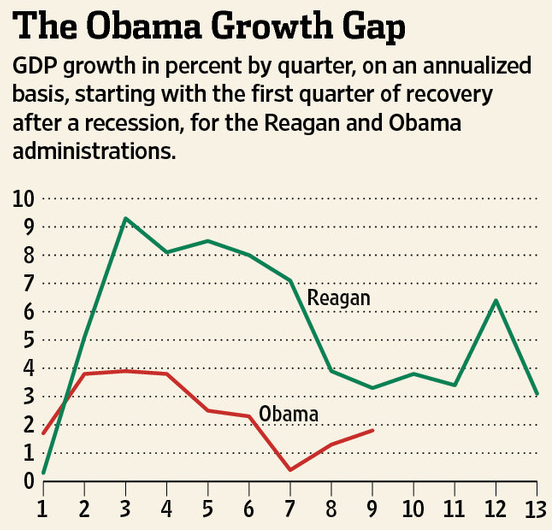
It’s not morning in America. And if the dawn does break on President Obama’s watch, the forecast is for heavy clouds. This graph from today’s Wall Street Journal, comparing economic growth during Reagan and Obama’s first terms, shows why:

ObamaReaganGrowth

January 24th, 2012 at 2:52 pm
The Nub of Romney’s Problem
Posted by Print

Writing today in Politico, Reagan biographer (and now Newt Gingrich chronicler) Craig Shirley gets to the very heart of the difficulty Mitt Romney faces in trying to persuade a Republican electorate desperate for an epochal shift in a party that they (rightly) perceive to have been insufficiently inattentive to limited government:

The former Bain Capital chief is the elitist heir to Rockefeller and the malapropistic heir to Ford and George H. W. Bush. Watching Ford speak extemporaneously was like watching a drunk cross an icy parking lot — and the same can be said for the exuberantly monosyllabic man from Massachusetts…

No one goes around calling themselves a Nixon Republican or a Ford Republican or a Bush Republican. But plenty now proudly call themselves Goldwater Republicans and Reagan Republicans.

One need not share Shirley’s enthusiasm for Gingrich to recognize the sagacity of his diagnosis of Romney. It’s not that conservatives don’t want a manager. It’s just that they want so much more. At this moment in our history — when all sense of principled restrictions on the power of the federal government seem to be eroding — they want someone to draw a line in the sand. Convincing conservative voters that he’s the man for that job is probably beyond Mitt Romney’s ability. To remain a serious candidate, however, he’ll at least have to convince them that he’s not a closet sympathist for their ideological adversaries within the party.

January 23rd, 2012 at 4:35 pm
1,000 Days Without a Budget
Posted by Print

Believe it or not, that’s the remarkable reality we’ll be facing when Barack Obama takes to the podium to deliver his State of the Union address tomorrow night: nearly three years wherein the federal government — the largest distributor of funds on the planet — has operated without a budget. That’s a failure that deserves widespread public attention. Happily, the GOP — which usually can be counted on to bobble these kinds of communications opportunities — is doing a serviceable job of highlighting this ignominious milestone: