This week’s installment of the Liberty Update, CFIF’s weekly e-newsletter, is out. For those readers who haven’t had a chance to read it, below is a summary of its contents:
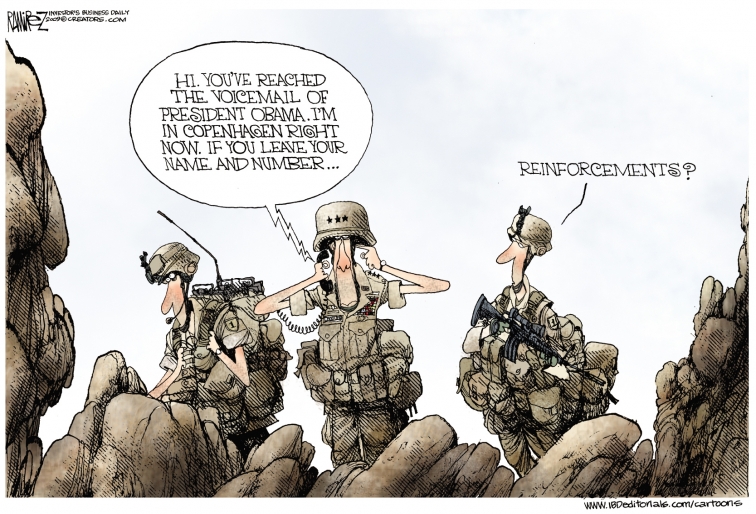
COPENHAGEN — The International Olympic Committee delivered a stunning blow to Chicago’s bid for the 2016 Olympics, knocking it out of the voting in the first round Friday, leaving Rio de Janeiro and Madrid waiting for the announcement which city will host the Games. Tokyo was eliminated in the second round.
I.O.C. president Jacques Rogge made the announcement as the first round concluded, a surprisingly early exit, especially because of President Barack Obama’s whirlwind trip to boost the bid of his adopted city. Mr. Obama was the first American president to make an in-person appeal for a bid city and first lady Michelle Obama had also come earlier this week to lobby I.O.C. members for votes. Chicago’s bid leaders had worked for nearly four years and spent close to $50 million to bring the Olympics to the United States for the first time in 20 years. Chicago had been considered among Olympic insiders as a favorite to win the Games, along with Rio.
Meanwhile, U.S. troops in Afghanistan are still waiting on Obama to make a decision on whether he will send reinforcements, Iran has nuclear weapons, U.S. unemployment hit 9.8% today, the stimulus isn’t working, deficit spending is through the roof, your neighbor just lost his job… do we really need to keep going?
It did not come to our attention until yesterday that it is compulsory for every writer and commentator in America – regardless of more pressing concerns such as the bankruptcy or national security of said country – to publicly express an opinion on Roman Polanski, non-compliance punishable by loss of writing or commentating license, or both.
But what if one’s opinion is unprintable, and one’s solution, involving 13 mastiffs, is unacceptable to contemporary society?
Such a one is left with but a single line: “Forget it, Jake. It’s Chinatown.”
On top of being morally problematic (almost always doing more damage to a nation’s population as a whole than to the government), sanctions rarely achieve anything. The one exception I can think of in recent history was South Africa under apartheid, but that was essentially a western democracy with some illiberal policies — an atmosphere that is going to be more sensitive to economic downturns. Countries like North Korea and Iran don’t have the sense of economic entitlement that makes sanctions so painful in the West, and their undemocratic governments mean that there are only meaningful consequences to the government if the population is roused to revolt.
That being said, however, Barnett misses some key points. He compares Iran to 1970s China and notes that Obama doesn’t have Nixon’s ability to forge a diplomatic breakthrough (Michael Tomasky also entertains this notion in the UK Guardian today). But China was (and is) a conventional great power playing realpolitik games. Their interest was primarily strengthening their place in the international balance of power. But as I mentioned in my piece earlier this week, you can’t understand the regime in Iran without understanding their ideological motivations — something Barnett and Tomasky don’t factor in. That makes the regime in Tehran both more dangerous and less likely to soften than Mao’s China was.
Despite the Senate Finance Committee voting twice this week to reject a government-run public health insurance option, Senate Majority Leader Harry Reid said today on a phone call with constituents:
We are going to have a public option before this bill goes to the president’s desk.”
Recently, the World Trade Organization (WTO) ruled that the European Union has been illegally subsidizing Airbus, a foreign competitor to Boeing.
Last year, the Center for Individual Freedom sounded a note of caution over an Air Force decision to award a new $40 billion air refueling tanker contract to Airbus, and not to Boeing. Now, the WTO’s decision adds fodder to the speculation that the European Union’s subsidies illegally undercut Boeing’s bid for the Air Force contract.
In this week’s Freedom Minute, CFIF’s Renee Giachino discusses the massive tax hike on life-saving medical devices that Senate Democrats wish to pass as part of health care reform legislation.
So insatiable is Washington’s appetite to spend that the federal government has not only spent all the money it has, but all the money previous generations were thought to have saved, and now we’re working our way through the money future generations hope to earn. What our government has done is a crime. And yet, almost no one in Washington – in either party – seems interested in the giant iceberg we’re steaming toward… Not when there are deckchairs to rearrange!”
When we posted commentary this morning regarding the imposition of ginormous new Medicaid mandates on the states if “health care reform” passes, we briefly alluded to Senate Majority Leader Harry Reid, in an attempt to ease his dismal re-election chances, getting 100% reimbursement for Nevada, while sticking other states with their share and part of his also.
Our point was to motivate governors (who well understand the problem) to oppose this travesty.
Manu Raju of politico.com wrote on another aspect of Reid’s sweetheart deal – the grumbling of other Senate Democrats – and the piece is priceless.
Note how the other Democrats oh so seriously want their states to be treated “fairly,” not once acknowledging that they are about to screw all of them, in varying degrees.
Note how Reid uses the argument to make his campaign speech to Nevadans, which seems to say, “I’m going to pass this bill that screws you, but less than others. Don’t you want to keep me?”
Note how none of these worthies recognize how ridiculous they sound.
No one knows our health care system better than doctors. Thankfully, there are several in Congress, including Senator Tom Coburn (R-OK), who understand that a government-run system would lead to rationing and a lower quality of care.
Here is a clip from one of the recent “Senate Doctors Show.”
After our experience at the 9-12 March on Washington, there is a renewed push to turn that event into another way to persuade Congress that more government is not the answer to what troubles our nation.
If you have a message for your Representative or Senator, please send them here, by responding directly to the You Tube video. This is a project of the National Taxpayers Union but the effort is shared by all taxpayers and all Americans concerned with runaway spending.
These messages will be burned onto a DVD and delivered to Congress during the current health care debate. If Congress didn’t get the message during the rally, give it to them one more time.
In the landmark 2008 decision in District ofColumbia v. Heller, the United States Supreme Court at long last affirmed that the Second Amendment protects an individual right of citizens to keep and bear arms. Unfortunately, the decision technically only applied to federal jurisdictions such as Washington, D.C., and set aside the question of whether the 50 states were similarly prohibited from infringing on that critical right.
Through an unjustified quirk of constitutional jurisprudence, courts over the past 150 years have picked and chosen which provisions of the Bill of Rights they consider “fundamental,” and therefore applied against state infringement. Most provisions have received such recognition, and it obviously defies logic to contend that the Second Amendment, which was among the most important in the minds of the Founding Fathers, is somehow “not fundamental.” Despite this, the left has creatively and dishonestly made that very assertion.
Today, however, the Court announced that it will hear the case of McDonald v. City of Chicago. At issue in that case is a Chicago law broadly prohibiting handguns, taxing firearms generally, and various other infringements on the right to keep and bear arms. Accordingly, the Supreme Court now has the opportunity to do the right thing and protect Americans’ Second Amendment rights against the ever-growing menace of government infringement.
In these tough economic times, most American families have been forced to tighten belts and pinch pennies to make ends meet. And with rising deficits and an exploding national debt, we would expect our lawmakers in Washington to do the same when it comes to spending our tax dollars. That is, if Americans didn’t know any better.
Under a House-Senate conference measure, approved by the House last week and poised for passage in the Senate on Wednesday, spending for the legislative branch will increase 5.8 percent this year, boosting Capitol Hill’s annual budget to $4.7 billion.
“The measure includes a hodgepodge of new funding for lawmakers: a $500,000 pilot program for senators to send out postcards about their town hall meetings, $30,000 for receptions for foreign dignitaries and $4 million for consultants…”
The measure also includes a 128% increase in funding for House office buildings and a 155% spending increase for the Government Printing Office’s revolving fund, among other goodies.
In a column published today, CFIF Contributing Editor Troy Senik argues that the Administration’s response to a nuclear Iran must be more definitive.
Below are some highlights of the piece:
The die has yet to be cast, but when the history of the momentous changes that beset Iran (and with it the world) in the early 21st century is written, this may go down as the first time in our history when Americans – who often wait too long to respond to a crisis – failed to react whatsoever.
“Last week, as President Obama gathered with world leaders at a United Nations session in New York, Iran announced the existence of a second nuclear site on its soil, this one’s location obscured deep beneath one of the country’s mountain ranges. For the second time in less than a year, a rogue nation was showing off its weapons capacities as the President held court about the need for a nuclear-free world. The net effect was something like holding a gun control rally in the middle of a gang fight.”
The common refrain in the Senate is that a bill needs 60 votes (3/5 of the Senate) to pass. Otherwise, a dedicated cadre of 41 Senators can continue debate on a bill forever, thus killing its legislative prospects.
However, during a process known as budget reconciliation, the Senate is allowed to pass legislation directly related to taxing and spending with only a majority (51 votes) needed. Thus, as Harry Reid has already pledged, a government-takeover of health care could pass, even with unanimous GOP objection and with several Democratic defectors.
Opponents of a government takeover do have several arrows in their quiver. Under the “Byrd Rule,” a Senator can make a budget point of order and rule that a certain piece of legislation is not germane to the budget reconciliation process. It takes 60 votes to overcome a budget point of order. Thus, any health care bill passed during the reconciliation process would likely emerge from the Senate as a smelly piece of Swiss Cheese, not pie-in-the-sky universal health care.

 CFIF Freedom Line Blog RSS Feed
 CFIF on X
 CFIF on YouTube