Archive

Author Archive
April 23rd, 2026 at 10:45 am
CFIF Thanks Legislative Champions of Certificate of Need (CON) Reform in Tennessee

The Tennessee General Assembly recently passed important legislation to repeal the state’s Certificate of Need (CON) requirements for acute care hospitals and other critical healthcare services. Pending Governor Bill Lee’s signature, the bill paves the way for more choices and better-quality care for patients across the state.

CON laws compel hospitals and other healthcare providers to demonstrate a “need” for and to receive special government permission to build new facilities and offer certain new healthcare services. Not only is that approval process governed by a government board unaccountable to voters, but incumbent providers also get a say in whether new facilities are permitted to open or new services can be offered by competitors in their geographic footprint.

Simply put, CON laws empower a board of unelected government bureaucrats to insulate incumbent healthcare providers from competition and limit access to care for patients.

The detrimental effects of CON laws have been felt across the Volunteer State. According to a recent report by the Beacon Center of Tennessee, which examined the impact of the state’s CON laws over a more than two-decade span from 2000 to 2022, as many as 5.5 million Tennesseans were denied increased access to healthcare services and Tennessee communities lost over $700 million dollars in direct investment as a result of the state’s CON denials during that time period.

Given the sizable negative impact CON laws have, the efforts of numerous legislators from across the state to pass significant reform, including phasing out Tennessee’s CON requirements for acute care hospitals, merits significant praise.

CFIF, therefore, joins countless Tennessee patients, community leaders, healthcare providers and other leaders in expressing appreciation for the General Assembly’s passage of critical CON reform this session. Tennessee patients can now look forward to increased access to the affordable, high-quality care they depend on closer to home.

Specifically, CFIF would like to thank the following members of the Tennessee General Assembly for their thoughtful leadership and many years of hard work on this issue:

  • House Speaker Cameron Sexton (R-Crossville)
  • Senator Bo Watson (R-Hixson)
  • Representative Johnny Garrett (R-Goodlettsville)
  • Senator Rusty Crowe (R-Johnson City)
  • Representative David Hawk (R-Greeneville)
  • Senator Brent Taylor (R-Memphis)
  • Senator Shane Reeves (R-Murfreesboro)
  • Senator John Stevens (R-Huntingdon)
  • Senator Paul Bailey (R-Sparta)
  • Senator Kerry Roberts (R-Springfield)
  • Senator Bobby Harshbarger (R- Kingsport)
  • Representative William Lamberth (R-Portland)
  • Representative Jeremy Faison (R-Cosby)
  • Representative Clark Boyd (R-Lebanon)
  • Representative Mary Littleton (R-Dickson)
  • Representative Esther Helton-Haynes (R-East Brainerd)
  • Representative Ron Travis (R-Dayton)
  • Representative Lowell Russell (R-Vonore)
  • Representative Mike Sparks (R-Smyna)
  • Representative Jay Reedy (R-Erin)
  • Representative Jody Barrett (R-Dickson)
  • Representative Bud Hulsey (R-Kingsport)
  • Representative Tim Rudd (R-Murfreesboro)
  • Representative Sabi Kumar (R-Springfield)
  • Representative Tim Hicks (R-Gray)
  • Representative Jake McCalmon (R-Franklin)
  • Representative John Crawford (R-Bristol/Kingsport)
  • Representative Paul Sherrell (R-Sparta)
  • Representative Rick Eldridge (R-Morristown)
  • Representative Aron Maberry (R-Clarksville)
  • Representative Rebecca Alexander (R-Jonesborough)
  • Representative Justin Lafferty (R-Knoxville)
  • Representative Timothy Hill (R-Blountville)
May 28th, 2025 at 1:05 pm
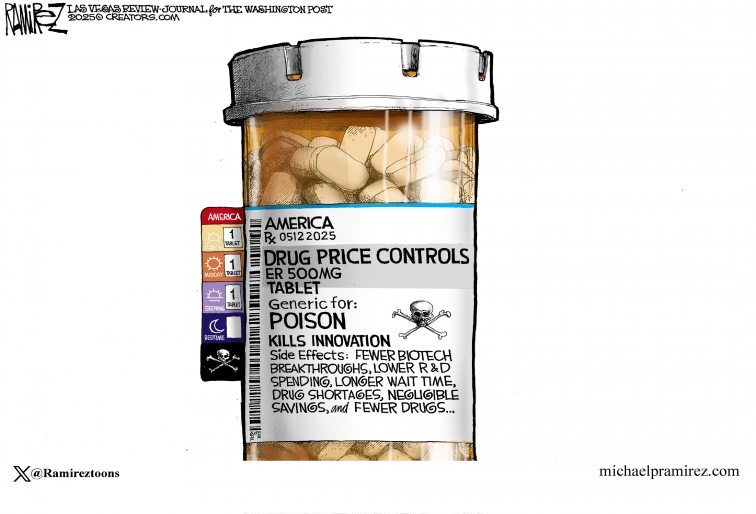
Ramirez Cartoon: Drug Price Control Poison

The history of government price-control policies that seek to impose price ceilings on goods and services is both long and replete with failure. That’s because price controls discourage innovation and investment, and lead to shortages in the marketplace, among other unintended consequences.

No targeted industry is immune from the predictable negative impacts of prices controls – not even prescription drugs, which seem to be a primary target in the price-control crosshairs of policymakers at all levels of government.

In his latest cartoon, two-time Pulitzer Prize winner Michael Ramirez sums up the negative consequences of prescription drug price control policies – whether they take the form of direct price caps, “negotiated” Medicare and other prices, or Most Favored Nation reference pricing that benchmarks prices against those in foreign countries.

The side effects of such poisonous policies? “Fewer biotech breakthroughs, lower R&D spending, longer wait time, drug shortages, negligible savings, and fewer drugs…”

click to enlarge (+)

May 15th, 2023 at 11:14 am
Without Certificate of Need Laws, States Would Have More Hospitals

Last week was National Hospital Week, when we recognized and expressed our gratitude for hospitals, health care facilities and caregivers who provide vital health care services across the nation. National Hospital Week also serves as a reminder that antiquated and burdensome Certificate of Need (CON) laws create government red tape and needlessly empower unelected bureaucrats to limit access to care.

Recently, the Beacon Center of Tennessee released a report showing how, in the last two decades, CON laws have prevented up to 63 new hospitals in Tennessee and deprived Tennessee communities of $733.6 in direct investment. The report also found that Tennessee has seen a 70 percent decrease in applications for new health care facilities and expanded services since 2004 due to the state’s CON laws.

Florida has seen a rapid increase in new hospitals and other healthcare facilities since its Certificate of Need requirements were dropped a couple of years ago.

It’s no wonder that South Carolina in recent weeks repealed its CON laws and Georgia is working to follow suit.

CON laws limit patient access to care and increase health care costs by preventing new health care facilities from opening, particularly in rural communities that desperately need health care infrastructure.

Lawmakers in states where CON laws still exist should recognize the obvious harm they cause and move to fully repeal them.

May 8th, 2023 at 4:31 pm
South Carolina Moves to Repeal Certificate of Need Laws, Tennessee and Others Should Follow

The South Carolina Legislature voted last week to repeal the state’s Certificate of Need (CON) laws. The legislation, which immediately eliminates CON requirements for the majority of health care facilities and establishes a three-year CON “sunset” period for existing hospitals, serves as a massive victory against unelected bureaucrats who have been unnecessarily empowered to block patients’ access to new healthcare facilities and services.

In Tennessee, similar antiquated CON laws continue to stifle the free market, limit access to affordable health care choices and deprive communities across the state of critical jobs and investment. Tennessee’s CON laws require health care providers in the state, even private ones, to receive government permission slips approved by unelected government bureaucrats prior to opening new facilities or offering new health care services.

CFIF has been actively advocating full repeal of Tennessee’s CON laws.

The Beacon Center of Tennessee outlined the devastating impact CON laws have on the state in a report released earlier this year. Over the last twenty years, CON laws have:

  • Cost the state more than 60 additional hospitals – many in underserved or rural areas.
  • Denied 5.5 million Tennesseans increased access to much-needed new health care services.
  • Deprived local communities of $733 million dollars of direct investment.

Florida, a conservative state that prioritizes free-market solutions and medical freedom, has experienced a rapid increase in new health care facilities since repealing its Certificate of Need requirements.

Tennessee should follow its Southern neighbors’ example and eliminate its remaining CON laws during next year’s legislative session. Doing so would remove burdensome and unnecessary government red tape that currently serves as a barrier to new health care choices, restore medical freedoms and increase access to affordable, high-quality health care for Tennesseans across the state.

March 28th, 2023 at 1:09 pm
Steve Forbes: ‘It’s Time to Get Rid of the Biggest CON Job in Healthcare’

Steve Forbes, chairman and editor-in-chief of Forbes, recently released a video calling for citizens and local groups to “demand their legislators get rid of” Certificate of Need (CON) laws. Currently, 35 states and Washington, D.C. still have CON laws on the books.

Forbes outlines the flawed CON approval process that requires special government permission for private health care providers to build new hospitals or expand the services they offer. Additionally, Forbes explains how CON laws disrupt competition in the healthcare market and limit access to care while increasing costs for consumers.

In Tennessee, where CFIF has been actively advocating full repeal of the state’s remaining CON laws, such laws continue to stifle the free market, limit access to health care choices for Tennesseans and deprive communities of critical investment. A recent Beacon Center of Tennessee report found that over the last two decades, the state’s CON laws have cost Tennessee up to 63 hospitals, many of them in underserved rural areas. In total, 5.5 million Tennesseans have been denied increased access to health care services and local communities have lost out on over $700 million dollars in direct investment as a result of the state’s CON laws.

KEY EXCERPTS FROM THE VIDEO:

  • “CONs restrict competition and promote regional and local monopolies, which means higher prices and restricted access to medical care. After all, approval boards are often loaded with personnel tied to existing facilities. It’s like a panel of people from McDonalds passing judgment on an application for a new Wendy’s. To obtain a certificate of need is not cheap, what with unavoidable outlays for lawyers and consultants, not to mention unnecessary time delays.”
  • “CONs are costly. The Kaiser family Foundation found that states with CON laws have higher health care costs than states that don’t. A study from the Mercatus Center at George Mason University confirms that CON states have fewer hospitals, fewer beds and fewer service centers per capita than CON-free states.”

Watch the Video Here

October 6th, 2021 at 10:43 am
Senate Cosponsors of Save Local Business Act Increases Following CFIF-Led Coalition Letter

In a letter sent at the end of August, a coalition of more than two dozen prominent free-market organizations and individuals, led by the Center for Individual Freedom (CFIF), urged Congress to pass the Save Local Business Act (H.R. 3185/S. 1636).

The Save Local Business Act, which is sponsored by Representative James Comer (R-KY) in the U.S. House and Senator Roger Marshall, M.D. (R-KS) in the U.S. Senate, would restore decades of commonsense labor law norms and protect our nation’s employers against a radical redefinition of the nature of employment that creates uncertainty for struggling businesses across the nation and subjects them to unfair and unreasonable legal liability.

Specifically, the legislation would amend the National Labor Relations Act (NLRA) and Fair Labor Standards Act (FLSA) to restore the definition of “Joint Employer” to businesses that “directly, actually, and immediately exercise significant control over the essential terms and conditions of employment.”

Good news! Since the coalition letter was sent, the number of U.S. Senate cosponsors of the Save Local Business Act has increased by eight — bringing the total number of cosponsors to 13.  They include:

Sen. Scott, Tim [R-SC]* 05/13/2021
Sen. Inhofe, James M. [R-OK]* 05/13/2021
Sen. Burr, Richard [R-NC]* 05/13/2021
Sen. Cassidy, Bill [R-LA]* 05/13/2021
Sen. Braun, Mike [R-IN]* 05/13/2021
Sen. Ernst, Joni [R-IA] 09/13/2021
Sen. Rubio, Marco [R-FL] 09/13/2021
Sen. Blackburn, Marsha [R-TN] 09/14/2021
Sen. Cornyn, John [R-TX] 09/20/2021
Sen. Wicker, Roger [R-MS] 09/20/2021
Sen. Lummis, Cynthia [R-WY] 09/23/2021
Sen. Hagerty, Bill [R-TN] 09/30/2021
Sen. Barrasso, John [R-WY] 10/04/2021

If your Senators are no included in the cosponsor list above, please call them today and urge them to cosponsor this important legislation.

Find  the contact information for your Senators here.

Or, call the United States Capitol switchboard at (202) 224-3121. A switchboard operator will connect you directly with your Senators’ offices.

January 26th, 2021 at 5:58 pm
President Biden’s Private Prison Executive Order Is Ill-Considered and Misguided

People should experience before they judge.

I say that in reference to the escalating national debate about private prisons, fueled even more by President Biden’s ill-considered executive action today ordering the Department of Justice not to renew its contracts with private facilities.

I would know, because I took the time to actually visit two private facilities – and could not have been more impressed. As I explained in an op-ed in March, I toured two re-entry facilities and was able to freely interact with staff and residents.

Everyone was filled with mutual respect, with the staff displaying genuine pride in helping residents succeed and providing them with the opportunities and tools to lead successful lives on the outside. Residents spoke with a newfound optimism and hope that they could finally break the cycle of incarceration.

In other words, the supportive atmosphere is the exact opposite of what many might expect, based on the media narrative and extreme rhetoric surrounding this issue.

As such, federal officials should take the time to tour privately managed detention facilities before hastily deciding to ban them. Unless and until that happens, President Biden should reconsider – and reverse – the executive action he signed today.

Any impartial examination of the facts and evidence show that companies such as the GEO Group, which manages private prisons and detention centers, are doing good work. GEO is so focused on providing services and promoting rehabilitation that it actually has a division for it: the Continuum of Care. The company invests $10 million a year into this forward-thinking division, and evidence of its effectiveness is growing.

A GEO study using Illinois Department of Corrections data, for example, shows that prisoners who graduated from a GEO Reentry Service Center re-offended at half the rate of other inmates.

Another critical misconception surrounds mass incarceration, for which many blame private prisons. Yet evidence shows that is simply wrong: only about eight percent of prisoners in the U.S. are held at privately run facilities.

In a recent law review article, Fordham University law professor John F. Pfaff put it plainly. “Mass incarceration is a public sector affair in the United States,” he wrote.

And as it turns out, it’s further unfair to hold private prisons accountable for mass incarceration because the overwhelming majority, if not all, of those housed in federal private prisons are criminal aliens, non-U.S. citizens convicted of federal crimes by courts of law.

They do not house U.S. citizens.

Those who oversee state-run prisons could learn a thing or two from privately contracted facilities and the sound, smart and humane management they offer. President Biden and those around him should take the time, as I did, to learn the facts.

December 4th, 2020 at 11:10 am
Tributes to Bruce Herschensohn (September 10, 1932 – November 30, 2020)

Below are links to tributes from across the web to our friend Bruce Herschensohn, who served on CFIF’s Board of Directors from its inception until his death on November 30, 2020. May he R.I.P.

February 3rd, 2020 at 4:46 pm
President Trump Should Again Reject Socialism, Including HHS’s Drug Price Control Proposal

During his 2019 State of the Union address, President Donald Trump confidently stated, “We will never be a socialist country.”  Today, however, his Department of Health and Human Services (HHS) is pushing an International Pricing Index (IPI) proposal, a socialist policy idea that would peg what Medicare Part B pays for prescription drugs to prices in other developed countries. Simply stated, the IPI proposal would require the U.S. to adopt the price controls of foreign nations that have socialized medicine policies.

Here’s hoping that at this year’s SOTU, President Trump sticks to his guns and continues to reject socialist policies, including HHS’s destructive IPI proposal.

To understand how bad the IPI proposal is, consider this: Its two most vocal proponents in Congress are Speaker of the House Nancy Pelosi and self-proclaimed socialist Senator Bernie Sanders.

Speaker Pelosi’s proposed H.R. 3, among other things, applies the IPI rate-setting model to the U.S. drug market.  It’s noteworthy that the White House Council of Economic Advisors rightly says that, “the threat [H.R. 3] poses to continued medical innovation will harm American patients in ways that far outweigh any benefits.”  That’s because rate setting restricts access to life saving medicines.  For example, in many European counties, patients have to wait about a year, sometimes longer, to access new cancer medicines.  No patient should suffer that risk. In the U.S., in contrast, patients wait an average of only 3 months and have access to a far greater variety of medicines.

The IPI proposal would also diminish U.S. economic leadership in biopharma innovation.  That industry is an economic engine that supports 4 million U.S. jobs and invests billions of dollars in R&D in the United States – roughly $80 billion in 2018 alone.

Simply put, HHS’s misguided IPI proposal amounts to socialized medicine. If President Trump is true to his declaration at last year’s SOTU, he will banish it to the dustbin of history.

December 11th, 2019 at 3:44 pm
CFIF Files Comments in Support of IRS Rulemaking to Protect Donor Privacy
In formal comments filed with the Internal Revenue Service (“IRS”) this week, the Center for Individual Freedom (“CFIF”) offered strong support for the IRS’s proposed rulemaking to eliminate the requirement that certain nonprofit organizations provide the names and addresses of contributors on Schedule B of their annual tax filings.

As CFIF notes in its filing, “the Proposed Rulemaking would help protect the First Amendment rights of subject organizations and their citizen donors, without negatively impacting the legally permissible handling of the nation’s tax laws or 501(c) organization tax filings.”

Read CFIF’s comments here (PDF).

July 15th, 2019 at 12:46 pm
CFIF Applauds the FCC for Acting to Stop the Local Internet Power Grab

More than thirty years ago, Congress gave local governments the power to impose “franchise fees” and other regulations on cable television service. It was part of a broad framework for shared national and local authority over cable television in the 1984 “Cable Act,” which laid the foundation for the cable (and eventually satellite) TV boom of the 1980s and beyond.

By contrast, local governments have very limited power to tax or regulate the internet. Unlike television, which has a long tradition of serving independent local markets with discrete programming, options and infrastructure, from the beginning it’s been clear that the internet is inherently national and interstate and can only be effectively regulated at the federal level. That has been core federal policy for decades, as most recently expressed in the 2017 Restoring Internet Freedom Order, which concluded that, “regulation of broadband Internet access service should be governed principally by a uniform set of federal regulations, rather than by a patchwork that includes separate state and local requirements.”

Recently, however, a number of local franchising authorities have tried to upend that federal policy and claim the right to impose local taxes and regulations on the internet by seizing on the fact that some broadband providers also offer cable television services. Now, the Federal Communications Commission (“FCC”) is rightly working to put a stop to this local government internet power grab – moving to make clear that the Cable Act only allows local franchising boards to tax and regulate cable companies based on their cable television operations.

If every local franchising board in the country can impose its own rules and fees on internet providers, the freewheeling and open internet we all enjoy today will slowly grind to a halt. The resulting cacophony of regulation will overwhelm operators, slowing down cyberspace and making it less reliable and less secure. It will drive away new investment needed to continue to achieve ever-increasing speeds users have come to take for granted. And it will confuse consumers who expect the internet to be a consistent experience everywhere they go.

This is the exact harm federal policy strives to avoid. As the FCC explained, “allowing state or local regulation of broadband internet access service could impair the provision of such service by requiring each ISP to comply with a patchwork of separate and potentially conflicting requirements across all of the different jurisdictions in which it operates.”

For that reason, CFIF encourages the FCC to vote to shut down the local power grab by making clear that neither the Cable Act nor any other source of local regulatory power authorizes franchise boards to tax or regulate the internet or any other non-cable-television businesses.

The future of the internet and our unfettered access depend on it.

Tags: ,
April 4th, 2019 at 10:16 am
CFIF Urges Opposition to the Importation of Foreign Price Controls
ALEXANDRIA, VA — In November of last year, the Center for Individual Freedom (“CFIF”) joined with 57 free-market organizations and individuals on a coalition letter opposing the importation of foreign price controls on prescription drugs, a proposal currently under consideration at the U.S. Department of Health and Human Services (“HHS”).  In a coalition video released last week, several leading free-market voices, including CFIF, spoke out once again against the perils of imposing foreign price controls.

Unfortunately, recently introduced legislation by Senator Rick Scott (R-FL) entirely ignores that overwhelming opposition from conservatives and the free-market community and seeks to import foreign price controls into the U.S.  This legislation, known as the “Transparent Drug Pricing Act” (S.977), would fix U.S. drug prices to the lowest cost of the same drugs sold in five other countries: Canada, France, the United Kingdom, Japan and Germany.

It is CFIF’s strong belief that importing socialist price controls in an effort to lower drug prices is the wrong approach and will reduce access to medicines, kill innovation and harm patients.  Therefore, CFIF urges Senators not to cosponsor or vote in favor of this harmful legislation.

###
September 24th, 2018 at 9:40 am
The FCC Must Move to Stop the Local Internet Power Grab

More than thirty years ago, Congress gave local governments the power to impose “franchise fees” and other regulations on cable television service.  It was part of a broad framework for shared national and local authority over cable television in the 1984 “Cable Act,” which laid the foundation for the cable (and eventually satellite) TV boom of the 1980s and beyond.

By contrast, local governments have very limited power to tax or regulate the internet.  Unlike television, which has a long tradition of serving independent local markets with discrete programming, options, and infrastructure, from the beginning it’s been clear that the internet is inherently national and interstate and can only be effectively regulated at the federal level.  That has been core federal policy for decades, as most recently expressed in the 2017 Restoring Internet Freedom Order, which concluded that, “regulation of broadband Internet access service should be governed principally by a uniform set of federal regulations, rather than by a patchwork that includes separate state and local requirements.”

But recently, a number of local franchising authorities have tried to upend that federal policy and claim the right to impose local taxes and regulations on the internet by seizing on the fact that some broadband providers also offer cable television services.  Now, the Federal Communications Commission (“FCC”) is rightly working to put a stop to this local government internet power grab – moving to make clear that the Cable Act only allows local franchising boards to tax and regulate cable companies based on their cable television operations.

If every local franchising board in the country can impose its own rules and fees on internet providers, the freewheeling and open internet we all enjoy today will slowly grind to a halt.  The resulting cacophony of regulation will overwhelm operators, slowing down cyberspace and making it less reliable and less secure.  It will drive away new investment needed to continue to achieve ever-increasing speeds users have come to take for granted.  And it will confuse consumers who expect the internet to be a consistent experience everywhere they go.

This is the exact harm federal policy strives to avoid.  As the FCC explained, “allowing state or local regulation of broadband internet access service could impair the provision of such service by requiring each ISP to comply with a patchwork of separate and potentially conflicting requirements across all of the different jurisdictions in which it operates.”

For that reason, the FCC’s “Section 621 Proceeding” must move quickly to shut down the local power grab by making clear that neither the Cable Act nor any other source of local regulatory power authorizes franchise boards to tax or regulate the internet or any other non-cable-television businesses.

The future of the internet and our unfettered access depend on it.

July 13th, 2018 at 9:37 am
The Price and Importance of Innovation

America’s pharmaceutical innovators lead the world, saving and improving people’s lives on a daily basis.  But relentless efforts to move toward a single-payer system and impose destructive price controls threaten our continuing progress.

Drug maker Biogen recently announced exciting results of a clinical trial for a new drug to treat Alzheimer’s disease. Yet, despite the promise that this could be a breakthrough that gets us closer to a cure, the medical community and families with loved ones suffering from the disease are holding their collective breath.

Why? Because we’ve been down this road before.

Alzheimer’s is one of the most complex and pernicious medical conditions that we face, with no known cure and an immense emotional and economic toll. Worse, the rate of diagnosis is increasing and estimates suggest the cost of the disease has already surpassed $259 billion.  According to one Alzheimer’s Association spokesperson, it will “bankrupt Medicare.” By 2050, the cost of care for Alzheimer’s patients could exceed $1 trillion annually.

That is a crisis medical professionals are rushing to solve, but progress has been slow. An estimated 99.6 percent of Alzheimer’s drug “candidates” (i.e. experimental drugs designed to treat Alzheimer’s) fail.

In 2018 alone, high profile failures in Phase 3 clinical trials from drug makers like Eli Lilly and Merck represent decades of work and hundreds of millions of dollars in research yielding little to no results. Even Biogen’s announcement, as promising as it is, has only a 50 percent chance of gaining FDA approval, according to analysts.

The issue of high drug prices is real, but too often the public doesn’t understand the immense risk – and cost pharmaceutical companies take on to research and develop new treatments for devastating diseases like Alzheimer’s. While everyone hopes Biogen’s new drug is a success, many drugs – including many recent potential treatments for Alzheimer’s – never make it through the clinical trials to market. What’s worse, the lack of transparency in our health care payment system drives costs up even further.

Drug makers invest hundreds of millions of dollars and more into developing new treatments and cures, with no guarantees their research and development will yield results.  That risk must be protected to ensure the continued motivation to strive for better treatments and new cures.

Efforts to cap prices and leverage government buying power via a single-payer system threaten to curtail research and delay or eliminate future cures. It’s a gamble that the United States cannot make, both for our own health and for future generations.

April 26th, 2018 at 5:51 pm
Help Modernize the U.S. Sugar Program: Text “SUGAR” to 52886

We at CFIF have long sounded the alarm regarding the federal sugar policy morass.

There may be no uglier illustration of the crony capitalism, government meddling in our economy and bureaucratic mandates anywhere within our federal government.  And the program demonstrably ends up costing far more jobs and hurting far more American consumers than it benefits, as we noted in January:

It costs almost three times as many jobs as it claims to protect;  results in American consumers and manufacturers paying double the cost for a product that consumers and industries in other countries pay;  eliminates over 100,000 American manufacturing jobs;  and costs Americans approximately $3 billion per year.

But now there’s something you can do to bring about positive change.  Our friends at the Alliance for Fair Sugar Policy have launched a simple and effective grassroots tool to help generate messages to Congress.

There’s nothing that grabs the attention of Senators and Representatives and drives them to action more than hearing from actual constituents. Accordingly, please take just a short moment to view the image below and take action by simply texting “SUGAR” to 52886.

February 27th, 2018 at 11:06 am
Net Neutrality Déjà Vu
Today, “netroots” activists are holding yet another “Day of Action” to save their version of “net neutrality” (government overregulation via Title II). According to Battle for the Net, the goal of this internet-wide push is to “flood the Senate with messages in support of using the CRA.”  Here’s our question:  How many times are we going to see this issue be turned into political theatre?

The so-called consumer groups involved, along with certain media outlets and Members of Congress, scream every chance they get that the internet as we know it is in serious danger of ceasing to exist unless the Obama-era Title II regulatory stranglehold is restored never mind that the Title II utility-style regulatory scheme, not imposed until 2015, makes the internet weaker, not stronger.

At the end of the day, this entire fight is about how to enforce practical internet policy. With the imposition of Title II, the Obama-Wheeler FCC granted unprecedented government authority and mother-may-I control over the free marketplace, diminishing industry investments in the process.  The current FCC, under Chairman Ajit Pai’s leadership, rightly decided to restore sanity to internet policy, prioritizing free market principles and light-touch regulation the way it was practiced for decades under bipartisan administrations.

The light-touch approach is how the internet thrived and will continue to remain truly free and open. It’s also how to protect America’s position as a global innovation leader.

This latest effort by Senate Democrats to hit the reverse button and go back to the investment-killing Title II scheme via a Congressional Review Act (CRA) vote serves zero legitimate policy purpose. It’s nothing more than a political stunt. After all, if they truly wanted to get serious about cementing the principles of “net neutrality,” they would come to the table and work with Republicans on a sustainable legislative solution, something they have refused time and again to do.

September 27th, 2017 at 12:02 pm
Net Neutrality “Day of Advocacy” – A Reality Check

Today, activist organizations, including Free Press, Public Knowledge and Fight for the Future, plan to descend upon Capitol Hill offices to underscore their disapproval of Federal Communications Commission (FCC) Chairman Ajit Pai’s proposed plan to repeal the Obama Administration’s 2015 “Open Internet Order” classifying Internet Service Providers (ISPs) as public utilities under Title II of the 1934 Communications Act.

In anticipation of their effort, the Center for Individual Freedom teamed up with the Taxpayers Protection Alliance to provide Congress with a “Reality Check” of key messaging and themes to expect from those groups as they visit with lawmakers.

Read the document here.

July 24th, 2017 at 5:57 pm
CFIF Joins Coalition Urging Congressional Reversal of CFPB’s Anti-Arbitration Rule

The Center for Individual Freedom (CFIF) today joined a coalition made up of more than two dozen free-market organizations on a letter urging Congress to use the Congressional Review Act to reverse a new rule by the Consumer Financial Protection Bureau (CFPB) that prevents financial services companies from using arbitration to resolve customer disputes.

“The CFPB’s arbitration rule has been described as ‘Christmas in July’ for America’s trial lawyers – and rightly so,” the coalition stresses in the letter.  “According to the CFPB’s own finding, the rule will cost consumers billions of dollars and unleash over 6,000 class action lawsuits every five years. This rule is an obstacle to the efforts to right America’s fiscal ship and create jobs and prosperity for the American people.”

The letter, which was organized by the Center for Freedom and Prosperity, can be read in its entirety here (PDF).

Read the Center for Freedom and Prosperity’s official press release here.

February 15th, 2017 at 5:21 pm
The Tax Code Isn’t Working for America
There’s perhaps no greater defining mark of American politics today than the polarization that plagues our discourse.  Acrimony has become the default posture of the major political parties and their supporters on even the most mundane issues.

But there is one issue—a major issue—that holds enormous bipartisan potential, despite the political animus:  the need for comprehensive tax reform.  Yes, disagreement naturally exists over some of the details on how to reform the tax code, but few argue against the need and urgency to do so.

The U.S. tax code is almost surreal in its complexity, making it impossible for most people and businesses to prepare their own returns. Roughly 70% of Americans rely on some form of paid assistance with their taxes, and the tax preparation industry is forecast to generate an incredible $11 billion in revenues in 2018. That’s a lot of money that could be better spent in productive ways in the real economy.

Small businesses, in particular, bear the brunt of the tax code’s many problems, creating significant and ongoing drag on our economy.  And all U.S. businesses have to contend with a growth-killing 35% corporate tax rate, the highest among OECD countries.

Today, most businesses’ competitors reside not just next door and down the street, but across the globe.  It’s no wonder why most of America’s global competitors have been cutting corporate tax rates for many years—to make it easier for their businesses to compete in the global marketplace. With its enormous complexity and sky-high rates, the U.S. tax code, meanwhile, actively stifles growth, entrepreneurship, innovation, investment and job creation.

The current tax code is broken. It must be simplified and set fair rates for businesses of every size. Only when this happens will the United States once again be the best place in the world to start and run a business.

The time for tax reform is now!

October 26th, 2016 at 11:59 am
Begrudgingly Celebrating the 30th Anniversary of the Tax Reform Act of 1996
Entrepreneurs and small businesses are being crushed by an outdated, confusing and counter-productive tax code. And businesses aren’t the only ones being squeezed.  The United States has the highest business tax rate in the world, which is costing American families $3,000 per year in spending power.

Yet despite these challenges, last week marked a staggering 30 years since Congress last passed major tax reform.

Working together, the next president and Congress can deliver for America’s taxpayers by simplifying the tax code and setting a fair business rate of no higher than 25 percent within the first 100 days.

It’s time for Congress to get to work!