February 18th, 2016 at 12:57 pm
Ramirez Cartoon: The Hypocrite In Chief
Below is one of the latest cartoons from two-time Pulitzer Prize-winner Michael Ramirez.
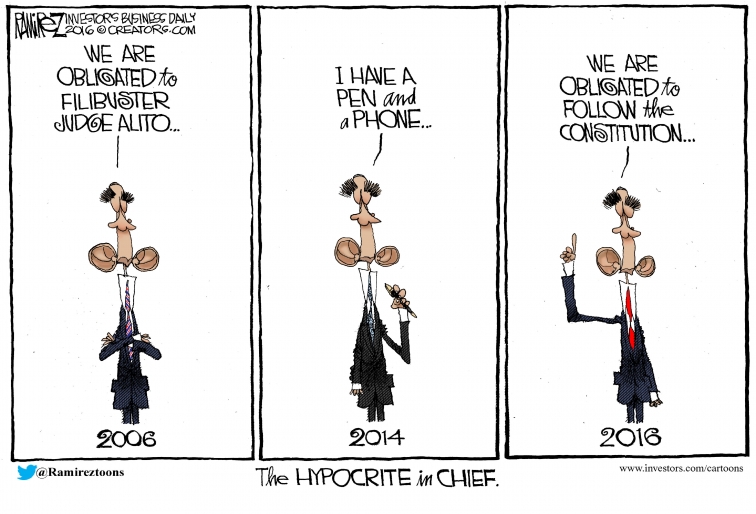
View more of Michael Ramirez’s cartoons on CFIF’s website here.

Below is one of the latest cartoons from two-time Pulitzer Prize-winner Michael Ramirez.
View more of Michael Ramirez’s cartoons on CFIF’s website here.
Following the tragic news of Supreme Court Justice Antonin Scalia’s passing, Senate Majority Leader Mitch McConnell and other Republican lawmakers rightly have been arguing that Scalia’s replacement should be left to the next President.
Predictably, Senator Charles Schumer (D-NY), Harry Reid’s hand-picked replacement to become the Senate Democrat leader following Reid’s retirement in 2016, is crying foul. On ABC’s “This Week,” Schumer bemoaned, “You know, the kind of obstructionism that Mitch McConnell’s talking about, he’s harkening back to his old days.”
But it was Schumer, back in July 2007, who argued in a speech to the American Constitution Society that, except for in extraordinary circumstances, the Senate should block any Supreme Court nominations made by President George W. Bush during his remaining time in office. At the time, Schumer said:
We should reverse the presumption of confirmation. The Supreme Court is dangerously out of balance. We cannot afford to see Justice Stevens replaced by another Roberts, or Justice Ginsburg by another Alito.
Schumer went on to add:
We should not confirm any Bush nominee to the Supreme Court, except in extraordinary circumstances.
For the record, there were 18 months left in George W. Bush’s term when Schumer argued that the Senate block any additional nominees the President may have made to the Supreme Court. The nation is now less than seven months away from electing Obama’s successor.
 In an interview with CFIF, Sarah Westwood, Watchdog Reporter for the Washington Examiner, discusses the controversy surrounding Hillary Clinton’s paid speeches to private groups, what is different about the use of personal e-mail accounts by former Secretaries of State Colin Powell and Condoleezza Rice as compared to Hillary Clinton, and the finger-pointing and mudslinging on the GOP side of the campaign trail.
Listen to the interview here.
Below is one of the latest cartoons from two-time Pulitzer Prize-winner Michael Ramirez.

View more of Michael Ramirez’s cartoons on CFIF’s website here.
Late last year, we posed several questions to Banco Popular President and CEO Richard Carrion, in conjunction with his appearance as a witness during a Congressional hearing on Puerto Rico’s public debt.
Our questions centered mainly upon his recent emergence as a staunch advocate of a unilateral restructuring of Puerto Rico’s debt, a bizarrely anti-lender stance for the head of the Island’s largest bank. Among our questions, we asked how Carrion’s bank had avoided the severe exposure to Puerto Rican debt experienced by the Island’s other lenders and citizens, and why Popular – a private sector leader by any definition – has been so reluctant to align with other private sector actors in negotiating a consensual debt solution between Puerto Rico and its lenders.
Needless to say, we found Carrion’s newfound fondness for complete restructuring puzzling.
A closer look at Popular’s financial disclosures, however, reveals the real reason the bank so proudly advocates in support of a super restructuring: In 2014 and 2015, Popular shed massive amounts of government and public corporation debt that would be subject to a restructuring, enabling it to emerge as an ally for the Garcia Padilla Administration.
In December 2014, Popular was itself a large bondholder, with approximately $337 million of their $811 million (42%) exposure to Puerto Rican debt in public corporations PRASA and PREPA. Its exposure to General Obligation debt was roughly $82 million, or 14% of its holdings.
Fast forward one year. Banco has reduced its exposure to debt that would be subject to a restructuring drastically, now holding only $59 million of public corporation debt (10%) and $23 million (4%) of general obligation debt. The remaining 86% of its exposure is to debt is in the form of loans to municipalities, which are not and never have been part of the restructuring discussion. It has actually increased its exposure to this “safe” municipality debt by about $20 million over the same time span.
In other words, over the last year, Banco Popular has shed exposure to hundreds of millions in debt that would be subject to La Fortaleza’s scheme, while unsuspecting Puerto Ricans held various debts (PFCs, GOs, PREPA) and lost their hard-earned money.
Herein lies the twist: Carrion’s timing was impeccable, but it also raises red flags.
In a recent news report, the Washington Free Beacon notes Carrion’s relationship with Antonio Garcia Padilla, the scandal-plagued brother of the governor who is the lone employee of a suspicious island-based non-profit. That non-profit, of which Carrion is a board member, has received large contributions from Banco Popular and is housed in the bank’s San Juan headquarters. Was Popular given advanced warning of this plan in exchange for that money?
As if that’s not already bad enough, there’s more. Popular’s close relationship with the Garcia Padilla administration continues to pay dividends. Banco stands to generate another $9 million in profit from the government’s recently proposed liquidation of Housing Finance Authority Assets, another windfall for what has already been a profitable financial crisis for the bank.
And what about the rest of the bondholders – those who will be wiped out by an unconstitutional restructuring, and don’t have the luxury of dumping their life savings in exchange for sweetheart deals from the Garcia Padilla administration?
If Popular truly seeks to restructure these debts for the good of Puerto Rico, will it support the same type of unilateral restructuring for other types of loans taken out by regular Puerto Ricans who are Popular customers? Will Popular allow its own clients to restructure their mortgages and car loans and cease and desist from any and all foreclosure processes against these borrowers?
Call us skeptical.
Join CFIF Corporate Counsel and Senior Vice President Renee Giachino today from 4:00 p.m. CST to 6:00 p.m. CST (that’s 5:00 p.m. to 7:00 p.m. EST) on Northwest Florida’s 1330 AM WEBY, as she hosts her radio show, “Your Turn: Meeting Nonsense with Commonsense.” Today’s guest lineup includes:
4:00 CST/5:00 pm EST: Ambassador Terry Miller, Director, Center for Data Analysis and The Center for Trade and Economics and Mark A. Kolokotrones Fellow in Economic Freedom at the Institute for Economic Freedom and Opportunity at The Heritage Foundation – 2016 Index of Economic Freedom;
4:30 CST/5:30 pm EST: Bradley A. Smith, Chairman and Founder of the Center for Competitive Politics and Former Chairman of the Federal Election Commission – 40th Anniversary of Buckley v. Valeo;
5:00 CST/6:00 pm EST: Sarah Westwood, Watchdog Reporter for the Washington Examiner – Recent Stories from the Campaign Trail; and
5:30 CST/6:30 pm EST: Quin Hillyer, Contributing Editor of National Review, a Senior Editor for The American Spectator, and a nationally recognized political expert – New Hampshire Primary.
Listen live on the Internet here. Call in to share your comments or ask questions of today’s guests at (850) 623-1330.
We’re not in the business of demonizing particular private enterprises. But it is our mission to advance the principles of free markets. And few things corrupt contemporary markets more than crony capitalism, the exploitation of government power for private purposes. From eminent domain abuse to kneecapping competing businesses, individuals and groups who favor free markets shouldn’t remain silent when businesses engage in it.
And in the case of Dish Network, we seem to have a serial offender.
In recent weeks, we’ve rightfully criticized Dish’s shenanigans as it relates to the desperately-needed Federal Communications Commission (FCC) spectrum auction.
Unfortunately, that unseemly behavior extends to the realm of marketplace mergers between willing parties. We believe that absent some demonstrable unfair harm or illegality, private businesses should be free to merge, split or otherwise transact as they see fit without governmental meddling. Regulators and disagreeable parties should have to carry a burden of proof in establishing such illegality or unfair harm before telling mutually-bargaining parties what they and cannot do.
Dish Network, however, appears to believe that it should be free to engage in merger activity when it sees fit, but others should not enjoy the same freedom when that doesn’t serve Dish’s perceived interest.
Perhaps the most prominent immediate example is Dish’s opposition to the proposed merger between Time-Warner Cable and Charter Communications, where it has gone so far as to petition the FCC to block the agreement. That maneuver parallels its previous opposition to the Time-Warner/Comcast merger, which CFIF supported in the face of needless federal meddling. Dish also considered it appropriate to oppose the AT&T/DirecTV merger.
But note something peculiar. Several years prior, Dish itself sought to merge with DirecTV. Similarly, Dish sought to merge with T-Mobile back in 2015, and in 2013 it asked the FCC to refrain from interfering with the Sprint/Softbank Stake merger, because its own desire to acquire Clearwire depended upon that particular merger going forward. And in 2011, Dish sought a $2 billion purchase of Hulu, despite maligning the same company less than one year earlier.
Again, we hold no particular animosity toward Dish as an entity, and no opinion regarding the quality of its service. But we do have a problem with a company inserting itself into merger negotiations between third parties, characterizing mergers as harmful to the marketplace and imploring regulators to interfere with other parties’ private interactions, only to turn around and seek the very same types of mergers when it anticipates some individualized benefit.
That is the definition of crony capitalism, and it should be opposed by government officials and American citizens alike.
Below is one of the latest cartoons from two-time Pulitzer Prize-winner Michael Ramirez.

View more of Michael Ramirez’s cartoons on CFIF’s website here.
 In an interview with CFIF, David Barnes, Policy Director of Generation Opportunity, discusses the challenges Millennials face, real solutions to be considered, and his recent TIME op-ed, “Obama’s Optimism Isn’t Shared by Millennials.”
Listen to the interview here.
In this installment of the Freedom Minute, the Center for Individual Freedom’s (“CFIF”) Renee Giachino discusses our nation’s growing epidemic of frivolous patent litigation by illegitimate parties who hope to score “jackpot jury” verdicts or simply frighten legitimate patent holders into costly out-of-court settlements to avoid catastrophic litigation costs, and the bipartisan effort in Washington, DC, to help address the problem.
 In an interview with the Center for Individual Freedom, William Yeatman, Senior Fellow at the Competitive Enterprise Institute, discusses the EPA’s Clean Power Plan overreach and why the Model FIP is a cap-and-trade policy and thereby raises concerns under the Tenth Amendment of the U.S. Constitution.
Listen to the interview here.
Below is one of the latest cartoons from two-time Pulitzer Prize-winner Michael Ramirez.

View more of Michael Ramirez’s cartoons on CFIF’s website here.
CFIF has long advocated auction of over-the-air television stations’ airwaves – or spectrum – by the Federal Communications Commission (FCC), which offers a critical free-market opportunity for the wireless telecommunications industry to avoid looming network congestion issues. It’s one of those rare potential win/win opportunities as Americans increasingly rely on mobile devices, and it constitutes the core mission of what the FCC should rightfully be doing with its resources.
While strongly favoring spectrum auction, however, we’ve also consistently opposed crony capitalist efforts to game the system and corrupt this promising opportunity. Just last week, for example, we highlighted our distaste for Dish Network’s scheme to exploit “small business” discounts for its own benefit.
Unfortunately, we may be witnessing another attempt at exploitation of the spectrum auction process. Namely, television broadcasters offering spectrum in the upcoming incentive auction may possess the ability to sell it twice, as reported by Broadcasting & Cable’s Washington Bureau Chief John Eggerton:
According to a source familiar with their thinking, some ‘major’ broadcasters are looking at putting spectrum in the pot and, if they win, taking advantage of tax laws to keep that money in escrow and use more cash, or a loan, to bid on some of that reclaimed broadcast spectrum in the forward auction – they would need to use other money since reverse payments won’t be available until both sides of the auction close. They could then sell or lease the spectrum to wireless carriers hungry for it.”
What would make such attempts particularly galling is that the broadcasters originally received that spectrum free of charge, so they’d be selling twice something they didn’t pay for even once.
FCC auction of spectrum for more productive use is to be applauded, and was a long time in coming. But please, let’s keep it free of attempts at unjust enrichment via exploitation of byzantine regulatory mechanisms.
 In an interview with CFIF, Ted Frank, Senior Attorney and Director of the Center for Class Action Fairness at the Competitive Enterprise Institute, discusses unfair class action procedures and settlements and the petition for certiorari before the US Supreme Court in Frank v. Poertner.
Join CFIF Corporate Counsel and Senior Vice President Renee Giachino today from 4:00 p.m. CST to 6:00 p.m. CST (that’s 5:00 p.m. to 7:00 p.m. EST) on Northwest Florida’s 1330 AM WEBY, as she hosts her radio show, “Your Turn: Meeting Nonsense with Commonsense.” Today’s guest lineup includes:
4:00 CST/5:00 pm EST: Derek Scissors: Resident Scholar at the American Enterprise Institute – The Real Reason Behind the Dramatic Fall in China’s Stock Prices;
4:20 CST/5:20 pm EST: William Yeatman: Competitive Enterprise Institute’s Senior Fellow in Environmental Policy and Energy Markets – EPA’s Clean Power Plan;
4:30 CST/5:30 pm EST: David Barnes, Policy Director of Generation Opportunity – Millennials and the American Dream;
5:00 CST/6:00 pm EST: Sarah Westwood, Watchdog Reporter for the Washington Examiner – Recent Stories from the Campaign Trail; and
5:30 CST/6:30 pm EST: Timothy Lee, CFIF’s Senior Vice President for Legal and Public Affairs – IP Rights and Patent Litigation Reform and Internet Access Taxes.
Listen live on the Internet here. Call in to share your comments or ask questions of today’s guests at (850) 623-1330
In a letter to Senate Majority Leader Mitch McConnell and Senate Minority Leader Harry Reid, the Center for Individual Freedom (“CFIF”) today joined a coalition of more than 40 other organizations representing tens of millions of consumers from across the nation to urge support of a permanent extension of the Internet Tax Freedom Act currently embedded in H.R. 644, the Trade Facilitation and Trade Enforcement Act.
“In the 17 years since Congress first passed a ban on Internet access taxes, the Internet has evolved from a luxury into a necessity of modern life. ITFA helped to spark this revolution,” the letter states. “Without ITFA, it is likely that Internet services would be taxed at the high rates of tax imposed on traditional telecommunications services, which often are more than double the rate of tax imposed on other goods and services.”
The letter concludes by urging the U.S. Senate “to act swiftly and decisively to pass a permanent extension of ITFA.”
To read the letter in its entirety, click here (.pdf).
To read the coalition press release, click here.
Below is one of the latest cartoons from two-time Pulitzer Prize-winner Michael Ramirez.

View more of Michael Ramirez’s cartoons on CFIF’s website here.
In a recent Daily Caller piece entitled “Patents Are Private Property, Too,” Eagle Forum adviser James Edwards throughout most of his column marshals a strong defense of America’s intellectual property (IP) rights system.
Unfortunately, in his final two paragraphs he needlessly and erroneously detours into alleging that patent litigation reform efforts before Congress somehow undermine IP protections. The truth is precisely the opposite. Patent litigation reform and IP rights are complementary, not contradictory.
CFIF takes a backseat to no organization in defending IP rights, and Edwards rightly highlights how America’s strong IP system provides the foundation upon which we became and remain the most innovative and prosperous nation in human history. He correctly notes that our Founding Fathers considered IP a natural right no different than physical property, and how they accordingly specifically protected them in the text of the Constitution. As Abraham Lincoln later observed, “The patent system added the fuel of interest to the fire of genius.”
And as we have noted repeatedly, it is not by coincidence that America maintains the world’s strongest IP protections while also standing unrivaled as the most inventive, powerful, prosperous and influential nation in history. That relationship is causal.
Unfortunately, in his final two paragraphs Edwards veers regrettably astray. Specifically, he claims that patent litigation reform legislation currently under Congressional consideration would somehow undermine patent rights and “make it much more difficult and riskier to defend one’s patent against infringers.”
Respectfully, that is flatly false.
Patent litigation reform legislation, which passed the House two years ago with an overwhelming 325-to-91 majority, addresses how patent disputes are litigated, not patent rights themselves.
Under current law, as most people know, overly litigious actors can file frivolous lawsuits or baselessly defend against valid claims because it’s highly unlikely under our current system that they’ll be forced to pay the other side’s attorney fees and litigation costs when they ultimately lose. That’s because American law generally requires each side to pay its own costs and fees, even if the other side’s claim was weak. As a litigating attorney who defended against innumerable frivolous claims in my legal career, I can confirm firsthand that winning an award of costs and fees from even the most egregious litigants is exceedingly and unfortunately rare. Accordingly, bad actors often use our court system to extract improper settlements or frighten legitimate patent holders from defending their rights due to the prospective time and costs of litigation.
That’s where patent litigation reform comes in.
The Innovation Act, the bill that CFIF most strongly supports, targets abuse of our court system by: (1) Holding losing parties accountable for prevailing parties’ attorney fees and costs unless they can demonstrate that their “position and conduct … were reasonably justified in law and fact, or that special circumstances (such as severe economic hardship to a named inventor) make an award unjust”; (2) Reforming pleading standards to require greater clarity and justification for their case, rather than relying on vague and unintelligible boilerplate allegations; (3) Increasing transparency regarding the true owners of disputed patents; and (4) Streamlining the burdensome discovery process, which too often imposes oppressive burdens and delays resolution of cases.
Those are manifestly common-sense litigation reforms that all Americans, particularly conservatives and libertarians who broadly favor reform of America’s flawed system of litigation, should support.
CFIF simply would not support any bill that undermined America’s patent or other IP protections. The simple fact is that patent litigation reform would protect legitimate patent holders, and the only people with anything to fear are those who cannot demonstrate that their claims are based upon good faith and valid law – which is not difficult for legitimate litigants to show. We therefore encourage all of our supporters and activists across the country to contact their elected representatives in Congress to voice their support for badly-needed patent litigation reform legislation.
 In an interview with CFIF, Cam Edwards, host of NRA News’ Cam & Co., discusses President Obama’s proposed executive action on gun control, how the president’s stated belief in the Second Amendment is inconsistent with his executive action, and why the executive actions will do nothing to stop violent crime.
Listen to the interview here.
 CFIF Freedom Line Blog RSS Feed CFIF Freedom Line Blog RSS Feed CFIF on X CFIF on X CFIF on YouTube CFIF on YouTube |
