December 4th, 2015 at 5:10 pm
ObamaNet in Court Again: Positive Early Signs from Today’s Oral Argument
Posted by Print

Today, the D.C. Circuit Court of Appeals, commonly known as the nation’s second-highest court, heard oral argument on the latest attempt by the Obama Administration to regulate Internet service.  On two previous occasions, the same court rejected the administration’s efforts, so now we’re at Round Three.  Lawrence Spiwak of the Phoenix Center offers a helpful summary of today’s hearing, and while it’s impossible to predict the ultimate outcome, early signs are encouraging:

While it is difficult to make accurate prognostications about how a court will ultimately rule based on the questions raised at oral argument, several key points dominated the discussion:

As an initial matter, Judge Tatel clearly took umbrage with the FCC’s rejection of the roadmap under Section 706 the DC Circuit set forth in Verizon v FCC (and initially adopted by the Commission in its May 2014 Notice of Proposed Rulemaking) as the result of direct pressure from the White House. As Judge Tatel observed, given such a short time frame, the Commission’s radical departure ‘could not have been changed facts.’

Notwithstanding this displeasure, the panel generally agreed that they are governed by the Supreme Court’s holding in Brand X which emphasizes a focus on how customers perceive the offer of service provided. However, as the court also recognized that the FCC has great latitude the interpret this offer for purposes of regulatory classification, predicting whether or not the court overturns the FCC on wireline reclassification is a close call.

That said, the court appeared skeptical of the FCC’s reclassification of wireless broadband as a Title II common carrier service due to FCC’s gerrymandering of the definition of the term ‘public switched telephone network.’ Moreover, the court seemed concerned over the lack of public notice of the legal theory the Commission used to reclassify mobile broadband. As such, there is a better chance of the court overturning FCC on this issue.

Finally, as assuming the court upholds the FCC’s decision to reclassify broadband as a Title II common carrier service, the court did not appear convinced that the FCC’s application of Title II was entirely legitimate. In particular, a good part of the oral argument focused heavily on the fact that the FCC — in apparent response to last minute lobbying by edge providers to counter the analysis made in our law law review Tariffing Internet Termination: Pricing Implications of Classifying Broadband as a Title II Telecommunications Service — included ‘terminating access’ (i.e., the relationship between edge providers and BSPs) into ‘broadband Internet access service’ (‘BIAS’), even though they are distinctly different products serving entirely different markets.”

Hopefully, the judicial branch will once again reject this administration’s lawless and destructive overreach, and the light-touch federal regulatory approach to Internet service that existed through both the Clinton and Bush administrations will continue.


December 4th, 2015 at 9:44 am
ObamaCare Meltdown, Cont’d: Health Spending Rises Most Since 2007
Posted by Print

When even The New York Times issues lamentations as the consequences of ObamaCare become more clear, it’s obvious that things aren’t going well:

Health spending grew faster than the economy in 2014, and the federal share of health spending grew even faster, as major provisions of the Affordable Care Act took effect.  Total spending on health care increased 5.3 percent last year, the biggest jump since 2007, and accounted for 17.5 percent of the nation’s economic output, up from 17.3 percent in 2013, the Department of Health and Human Services said in its annual report on spending trends.”

But not to worry.  The Obama Administration assures us that things are fine:

The spending report comes as the Obama administration is already on the defensive over rising premiums and deductibles on insurance policies sold through the health law’s exchanges.  Last month, United Health Group, one of the nation’s largest health insurance companies, significantly lowered its profit estimates and blamed the federal health care law.  Obama Administration officials said Wednesday that the rise in health spending last year did not undermine their conviction that the Affordable Care Act had been a boon for the nation.”

Of course, this is the same administration that assured us just hours before the Paris terrorist attacks that ISIS is contained, not to mention that “if you like your doctor, you can keep your doctor, period.”  Per Nancy Pelosi’s claim, we’re finding out what’s in ObamaCare, and the only question is whether this or the Iran nuclear accord – which we’re now told Iran didn’t even sign – will prove the worse of Obama’s two signature “achievements” as time progresses.


December 4th, 2015 at 8:07 am
Video: Obama’s Dereliction of Duty
Posted by Print

In this edition of the Freedom Minute, CFIF’s Renee Giachino discusses President Obama’s handling of the growing threat from ISIS and how ensuring America’s national security must come first, before acting on any humanitarian impulse to help the true victims of the chaos in Syria.


December 1st, 2015 at 1:44 pm
Puerto Rico Should Work With Stakeholders to Reach Consensual Solution to Debt Crisis
Posted by Print

At today’s hearing, Richard Carrion testified that as a professional banker, he was “extremely reluctant” to testify in favor of debt restructuring.  Yet Carrion has given no weight to promising proposals put forth by the private sector, preferring instead to trumpet the agenda of his friend Governor Garcia Padilla.  As demonstrated by today’s bond payment, the Puerto Rican government has the means to meet its obligations, and should work with stakeholders to reach a consensual solution.


December 1st, 2015 at 10:43 am
Puerto Rico Debt Crisis: Richard Carrion Is a Problematic Witness Sitting Alongside Governor Garcia Padilla
Posted by Print

At today’s Senate Judiciary Committee hearing on Puerto Rico’s fiscal situation, Governor Alejandro Garcia Padilla will likely face tough questioning from Senators displeased with his handling of the island’s economy.  Sitting alongside Gov. Garcia Padilla to face those questions will be a close friend from the Commonwealth’s financial sector:  Banco Popular Chairman and CEO Richard Carrion.

Carrion, whose bank is no stranger to asking for federal assistance – it received almost $1 billion in TARP funding from the Treasury (which it did not repay until July 2014) – is a longtime Garcia Padilla supporter who continues to maintain a close relationship with the Puerto Rican government.  Additionally, Banco Popular’s General Counsel Javier Ferrer is the former GDB President under Gov. Garcia Padilla, and longer-tenured lawmakers will also be familiar with the bank’s previously cozy relationship with Representative Luis Gutierrez, who lobbied for that TARP funding for the bank in 2008.

The island’s largest lender holds unmatched influence over the Island’s financial sector, controlling over 40% of the Commonwealth’s credit market.  It has also benefited from Puerto Rico’s debt crisis by collecting underwriting fees on large swaths of the public debt and acting in a fiduciary capacity for many debt issuers.

At today’s hearing, we therefore urge Senators to consider the motivations behind Carrion’s testimony.

Over the years, Banco Popular stands as the biggest beneficiary of Puerto Rico’s debt crisis, collecting fees to underwrite huge swaths of Puerto Rican debt.  Since 2008, Banco Popular’s subsidiary, Popular Securities, has been involved in the underwriting of over $56 billion in Puerto Rican bond offerings, mostly for the Puerto Rican government.  In that capacity, Popular has had a direct hand in the issuance of billions of dollars of debt to investors on the island and mainland, including to small investors, pensions, and mutual funds.  As underwriter, Popular has performed due diligence on every bond offering in which it has been involved.  Yet in advocating for a complete restructuring of Puerto Rico’s debts, Popular is now asking to restructure the very same bonds it recommended to regular investors saving for retirement after having passed judgment on their suitability for such investors.

In addition to fees collected as underwriter, Popular also acts in a fiduciary capacity for several bond issuers, serving as paying agent, escrow agent, and trustee.  These issuers include institutions with deep ties to Gov. Garcia Padilla’s administration, including the Government Development Bank, COFINA, the University of Puerto Rico, and the recently defaulted Public Finance Corporation among others.

Despite having already profited handsomely on the debt crisis that it has helped to create, Popular is now advocating for a complete restructuring of the government’s public debts.  At first glance, it seems strange that a large lending institution like Popular would take such an anti-lender stance on Puerto Rico’s debt, especially given that it helped to issue so much of it.  Through an agreement with JP Morgan, and previously Morgan Stanley, however, Popular is only exposed to a small fraction of the underwriting exposure for any offering made to mainland US investors.  Further, most of Popular’s outstanding exposure to Puerto Rico debt is to several of the Island’s 78 municipalities, which has never been part of a restructuring proposal.  Their direct exposure to debt that would be subject to a restructuring is minimal.

Even after a total debt restructuring, Popular would no doubt choose to continue its practice of selling  loans made to struggling, regular Puerto Ricans to mainland institutional investors and hedge funds at steep discounts, who in turn seek 100% repayment from the borrowers.  To be clear, Popular has long engaged in these dealings with Wall Street, having already unloaded over $1.75 billion in loans to institutional investors which are in varying states of foreclosure.

All of this suggests a self-serving agenda.  While it carries minimal direct exposure to the debts that it seeks to restructure, Popular stands to profit handsomely on the backs of regular Puerto Ricans by continuing to sell their loans to Wall Street firms when they cannot pay their debts.

It triggers the question, then, that if Popular truly seeks to restructure these debts for the good of Puerto Rico, will it support the same type of unilateral restructuring for other types of loans taken out by regular Puerto Ricans who are Popular customers?  Will Popular allow its own clients to restructure their mortgages and car loans and cease and desist from any and all foreclosure processes against these borrowers?  Or will it reap the financial benefits of the crisis that it is creating for Puerto Rican borrowers?

In addition to those questions, here are some others that Senators would be wise to ask of Carrion:

  • What is your relationship, personally and professionally, with Gov. Garcia Padilla, his administration and his family?
  • How is it that your bank, the largest in Puerto Rico, has avoided the exposure to public securities experienced by other banks?
  • As a recipient of a large federal bailout resulting from poor lending practices, what qualifies you to advise on the best path forward for Puerto Rico’s recovery?
  • As a private sector leader, why are you not working with other members of the private sector to reach a consensual solution?
  • If you are willing to advocate for massive debt forgiveness to the Puerto Rican government, are you willing to provide similar debt forgiveness to regular Puerto Ricans that struggle to make loan payments to your bank?

Considering that the biggest beneficiary of the Puerto Rico debt crisis now calls for “Super Chapter 9” bankruptcy and broad restructuring powers, those are all reasonable questions.


November 30th, 2015 at 3:56 pm
“Contained?” ISIS Captures First City Beyond Iraq or Syria
Posted by Print

Just hours prior to the terrorist massacre in Paris, Barack Obama foolishly claimed that ISIS was “contained.”  This morning, we awoke to more bad news, and additional refutation of Obama’s assertion.  Namely, ISIS has now captured Sirte, Libya, meaning that it now controls its first city beyond Syria or Iraq:

Even as foreign powers step up pressure against Islamic State in Syria and Iraq, the militant group has expanded in Libya and established a new base close to Europe where it can generate oil revenue and plot terror attacks.  Since announcing its presence in February in Sirte, the city on Libya’s Mediterranean coast has become the first that the militant group governs outside of Syria and Iraq.”

So much for “containment.” What has become undeniably clear is that Obama’s foreign policy generally, and anti-terrorism leadership specifically, are failures.  Fortunately, there will be a new Commander in Chief in just a few months.  But unfortunately, there’s a lot more damage that he can do before then.  The key for the American electorate is to choose a replacement who will bring improvement.

Tags: , ,

November 30th, 2015 at 8:12 am
The Expanding Threat Posed by ISIS
Posted by Print

In an interview with CFIF, James Phillips, Senior Research Fellow for Middle Eastern Affairs at the Douglas and Sarah Allison Center for Foreign Policy Studies at The Heritage Foundation, discusses how the Paris terrorist attacks underscore the expanding threat posed by ISIS, the evolving ISIS strategy, forming a U.S. response to ISIS and what it means for Russia to “have skin in the game.”
Listen to the interview here.


November 27th, 2015 at 2:23 pm
Wising Up to the ‘Black Friday Con’
Posted by Print

Black Friday is upon us, and — in keeping with tradition — so are the attendant brawls, melees, assaults, thefts and general mayhem.

Nevertheless, Black Friday appears a bit more sedate this year overall. Reuters reports:

Bargain hunters found relatively little competition compared with previous years. Some had already shopped Thursday evening, reflecting a new normal of U.S. holiday shopping, where stores open up with deals on Thanksgiving itself, rather than waiting until Black Friday.

Retailers “have taken the sense of urgency out for consumers by spreading their promotions throughout the year and what we are seeing is a result of that,” said Jeff Simpson, director of the retail practice at Deloitte. Traffic in stores was light on Friday, while Thursday missed his expectations, he said.

As much as 20 percent of holiday shopping is expected to be done over the Thanksgiving weekend this year, analysts said. But the four days are not considered a strong indicator for the entire season. A slow start last year led to deeper promotions and a shopping rush in the final ten days of December.

Steve Bratspies, chief merchandising officer, Wal-Mart Stores Inc , told Reuters he was not surprised that a store would see thinner crowds on Friday after it kicked off Black Friday deals on Thursday night.

Suntrust Robinson Humphrey analysts were more blunt, calling Thursday a “bust”. “Members of our team who went to the malls first had no problem finding parking or navigating stores,” he wrote in a note.

My Manhattan Institute colleague Nicole Gelinas anticipated this turn in her New York Post column earlier this week. The crux: consumers are a lot smarter about bargain-hunting than retailers think. She writes:

Last year, Thanksgiving weekend sales dropped by double digits.

It’s important to remember here: This is good news. People aren’t as stupid as retailers think they are. They saw the artificially created stampedes for a piece of plastic that their kids will have broken or forgotten about in a few weeks anyway — and they said no.

Plus, retailers’ fake-emergency marketing has worked against them. People can see that stuff is already on sale — and that it will be on sale next week, the week after and, of course, after Christmas. There is no rush.

People are also smarter than their own government. For the past seven years, Washington has kept interest rates at record lows in the hopes that people would go out and borrow and spend again. They haven’t.

People knew, in 2007 and 2008, that they had taken on way too much debt.

Since then, they’ve been trying to fix that — and in doing so, have been helping us strengthen our economy. Americans’ household debt peaked in 2007, at about $16.2 trillion in today’s dollars. Today, it’s barely above $14 trillion.

Black Friday is unlikely to go away altogether — it’s hard to remember now, but 15 years ago, most retailers’ idea of opening early the day after Thanksgiving meant 7:00 a.m. — but a little more sanity and fewer doorbuster donnybrooks would be a welcome turn of events.


November 24th, 2015 at 4:57 pm
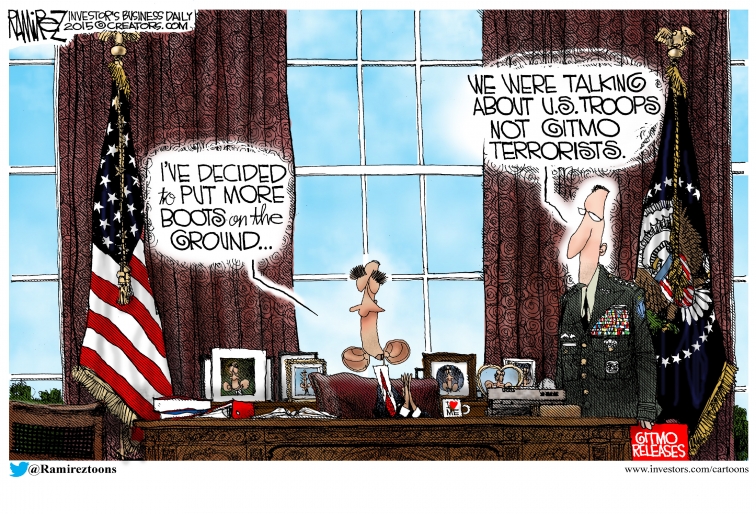
Ramirez Cartoon: Boots on the Ground
Posted by Print

Below is one of the latest cartoons from two-time Pulitzer Prize-winner Michael Ramirez.

View more of Michael Ramirez’s cartoons on CFIF’s website here.


November 23rd, 2015 at 3:17 pm
This Week’s “Your Turn” Radio Show Lineup
Posted by Print

Join CFIF Corporate Counsel and Senior Vice President Renee Giachino today from 4:00 p.m. CDT to 6:00 p.m. CDT (that’s 5:00 p.m. to 7:00 p.m. EDT) on Northwest Florida’s 1330 AM WEBY, as she hosts her radio show, “Your Turn: Meeting Nonsense with Commonsense.”  Today’s guest lineup includes:

4:00 CDT/5:00 pm EDT:  Craig Shirley, New York Times bestselling author and president of Shirley & Bannister Public Affairs: “Last Act: The Final Years and Emerging Legacy of Ronald Reagan”;

4:30 CDT/5:30 pm EDT:  Tod Lindberg, research fellow at Stanford University’s Hoover Institution and bestselling author: “The Heroic Heart: Greatness Ancient and Modern”;

4:45 CDT/5:45 pm EDT:  David Adesnik, Policy Director at the Foreign Policy Institute: The State of the Global Islamist Terror Movement;

5:00 CDT/6:00 pm EDT:  James Philips, Senior Research Fellow for Middle Eastern Affairs at The Heritage Foundation: The Expanding Threat Posted by ISIS; and

5:30 CDT/6:30 pm EDT:  Dan Epstein, Executive Director of Cause of Action: The Latest Progressive Attack on Speech.

Listen live on the Internet here. Call in to share your comments or ask questions of today’s guests at (850) 623-1330.


November 20th, 2015 at 9:55 am
In Other News, ObamaCare Is Now a Slow-Motion Disaster
Posted by Print

As ObamaCare enters the real world and departs Barack Obama’s “If you like your doctor, you can keep your doctor” fantasy world, it is already proving a slow-motion disaster for Americans.  This week, The Wall Street Journal featured a front-page article entitled “Rising Rates Pose Challenge for Health Law,” and the news is grim:

Insurers have raised premiums steeply for the most popular plans at the same time they have boosted out-of-pocket costs such as deductibles, copays and coinsurance in many of their offerings.  The companies attribute the moves in part to the high cost of some customers they are gaining under the law, which doesn’t allow them to bar clients with existing health conditions.  The result is that many people can’t avoid paying more for insurance in 2016 simply by shopping around – and those who try risk landing in a plan with fewer doctors and skimpier coverage.”

The report proceeds to describe the magnitude with greater specificity, and it is astonishing:

Premiums for individual plans offered by the dominant local insurers are rising almost everywhere for 2016, typically by double-digit percentage increases, according to a Wall Street Journal analysis of plan data in 34 states where the Healthcare.gov site sells insurance.  More than half of the midrange ‘silver’ plans are boosting the out-of-pocket costs enrollees must pay, while more than 80% of the less-expensive ‘bronze’ plans are doing so.”

Meanwhile, a new Gallup survey released this week shows that the percentage of Americans rating their healthcare quality as excellent or good has plummeted from 62% in 2010 when ObamaCare was enacted to 53% now.  The survey also reveals that the percentage who are satisfied with healthcare costs has actually declined from 26% in 2009 to 21% today.

As experience with ObamaCare increases with implementation, the situation promises to get worse by the day.  Obama, Harry Reid and Nancy Pelosi passed, now we’re staring at the reality of what was in it.


November 17th, 2015 at 9:30 pm
“President Obama’s Cynical Refugee Ploy”
Posted by Print

To understand the Syrian refugee crisis, Walter Russell Mead’s analysis in The American Interest is a must read and then must read again.  Mead is not a politician; he’s a Professor of Foreign Affairs and Humanities at Bard College and Professor of American foreign policy at Yale University.
 
He asks and answers, in no uncertain terms, “Why is there a Syrian refugee crisis in the first place?”

Read the piece here.


November 17th, 2015 at 9:47 am
Poll: Just 15% of Military Personnel Hold Favorable Opinion of Hillary Clinton
Posted by Print

Year after year, the public rates the U.S. military the most trusted and popular institution in American life.  Now, at a moment in which the military may play an increasingly vital role in protecting us against growing terrorist threats and and increasingly restive antagonists like Russia and China, a new poll reveals that Hillary Clinton’s standing among military personnel can only be described as atrocious:

Hillary Clinton is still in line to win the Democratic Party’s nomination to be the next commander in chief, but few Americans in the military have a good impression of her.  A new Rally Point/Rasmussen Reports national survey of active and retired military personnel finds that only 15% have a favorable impression of Clinton, with just three percent (3%) who view the former Secretary of State very favorably. Clinton is seen unfavorably by 81%, including 69% who share a very unfavorable impression of her.”

For someone applying for the job of Commander in Chief, that is an ominous sign, and one that may receive increasing attention as the 2016 election approaches.


November 16th, 2015 at 2:31 pm
Obama Shows More Anger Over Alleged Anti-Muslim Discrimination by Republicans Than Toward ISIS
Posted by Print

Barack Obama, the man who once dismissed ISIS “junior varsity” and labeled it “contained” mere hours before Friday’s deadly attacks in Paris, held a press conference this morning while attending the G-20 summit in Turkey.

It is worth watching in its entirety, if for no other reason than that he was forced to confront reporters challenging him about his pronouncements regarding ISIS and his anti-terrorism policies.  Most notable, however, is the fact that Obama, as usual, maintains a listless, detached, dispassionate, cold demeanor when discussing radical Islamic terrorism and the acts it undertakes.  But note his sudden change in tone, how animated and forceful he becomes when he shifts his focus toward fellow American political figures whom he accuses of anti-Islamic bigotry.  Would that Obama demonstrated the same hostility toward America’s overseas enemies as he does fellow Americans who happen to hold different political points of view.

It’s increasingly difficult for anyone to deny that Obama directs his disgust more toward fellow Americans than he does foreign terrorism.


November 13th, 2015 at 9:38 am
NY Times: Obama Years Have Devastated His Own Party
Posted by Print

Throughout Barack Obama’s tenure, we’ve understandably delighted in highlighting the “Reverse Midas” touch of this man who openly aspired to become a transformative president on the level of Ronald Reagan.  In a number of ways, he has actually accomplished that, although not in the way he had hoped.  From driving down trust in government to record lows to helping elect Republicans at the national and state levels with his unpopular behavior, Obama has indeed been transformative.

Today, The New York Times details the degree to which Obama has devastated his own party from within:

“While Mr. Obama’s 2008 election helped usher in a political resurgence for Democrats, the president today presides over a shrinking party whose control of elected offices at the state and local levels has declined precipitously.  In January, Republicans will occupy 32 of the nation’s governorships, 10 more than they did in 2009.  Democratic losses in state legislatures under Mr. Obama rank among the worst in the last 115 years, with 816 Democratic lawmakers losing their jobs and Republican control of legislatures doubling since the president took office – more seats lost than under any president since Dwight D. Eisenhower.  ‘Republicans have more chambers today than they have ever had in the history of our party,’ said Tim Storey, an analyst at the National Conference of State Legislatures.”

That devastation extends beyond the state level, as the report explains:

It has also meant a hollowing out of the roster of potential Democratic candidates for major races…  The absence of up-and-coming Democrats is evident in Washington, where the party leadership in Congress consists largely of aging veterans.  The average age of the three top Democratic leaders in the House is 75, while the three most senior Republican leaders – with the new Speaker of the House, Paul D. Ryan – average 48 years old.  There are a handful of young, ambitious members of the Democratic caucus, especially in the House, but it may be years before they are ready to play a bigger role on the national stage.”

So Barack:  mission accomplished?


November 13th, 2015 at 8:40 am
Podcast: Is America Closed for Business?
Posted by Print

In an interview with CFIF, Patrick Hedger, Policy Director of American Encore, discusses why Obama made the wrong decision on Keystone XL pipeline project and what it means for jobs, the economy and gas prices. 

Listen to the interview here.


November 11th, 2015 at 9:50 am
Video: Honoring the Men and Women of the U.S. Armed Forces
Posted by Print

This Veterans Day, the Center for Individual Freedom honors the men and women of the U.S. Armed Forces.


November 10th, 2015 at 8:59 am
Ramirez Cartoon: ObamaCare Costs
Posted by Print

Below is one of the latest cartoons from two-time Pulitzer Prize-winner Michael Ramirez.

View more of Michael Ramirez’s cartoons on CFIF’s website here.


November 9th, 2015 at 1:56 pm
This Week’s “Your Turn” Broadcast Lineup
Posted by Print

Join CFIF Corporate Counsel and Senior Vice President Renee Giachino today from 4:00 p.m. CST to 6:00 p.m. CST (that’s 5:00 p.m. to 7:00 p.m. EST) on Northwest Florida’s 1330 AM WEBY, as she hosts her radio show, “Your Turn: Meeting Nonsense with Commonsense.”  Today’s guest lineup includes:

4:00 CST/5:00 pm EST:  Craig Shirley, New York Times bestselling author and president of Shirley & Bannister Public Affairs – “Last Act: The Final Years and Emerging Legacy of Ronald Reagan”;

4:30 CST/5:30 pm EST:  Ike Brannon, president of Capitol Policy Analytics – Puerto Rico;

5:00 CST/6:00 pm EST:  Patrick Hedger, policy director of American Encore – Keystone XL Pipeline Project;

5:15 CST/6:15 pm EST:  Sarah Westwood, watchdog reporter for the Washington Examiner – Ben Carson and West Point; and

5:30 CST/6:30 pm EST:  Ben Boychuk, CFIF’s contributing writer, associate editor for City Journal, and columnist for the Sacramento Bee and ScrippsHoward – Common Core.

Listen live on the Internet here.   Call in to share your comments or ask questions of today’s guests at (850) 623-1330.


November 9th, 2015 at 10:11 am
TechNotes: Latest Evidence Surrendering U.S. Oversight of Internet Is a Dangerous Prospect
Posted by Print

CFIF opposes the Obama Administration’s effort to surrender longstanding U.S. oversight over the Internet to the so-called “global community” for many of the same reasons that surrendering any form of U.S. authority to international groups like the United Nations is a dangerous idea.

L. Gordon Crovitz, The Wall Street Journal’s weekly “Information Age” columnist, also opposes the prospective transfer of authority, and has emphasized the particular threat of Internet censorship by nations like China and Russia as a primary reason.  In today’s column entitled “China’s ‘Soft’ Power Exposed,” Crovitz highlights just the latest evidence justifying such fears.  Namely, witness the covert effort by the state-controlled China Radio International to control American radio stations:

Last week it came to light that Beijing’s state-run China Radio International secretly owns 60% of a U.S. company, G&E Studio, which leases stations and airtime in Washington, Philadelphia, Boston and San Francisco, among other cities.  Beijing uses similar subterfuges in Europe and Australia.  China went to great lengths to hide its role.  Reuters broke the story after deploying 39 reporters to investigate in 26 countries, including the review of ‘scores of regulatory, zoning, property, tax, immigration and corporate records, including radio station purchase contracts and lease agreements.”

So why does that matter?  Because it parallels other ongoing efforts to censor content from the global Internet, including control of .xyz domain addresses and words like “freedom” or “democracy” or even “1989,” which was the year in which the Tiananmen massacre occurred.  Fortunately, as we have highlighted, there’s something Congress can do.  And as Crovitz concludes, “Congress should ask the U.S. Commerce Department to explain why it would allow Icann – which it oversees for now via a contract intended to protect the open Internet – to become the global enforcer of the Chinese regime’s censorship against Chinese citizens.  China’s plan to censor Web addresses highlights the folly of the Obama Administration’s plan to end U.S. protection for the Internet.”

Good advice, and we agree.