June 24th, 2014 at 6:42 pm
Oregon v. Oracle ObamaCare Brawl Heating Up
Posted by Print

There is a nasty fight brewing between Oregon’s governor and Oracle, the software company the state hired to create its doomed ObamaCare website.

Earlier this year Cover Oregon, the state board that contracted with Oracle, decided to scuttle the project after spending upwards of $300 million for a website that failed to enroll a single person.

When Oregon nixed the deal in April, Democratic Governor John Kitzhaber blamed the entire fiasco on Oracle, suggesting the state should consider suing the company to recover its losses.

But at a House Energy and Commerce hearing last week in Washington, D.C., Oracle hit back.

“The website was operational in February,” Oracle said, but “the state of Oregon pulled the plug on it for political reasons.”

The company had previously written to state officials that “Cover Oregon executives have stated to Oracle that application functionality is sufficient to support individual enrollment. However, Cover Oregon has not agreed to give individuals direct access to the application. Thus Cover Oregon, not Oracle, made the decision to keep the exchange closed to individuals even though the functionality has been delivered by Oracle.”

Kitzhaber may face a surprisingly difficult reelection campaign due to the spectacular failure of Cover Oregon. The governor embraced ObamaCare early, so any negative fallout from the law’s poor local performance could sink him.

To be fair, though, Oracle isn’t totally without blame. Saying that the website was functional in February when the enrollment period began in October – and ended in March – is hardly prompt performance. Does anyone seriously think that one of Oracle’s private sector clients wouldn’t be threatening legal action under the same circumstances?

Whatever the outcome of the ongoing investigation, Oregon’s ObamaCare debacle is sure to cost taxpayers even more money as lawyers, tech consultants and political strategists get their part of a never-ending spending spree.


June 24th, 2014 at 3:52 pm
RESPECT Act: Rectifying a Legal Anomaly, Providing Equity for Digital Broadcast of Pre-1972 Recordings
Posted by Print

Is it fair that digital radio broadcasters pay royalties for the privilege of playing songs recorded after the arbitrary date of February 15, 1972, but not for pre-1972 recordings?

By way of perspective, no fewer than 305 of Rolling Stone’s 500 “Greatest Songs of All Time” were recorded before 1972, including 9 of its top 10.  Additionally, 65 of its 100 greatest artists recorded songs prior to 1972, including all 10 of its top 10.  Further, the overwhelming majority of artists inducted into the Rock & Roll Hall of Fame also recorded before 1972, as were 83% of the recordings in the Grammy Hall of Fame.

Yet due to a legal quirk, digital broadcasters decided they would stop paying royalties for music recorded before 1972, believing that they’re entitled to play them for free.

Recordings predating 1972 remain protected by a patchwork of state laws, whereas recordings after February 15 of that year going forward are covered under federal law.  That amounts to a historical idiosyncrasy, without any prevailing substantive logic.  But digital radio stations, some of which center entirely upon pre-1972 music, have capitalized on the legal aberration to simply stop paying for performance of the pre-1972 songs still covered by state laws.  Estimates of royalties lost as a result reach $60 million per year.

As a result, the Righteous Brothers’ “You’ve Lost that Lovin’ Feelin’” receives no payment, but Hall & Oats’s remake does.  The Rolling Stones’ “(I Can’t Get No) Satisfaction” is not compensated, but Devo’s remake is.  The Beach Boys get paid for “Kokomo” but not “Good Vibrations.”  This situation has also led to numerous lawsuits spanning various states, adding further legal complexity and uncertainty for artists, consumers and digital broadcasters alike.

Digital radio stations operate under privilege of federal license to broadcast, but take the position that they need not pay for pre-1972 songs that remain protected under state laws.  They profit from playing those songs, but refuse to pay accordingly.  Keep in mind that unlike contemporary performers, many of those older affected artists are no longer capable of touring, and sales of their records have diminished over the years, leaving royalties for performance of their songs as their only remaining means of continuing compensation.

Now, however, some in Congress seek to rectify that unfairness.  Representative George Holding (R – North Carolina) has introduced the Respecting Senior Performers as Essential Cultural Treasures Act – the “RESPECT” Act.  Under that legislation, digital radio stations that enjoy federal broadcast privileges would finally be obligated to provide royalty payments for songs recorded before 1972, in the same way they already pay for songs recorded after 1972, as a condition for maintaining their licenses.  Importantly, the bill does not attempt to rework copyright laws or “federalize” pre-1972 recordings, which would introduce unnecessary legal complexity and confusion.  Rather, it explicitly maintains existing protection under state laws.  It simply conditions continued broadcasting privilege upon payment to artists for pre-1972 recordings.  A long list of musicians, spanning Martha Reeves to Brian Wilson to the Allman Brothers to Al Green have signed on in support of the bill.

Digital radio has provided an amazing innovation for which we can all be grateful.  Nevertheless, it’s simply unfair for them to attempt to exploit a legal quirk to avoid paying artists for songs recorded prior to the arbitrary date of February 15, 1972.  Congressman Holding is therefore to be applauded for his effort, and Americans should contact their Senators and Representatives to voice their support.


June 24th, 2014 at 9:18 am
Must See IRS TV: Trey Gowdy Schools IRS Commissioner Koskinen
Posted by Print

At a House Oversight Committee hearing last night, IRS Commissioner Koskinen was on the hot seat regarding the “lost” emails of Lois Lerner and other employees implicated in the IRS targeting scandal.  The tough line of questioning by Congressman Trey Gowdy (R-SC) is a must see.


June 23rd, 2014 at 3:56 pm
This Week’s “Your Turn” Radio Lineup
Posted by Print

Join CFIF Corporate Counsel and Senior Vice President Renee Giachino today from 4:00 p.m. CDT to 6:00 p.m. CDT (that’s 5:00 p.m. to 7:00 p.m. EDT) on Northwest Florida’s 1330 AM WEBY, as she hosts her radio show, “Your Turn: Meeting Nonsense with Commonsense.”  Today’s guest lineup includes:

4:00 CDT/5:00 pm EDT:  Craig Shirley, Author, Historian, Conservative – President Reagan, Then and Now;

4:30 CDT/5:30 pm EDT:  Hans von Spakovsky, Manager, Election Law Reform Initiative and Judicial Studies at The Heritage Foundation – Lerner’s Lost E-Mails and Other IRS Scandals;

5:00 CST/6:00 pm EDT:  Robert Zarate, Policy Director of the Foreign Policy Initiative – What to do in Iraq; and

5:30 CDT/6:30 pm EDT:  Steve Soukup, Vice President and Publisher of The Political Forum and Fellow in Culture and Economy at the Culture of Life Foundation – Immigration.

Listen live on the Internet here.   Call in to share your comments or ask questions of today’s guests at (850) 623-1330.


June 23rd, 2014 at 10:32 am
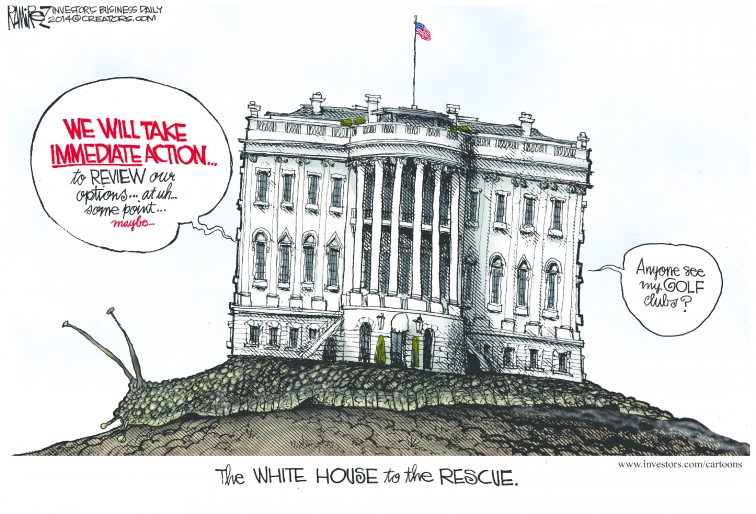
Ramirez Cartoon: The White House to the Rescue
Posted by Print

Below is one of the latest cartoons from two-time Pulitzer Prize-winner Michael Ramirez.

View more of Michael Ramirez’s cartoons on CFIF’s website here.


June 23rd, 2014 at 8:29 am
Supreme Court Winding Up Current Term
Posted by Print

In an interview with CFIF, Megan Brown, a partner in Wiley Rein’s Litigation, Appellate and Communications practice, reviews several recent Supreme Court decisions and cases, including Greece v Galloway (town prayer) and McCullen v. Coakley (“buffer zones”), some First Amendment cases presently before the DC Circuit, and a percolating and timely establishment clause case in the Second Circuit over the World Trade center cross.

Listen to the interview here.


June 20th, 2014 at 11:00 am
Liberty Update
Posted by Print

June 20th, 2014 at 10:05 am
School’s Out, But Lunchroom Fight Continues
Posted by Print

In an interview with CFIF, Daren Bakst, Research Fellow in Agricultural Policy at The Heritage Foundation, discusses the massive food costs of the new school lunch requirements, major declines in student participation, food waste, lack of flexibility and First Lady Michelle Obama’s criticism of the House of Representatives for considering a one-year reprieve for certain schools.

Listen to the interview here.


June 18th, 2014 at 10:26 am
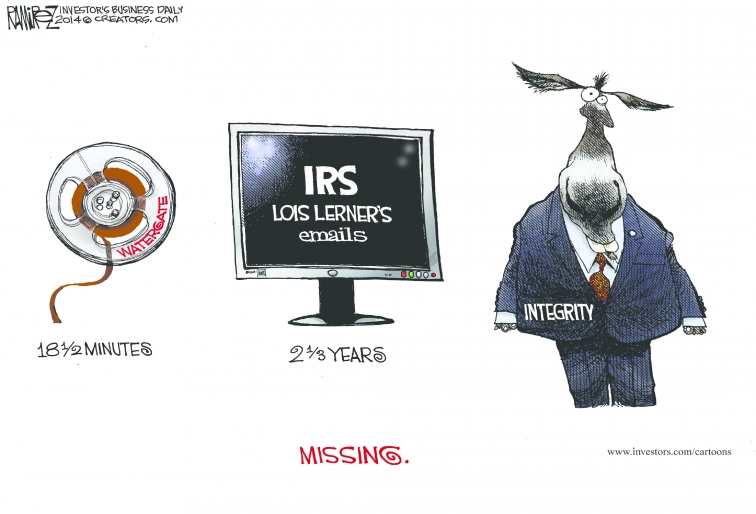
Ramirez Cartoon: Missing
Posted by Print

Below is one of the latest cartoons from two-time Pulitzer Prize-winner Michael Ramirez.

View more of Michael Ramirez’s cartoons on CFIF’s website here.


June 13th, 2014 at 1:51 pm
Video: “Suck it Up and Salute”
Posted by Print

From the squalid conditions in the VA to Obama skipping the traditional Memorial Day ceremony at Arlington National Cemetery to go on vacation, CFIF’s Renee Giachino laments the lack of respect afforded the U.S. military by this administration.


June 13th, 2014 at 12:47 pm
Podcast: The Gov’t Should Keep Its Regulatory Hands Off the Internet
Posted by Print

Timothy Lee, CFIF’s Senior Vice President of Legal and Public Affairs, discusses net neutrality and the misguided push to have the federal government regulate the Internet.
Listen to the interview here.


June 13th, 2014 at 12:41 pm
Liberty Update
Posted by Print

June 12th, 2014 at 7:05 pm
The Liberal Case Against Common Core
Posted by Print

Diane Ravitch is calling on fellow liberals to oppose Common Core.

The NYU education policy expert wants Congress to investigate how Bill Gates bought off various groups to support his Common Core initiative, and whether Gates colluded with Education Secretary Arne Duncan to ram through implementation.

First, consider who wrote Common Core.

“The writers of the standards included no early childhood educators, no educators of children with disabilities, no experienced classroom teachers; indeed, the largest contingent of the drafting committee were representatives of the testing industry,” Ravitch writes at the Huffington Post.

Not only this, but “No attempt was made to have a pilot testing of the standards in real classrooms with real teachers and students. The standards do not permit any means to challenge, correct, or revise them.”

Ravitch then reminds her liberal readers why state and local control matters. “Until now, in education, the American idea has been that no single authority has all the answers. Local boards are best equipped to handle local problems. States set state policy, in keeping with the concept that states are ‘laboratories of democracy,’ where new ideas can evolve and prove themselves.”

Ravitch’s commentary is just the latest in a long line of bipartisan populist backlash over the top-down imposition of Common Core. Voters don’t have much of an opportunity strike back at the elites who are pushing this, but they can remove politicians who support the switch.

As Ravitch’s piece shows, opposition to Common Core is quickly becoming a rallying cry on both the right and the left.

Let’s hope it continues.


June 12th, 2014 at 10:28 am
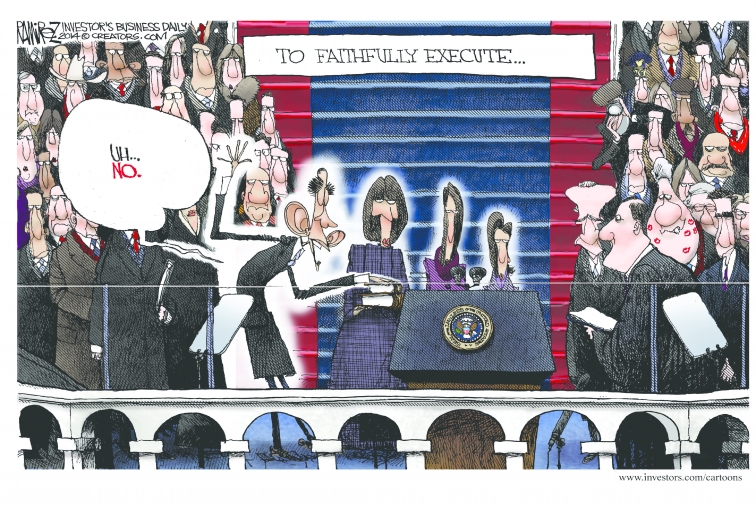
Ramirez Cartoon: To Faithfully Execute…
Posted by Print

Below is one of the latest cartoons from two-time Pulitzer Prize-winner Michael Ramirez.

View more of Michael Ramirez’s cartoons on CFIF’s website here.


June 11th, 2014 at 7:34 pm
Surge in Illegal Immigration Triggered by Alleged Fed Govt. ‘Free Passes’
Posted by Print

A Border Patrol memo obtained by the Washington Times and referenced today in a Senate hearing identifies the main reason Central American women and children are risking illegal entry into the United States – A guaranteed ‘free pass’ by federal government.

“The immigrants come seeking ‘permisos,’ which apparently are the ‘notices to appear,’ the legal documents given to non-Mexicans caught at the border,” reports the paper. “Those notices officially put the immigrants into deportation proceedings. The immigrants usually are released to await a court date, giving them a chance to fade into the shadows in the interior of the U.S.”

According to the Border Patrol memo, “This information is apparently common knowledge in Central America and is spread by word of mouth and international and local media.” It goes on to say that, “A high percentage of the subjects interviewed stated their family members in the U.S. urged them to travel immediately, because the United States government was only issuing immigration ‘permisos’ until the end of June 2014.”

The only permissive immigration policy I’m aware of that is slated to end this month is President Barack Obama’s Deferred Action for Childhood Arrivals – or DACA – program.

In my column this week I explain how President Barack Obama’s Deferred Action program impels more illegal immigrants to bring or send for their children, hoping that once here the federal government will expand the de facto amnesty program.

Recently, President Obama announced that he is extending DACA another two years to the end of his presidency. That means we can expect to see increasing numbers of Central American and perhaps other illegal immigrants flooding into the country seeking those promised “permisos” that allow them to drift into the shadows and avoid deportation.

Given enough time to put down roots perhaps they’ll demand to come out of the shadows on a pathway to citizenship.


June 10th, 2014 at 5:26 pm
Interim VA Chief Adopts Boehner’s Private Option Fix
Posted by Print

Last week House Speaker John Boehner (R-OH) sent a letter to President Barack Obama demanding that “any veteran unable to obtain an appointment within 30 days [have] the option to receive non-VA care.”

This week it was revealed that 57,000 veterans have been waiting 90 days or longer for care from VA facilities.

But at a time when the White House is dithering, the acting VA chief is adopting Boehner’s approach.

“The interim VA secretary said he would spend $300 million to increase hours for VA medical staffers and contract with private clinics to see veterans who are unable to get care through VA medical centers,” reports the Washington Post.

Kudos to Sloan Gibson, the temporary VA secretary, for leveraging the private sector to care for those who’ve rendered the highest public service.


June 10th, 2014 at 3:31 pm
Podcast: SCOTUS, Congress and the War on Political Speech
Posted by Print

In an interview with CFIF, Erin Murphy, partner at Bancroft PLLC, discusses her successful legal argument before the U.S. Supreme Court in McCutcheon v. FEC, in which the Court held the federal aggregate limits on campaign contributions unconstitutional.  Ms. Murphy also discusses her work on Bond v. United States, a case recently decided by the Court involving a poisoned mailbox.

Listen to the interview here.


June 6th, 2014 at 11:52 am
The “First Sale” Doctrine: A Bad Idea for Digital Goods in the Internet Era
Posted by Print

The “First Sale” doctrine refers to an exception in copyright law that allows people to resell used physical products such as books, DVDs, CDs, etc.  While a century of Supreme Court precedent and federal statutes protect that exception for physical goods, some now want to extend it to digital goods even though the doctrine’s underlying logic does not rightfully apply.  More on this in next week’s Liberty Update, but for now, two good recent commentaries from Jim Martin over at the 60 Plus Association and George Landrith over at Frontiers for Freedom.

As Mr. Martin notes:

In the online space, where copies of intangible content are identical to originals, never decay, and are virtually costless to reproduce and transport, creation of a new first sale doctrine would destroy the primary market and discourage investment, innovation and creation.”

And as Mr. Landrith observes:

The ‘first sale’ exception makes sense for physical objects, but it does not make sense for intangible content.  Many have criticized the creative community for being slow to adjust to the modern digital marketplace.  But now some of those same voices are calling for government regulation which would effectively drag our modern modes for distributing books, movies and music back to a 1908 framework that only contemplated physical distribution.”


June 6th, 2014 at 11:19 am
“Operation Choke Point” – Obama Administration’s Latest Tactic to Circumvent Rule of Law and Persecute Disfavored Groups
Posted by Print

By now Americans are well familiar with the Obama Administration’s habit of circumventing laws and persecuting groups it disfavors.  The IRS.  Operation “Fast and Furious.”  Targeting journalists.  The EPA.  More recently, its release of five high-level terrorists from Guantanamo Bay without consulting Congress as required by statute.

Now, we can add “Operation Choke Point” to that dishonorable list.

As detailed by a new House Oversight and Government Reform Committee report, Operation Choke Point is an Obama Justice Department campaign to “choke out” perfectly legal businesses that the Administration simply finds politically objectionable.  “The goal of the initiative,” the House report notes, “is to deny these merchants access to the banking and payments networks that every business needs to survive”:

Over the past year, the Department of Justice has initiated a wide-ranging investigation of banks and payment processors, known informally as ‘Operation Choke Point.’  As of December 2013, the Department has issued over fifty subpoenas to banks and payment processors.  The ostensible goal of the investigation is to combat mass-market consumer fraud by foreclosing fraudsters’ access to payment systems.  However, there is evidence that the true goal of Operation Choke Point is to target industries deemed ‘high-risk’ or otherwise objectionable by the Administration.”

Those targeted industries include firearms and ammunition sellers, short-term lenders that help lower-income workers, and other legitimate businesses.  By threatening and pressuring banks and financial institutions through this operation, the Obama Administration hopes to pressure them to refuse to continue doing business with law-abiding targeted industries.  Although the Administration claims to be acting on the basis of federal statutes prohibiting consumer fraud, the House report notes that no fraud by the targeted businesses has been demonstrated, let alone proven by evidence in a court of law.

The House will continue to pursue the matter, but individual Americans can do their part by remaining vigilant on this issue, and by contacting their elected representatives in the House and Senate to demand action (contact information can be found quickly and easily on CFIF’s “Take Action” page here).


June 6th, 2014 at 11:00 am
Liberty Update
Posted by Print