Archive

Posts Tagged ‘Barack Obama’
February 14th, 2012 at 3:07 pm
Obama Budget Looks to Kill School Choice in Washington D.C.
Posted by Print

If there’s one controlling lesson after three years of the Obama Administration, it’s this: watch what he does, not what he says.

For all of his pieities about being a serious education reformer, Obama has time and again cast his lot with the liberal teachers unions that are perhaps the biggest threat to opportunity for the nation’s underprivileged children. This trend showed up early in his presidency, when he attempted to bleed Washington D.C.’s school voucher program by prohibiting new entrants. Apparently, hope and change wasn’t an offer for poor, overwhelmingly minority students in some of the nation’s worst schools.

Thanks to the efforts of Republicans in Congress, the D.C. Opportunity Scholarship Program is back in action. But under President Obama’s new budget proposal released yesterday, it would be zeroed out. What makes clear that this is a shameless gift to special interests is how decisively the facts weigh in favor of the program. Consider this, from the Heritage Foundation’s Lindsey Burke:

The D.C. OSP has been highly successful. According to federally-mandated evaluations of the program, student achievement has increased, and graduation rates of voucher students have increased significantly. While graduation rates in D.C. Public Schools hover around 55 percent, students who used a voucher to attend private school had a 91 percent graduation rate.

And at $8,000, the vouchers are a bargain compared to the estimated $18,000 spent per child by D.C. Public Schools.

Better outcomes at lower costs. A new generation of young minority students who don’t believe that life ends at 18. And the first reaction of the President of the United States is to see how fast this innovation can be smothered. Many of Obama’s positions can be challenged on the grounds of incorrectness or imprudence. This one, however, deserves disdain for its rank inhumanity.
February 10th, 2012 at 4:52 pm
Cato on Contraception Mandate: ‘We Should All be Exempt’

As a companion must-read article to Tim’s column on the ObamaCare birth control mandate, John Cochrane of Cato explains why President Barack Obama’s proposed compromise to exempt church-related institutions misses the point:

Our nation is divided on social issues. The natural compromise is simple: Birth control, abortion and other contentious practices are permitted. But those who object don’t have to pay for them. The federal takeover of medicine prevents us from reaching these natural compromises and needlessly divides our society.

The critics fell for a trap. By focusing on an exemption for church-related institutions, critics effectively admit that it is right for the rest of us to be subjected to this sort of mandate. They accept the horribly misnamed Patient Protection and Affordable Care Act, and they resign themselves to chipping away at its edges. No, we should throw it out, and fix the terrible distortions in the health-insurance and health-care markets.

Sure, churches should be exempt. We should all be exempt.

February 6th, 2012 at 8:00 pm
Tea Party Gingrich Backer: ‘Campaign is a Disaster’

Thanks to Politico, I came across this open letter to Newt Gingrich from Tea Party Nation founder Judson Phillips.  Phillips, a Gingrich supporter since last fall, thinks Newt’s Florida primary loss to Romney can be explained by a damning lack of organization:

Your campaign is sinking faster than an Italian Cruise ship. I don’t know if anyone is telling you what is going on in your campaign but right now it is a disaster.

Last week, I was in Florida with the Tea Party Express tour. At the events, other campaigns had surrogates. By default, I became yours. I did not mind, but your campaign should have had someone there. While I was at the events in Florida, Romney supporters were there with signs, Ron Paul supporters with signs and Rick Santorum supporters with signs. Your supporters were there. They asked me for signs.

Because there was no one from your campaign attending, there were no signs to give.

Remember, Newt has been a congressman and a consultant, not a CEO.  He resigned his speakership under after a failed coup.  His network of business ventures are built around getting people to imagine fundamental changes that win the future.  I’m a fan of some of his ideas, and I envy his ability to frame an issue around core conservative themes.  That said, if a presidential campaign operation is any indication of how well a candidate manages an important enterprise, I’m afraid we’re left to conclude that Newt Gingrich is not up the job of running the White House, let alone a campaign against Barack Obama.

January 31st, 2012 at 5:12 pm
Head of U.S. Intelligence: Iran’s Appetite for Terror Strikes in the U.S. Growing
Posted by Print

James Clapper, the Director of National Intelligence, was on Capitol Hill earlier today to brief lawmakers on the biggest national security threats facing the nation in the year ahead. While there was some good news (Al Qaeda, for instance, has been substantially weakened by the death of Osama bin Laden and many of its other senior leaders), Clapper’s warnings about Iran were ominous. As the Washington Post reports it:

U.S. intelligence agencies believe that Iran is prepared to launch terrorist attacks inside the United States in response to perceived threats from America and its allies, the U.S. spy chief said Tuesday.

Director of National Intelligence James R. Clapper Jr. said in prepared testimony that an alleged Iranian plot to assassinate the Saudi ambassador in Washington that was uncovered last year reflects an aggressive new willingness within the upper ranks of the Islamist republic to authorize attacks against the United States.

That plot “shows that some Iranian officials — probably including Supreme Leader Ali Khamenei — have changed their calculus and are now more willing to conduct an attack in the United States in response to real or perceived U.S. actions that threaten the regime,” Clapper said in the testimony, which was submitted to the Senate Intelligence Committee in advance of a threat assessment hearing Tuesday. “We are also concerned about Iranian plotting against U.S. or allied interests overseas.”

Bracing stuff. It should now be clear that Iran poses a greater immediate national security threat to the U.S. than any other nation on earth. And our response — to the extent that we’ve had one — has been woefully inadequate.

One of the great ignominies of President Obama’s tenure in office was his decision not to side with the Iranian dissidents who rose up against the government of Mahmoud Ahmadinejad in 2009, missing an opportunity not only to advance our strategic interests in the region but also to put our moral capital on the line for a people yearning to throw off the hand of oppression. At the time, the president was more concerned with preserving his diplomatic options with the mullahs’ regime, even though their actions proved exactly why such overtures would be fruitless.

Though the White House now seems to have a slightly more acute sense of the dangers posed by Iran, the upshot has not been a more effective foreign policy. The current response of choice is to step up economic pressure through the widespread use of economic sanctions by the U.S. and our allies. This will fail to stem the tide of Iranian radicalism. Sanctions and their corresponding decline in economic growth only serve to make life less bearable for workaday citizens. That may make the regime less popular, but in an undemocratic system that’s a development that comes with little cash value.

Khamenei and his ilk are true believers, convinced that history is winding inevitably towards an outcome ordained for them by God. There’s not an instrument of policy sufficient to change that orientation — other than regime change.

January 27th, 2012 at 3:25 pm
Now Biden’s Solyndra Goes Belly Up

During a visit to Solyndra’s Fremont, CA, headquarters President Barack Obama infamously proclaimed “we can see the positive impacts [of Recovery Act stimulus money] right here at Solyndra.”  A year later, Solyndra filed for bankruptcy.  Less noticed was Vice President Joe Biden’s equally presumptuous statement last year that Indiana-based EnerDel – a maker of government subsidized batteries for electric cars – was the “start” to reorienting “the way Americans power their lives.”   As of yesterday, exactly one year after Biden uttered those words, the latest green energy fiasco declared bankruptcy.

For those keeping score, that’s Solyndra costing $535 million, EnerDel $118 million, with more failures to follow.  Had enough, America?

January 26th, 2012 at 3:08 pm
Nearly $133 Billion in Bailout Money Still Not Repaid
Posted by Print

As I note in my new weekly column, out today, President Obama’s State of the Union address on Tuesday night was littered with risible claims, not the least of which was his defense of the hundreds of billions of dollars poured into the financial and auto industries at the height of the nation’s economic crisis (efforts, in fairness, that began with the Bush Administration). Contrary to the president’s rosy recitations, however, the bailouts were not an unimpeachable success. As the AP reports today:

A government watchdog says U.S. taxpayers are still owed $132.9 billion that companies haven’t repaid from the financial bailout, and some of that will never be recovered.

The bailout launched at the height of the financial crisis in September 2008 will continue to exist for years, says a report issued Thursday by Christy Romero, the acting special inspector general for the $700 billion bailout. Some bailout programs, such as the effort to help homeowners avoid foreclosure by reducing mortgage payments, will last as late as 2017, costing the government an additional $51 billion or so.

This report won’t get much attention, simply because of the fact that a majority of the money has been paid back. That fact, however, reveals what may be the most damning legacy of the bailouts’ gonzo economics: the ability to think of a $133 billion shortfall as a rounding error.

January 25th, 2012 at 8:58 pm
Why Obama Can’t Run as Reagan Redux
Posted by Print

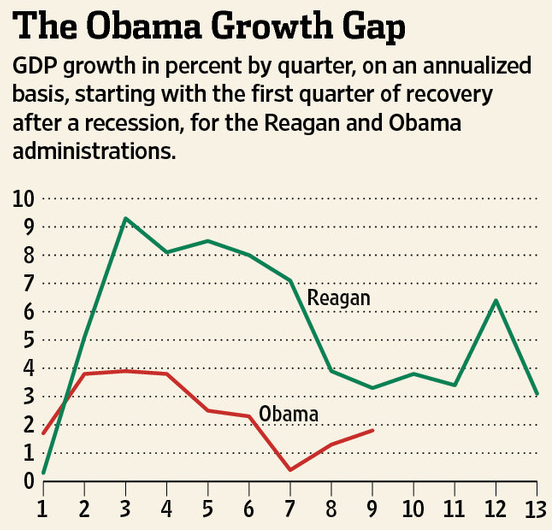
It’s not morning in America. And if the dawn does break on President Obama’s watch, the forecast is for heavy clouds. This graph from today’s Wall Street Journal, comparing economic growth during Reagan and Obama’s first terms, shows why:

ObamaReaganGrowth

January 25th, 2012 at 12:36 pm
Mitch Daniels Gets It Right

Reading the text of Indiana Governor Mitch Daniels’ Republican response to President Barack Obama’s State of the Union Address gives us a bittersweet reminder of what might have been had he run for President this year.  Here are some phrases I hope the eventual nominee incorporates into his campaign – and governing – rhetoric:

“In three short years, an unprecedented explosion of spending, with borrowed money, has added trillions to an already unaffordable national debt. And yet, the President has put us on a course to make it radically worse in the years ahead. The federal government now spends one of every four dollars in the entire economy; it borrows one of every three dollars it spends. No nation, no entity, large or small, public or private, can thrive, or survive intact, with debts as huge as ours.

“The extremism that stifles the development of homegrown energy, or cancels a perfectly safe pipeline that would employ tens of thousands, or jacks up consumer utility bills for no improvement in either human health or world temperature, is a pro-poverty policy. It must be replaced by a passionate pro-growth approach that breaks all ties and calls all close ones in favor of private sector jobs that restore opportunity for all and generate the public revenues to pay our bills.

“The mortal enemies of Social Security and Medicare are those who, in contempt of the plain arithmetic, continue to mislead Americans that we should change nothing. Listening to them much longer will mean that these proud programs implode, and take the American economy with them. It will mean that coming generations are denied the jobs they need in their youth and the protection they deserve in their later years.

“We will advance our positive suggestions with confidence, because we know that Americans are still a people born to liberty. There is nothing wrong with the state of our Union that the American people, addressed as free-born, mature citizens, cannot set right. Republicans in 2012 welcome all our countrymen to a program of renewal that rebuilds the dream for all, and makes our ‘city on a hill’ shine once again.”

If Republicans win the White House this year I hope there’s an important place in the Administration for Mitch Daniels.

January 23rd, 2012 at 9:12 pm
Mapping Obama’s Energy Winners & Losers

A funny thing happens when you overlay two of President Barack Obama’s recent energy proclamations onto a 2008 electoral map: You find out just how political is his decision to kill the Keystone XL pipeline and embrace natural gas from the Marcellus Shale formation.

Here’s a map of the Keystone XL project.  And this is a map of the 2008 presidential election.  Note that the path of Keystone XL runs from Canada directly south through six states: North Dakota, South Dakota, Nebraska, Kansas, Oklahoma, and Texas.  All of these states voted for John McCain in 2008.  (Incidentally, not even a sideline to Obama’s Illinois during the pipeline’s initial phase could placate the anti-fossil fuel President.)

Now look at this map of the Marcellus Shale natural gas formation that the Obama White House now says would be a great place to start drilling for America’s energy future.  It touches vast swaths of New York, Pennsylvania, and Ohio, with a large portion covering West Virginia.  Obama won New York, Pennsylvania, and Ohio in 2008, and will need to do so again in 2012 to stay in the Oval Office.

As I said in my column last week, expect to hear Obama make the pitch that natural gas from Marcellus Shale is the new way forward as a way to placate blue collar energy workers in states he needs to maintain – and in the case of West Virginia, possibly pick up.  (Reports are coming in that the President will devote a significant portion of his State of the Union Address to promoting domestic natural gas production.)

It’ll be a tough sale.  Obama’s EPA is trying to regulate the West Virginia coal industry out of existence, while working class voters are rightfully suspicious of a President who promises everything from expanded offshore drilling to solar powered miracles (Solyndra, anyone?), only to be exposed as a fraud.  Natural gas may be the next big thing, but it won’t mean anything to a coal worker out of work because his industry went out of business thanks to Obama’s latest round of picking winners and losers.

The big question is: Will the GOP be able to turn Obama’s politicization of America’s energy future into an articulate appeal for an all-of-the-above approach?

January 23rd, 2012 at 4:35 pm
1,000 Days Without a Budget
Posted by Print

Believe it or not, that’s the remarkable reality we’ll be facing when Barack Obama takes to the podium to deliver his State of the Union address tomorrow night: nearly three years wherein the federal government — the largest distributor of funds on the planet — has operated without a budget. That’s a failure that deserves widespread public attention. Happily, the GOP — which usually can be counted on to bobble these kinds of communications opportunities — is doing a serviceable job of highlighting this ignominious milestone:

January 20th, 2012 at 5:21 pm
Everything That’s Wrong About the Keystone XL Pipeline Decision in One Paragraph
Posted by Print

This insight, courtesy of Warren Meyer writing in Forbes, tells you everything you need to know about why the Obama Administration’s decision to block the Keystone XL Pipeline is misbegotten:

Some would argue that [the pipeline’s] opponents aren’t anti-energy, they just want to shift energy use from fossil fuels to “green” energy like wind and solar.  This is either disingenuous or unbelievably naive. The Keystone XL pipeline would have single-handedly carried more energy to the United States than the sum of all the green energy projects funded by the Obama Administration. And it would have done so entirely with private  funds rather than the Administrations increasingly ill-fated and ham-handed attempts at venture capitalism with taxpayer funds. The fact of the matter is that, for the foreseeable future, opposing fossil fuels is equivalent to opposing energy use.

That, my friends, is the nub of the issue. Liberal environmentalists — those same individuals that sneeringly deride their opponents as “anti-science” — can’t come to grips with the empirical reality: there are conventional energy sources that work and “alternative energy” sources that are viable only in the more fevered recesses of their imaginations. The greens can deny that reality all they want, but they won’t be able to deny the subsequent consequences: higher energy prices and lower economic well-being. That’s a very high price to pay for a sense of moral superiority.

January 20th, 2012 at 12:21 pm
Obama’s Keystone XL Folly Puts Swing States in the Mix

From BusinessWeek:

President Barack Obama’s rejection of TransCanada Corp.’s Keystone XL pipeline permit exposed a split in a core Democratic constituency and handed Republicans a new line of election-year attack.

Unions representing construction workers condemned the move while labor groups including the United Steel Workers, the United Auto Workers and the Service Employees International Union joined with environmental advocates in saying they support Obama’s decision. It also triggered swift criticism from congressional Republicans and the party’s presidential candidates.

Expect Republicans to run ads targeting blue collar workers in Rust Belt swing states like Pennsylvania and Ohio where ties to manufacturing jobs run deep.  When Obama ran against Hillary Clinton in 2008 he consistently lost the white working class vote for stances like picking sky-is-falling environmentalists over John and Jane hardhat.

Dissatisfaction among traditionally Democratic blue collar voters toward Obama has been building for months due to political decisions that – as discussed in my column this week – kill unionized jobs in coal and oil, but interestingly not natural gas.  Obama’s turn away from blue collar voters has been met with a renewed emphasis on ginning up votes among other core Democratic constituencies like recent college graduates (hello, Occupiers!) and other gentry liberals.

But the strategy of maximizing votes in liberal enclaves like college towns and deep blue coastal states that Obama would win anyway doesn’t quite add up for one simple reason: the Electoral College – not the popular vote – elects the President.  Even if Obama gets a larger share of liberals in blue states like California he still nets only 54 electoral votes.  But if he fails to connect with everyday Democrats in swing states in Ohio and Pennsylvania that see their President willfully killing jobs they’d otherwise have, he’ll move entire states into the Republican column.

This kind of divide-and-conquer strategy looks like a recipe for defeat.  Then again, from my perspective, I couldn’t ask for a better campaign strategy.  (Unless, of course, this scenario occurs.)

January 16th, 2012 at 6:36 pm
This is the Face of Media Bias
Posted by Print

newsweekobamacover

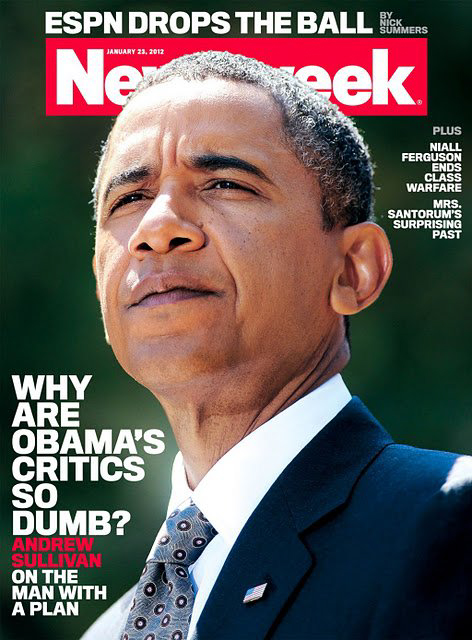
This is no joke. It looks like Newsweek has allowed its collective editorial id to design the cover of the magazine’s newest issue.

Remember, there was a time when this was one of America’s newsmagazines of record. Not coincidentally, that was a time before Andrew Sullivan’s feature-length slanders were considered cover material. It’s becoming clearer every day why Newsweek only managed to fetch $1 when it went up for sale in 2010. Also becoming clearer? It was overpriced.

January 11th, 2012 at 2:20 pm
Can Romney Defend Democratic Capitalism?

I’m glad to see the Wall Street Journal’s editorial page echoing Troy’s advice to Mitt Romney to get out in front of the Bain-bashing and make a full-throated defense of free market capitalism.  But as both Troy and the Journal seem to allude to, Romney doesn’t appear capable or willing to make the case for democratic capitalism; the kind of market economy that emphasizes equal access and opportunities instead of guaranteed outcomes.

The way I’m using the term, democratic capitalism disdains the unfairness many perceive in the crony capitalism of Obama’s Solyndra deal, and in the bailouts of companies deemed too big to fail.  Americans don’t like it when public employee unions get tenure protections and better benefits than the private sector.  People feel cheated when General Electric pays no federal income taxes thanks to loopholes only the wealthy like Warren Buffet can exploit.  For the free market to work, people have to trust it, and right now Wall Street, the White House, and many other entrenched special interests from unions to rent-seeking businesses are making everyday Americans think the capitalistic system they’ve been sold is far from democratic.

In a sense, democratic capitalism is at the heart of Sarah Palin’s appeal.  Her entire career in Alaska was built around taking down entrenched interests enriching themselves at the expense of a fair system.  She exposed a corrupt state oil and gas commission; disrupted the state GOP’s patrician good old boys club by defeating an incumbent governor; and won a fight with a major oil company over its ability to exploit Alaska’s natural wealth without sharing some of it with residents.  These were the accomplishments that made her a maverick and put her on John McCain’s vice presidential radar.  When Palin was toying with a presidential run this time around, she gave a major speech blasting distortions of the economy that make the market less fair, and ultimately, less free.  Better than anyone to date, Palin communicates the Tea Party’s angst over Big Government into a larger narrative about the dangers posed by any segments of society that threaten the democratic element in America’s form of capitalism.

Now, I’m not saying that Mitt Romney is a foe of democratic capitalism.  What I’m saying is that he doesn’t appear comfortable articulating his understanding of the free market in a message that applies equally to executives and frontline workers.  That’s probably because he’s never been a frontline worker.  Of course, he’s worked hard – graduating with honors from Harvard law and business schools demands it – but as the son of an auto executive and governor whose first job out of graduate school was telling CEO’s how to fix their companies, Mitt Romney has never experienced capitalism from the factory floor.  That means he will have a hard time explaining the virtues of capitalism to people near the destructive end of capitalism’s creativity.

Fairly or not, if Romney is the nominee liberals will savage him as a member of the 1% who made millions replacing people with technology and exporting many of the remaining jobs overseas.  Conservatives who favor the free market should hope that Romney discovers how to articulate the democratic element of capitalism soon and well.  He could start by reading Troy’s excellent remarks as soon as possible.

January 10th, 2012 at 11:24 pm
How Romney Beats the Rap on Bain
Posted by Print

Regular readers know that I’m far from the biggest Mitt Romney supporter in the world. That being said, the criticisms of his time at Bain Capital leveled by fellow candidates Newt Gingrich, Jon Hunstman, and Rick Perry have been shockingly opportunistic and intellectually dishonest, particularly for self-proclaimed advocates of free market capitalism (they’ve also ignored the more salient criticism — the numerous instances in which Bain lived off the taxpayer).

Over at Ricochet, I have a proposed rhetorical response for Romney. The whole’s thing here, but here’s a sample:

I would remind my opponents – as I would remind President Obama – that work is a form of public service. Our ability to make money is directly tied to our ability to provide something of value to our fellow man. But sometimes when the customer’s needs change or when we lose ground to our competitors, we have to make changes. We don’t choose these circumstances. As a matter of fact, we hate these circumstances. But, like many Americans that are struggling today, we accept the things that we cannot change, we make the hard choices, and we persevere. That is never an easy task. And unfortunately, sometimes people lose their jobs as a result. But what, I wonder, do my opponents think the alternative is?  If a company on the brink of failure has no choice but to let a few employees go now or to see all of their jobs disappear eventually, what should they do?

Those are the kind of painful choices that people face in the real economy. And I find it telling that that concept is foreign to my opponents. They’re not foreign to the American people – because they’re living through them every day. You can talk to anyone who’s ever sat behind a manager’s desk – whether it’s in a corner office or a corner store – and they’ll tell you that there’s nothing that they hate more than having to fire someone. Americans take pride in their work. Losing a paycheck hurts. But losing your sense of dignity hurts more. My experiences in business didn’t make me enjoy firing people. It made me loathe the politicians in Washington for whom those people are nothing more than statistics on a spreadsheet.

January 10th, 2012 at 12:51 pm
Obama’s Taliban Prisoner Release is a Bad Deal for America

Last week I wrote that President Barack Obama is entertaining the idea of releasing several high-value Taliban prisoners currently held at Guantanamo Bay as a way to negotiate peace with the terrorist group.  The idea is foolish for a variety of reasons, the most important being that these men will almost certainly return to the purpose of their lives: waging war against America.

For proof, consider this recent article from Marc Thiessen, a former Bush speechwriter and now a columnist for the Washington Post.  In it, Thiessen explains that two of the detainees are wanted by the UN for war crimes, another has experience facilitating terrorist networking events like joint trainings with al-Qaida, and a fourth is believed to have played a part in the deaths of two Americans.  The last member of Thiessen’s terrorist round-up worked directly for Usama bin Ladin, and attended meetings with the Palestinian terrorist group Hamas.

As Thiessen points out, this isn’t the first time a president has considered releasing a Taliban fighter with disastrous consequences:

In 2007, the Bush administration released a Taliban leader named Mullah Zakir to Afghan custody. Unlike these five, he was assessed by our military as only “medium risk” of returning to the fight. They were wrong. Today, Zakir is leading Taliban forces fighting U.S. Marines in Helmand province, and according to former intelligence officials I spoke with, he has provided the Taliban with an exponential increase in combat prowess.

We’ve been down this road before.  If Obama does in fact release any of these terrorists from Gitmo, Americans will rightly place the blame for any deaths caused by them on his doorstep.

January 9th, 2012 at 5:54 pm
How the Republican Candidates Fall Short
Posted by Print

The ever-perceptive Michael Barone is out with a new piece today chronicling — in his trademark even-handed style — the weaknesses of the various Republican presidential candidates (Barone makes clear up front that this isn’t an attack piece, just an attempt to balance their professed strengths with the demerits they try to obscure). My favorite is his judgment of Jon Huntsman, who hasn’t been able to break through with conservative voters despite the fact that he had a serviceable record as Governor of Utah:

Jon Huntsman, even more dependent on a breakout in New Hampshire than Santorum, has a different weakness. His disdainful dismissal of other Republicans, even more than his service as Barack Obama’s ambassador to China, has antagonized many conservatives.

That’s it in a nutshell. Attitudes matter just as much as — if not more than — positions. You never get a second chance to make a first impression and Huntsman’s decision to curry favor with the media by running down the conservative base in the early days of his campaign can’t be ameliorated by the virtues of his positions on taxes, education, or abortion in Salt Lake City.

Where I think Barone gives us a genuinely new insight is in his read of Mitt Romney:

His weakness is that he never experienced the cultural revolution of the 1960s and so sounds corny and insincere. So far, that hasn’t been disabling.

Here, I think Barone dramatically oversimplifies. The sense of insincerity has a lot to do with Romney’s ideological elasticity, which has seen him seemingly take every side of every issue at some point in his career. But the cultural point is still well-taken. Barack Obama is the ultimate postmodern president — cool, detached, ironic in the fashion of those who spend too much time on college campuses, and utterly solipsistic. It’s a long way from there to Romney, who seems like the buttoned up father figure on a black and white sitcom. But while the former Massachusetts Governor is far from the ideal corrective to the current occupant of the White House, there’s no doubt that a president who seems pried from “Leave it to Beaver” is preferable to one whose entire political career seems like an extended audition for “The Real World”

January 5th, 2012 at 5:21 pm
Obama Planning to Launch Trillion-Dollar Housing Bailout Without Congressional Approval?
Posted by Print

Skim through this week’s commentary pieces here at CFIF, and you’ll notice that all of us at the Center are incensed by President Obama’s recess appointments to the NLRB and the Consumer Finance Protection Bureau yesterday, all of which seemed to clearly overstep the president’s constitutional authority.

According to the invaluable James Pethokoukis, however, we ain’t seen nothing yet. Writing at the American Enterprise Institute’s Enterprise Blog, Pethokoukis notes that there’s an ominous implication from yesterday’s appointments — that the president could use a similar tactic to appoint a new head of the Federal Housing Finance Agency. He writes:

And why is that important? The Federal Housing Finance Agency is the regulator and conservator of Fannie Mae and Freddie Mac. And the FHFA currently has an acting director, Edward DeMarco. If Obama replaces him with a “housing advocate” via the same recess appointment process, here’s what might happen next, according to [the Washington Research Group’s Jaret] Seiberg:

“That could lead to a mass refinancing program for agency-backed mortgages that would go well beyond the existing HARP program. That could hurt agency MBS pricing and result in higher financing costs going forward. Yet it also could be a big boost for the economy and housing going into the election.”

Indeed, my sources tell me the Obama administration has been eager to implement just such a plan, but needs to have its own man heading the FHFA to make it happen.

There are more grisly details in Pethokoukis’s original post. The upshot? President Obama — without approval from Congress — could commit taxpayers to a quarter-trillion dollars of spending in order to bail out imprudent homeowners in an election year. Essentially, we’d all be financing the president’s reelection campaign. And, in a tight race, the resulting bribe stimulus might just do the trick.

January 3rd, 2012 at 5:00 pm
Tyranny, Thy Name is Syria
Posted by Print

Over the weekend, Nick Cohen in the UK Guardian provided halting testimony to just how macabre the  abuse of human rights by the Assad regime in Syria has become. From the piece:

To grasp the scale of the barbarism, listen to Hamza Fakher, a pro-democracy activist, who is one of the most reliable sources on the crimes the regime’s news blackout hides. “The repression is so severe that detainees are stacked alive and kicking in shipping containers and disposed off in the middle of the sea,” he told me. “It is so bad that they’ve invented a new way of torture in Aleppo where they heat a metal plate and force a detainee to stand on it until he confesses; imagine all the melting flesh reaching the bone before the detainee falls on the plate. It is so bad that all demonstrators have opted for armed resistance. They know it is about survival now, not about freedom any more. This needs to be highlighted: Syrians are fighting for their lives now, not for freedom.”

Looking back on 2011, remember that the Obama Administration pressured Hosni Mubarak to step down in Egypt despite the fact that it was clear that the upshot would damage American national security interests. We also intervened in Libya despite the fact that our interests there were peripheral at best. Now comes Syria: an ally of Iran, a sponsor of terrorism, and, as this article attests, an utterly wicked regime. Rarely is the confluence of our strategic interests and our moral interests so unambiguous. Let us hope that the administration doesn’t miss this opportunity, as it did in Iran in 2009.

December 23rd, 2011 at 2:20 pm
The Moral Case Against Obama’s Policies

Kimberly Strassel of the Wall Street Journal draws attention to the central  failure of Republicans losing ground against a Barack Obama quietly gaining in popularity:

One mistake the party is making is fighting this race like the 2010 midterms. A certain laziness has settled in, based on the notion that the GOP can make 2012 another referendum on the president’s mismanagement. But while Obama-bashing may again fire up the conservative base, it delivers nothing to those crucial independent and middle-of-the-road voters who are anxious, confused and looking for someone to convince them they have a better plan.

Strassel goes on to explain how focus groups in battleground states are showing a consistent pattern in swing voters.  They want Republicans to make a moral case against the President and his policies.  They assume both parties will overspend.  What they want is a coherent explanation of why Obama’s policies are wrong for the country and wrong for them.  In short, what Americans want are concrete arguments explaining why Obama’s liberalism is so bad for the country, followed by an alternative vision that flows in the mainstream of American political thought and experience.

More Strassel:

Consider that ObamaCare was a concern of the focus group, though it had notably receded. This is in part because, while the GOP often complains about the law and its individual mandate, it has largely stopped explaining to voters what else is in it, or how other upcoming provisions will hurt consumers, or exactly how they grow government.

Presidential aspirants and congressional Republicans, take note: To make a moral argument against the president, you also have to make one for yourselves. To the extent the GOP is lobbing the usual Obama complaints or going to the mat over who cares more about a piddling payroll tax holiday, it is wasting time.

In a nutshell, the GOP’s messaging failure explains Paul Ryan’s success.  Almost alone among major Republican leaders, Ryan is defining the problems we face with confidence-building detail, offering thoughtful, consensus-based solutions, and justifying them in light of our history and tradition.  This is the work of a statesman.  The sooner Republicans take the hint and follow suit, the sooner America will remember the moral case for prosperity.