Archive

Posts Tagged ‘Jobs’
May 14th, 2011 at 5:39 pm
Gingrich: “Obama Most Successful Food Stamp President”

If nothing else, presidential candidate Newt Gingrich (R-GA) will almost always give the 2012 campaign cycle its most colorful one-liners.  Along with saying that the 2012 contest is the most important election since Abraham Lincoln’s in 1860, Gingrich said in a speech to Georgia Republicans that Barack Obama is “the most successful food stamp president in modern American history.”

Leaving aside who would be Obama’s competition in the pre-modern American era, Gingrich said that Obama’s economic policies have thrown more people onto the government dole as jobs have dried up.  To Gingrich, cutting corporate tax rates from 35% to 12.5% would drop the compliance cost for businesses, giving them an incentive to redirect money from loophole-loving lawyers to frontline job creation.  Believing that, “The most important social welfare program in America is a job,” Gingrich said, “I would like to be the most successful paycheck president in American history.”

With the nationwide unemployment rate holding steady at 9%, Gingrich’s jobs mantra could catch on.

May 9th, 2011 at 8:58 am
Ramirez Cartoon: Time to Celebrate?
Posted by Print

Below is one of the latest cartoons from two-time Pulitzer Prize-winner Michael Ramirez.

View more of Michael Ramirez’s cartoons on CFIF’s website here.

April 22nd, 2011 at 2:08 pm
The Trouble with California in One Paragraph

John Fund gives an excellent distillation for the reasons California businesses are relocating en masse to Texas:

Andy Puzder, the CEO of Hardee’s Restaurants, was one of many witnesses to bemoan California’s hostile regulatory climate. He said it takes six months to two years to secure permits to build a new Carl’s Jr. restaurant in the Golden State, versus the six weeks it takes in Texas. California is also one of only three states that demands overtime pay after an eight-hour day, rather than after a 40-hour week. Such rules wreak havoc on flexible work schedules based on actual need. If there’s a line out the door at a Carl’s Jr. while employees are seen resting, it’s because they aren’t allowed to help: Break time is mandatory.

Indeed, California policymakers are enjoying an extended break from economic reality by focusing on everything else but job creation.

If the trend of 4.7 businesses a week abandoning California continues, pretty soon the great weather will be the only reason to visit the once Golden State.

March 25th, 2011 at 9:57 am
Obama’s Domestic Energy Policies Killing Jobs Across America

A damning study that shows the true cost of President Barack Obama’s disastrous domestic energy policies:

The study, “Domestic Vendor Spending Outside the Gulf” found that approximately $1.3 billion of the $1.8 billion in shallow water vendor spending was concentrated in 7 states:

  • Illinois: $376.2 million
  • Pennsylvania: $245.0 million
  • Wisconsin: $176.5 million
  • New York: 139.6 million
  • California: $138.0 million
  • Oklahoma: 125.8 million
  • Alabama: $104.5 million

Here’s what that means in political terms:

Additionally, the survey found a nationwide economic impact. Shallow water expenditures were made in 219 congressional districts — including 102 congressional districts with expenditures of $1 million or more, 32 congressional districts with expenditures of $10 million or more and 7 congressional districts with expenditures of $75 million or more.

Refusing to issue new permits for deep and shallow water drilling only increases the costs of gasoline and natural gas to consumers and destroys jobs across America.  Along with financial boondoggles like ObamaCare, the president’s willful refusal to increase domestic energy supplies is likely to be a huge liability in his reelection bid.

March 18th, 2011 at 10:32 am
Gallup Survey: Unions Reduce Workplace Wellbeing
Posted by Print

Apparently, whatever jobs labor unions don’t drive overseas or eliminate entirely are made worse by them.

According to a just-released Gallup survey, “U.S. Union Workers Score Lower on Work Enforcement Index.”  On a variety of measures, from the sense of employee/supervisor partnership to overall trust, unionized workplaces simply maintain substantially lower levels of workplace wellbeing.  Ultimately, as the Gallup report states, unionized workplaces impact the factors that “in turn have well-documented associations to various desirable business outcomes, including customer engagement, turnover, absenteeism, and productivity.”

As critical standoffs between taxpayers and intransigent labor bosses in Wisconsin and across the nation continue, this new Gallup survey sheds some important information on the matter.

February 4th, 2011 at 10:25 am
Unemployment: On Eve of Reagan’s 100th Birthday, Let’s Compare Presidents
Posted by Print

In its monthly report this morning, the Labor Department announced that unemployment has now remained at or above 9% for a post-World War II record 21st consecutive month.  Additionally, it reported just 36,000 new jobs, well short of the expected 140,000 number.

On the eve of the 100th anniversary of Ronald Reagan’s birth, these numbers contrast the results of a big government agenda versus a free market agenda.  In the 23 months since Obama’s massive $1 trillion “stimulus” passage, unemployment has increased from 8.2% to 9%.  One would expect better results in exchange for deficits of $1.4 trillion in 2009, $1.3 trillion in 2010 and an expected record $1.5 trillion this year.  Keep in mind that Obama projected that if we followed his big government agenda, unemployment would be down between 6% – 7% by now.  In contrast, the 23 months following the effective date of Reagan’s tax cuts in January 1983 saw unemployment plummet from 10.4% to 7.2%.

The facts speak for themselves.  Inexplicably, Obama nevertheless called for even more federal “stimulus” in his State of the Union address.  As we celebrate the Gipper’s 100th birthday, we should remember the timeless lesson taught by his freedom agenda’s success.

January 28th, 2011 at 10:13 am
Obama’s 2011 Deficit? A Record $1.5 Trillion
Posted by Print

Barack Obama assured Americans throughout his campaign that if we hired him, he’d reduce the deficit.  Here is Obama in his own words from his closing infomercial of October 29, 2008:

I believe we need to usher in a new era of responsibility.  Across the country, families are tightening their belts, and so should Washington.  That’s why, for my energy plan, my economic plan and the other proposals you’ll hear tonight, I’ve offered spending cuts above and beyond their cost.  I’ll also go through the federal budget, line by line, eliminating programs that don’t work … and making the ones we do need work better and cost less.”

Here’s the ugly reality, over two years later:  The Congressional Budget Office (CBO) announced this week that the 2011 budget deficit will reach a record $1.5 trillion.  That follows $1.4 trillion and $1.3 trillion deficits in his first two years.  The 2008 deficit, for purposes of comparison, was $455 billion.

Something to consider when assessing Obama’s latest State of the Union address, and his upcoming promises over the next two years.

January 7th, 2011 at 9:37 am
Unemployment Report: Over 9% For 20th Consecutive Month, Fewer New Jobs Than Expected
Posted by Print

This morning, the Labor Department announced a national unemployment rate of 9.4%.  Unfortunately, this means that the unemployment rate has surpassed 9% for a post-World War II record 20 consecutive months.  Moreover, the announcement of just 103,000 new jobs fell well short of the anticipated gain of 150,000 new jobs.

The Obama Administration will trumpet the misleading 0.4% decline from last month’s 9.8% rate as evidence that its agenda is somehow succeeding.  That claim, however, conceals the fact that the rate had already dropped from January 2010’s 9.7% rate to 9.5% in June, only to climb back to 9.8% to finish the year.  Further, this is the same Obama Administration that promised unemployment would peak at 8% in October 2009 – fourteen months ago – and be down to 7% by now if we just passed his so-called “stimulus” bill back in February 2009.  Almost $1 trillion in deficit spending and two years later, the verdict is clear.  It has failed miserably.

It’s something to remember as the Obama Administration attempts to “triangulate” and claim successful governance as we steam toward the 2012 reelection campaign.

November 30th, 2010 at 4:23 pm
Pampered Federal Employees “Rage” at Prospect of Mere Wage Freeze?
Posted by Print

Sign of the times from today’s New York Daily News“Federal Workers Rage Over President Obama’s Two-Year Wage Freeze.”

Let’s see…  Federal employment has grown 17% since 2007, and federal employees’ total compensation has risen 37% in the past decade (compared to 9% for private sector employees), according to The Wall Street Journal and USA Today.  Further, average federal employee compensation reached $123,000 in 2009, more than twice the $61,000 earned by the average private employee.

So in what moral universe are federal workers justified in reacting to a very modest two-year wage freeze proposal with “rage” and by labeling it a “slap” when they haven’t faced the brutal layoffs, salary reductions and cuts in health coverage their private counterparts must endure?  A majority of Americans surveyed favor federal workforce reductions and salary cuts, so perhaps they should behave less like spoiled Greek, French and English rioters and instead express gratitude to American taxpayers who continue to subsidize their relative good fortune.

November 10th, 2010 at 9:30 pm
Debt Panel Gets it 75 percent Right
Posted by Print

The Wall Street Journal is among the news sources carrying coverage of the preliminary recommendations being produced by President Obama’s much-feted debt reduction panel. According to the Journal’s synopsis:

Among the controversial proposals, the plan in its current form would end or cap a wide range of breaks relied on by the middle class, including the deduction for home-mortgage interest. It would tax capital gains and dividends at the higher rates now levied on wage income. To compensate, one version of the plan would dramatically lower and simplify individual rates, to 9%, 15% and 24%.

For businesses, the plan would significantly lower the corporate tax rate—from a current top rate of 35% to as low as 26%—but also eliminate a number of deductions. It would make permanent the research and development tax credit. Overall, the plan would cut the federal deficit by $3.8 trillion by 2020.

… On Social Security, the plan would gradually raise the retirement age to 68 around 2050 and 69 by 2075. It would combine a cut in benefits with a rise in taxes on wealthier people’s incomes. It would also seek to rein in federal spending on health care beyond what’s called for in the recently passed health-care overhaul. This would be achieved by introducing further changes, including reform of medical-malpractice law, and by seeking to slow the growth of the Medicare program.

The plan would make significant cuts on spending over which Congress has direct control, beyond entitlements such as Medicare. It identifies $410 billion in discretionary spending cuts by 2015. It proposes cutting the federal work force 10%, at a further savings of $13.2 billion by 2015.

Congressional earmarks—provisions inserted into legislation for lawmakers’ pet projects—would be banned permanently, saving $16 billion.

This a surprisingly market-friendly recommendation, much of which — though politically very tough — is admirable. Hopefully, low-tax advocates will train their fire on the unnecessary increases in capital gains and dividend rates, as well as what looks to be a proposed increase on Social Security and Medicare taxes for the wealthy. While we don’t know what deductions are on the chopping block, if the home mortgage example is representative there’s actually a strong free-market case to be made in favor of the eliminations. By giving economic preference to activities like home purchases, these deductions lead to economic inefficiency (they either direct consumers to make choices that wouldn’t be rational without the deduction or subsidize purchases that would have been made regardless).

Elsewhere in the WSJ piece, the authors refer to the fact that the current recommendations rely about 75 percent on spending cuts and 25 percent on tax increases. Good, but not great. A recognition that taxes always hamper economic activity means that tax increases should never be considered instead of spending cuts unless (A) government is only doing the things that are its rightful responsibility and (b) it is doing all those things at maximum efficiency. At some point, the exigencies of politics may require compromising short of that ideal, but I’d like to see a comprehensive examination of spending in the executive branch before tax hikes are even considered.

Let’s consider the cabinet departments. The Departments of Justice, Defense, Treasury, and State are the originals and unquestionably justified under our scheme of federal government. There are others that have probably grown into necessary organs in years since. We’ll need Health and Human Services as long as we have a federal welfare state, Interior as long as we have public lands and a National Park system, Transportation at least for the interstate highway system and air travel and, though its probably in need of some pruning, Homeland Security. Veterans Affairs seems like it could be folded into either Defense or HHS. As for the Departments of Education, Housing & Urban Development, Energy, Agriculture, Commerce, and Labor (apart from its statistical work), I’m at a loss for what useful purpose (or more importantly, results) justifies their existence. I’d be more than willing to scrap each of them, keep the few parts we still need, and re-check the ledger before considering higher taxes for even a single American.

November 5th, 2010 at 9:30 am
Latest “Stimulus” Report Card: Unemployment Remains 9.6%
Posted by Print

Today, the Labor Department announced that the unemployment rate remained at 9.6% for the third consecutive month.  When President Obama signed his nearly $1 trillion “stimulus” in February 2009, the unemployment rate stood at 8.2%.  In the 20 months since that date, the rate has increased to 9.6% despite White House projections that it would top out at 8% fully one year ago.

Once again, a comparison to the Reagan recovery is profoundly instructive.  In the same 20 month span following the effective date of the Reagan tax cuts in January 1983, unemployment plummeted from 10.4% to 7.3%.  Also instructive is the following headline from today’s Wall Street Journal“European Central Bank Parts Ways With U.S. on More Stimulus.” It is a sad state of affairs when even the spendthrift Europeans are providing economic guidance to Obama.

Liberal Keynesians have had almost two years to prove the validity of their economic agenda.  It has failed, their rationalizations have grown stale, and their desperate efforts to resist corrective action will only prolong the nation’s misery.

October 26th, 2010 at 2:13 pm
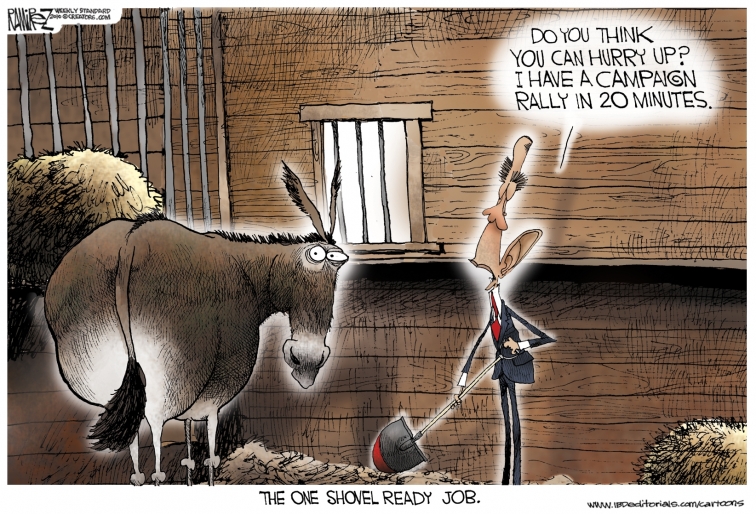
Ramirez Cartoon: The One Shovel Ready Job
Posted by Print

Below is one of the latest cartoons from two-time Pulitzer Prize-winner Michael Ramirez.

View more of Michael Ramirez’s cartoons on CFIF’s website here.

October 5th, 2010 at 9:52 am
Arthur Laffer: States With Lower Income Taxes Enjoy Higher Growth, Income
Posted by Print

Arthur Laffer brought us the famed Laffer Curve, which plotted how higher tax rates can paradoxically reduce incoming revenues by inhibiting economic growth.

In today’s Wall Street Journal, Laffer adds to his legacy by showing how state income taxes lead to lower economic growth, personal income and population growth.  The impetus for Laffer’s analysis is ballot Initiative 1098 in the state of Washington, which would impose a new 5% income tax on individuals earning over $200,000 or couples over $400,000 per year.  An additional 4% would be heaped upon individuals earning over $500,000 or couples earning over $1 million.  Laffer crunches the real-world economic numbers, which clearly demonstrate that this is a destructive idea.  He shows that the nine states without a personal income tax enjoy 26.5% higher economic growth, 13.1% higher personal income growth and 9.4% higher population growth than the nine staes with the highest personal income tax rates. The highest-tax states also suffer 22% lower tax revenue growth and underperform in standard of living.

As Laffer neatly summarizes, “Each and every state that introduced an income tax saw its share of total U.S. output decline.”  He can’t stop states from descending into economic self-destruction, but he provides a great service by providing this warning beacon.

September 17th, 2010 at 1:18 pm
$111 Million in Stimulus for Jobs, But Not One Penny for Business?

The Los Angeles Times reports that after receiving $111 million in federal stimulus money the City of Angels has only created 55 jobs.  Officials counter that whenever they get around to spending taxpayers cash the total jobs created will be 264.

Yeesh.

With California losing citizens and jobs to other states in record numbers, why not allow cities like L.A. to give $1 million to any business that promises to move into city limits and employ a domestic workforce?  Better yet, give 111 businesses $1 million in tax breaks to set up shop and revive the local economy.

American taxpayers can’t afford to spend millions of dollars for dozens of jobs.  (And government jobs at that!)  Since we need a much higher return on investment to get the economy growing again, why not direct money and incentives to businesses?  After all, they – unlike bureaucracies – can create jobs without perpetual government handouts.

August 21st, 2010 at 3:40 pm
Obama Administration Knowingly Killed Jobs with Drilling Ban

Here’s some fodder for your two minutes of hate, courtesy of the Obama White House:

Senior Obama administration officials concluded the federal moratorium on deepwater oil drilling would cost roughly 23,000 jobs, but went ahead with the ban because they didn’t trust the industry’s safety equipment and the government’s own inspection process, according to previously undisclosed documents.

Spanning more than 27,000 pages, they provide an unusually detailed look at the debate about how to respond to legal and political opposition to the moratorium.

They show the new top regulator or offshore oil exploration, Michael Bromwich, told Interior Secretary Ken Salazar that a six-month deepwater-drilling halt would result in “lost direct employment” affecting approximately 9,450 workers and “lost jobs from indirect and induced effects” affecting about 13,797 more. The July 10 memo cited an analysis by Mr. Bromwich’s agency that assumed direct employment on affected rigs would “resume normally once the rigs resume operations.

H/T: Wall Street Journal

August 16th, 2010 at 10:32 am
Latest Survey of Economists: No More “Stimulus,” Extend Tax Cuts for Everyone
Posted by Print

The latest survey of 53 economists by The Wall Street Journal offers a clear message.  Namely, no more government “stimulus,” and extend the soon-to-expire Bush-era tax cuts for everyone, not just those earning under $250,000 annually.

Of 48 polled economists, 30 flatly rejected calls for any form of additional fiscal or monetary “stimulus.”  Only 6 economists encouraged more Obama-Reid-Pelosi style fiscal stimulus, only 5 suggested additional monetary stimulus from the Federal Reserve and just 7 suggested both.  On the issue of taxes, fully 32 of the polled economists called for extending all of the current lower tax rates, in a sharp rebuke to Obamanomics.  Only 3 economists supported an end to the Bush-era tax cuts, and only 11 agreed with Obama and Timothy Geithner in their campaign to raise taxes on those individuals and small businesses reporting income over $250,000.  Unlike Obama and Geithner, economists recognize the destructive effect that raising taxes on individuals and small businesses in the top income segments will have.

As Stephen Stanley of Pierpoint Securities summarized, “the economy needs government to get out of the way.”  Well said.

August 13th, 2010 at 2:19 pm
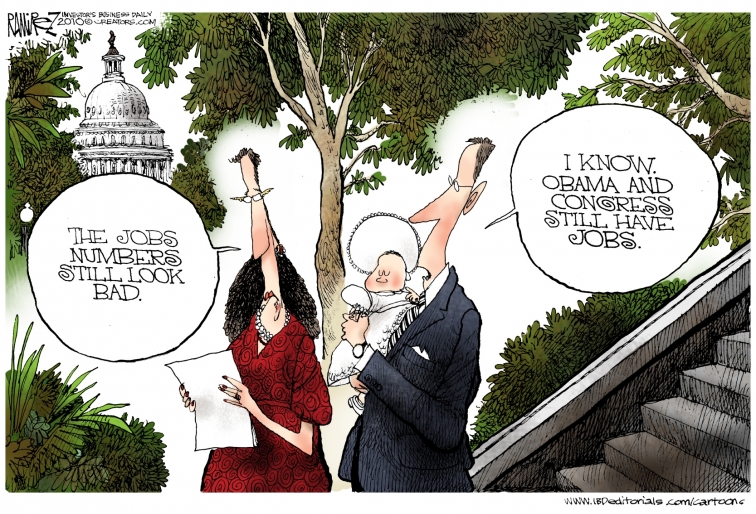
Ramirez Cartoon: The Jobs Numbers Still Look Bad…
Posted by Print

Below is one of the latest cartoons from two-time Pulitzer Prize-winner Michael Ramirez.

View more of Michael Ramirez’s cartoons on CFIF’s website here.

August 12th, 2010 at 9:15 pm
White House Aides Should Learn This Is Not the Time to Complain About Too Much Work

Victor Davis Hanson has some terrific commentary at National Review Online drawing out the distinctions between the well-paid, over-worked White House aides recently profiled by the New York Times, and the everyday Americans grinding it out during the Great Recession.

The Times wants to draw a sympathetic portrait of the heroic Obama cadre that suffers so much on our behalf. These are six-figure jobs that wear out one’s hands on the Blackberry, true, but serve as valuable stepping-stones to even higher-paying corporate jobs. And this is still a recession. This raise-the-bar griping will not go down well with the coal worker in Montana, the welder on a 30-story scaffold, or the oil worker offshore (e.g., it is not as if a Blackberry is going to blow up in one’s hands, or an acoustical tile is going to fall and crush one in the West Wing). It is all too reminiscent of the various explanations we’ve heard for why Michelle’s Costa del Sol sojourn was an understandable and much-needed refresher before the more arduous odyssey ahead on Martha’s Vineyard.

August 11th, 2010 at 8:28 pm
Conservative Quandry on the Link Between Unemployment Benefits and Job Creation

Everyone except Paul Krugman at least acknowledges that paying for the recently extended unemployment benefits Congress just authorized is a serious issue; even if some consider it outweighed by other concerns.

In addition to increasing the national debt, extending unemployment benefits may also increase unemployment itself.  As Thomas Cooley explains in Forbes, studies show that unemployment benefits can reduce the urgency to find a new job.  However, Cooley mentions another phenomenon that bears further meditation:

Economists Lawrence Katz and Bruce Meyer, in a 1990 study, showed that an increase of one week of benefits increased the duration of unemployment by about 0.2 weeks. Note that some benefits have been extended up to 99 weeks. A back-of-the-envelope calculation means that going from 26 weeks of benefits to 99 would increase unemployment duration by about 14 weeks very close to the increase in duration shown in Figure 3. Recently, however, in a testimony to the Joint Economic Committee (April 29, 2010) the very same Katz said that the effects are small. The difference between the 1990 study and his current finding is that, according to his research, permanent job losses as opposed to temporary layoffs have played a bigger part in this recession. (Emphasis mine)

Unlike Krugman, I’m not one to quibble with logic and empirical data.  But the current unemployment situation is different from the usual circumstance of entities within a sector reshuffling the staff rosters.  Such events cause minor displacements – though not to individual workers and their families – and can be smoothed out when laid off workers find comparable employment in the same or similar industry.

This recession is different.  As the bolded text above shows there appears to be an economy-wide reduction in workforce afoot.  Employers are discovering unknown efficiencies with contingency workers.  In many cases, former full-time, full-benefit workers are being hired back as independent contractors for project work with no benefits.

Once employers get used to getting more production for less compensation, those former full-time, full-benefit jobs won’t be coming back.  That poses a serious quandary for limited government conservatives.  Should government provide a benefits supplement for those working multiple jobs, but still failing to pay the bills, even if it means adding to the deficit?  On the other hand, should benefits be cut to stop the fiscal bleeding with the hope that the former recipients find a way to make ends meet?

Whatever path is chosen, conservatives need to think hard about how to combine stopping the government spending with policies that enable sustainable private sector job creation.

August 11th, 2010 at 10:58 am
More Than 150 Organizations, State Legislators and Bloggers Urge FCC to Abandon Plans to Regulate the Internet

In letters sent today to the Federal Communications Commission (“FCC”), the Center for Individual Freedom (“CFIF”) joined with more than 150 other organizations, state legislators and bloggers in urging the FCC to abandon its plans to regulate the Internet.

The letters were organized by Americans for Tax Reform.  One of the letters reads in part:

Despite universal acknowledgement that Americans enjoy a free, open, and vibrant Internet, the FCC is relentlessly pursuing a massive regulatory regime that would stifle broadband expansion, create congestion, slow Internet speeds, jeopardize job retention and growth, and lead to higher prices for consumers.

We oppose the FCC’s effort to regulate the Internet under Title II of the Communications Act of 1934, which was written during the depression era to regulate telephone monopolies – 60 years before the Internet was ever conceived. … This regulatory ‘reclassification’ would effectively turn innovative private Internet services into a public utility.

“The already free and open Internet has sparked unprecedented growth and innovation over the last decade precisely because it hasn’t been burdened with unnecessary regulation and taxation,” said CFIF President Jeffrey Mazzella.  “The reckless desires of three unelected FCC commissioners and a few radical fringe groups on the left that wish to turn the Internet into a government-controlled public utility now threaten to grind those wheels of Internet growth and innovation to a halt.

“The Courts have spoken.  A rare bipartisan majority in Congress opposes the FCC’s plans.  And, the American people reject this unnecessary and job-killing regulatory regime sought by the FCC,” Mazzella continued.  “It’s past time for the FCC to listen and abandon its plans for a government takeover the Internet.”

To read the letters send to the FCC, click here and here.

The Hill’s popular Hillicon Valley blog mentions the letters here.