Archive

Posts Tagged ‘Obamacare’
November 7th, 2014 at 5:45 pm
Supreme Court to Hear ObamaCare Subsidy Challenge

In a surprise move, the United States Supreme Court announced today it will hear a third challenge to ObamaCare in as many years.

The case, King v. Burwell, is one of many lawsuits challenging a controversial IRS decision to extend federal subsidies to any person eligible to buy insurance on an ObamaCare exchange. The legal fight is over whether the text of ObamaCare permits subsidies to be given to citizens purchasing health insurance through Healthcare.gov, the federal exchange, when the law clearly says they cannot.

Supporters of ObamaCare say the disputed statutory language amounts to typos inconsistent with the spirit and purpose of the law. Opponents insist that the plain meaning of the words be honored, or risk the rule of law taking a back seat to bureaucratic whim.

The timing of the Supreme Court’s decision means that oral arguments will be held sometime in the spring with a final decision likely next summer. If the challengers are successful, King v. Burwell may go down in history as the lawsuit that signaled the beginning of the end of ObamaCare.
November 5th, 2014 at 3:08 pm
Can Congressional GOP Hang Together on ObamaCare?

Conservative health policy experts Avik Roy and Gracie-Marie Turner both have interesting long reads on what the new Republican majority in Congress should do to transition away from ObamaCare towards a more market friendly alternative.

Both call for a unified strategy focused on repealing ObamaCare’s most unpopular elements and daring President Barack Obama to veto. Importantly, both want the GOP to leave the door open for a truly patient-centered alternative that reduces the government’s role while increasing access to quality health care. It’s a tall order with little consensus.

Roy and Turner each have specific pathways for achieving their goals, and it’s worth reading their articles to get a sense of where conservative health policy may be heading. However, the success of a conservative ObamaCare alternative ultimately comes down to whether House Speaker John Boehner (R-OH) and new Senate Majority Leader Mitch McConnell (R-KY) can corral enough of their members around a unified endpoint. That job is made trickier by the fact that the 2016 presidential campaign will soon be underway, with lots of Republican candidates keeping the specifics of their own ObamaCare alternatives close to the vest.

Going forward, the real goal for Boehner and McConnell is to get rid of what they can, minimize what they can’t and leave enough room for the 2016 presidential nominee to maneuver toward an alternative the public will support.

Easy? No. The price of leadership? You betcha.

November 3rd, 2014 at 5:09 pm
Fed Court Blocks Contraception Mandate Reporting Requirements

With its newest batch of regulations, the federal Department of Health and Human Services (HHS) essentially is telling non-profit religious employers that they can claim an exemption from ObamaCare’s contraception mandate, so long as they provide all the information necessary to violate the deeply held beliefs that justify the exemption.

As Lyle Denniston of SCOTUS Blog explains, the rules “also required the organization to tell the government what its health coverage plan for its employees was by name and type, and to provide contact information to the insurer operating the plan.

“The added information was designed to enable HHS to then take the initiative to arrange for the religious organization’s female employees to have contraceptive coverage at no cost, and with no cost to the organization itself.”

The controversial HHS rules came to light because of a legal challenge filed by a Catholic university in Florida. A federal judge blocked enforcement of the rules pending the outcome of the lawsuit.

A couple of observations immediately come to mind. First, there is no such thing as free contraception. If the insurance company must provide it “free” to some customers, it will then pass on the cost to others (e.g. higher premiums). Even the manpower at HHS spent on coordinating this run-around the First Amendment costs taxpayers money.

This brings up another point. How can it be that the federal agency charged with implementing ObamaCare has the resources and personnel available to investigate, negotiate and procure “free” contraception to the thousands (and more) employees working at exempt religious employers?

It’s not like there’s a public health crisis over lack of access to contraception. If HHS has so many extra people and dollars laying around, it should funnel them to real priorities like fighting Ebola, or perhaps, finishing ObamaCare’s main insurance portal before the second enrollment period begins in a matter of days.

Instead we get demands for information in order to make religious objectors participate in the very activity they cannot abide.

October 31st, 2014 at 9:47 am
ObamaScare: The ObamaCare Nightmare Continues
Posted by Print

In an interview with CFIF, Sally Pipes, President and the Taube Fellow in Health Care Studies at the Pacific Research Institute, discusses how the nightmare continues with the second open enrollment season for ObamaCare commencing November 15th, days after the mid-term elections, and why ObamaCare may be on shaky ground as court battles loom.

Listen to the interview here.

October 22nd, 2014 at 2:43 pm
Insurance Companies Got CMS Okay to Cancel Policies If ObamaCare Subsidies Invalidated

“Amy Lotven of the trade publication Inside Health Reform reports that before insurers agreed to sell coverage through the Patient Protection and Affordable Care Act’s health insurance Exchanges in 2015, they demanded that the federal Centers for Medicare and Medicaid Services explicitly agree to let them cancel policies if any of the Halbig cases succeed in blocking the subsidies that carriers had been receiving in the 36 states whose ObamaCare Exchanges were not, as [ObamaCare] requires before subsidies can flow, ‘established by the State’”, writes Michael Cannon.

You’ll recall that there is a big fight over whether the Obama administration is blatantly violating its own law by making subsidies available to people who don’t qualify under the statute. And, as Cannon points out, making illegal subsidies available also subjects up to 57 million individuals and employers to illegal penalties under ObamaCare’s individual and employer mandates.

That insurance companies demanded the right to cancel policies relying on subsidies shows how concerned the industry is at being blamed for high-cost coverage when and if the government’s policy is ruled illegal. That the Obama administration agreed indicates the strength of the argument that even the executive branch should follow the law.

October 21st, 2014 at 1:50 pm
Report: Without Subsidies, ObamaCare Enrollment in Death Spiral

“Without [ObamaCare’s] premium support, premiums rise by nearly 45 percent, and enrollment falls by nearly 70 percent,” says a report by RAND Health.

The analysis is part of an evaluation commissioned by the federal Department of Health and Human Services (HHS), the agency in charge of ObamaCare implementation.

The report’s publication follows on news that a federal district judge in Oklahoma ruled ObamaCare’s premium support (i.e. subsidies) mechanism is not available in states that use Healthcare.gov, the federal ObamaCare exchange. According to the text of the law, eligibility for subsidies depends on a citizen’s state operating its own exchange. If the law’s plain meaning is followed, RAND’s analysis will apply to citizens in more than half of the states.

The RAND Health report confirms a simple truth about ObamaCare – if people must pay the full freight of its “affordable” insurance, they will refuse.

H/T: The Daily Caller

October 20th, 2014 at 9:51 am
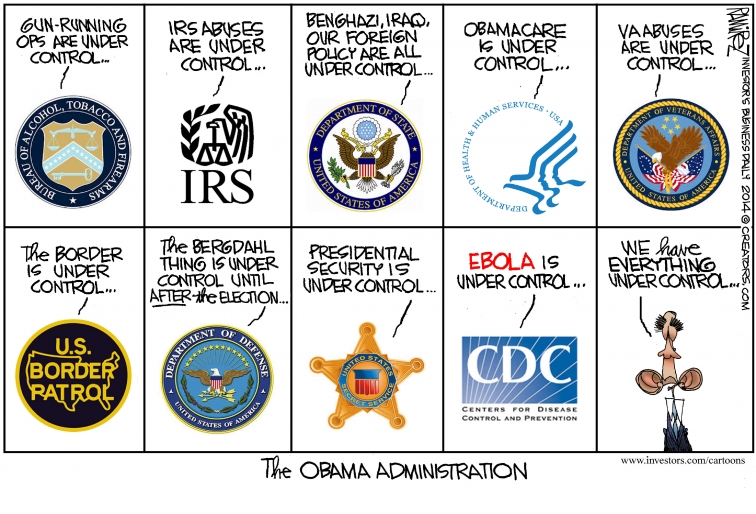
Ramirez Cartoon: The Obama Administration
Posted by Print

Below is one of the latest cartoons from two-time Pulitzer Prize-winner Michael Ramirez.

View more of Michael Ramirez’s cartoons on CFIF’s website here.

October 14th, 2014 at 12:06 pm
ObamaCare: Welcome to Politicized Medicine

Next year’s ObamaCare premiums won’t be available through Healthcare.gov – the federal insurance portal servicing 26 states – until the week after the November 4th midterm elections.

“Insurers say one big challenge for next year will involve millions of returning customers,” the AP reports. “It’s not really a technology issue, but a time crunch that also coincides with the Thanksgiving and Christmas holidays.”

In this case, it’s not the health insurance companies who are to blame, but rather the Obama administration. Late last year when Healthcare.gov was glitching its way into infamy, news leaked that the enrollment period for 2015 would be pushed back a month – from October 15 to November 15. Everybody who could read a political calendar knew the primary motivation was to hide the true cost of ObamaCare’s second year premiums from voters before going to the polls.

This is just one more reason why it’s a bad idea to have the government in control of health care pricing – those responsible will never allow the public to hold them accountable.

H/T: Townhall Tipsheet

October 9th, 2014 at 3:15 pm
Arkansas’ Medicaid Expansion Violated Obama HHS’ Own Budget Neutrality Rules

The Government Accountability Office (GAO) says that the State of Arkansas and the federal Department of Health and Human Services (HHS) violated federal guidelines when they agreed to expand Medicaid under a “private option” plan.

Arkansas was one of the first states to get permission from the Obama administration to expand Medicaid, but on different terms than laid out in ObamaCare.

Medicaid is the state-federal program that pays for health care services for the nation’s poor and disabled.

Under normal circumstances, Arkansas would only be allowed to get a waiver from ObamaCare’s expansion structure if it could prove that its plan would be budget neutral.

Guess what happened instead.

“According to federal regulations, the U.S. Department of Health and Human Services (HHS) has certain procedures they must follow when reviewing state requests for Medicaid waivers,” write experts at the Foundation for Government Accountability.

“One key component of any waiver is budget neutrality: states seeking waivers must demonstrate that they will not spend any more federal dollars under the waiver than they would have without the waiver. But as it turns out, the Obama Administration cut corners and ‘did not ensure budget neutrality’ requirements were actually met before approving Arkansas’ ObamaCare expansion.”

The result is an additional $778 million more in spending on Arkansas’ version of Medicaid expansion than would have occurred had HHS insisted on following its own budget neutrality rules.

The entire analysis of the GAO’s report is worth reading since it explains other serious problems with the Arkansas plan. Perhaps the most egregious is the depth at which the Democratic governor’s office and loyal state agencies went to mislead Republican state legislators on the true cost of the expansion. Evidence of bad faith negotiations like this make it impossible to have a substantive policy conversation. Even now there are reports that the governor is peddling incorrect information, and trying to silence opposition.

What’s emerging from the Arkansas fiasco is the extent to which supporters of bigger government will go to entrench their policies – truth, fairness and accountability be damned.

October 7th, 2014 at 6:06 pm
Pence-HHS Negotiations over How to Expand Medicaid Stall

A months-long negotiation over whether and how Indiana might expand Medicaid under ObamaCare may be coming to an impasse.

On Monday, Indiana Republican Governor Mike Pence emerged from a meeting with federal Health and Human Services Secretary Sylvia Burwell Mathews without any positive news.

“We had a substantive discussion, but we are not there yet,” Pence said in a statement quoted by the Indianapolis Star.

At issue is whether Indiana will be able to use ObamaCare’s Medicaid expansion dollars in a way that moves the program in a more market-friendly direction. As I’ve written before, conservatives can support reforms to entitlement programs so long as they move in that direction.

With HHS refusing to let Indiana require modest co-pays under its expanded Medicaid plain, the next move is up to Pence. He could weaken his proposal, but doing so would sacrifice any pretense his plan has for being fiscally conservative. On the other hand, he could stand firm on principle and absorb the potentially damaging criticism that he’s leaving almost $1 billion in federal Medicaid payments on the table – all of which is new taxpayer-financed spending.

Pence is thought to be a dark horse GOP candidate for president in 2016. His decision on this policy issue will go a long way towards determining how viable such a campaign would be.

October 6th, 2014 at 6:49 pm
Expert: ObamaCare Bailout of Insurance Industry Similar to Bush Era Prescription Drug Program

The Obama administration has been catching some flak over its intent to redirect taxpayer dollars toward a controversial “risk corridor” program designed to bailout ObamaCare-friendly health insurance companies that lose too much money.

The primary line of attack stems from the absence of any specific congressional appropriations to fund the program. Congressional Republicans and the Government Accountability Office say this precludes any end-run maneuvers to pay for it anyway, while the Obama administration is ignoring opposition.

But in the drive to add this abuse of executive discretion to President Barack Obama’s long list of power grabs, a bit of history is sure to make Republican critics think twice before pushing much farther.

“But Loren Adler, research director for the Committee for a Responsible Federal Budget, points out that a similar risk-protection program in the Medicare prescription drug program does not receive an explicit annual appropriation, yet has not been challenged,” reports an entry on the Modern Health Care blog. “He thinks that makes it highly unlikely that HHS will be deterred from making the payments to insurers under the risk corridors program.”

Indeed, any federal judge reviewing a future legal challenge to HHS’ pending move would very likely analogize the two programs and conclude that if Congress has not objected to the practice in one instance, and the two cases are similar, it probably intended to defer on both. In such a scenario, the end result is a judge (rightly) telling Congress to speak more clearly and fix the law.

The upshot of all this is that it makes everyone painfully aware of how important it is for Congress to pass clear laws. Republicans aren’t responsible for ObamaCare’s poor draftsmanship, but if they ever get enough power to make changes, they should take care to make them unambiguous to interpret.

October 3rd, 2014 at 11:24 am
ObamaCare Nearing a Fannie and Freddie-Style Bailout of Insurance Companies?

Could ObamaCare’s “risk corridor” program become the health insurance industry’s equivalent of Fannie Mae and Freddie Mac – the federally funded entities that spent $180 billion bailing out banks who issued subprime mortgages?

Stephen Moore, the chief economist at the Heritage Foundation, thinks so.

“But insurance experts warn that [the risk corridor] program creates the same moral hazard problem for health insurance that we saw in the mortgage market with Fannie Mae and Freddie Mac,” Moore writes at Investor’s Business Daily. “The guarantee on bad mortgages encouraged bad mortgages. The guarantee against losses on ObamaCare enrollees encourages insurers to toss sound underwriting standards out the window. This didn’t turn out so well with Fannie and Freddie, which received a taxpayer-funded bailout of more than $180 billion after issuing subprime mortgages that should never have been written.”

Moore goes on to say that surveys of health insurance companies selling plans on ObamaCare exchanges say that the vast majority expect to receive a payment from the federal government to cover their losses. Estimates for the first year near $1 billion. And, since there is no cap to how much the feds will reimburse, there is no limit to how much money a company can lose and still expect a check from Uncle Sam.

Despite all this, the Obama administration is chugging ahead with plans to make payments under the risk corridor program without explicit congressional appropriations. Republicans are contesting President Barack Obama’s authority to do this – with an assist from a recent GAO legal opinion – but they should really train their fire on eliminating the risk corridor program as is. As with IRS tax credits, ObamaCare can’t survive without a convoluted shell game that hides the true cost of health care.

We’ll never get health care policy right until we can talk honestly about how it’s funded. Now would be a good time for the GOP to being that process.

October 1st, 2014 at 6:29 pm
GAO Says CMS Lacks Authority to Bail Out ObamaCare Insurers

It’s been a rough couple of weeks for power-hungry bureaucrats.

Recently, the General Accountability Office (GAO) issued a report faulting the Centers for Medicare and Medicaid Services (CMS) for being unable to produce itemized spending documents, and thus not complying with federal audit guidelines.

This week, the non-partisan government watchdog agency issued a legal opinion saying CMS does not have the authority to bail out ObamaCare-aligned insurance companies, unless Congress agrees.

GAO’s non-binding but influential legal opinion was generated by a request from congressional Republicans concerned about a CMS announcement that it would use money appropriated for other activities to fund ObamaCare’s “risk corridor” program.

Risk corridors refer to a scheme within ObamaCare to compensate insurance companies who lose more than a specified amount of money covering high-cost patients. Initially, funds are redistributed from highly profitable companies. But if the losses exceed a certain threshold, federal taxpayers step in via CMS, the primary agency implementing ObamaCare.

With all of ObamaCare’s pricey mandates – most importantly “guaranteed issue,” which requires insurers to enroll customers with preexisting conditions – there is concern that significant losses among participating companies could put taxpayers on the hook to bailout several firms in the health insurance industry.

It’s worth noting that GAO released its legal opinion on the same day Federal District Judge Ronald A. White struck down a similar bureaucratic power grab by the Internal Revenue Service. While the timing is unconnected, the central issue is not. In both cases agencies within the Obama administration are attempting an end run around the plain meaning of a statute in order to make the president’s legacy program appear to work better than it is.

The rule of law is more important than avoiding bad press for a poorly written bill. Bravo to the GAO and Judge White for having the courage to hold the executive branch accountable.

September 30th, 2014 at 7:25 pm
HHS’ Burwell Caught Low-Balling Congress on Cost of Healthcare.gov

A new report by Bloomberg Government indicates that Sylvia Burwell, the Secretary of Health and Human Services (HHS), gave a potentially misleading answer when she told Congress that Healthcare.gov – the federal government’s ObamaCare portal – cost taxpayers $834 million to build.

Nicole Kaeding at the CATO Institute teases out some of the unstated, but related, costs that balloon the overall price tag to $2.14 billion, far north of Burwell’s testimony.

I’ve summarized them here as bullet points:

  • $300 million contract to process paper applications to serve as backups to electronic files
  • $387 million for real-time interfacing between the IRS and Healthcare.gov to verify income and family size for insurance subsidy calculations
  • $400 million in accounting tricks HHS used to pay for creating Healthcare.gov when 26 states refused to take federal start-up grants to build their own. Congress made no appropriations to build Healthcare.gov, so HHS shifted money from other units to fund the project.
  • $255 million in spending between February 2014 – the end of Burwell’s timeline – and August 20, 2014, the most recent information available. Bloomberg also included projected spending at current levels through September 30, 2014, the end of the fiscal year.

These are the kinds of expenses that Members of Congress would expect the HHS Secretary to include when testifying about full cost of a program. The fact that Burwell gave a low-ball estimate when these figures were easily accessible to her or her staff weakens her credibility as an honest broker of information. As her departing colleague Eric Holder knows, once Congress loses its ability to trust a Cabinet official, the gloves come off.

September 29th, 2014 at 5:07 pm
California’s ObamaCare Exchange Can’t Match Doctors to Plans

If you purchase an ObamaCare plan in California, good luck trying to find a directory that matches your insurance policy with a specific doctor.

“Altogether, the 10 insurers in Covered California have contracted with an estimated 75% of California’s licensed physicians, or nearly 90% of those considered active in the state,” reports the Los Angeles Times. “However, many of those doctors are available in just one or two health plans.”

That is, if you can find them.

“There’s no timetable for a state provider directory after the exchange scrapped an initial version that was riddled with errors. Instead, Covered California refers people to insurance company websites that vary in usefulness,” says the paper.

The resulting anger and confusion has spawned almost 300 complaints to state regulators and two consumer lawsuits against some of the biggest insurance companies in California.

Doctors are getting hosed too, according to the report. “Insurers say they can pass along savings by paying doctors less and rewarding that select group with higher patient volume. It’s also hoped those doctors will take on a bigger role coordinating patient care.”

To clarify, in return for getting paid less doctors that accept ObamaCare-compliant plans are getting more patients and more exposure to medical malpractice lawsuits.

No wonder there’s no directory matching providers to plans. The docs want to hide!

September 26th, 2014 at 10:46 am
Video: Why ObamaCare Still Matters
Posted by Print

In this week’s Freedom Minute, CFIF’s Renee Giachino explains why ObamaCare still matters and why the American people must continue to hold their representatives in Congress accountable on the issue.

September 24th, 2014 at 3:05 pm
ObamaCare’s Coverage Gaps Will Kill Good Health Insurance

If you’ve tried to buy insurance on an ObamaCare exchange, you’re familiar with the four levels of coverage available: Bronze, Silver, Gold and Platinum. Each level covers a set percentage of costs should you incur health-related expenses.

For example, a Bronze plan covers 58-62 percent, a Silver plan 68-72 percent, Gold 78-82 percent and Platinum 88-92 percent.

Notice, however, that there are gaps between the coverage levels.

Recall as well that ObamaCare’s coverage requirements get tweaked from year-to-year, changing the actuarial value – i.e. the percentage of covered benefits the insurance company is expected to pay – each year.

Here’s the problem.

“Suppose you are in a Bronze plan with an actuarial value of 58 percent. Then, a year from now, because of price changes, technology changes, or some other kind of change, your plan suddenly covers 64 percent of expected expenses. That’s good for you, right? Wrong. Because your plan no longer fits into one of the metallic corridors, it’s no longer a valid plan – despite the fact that it has become a better plan,” explains John C. Goodman, a conservative health policy expert.

The same is true at the other end of the coverage spectrum.

“Now let’s suppose you have a really good plan – a plan that pays 98% of expected health care costs,” writes Goodman. “Given the large number of Democrats who believe that health insurance should pay almost every medical bill, you would think that the law passed by a Democratic Congress without a single Republican vote would strongly encourage such a plan. If you’re inclined to think that, you are mistaken, however.

“Any plan that pays more than 92% of expected health care costs for the average enrollee is illegal under Obamacare.”

Get ready to change your health insurance more often than you change your auto insurance.

September 23rd, 2014 at 5:24 pm
New ObamaCare Glitch Could Cost Doctors Millions

Doctors who spent heavily trying to comply with ObamaCare’s electronic health records mandate could still be hit with costly penalties.

ObamaCare gives doctors until October 1, 2014, to switch from paper-based to electronic health records. Failure to comply results in losing 1 percent of federal reimbursements for treating Medicare patients.

Here’s the rub.

“[P]hysicians who went electronic for the first time this year are discovering that [the Centers for Medicare and Medicaid Services, or CMS] won’t be ready to officially register the evidence of their work until mid-October. That means they will miss the Oct. 1 deadline, and CMS will withhold 1 percent of their 2015 Medicare payments,” reports Politico.

That means that a doctors’ group like Morganton Eye Physicians in North Carolina spent $1.3 million to buy and implement new software – and added $250,000 to its annual operating budget – only to be threatened with a $65,000 penalty because the federal government can’t meet its own compliance deadline.

One would think CMS has a moral obligation to waive compliance until the agency is able to do its job, but so far it’s requiring doctors to submit to a cumbersome hardship process. How does a business politely explain that the hardship exists completely because of government ineptitude?

Welcome to ObamaCare’s bureaucratic hell. More episodes to follow.

September 22nd, 2014 at 6:49 pm
ObamaCare’s 7.3 Million Enrollments May be False

Last week the Obama administration released its first official headcount of ObamaCare enrollments since applauding itself for 8 million initial sign-ups.

The current enrollment is 7.3 million, according to the Centers for Medicare and Medicaid Services (CMS).

But there’s reason to be suspicious.

“Under ObamaCare, after a person has paid their first premium, a health plan can’t cancel anyone until they have gone three months without making a payment,” writes health care policy expert Bob Laszewski.

By saying that the 7.3 million number includes all enrollments that have occurred through mid-August, CMS is “effectively double counting by including the ‘adds’ while also keeping the ‘deletes’.” That means the 7.3 figure “also still includes every person who has failed to make a premium payment in June, July, and August – since the carriers can’t yet knock them off the rolls,” explains Laszewski. “The health plans tell me there is a 2% to 4% monthly attrition rate. That means the 7.3 million could be overstated by 6% to 12% of the total.”

Unfortunately, the most transparent administration in history refuses to release the monthly enrollment numbers since ObamaCare went online. That makes it impossible to verify whether the 7.3 million is accurate.

If the Obama administration is so proud of its new number, why not release the data on which it’s based?

September 16th, 2014 at 7:03 pm
Top Minnesota ObamaCare Insurer Leaving Exchange

The largest player on Minnesota’s ObamaCare exchange is dropping out, and not even the promise of federal subsidies can get it back.

Earlier today PreferredOne – an insurance company that covered 59 percent of Minnesota’s ObamaCare population – announced that it will not offer health care plans next year paid for with ObamaCare subsidies.

Apparently, the decision is being driven by high administrative costs associated with doing business with MNsure. Even after hiring an additional 50 workers to handle the exchange’s post-launch fixes and tweaks, PreferredOne says continuing to participate is financially unsustainable.

The move makes it likely that MNsure’s ObamaCare rates will jump since PreferredOne sold the lowest cost option. Those rates will be released sometime in October – just weeks before the midterm elections.