March 13th, 2020 at 1:13 pm
Image of the Day: Patent Rights and U.S. Pharmaceutical Leadership
Posted by Print

In our Liberty Update this week, we emphasize the critical role that strong patent rights play in U.S. pharmaceutical innovation.  Although the U.S. accounts for just 4% of the world’s population and 24% of the global economy, we account for an astonishing 2/3 of new drugs introduced worldwide, as this helpful image illustrates perfectly:

Patent Rights Protect U.S. Pharmaceutical Innovation Leadership

Patent Rights = Global Pharmaceutical Innovation Leadership


Strong patent protections, along with our more market-oriented approach, have made America the world leader in pharmaceutical innovation.  At a moment like this amid the coronavirus pandemic, it’s more important than ever to protect that legacy and oppose misguided efforts by some in Congress to undermine it.


March 6th, 2020 at 8:46 am
Breaking: Incredible U.S. Jobs Growth in February
Posted by Print

This is incredible.  Amid the coronavirus scare and economic malaise across the rest of the world, the Labor Department reports that job growth in the U.S. exceeded expectations by 100,000 in February:

Nonfarm payrolls grew far more than expected in February as companies continued to hire amid a growing coronavirus scare.  The Labor Department reported Friday that the U.S. economy added 273,000 new jobs during the month, while the unemployment rate was 3.5%.  Economists surveyed by Dow Jones had been looking for payroll growth of 175,000 and a 3.5% jobless level.  Average hourly earnings grew by 3% over the past year, in line with estimates.”

Although the effects of the coronavirus create uncertainty going forward, the Trump Bump has continued.


February 28th, 2020 at 11:12 am
“Money in Politics for Me, but Not for Thee” — More Leftist Hypocrisy
Posted by Print

In this week’s Liberty Update, we highlight the ironic absurdity of the “authentic” label constantly applied to 2020 Democratic presidential candidate Bernie Sanders, as his long career exposes him as perhaps the least authentic candidate of all.  His behavior simply doesn’t match his professed beliefs, including on so-called “campaign finance reform” laws (which violate Americans’ First Amendment rights).

In that vein, The Washington Post today highlights how the powerful Service Employees International Union (SEIU), perhaps the most powerful labor union of all, plans on spending a whopping $150 million – a record amount – to elect Democrats in November:

The Service Employees International Union plans to spend $150 million this year to get out the vote for Democrats in November, its largest political investment ever.

The union will deploy canvassers across more than 40 states, but its efforts will mainly focus on turning out infrequent voters from the African American and Latino communities across the eight battleground states of Colorado, Florida, Michigan, Minnesota, Nevada, Pennsylvania, Virginia and Wisconsin.

SEIU President Mary Kay Henry previewed the strategy to defeat President Trump during an extended interview in her office off DuPont Circle in Washington.  The union, which represents 2 million members, has opted not to endorse in the presidential primary, at least for now, but to focus instead on building a massive field operation to help whoever emerges from the convention this summer, as well as Democrats down the ballot.”

Wait…  A DuPont Circle office?  Pretty posh for an organization pretending to represent the interests of working-class members.  And if things are as bad for American workers today as the SEIU and leftists constantly claim despite all of the evidence to the contrary, why are they redirecting $150 million from dues paid by their own members toward nakedly partisan political purposes?

And more broadly, aren’t leftists the ones constantly claiming that we must “get money out of politics?”  Any chance that any of the Democratic candidates who stand to benefit from this will call them out and practice what they preach?

Don’t risk suffocation by holding your breath.


February 24th, 2020 at 4:44 pm
Sen. McSally Must Avoid the Trap of Counterproductive Prescription Drug Legislation
Posted by Print

Senator Martha McSally (R – Arizona) has broadly proven herself a stalwart ally of conservatives, libertarians and the Trump Administration in her brief tenure on Capitol Hill.  A former U.S. Air Force A-10 pilot, her votes have confirmed President Trump’s phenomenal array of judicial nominees and advanced his economic agenda to bring us arguably the greatest economic conditions in history.

She must be careful, however, to avoid potentially catastrophic missteps on the issue of healthcare and prescription drugs.

Specifically, Sen. McSally has introduced legislation and supported other Senate Finance Committee proposals that would introduce drug price controls from socialist foreign healthcare systems to the U.S., empower the Department of Health and Human  Services (HHS) to directly and bureaucratically negotiate pharmaceutical prices, allow importation of potentially dangerous drugs from foreign countries and introduce components that would erode our world-leading patent system.

It’s not by accident that the U.S. accounts for over two-thirds of all new lifesaving and life-improving pharmaceuticals introduced to the world – it’s the direct result of our strong patent protections here, and our more market-oriented approach.  In contrast, foreign nations that have introduced the principles contained in some of Sen. McSally’s legislation and bills that she supports inevitably suffer shortages, as even the United Nations World Health Organization (WHO) has acknowledged:

Every time one country demands a lower price, it leads to lower price reference used by other countries.  Such price controls, combined with the threat of market lockout or intellectual property infringement, prevent drug companies from charging market rates for their products, while delaying the availability of new cures to patients living in countries implementing those policies.

Of all new cancer drugs developed worldwide between 2011 and 2018, 96% were available to American consumers. Meanwhile, only 56% of those drugs became available in the Canda, 50% in Japan and just 11% in Greece, as just three examples. Patients in nations imposing drug price controls simply don’t receive access to new pharmaceuticals as quickly as Americans, if they ever receive them at all.

Senator McSally mustn’t sacrifice her conservative principles on behalf of prescription drug legislation that will make matters worse for American consumers, not better.  She should withdraw her proposed bill and renounce the Senate Finance Committee’s proposal, and instead support more market-based solutions that have proven effective not only with pharmaceuticals, but across all economic realms.


February 14th, 2020 at 10:06 am
Image of the Day: Economy Even Better Than We Realized
Posted by Print

Americans already expressed record satisfaction on economic conditions in the U.S., over three years into President Trump’s tenure.  Turns out that things are even better than we initially realized, as employment data from the end of 2019 was just significantly updated:

.

Even Better Than Initially Realized

Even Better Than First Realized


.


February 4th, 2020 at 3:37 pm
Congressional Proposals Targeting Consumer Finance Lending Will Harm Lower-Income Americans They Claim to Protect
Posted by Print

This week, the House Financial Services Committee – headed by far-left Representative Maxine Waters (D – California) – holds a hearing on the issue of loan services to struggling American consumers, including legislation that would make matters worse in the name of claiming to help them, such as the so-called “Veterans and Consumers Fair Credit Act.”

On a superficial level, federal legislation regulating lending services and capping repayment rates may seem helpful to Americans struggling paycheck-to-paycheck.  But the real-world impact only eliminates a source of reliable, legal short-term loans to get them through temporary emergencies.

According to the Federal Reserve System’s Board of Governors in a study on the economic wellbeing of U.S. households in 2018, nearly 40% of American families don’t possess sufficient savings to cover even a $400 emergency expense. Incredibly, 51% of military service members live paycheck-to-paycheck.

In such circumstances, credit cards aren’t always a viable option for them, and a more traditional bank loan isn’t an option due to the small amount needed.  Whereas higher-income Americans with stronger credit history are able to borrow from banks, use assets they possess as leverage or use their savings amounts, those with lower credit scores and without sufficient savings cannot.  In fact according to the Fair Isaac Corporation, some 46% of consumers possess credit scores below 700, meaning that traditional bank loans aren’t possible for them.

In such circumstances, struggling Americans can access the money they need for the short-term via consumer finance loans.  But under the sorts of legislation contemplated by the House and pushed by leftists who think they know better, consumer finance lending will become less available.

And the unintended consequence will be more people seeking out illegal loansharks, suffering overdrafts, or simply being unable to cover their temporary costs.  As the World Bank found, such regulatory and legislative proposals lead to “increases in non-interest fees and commissions; reduced price transparency; lower number of institutions and reduced branch density; and adverse impacts on bank profitability, in addition to the lack of access for smaller and riskier borrowers.”

That’s not fair, nor does it help the people that such legislation claims to protect.  For that reason, all of our elected leaders should reject this chimerical effort, which would only serve to make consumer finance lending more difficult and more expensive.


February 3rd, 2020 at 4:46 pm
President Trump Should Again Reject Socialism, Including HHS’s Drug Price Control Proposal
Posted by Print

During his 2019 State of the Union address, President Donald Trump confidently stated, “We will never be a socialist country.”  Today, however, his Department of Health and Human Services (HHS) is pushing an International Pricing Index (IPI) proposal, a socialist policy idea that would peg what Medicare Part B pays for prescription drugs to prices in other developed countries. Simply stated, the IPI proposal would require the U.S. to adopt the price controls of foreign nations that have socialized medicine policies.

Here’s hoping that at this year’s SOTU, President Trump sticks to his guns and continues to reject socialist policies, including HHS’s destructive IPI proposal.

To understand how bad the IPI proposal is, consider this: Its two most vocal proponents in Congress are Speaker of the House Nancy Pelosi and self-proclaimed socialist Senator Bernie Sanders.

Speaker Pelosi’s proposed H.R. 3, among other things, applies the IPI rate-setting model to the U.S. drug market.  It’s noteworthy that the White House Council of Economic Advisors rightly says that, “the threat [H.R. 3] poses to continued medical innovation will harm American patients in ways that far outweigh any benefits.”  That’s because rate setting restricts access to life saving medicines.  For example, in many European counties, patients have to wait about a year, sometimes longer, to access new cancer medicines.  No patient should suffer that risk. In the U.S., in contrast, patients wait an average of only 3 months and have access to a far greater variety of medicines.

The IPI proposal would also diminish U.S. economic leadership in biopharma innovation.  That industry is an economic engine that supports 4 million U.S. jobs and invests billions of dollars in R&D in the United States – roughly $80 billion in 2018 alone.

Simply put, HHS’s misguided IPI proposal amounts to socialized medicine. If President Trump is true to his declaration at last year’s SOTU, he will banish it to the dustbin of history.


January 28th, 2020 at 9:55 am
Image of the Day: Another View of Those Helped in Trump Economy
Posted by Print

From our friends at the Senate Joint Economic Committee (JEC), another helpful perspective on how President Trump’s economic agenda has helped those who need it most, in contrast to his predecessor who only claimed his policies pursued that end:

.

Trump Economy Boosts Those Most in Need

Trump Economy Boosts Those Most In Need

.


January 24th, 2020 at 12:34 pm
Image of the Day: More Fantastic News from Gallup – Economic Confidence Highest Since 2000
Posted by Print

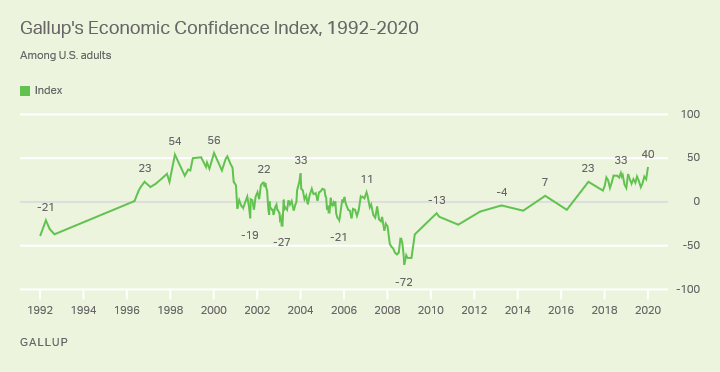
More phenomenal news from Gallup.  Consumer spending accounts for approximately two-thirds of the U.S. economy, and economic confidence has now reached its highest point since 2000, when the mainstream media couldn’t stop talking about how great things were.  Thank you, deregulation and tax cuts.

.

Thank You, Tax Cuts and Deregulation

Thank You, Tax Cuts and Deregulation


.


January 22nd, 2020 at 8:22 pm
Image of the Day: The U.S. Remains a Center/Right Nation
Posted by Print

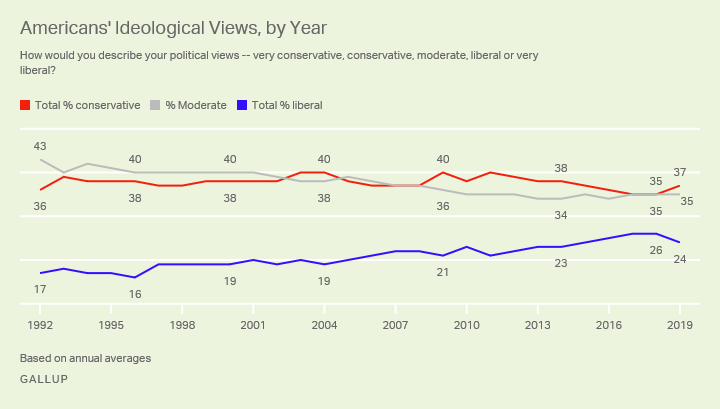
As an encouraging Image of the Day, rumors of conservatism’s demise have obviously been greatly exaggerated.  As illustrated by Gallup, the number of Americans labeling themselves “conservative” or “very conservative” has actually increased over the past three decades.  A significant 72% supermajority of Americans are either conservative or moderate, with conservatives actually leading the way with 37%:

.

Conservatives Outnumber Both Moderates and Liberals

Conservatives Outnumber Both Moderates and Liberals

.


January 13th, 2020 at 3:53 pm
On Sabre/Farelogix Merger, DOJ Mustn’t Undertake a Misguided Antitrust Boondoggle
Posted by Print

The U.S. travel technology firm Sabre may not ring an immediate bell, and perhaps you’ve not yet heard of its proposed acquisition of Farelogix, but it looms as one of the most important antitrust cases to approach trial since AT&T/Time-Warner.

The transaction’s most significant aspect is the way in which it offers a perfect illustration of overzealous bureaucratic antitrust enforcement, and the way that can delay and also punish American consumers.

Specifically, the transaction enhances rather than inhibits market competition, and will benefit both travelers and the travel industry by accelerating innovation.  That’s in part because Sabre and Farelogix aren’t head-to-head market competitors, but rather complementary businesses.  While Sabre serves customers throughout the industry – such as travel agencies, travel management companies and travel providers – Farelogix serves only a limited number of airlines.  Additionally, Farelogix remains small and growth-constrained, with only $7 million in revenues generated in the U.S. last year via its most important product offering, Open Connect.

Furthermore, Farelogix’s technology is based on the “New Distribution Capability,” a non-proprietary standard that dozens of companies as well as airlines already use. In its roughly 10 years of existence, Farelogix has been unable to gain meaningful traction in the airline industry. This is due to Farelogix’s demonstrated inability to scale its offerings, its position as simply an IT input among numerous competitors, and the growing industry realization that its product cannot substitute for the suite of services GDSs, like Sabre, provide.

In contrast, Sabre possesses the scale and resources to better leverage Farelogix’s products and talent to the benefit of both companies’ customers and travelers more generally. By acquiring Farelogix, Sabre can maximize value and convenience to its airline and agency customers and accelerate the delivery of a comprehensive platform for retailing and distribution that will drive competition and offer a high-value product for all customers.

Accordingly, considering the challenges and costs associated with those beneficial and critical objectives, the proposed acquisition shouldn’t be needlessly and unfairly delayed from improving the travel marketplace.

Unfortunately, the Department of Justice (DOJ) in its misplaced complaint bungles several important details.

For instance, contrary to the DOJ’s assertion, Sabre doesn’t seek to “kill” Farelogix. To the contrary, Sabre has repeatedly committed to maintaining current pricing, service levels and investment for existing Farelogix products.  The DOJ also gets it wrong in labeling U.S.-based Sabre the “dominant” company in the industry, as Spanish rival Amadeus is significantly larger and already possesses the NDC-based capabilities that Sabre hopes to acquire from Farelogix.  The DOJ also erroneously defines the relevant market in domestic terms only, because these companies operate in what is a decidedly global marketplace, with providers servicing customers worldwide, regardless of geography.

So why does the DOJ hope to prevent Sabre from acquiring and investing in the same capabilities as its larger Spanish rival – capabilities that must be scaled in order for the industry to satisfy consumers’ needs?  Sabre’s focus remains driving change, not entrenching the status quo.  Sabre’s CEO once ran Frontier Airlines, and has spent the past three years transforming Sabre into an agile, modern business. The proposed Farelogix acquisition is a critical part of that effort.

The DOJ has stubbornly and illogically opposed previous complimentary mergers, like AT&T/Time-Warner, and lost. They should expect the same outcome here.

Hopefully, the DOJ considers the facts before it repeats similar missteps, and needlessly penalizes global travelers in the meantime.  It shouldn’t remain stuck in the past while attempting to keep travel consumers stuck there with them.


January 8th, 2020 at 12:02 pm
Image of the Day: Lowest-Wage Industries Benefit Most Under Trump
Posted by Print

From the official federal Bureau of Labor Statistics and our friends at the American Enterprise Institute (AEI), a nice visualization of how the Trump economic agenda has most benefited those in the lower-wage industries starting in 2018 after tax reform took effect.  So much for leftists’ class warfare attacks on tax cuts and deregulation.


A Trump Bump

A Trump Bump


December 11th, 2019 at 3:44 pm
CFIF Files Comments in Support of IRS Rulemaking to Protect Donor Privacy
Posted by Print
In formal comments filed with the Internal Revenue Service (“IRS”) this week, the Center for Individual Freedom (“CFIF”) offered strong support for the IRS’s proposed rulemaking to eliminate the requirement that certain nonprofit organizations provide the names and addresses of contributors on Schedule B of their annual tax filings.

As CFIF notes in its filing, “the Proposed Rulemaking would help protect the First Amendment rights of subject organizations and their citizen donors, without negatively impacting the legally permissible handling of the nation’s tax laws or 501(c) organization tax filings.”

Read CFIF’s comments here (PDF).


December 6th, 2019 at 12:41 pm
Members of Congress Stand Up for Property Rights
Posted by Print

In rare but refreshing bipartisan good news out of Congress, Senator Thom Tillis (R – North Carolina) and Representatives Ben Cline (R – Virginia), Theodore Deutch (D – Florida), Martha Roby (R – Alabama) and Harley Rouda (D – California) have just taken a firm stand protecting property rights – copyrights specifically – and merit our praise.

As we’ve long highlighted, property rights constitute a central pillar of “American Exceptionalism,” and that includes intellectual property (IP) rights – copyrights, patents, trademarks and trade secrets.   Our Founding Fathers considered IP so important that they deliberately and explicitly singled it out for protection in the text of the Constitution.  As a direct result, we’ve become the most innovative and prosperous nation in human history.  And it’s not even close.

For that reason, it comes as welcome news that Senator Tillis and Representatives Cline, Deutch, Roby and Rouda recently sent a letter to the American Law Institute (ALI) to question its curious decision to develop what’s known as a “restatement” of copyright law, which Congress has already legislated over years, decades and even centuries.

For non-lawyers unacquainted with ALI, it’s an organization established in 1923 that issues what are known as “Restatements” that summarize common law principles such as contract or tort laws.  Accordingly, Restatements can assist law students, lawyers, judges or other professionals about various legal concepts as a helpful handy reference.

As Senator Tillis and Representatives Cline, Deutch, Roby and Rouda correctly point out in their December 3 letter, however, the ALI has joined too many other organizations such as the American Bar Association (ABA) in undertaking a more left-leaning political and ideological mission in recent years.  None other than Supreme Court Justice Antonin Scalia cogently highlighted that concern, as the letter notes:

The late Justice Antonin Scalia, who was the most frequent author of opinions citing ALI publications in nine opinions, wrote that ‘modern’ Restatements “are of questionable value, and must be used with caution.’  He added that, ‘[o]ver time, the Restatements’ authors have abandoned the mission of describing the law, and have chosen instead to set forth their aspirations for what the law ought to be.’  In his dissent in Kansas v. Nebraska, Justice Scalia stated that newer Restatements ‘should be given no weight whatever as to the current state of the law, and no more weight regarding what the law ought to be than the recommendation of any respected lawyer or scholar.’”

Their letter notes that Justice Scalia was not alone.  Rather, “many states have also begun to repudiate the more recent and controversial Restatement projects,” and the U.S. Copyright Office, the U.S. Patent and Trademark Office, the ABA’s own IP Law section and numerous judges and academics have expressed similar concerns.

And as it relates to copyrights, the letter wisely emphasizes that the ALI’s latest effort is particularly inappropriate:

Traditionally, Restatements have focused almost exclusively on areas of common law because judicial rulings across different jurisdictions may vary and ALI’s interpretations are predisposed to assembly, analysis, and summaries.  By contrast, laws created through federal statute, including federal copyright law, are ill-suited for treatment in a Restatement because the law is clearly articulated by Congress in both the statute and the legislative history…  Throughout its almost 100 years of history, the ALI has never chosen to draft a Restatement of an area of law that is almost exclusively federal statutory law – until now.”

The letter concludes by expressing concern that the ALI may seek to issue similar questionable Restatements on such areas as patent law, and by emphasizing that copyright law is and remains within Congress’s authority, rendering the sort of action attempted by ALI inappropriate and potentially damaging.

For that important wisdom and initiative, Senator Tillis and Representatives Cline, Deutch, Roby and Rouda deserve our respect and praise.


November 25th, 2019 at 12:34 pm
Image of the Day: Sources of Wealth in the U.S. Versus Elsewhere
Posted by Print

Returning to our recent Liberty Update commentary on how socialist advocates rely on a mythical misimpression of European realities, The Wall Street Journal offered a nice snapshot of the sources of wealth for billionaires in the U.S versus Europe, China and Russia:

.

Sources of Wealth

Sources of Wealth

.


So would socialists like Bernie Sanders prefer that wealth derive more from inheritance and political connections as they do in Europe or Russia, as opposed to business founders and financial advisors who help American workers and retirees benefit from record stock markets?


November 15th, 2019 at 11:57 am
Congress Moves to Exacerbate the Unjustifiable Electric Vehicle Subsidy Monstrosity
Posted by Print

We at CFIF have repeatedly highlighted how the electric vehicle (EV) subsidy complex captures the American public’s most hated elements of bureaucracy:  crony capitalism, wasteful spending, inefficient incentives and government picking winners and losers.

Whatever novelty that EVs may offer, taxpayer dollars shouldn’t be subsidizing them, and bureaucrats shouldn’t be unjustifiably foisting them upon a perfectly healthy automobile marketplace.

Unfortunately, as Myron Ebell of the Competitive Enterprise Institute (CEI) notes, the EV Industrial Subsidy Complex is now demanding even more:

Although wind and solar advocates continue to assure us that wind and solar are now cheaper than conventional power, the wind and solar lobbies don’t agree.  They are back at the trough.  And the automakers, led by GM and Tesla, are pushing to lift the limit on electric vehicle subsidies from 200,000 EVs per manufacturer to 600,000.”

Preposterously, Congressman Dan Kildee (D – Michigan), who has sponsored legislation to do just that – triple the number of subsidized vehicles allowed – defended that idea by claiming, “The whole notion is that over time, it’s going to take less to incentivize.”

Pardon?

The scheme has already had plenty of time, yet apparently it’s going to take even more to incentivize, not less.

As CFIF emphasized, the entire EV subsidy idea from over a decade ago during the Bush Administration was based upon the idea that the EV industry merely needed a temporary, limited push to create momentum that would become self-sustaining:

[T]he EV subsidy boondoggle was originally justified as a temporary, limited incentive to kickstart the fledgling EV industry.  In 2008, before the American fracking revolution subsequently eased our concerns about the overreliance on foreign oil, the Pelosi-Schumer Congress created a $7,500 tax credit for purchasers of EVs.  Senator Orin Hatch (R – Utah) at the time emphasized the subsidy’s limited scope and duration:

I want to emphasize that, like the tax credits available under current law for hybrid electric vehicles, the tax incentives in the Freedom Act are temporary.  They are needed in order to help get these products over the initial stage of production, when they are quite a bit more expensive than older technology vehicles, to the mass production stage, where economies of scale will drive costs down, and the credits will no longer be necessary.

Well, over a decade later we’re well past the ‘initial stage of production,’ yet they remain ‘more expensive’ and continue to receive taxpayer subsidies.”

We were promised over a decade ago that EV subsidies were temporary and limited.  Today, with greater energy independence achieved due to the fracking revolution and with EVs widely available for any consumers willing to purchase them with their own dollars, there’s simply no reason that the subsidy should be allowed to continue.

Let alone to be tripled.


October 29th, 2019 at 10:08 am
Pelosi Healthcare Proposal H.R. 3 Isn’t Just Destructive, It’s Likely Unconstitutional
Posted by Print

Alongside other conservative and libertarian organizations, we at CFIF have been highlighting the clear and present danger of Nancy Pelosi’s (D – California) proposed healthcare legislation H.R. 3 in letters to Congress and commentaries.

Pelosi’s bill includes an astonishing 95% tax on total pharmaceutical sales – not on profits, but sales – for private companies that don’t play ball to Pelosi’s satisfaction. Her proposal would also impose foreign price controls, completely restructure the popular Medicare Part D program, and create a compulsory arbitration mechanism overseen by government bureaucrats…  Pelosi’s legislation would jeopardize nearly $1 trillion in U.S. pharmaceutical investment, undermine patent protections, suffocate drug innovation and ultimately punish consumers. That’s far too high a price to pay, and responsible members of Congress must therefore stop Pelosi’s bill in its tracks.”

Now, a new nonpartisan Congressional legal analysis suggests that it’s also likely unconstitutional.  In fact, the report cites three separate provisions of the Constitution that Pelosi’s effort to commandeer Americans’ healthcare choices under federal bureaucrats’ control:

The Program created by Title I raises a number of legal considerations.  First, because the negotiation under the Program is intended to lower the prices manufacturers can charge for certain selected, single-source drugs, the Takings Clause of the Fifth Amendment may be implicated.  Second, the Program’s enforcement mechanisms – the excise tax and civil monetary penalties – may raise questions relating to the scope of Congress’s taxing power and the Excessive Fines Clause of the Eighth Amendment.  Third, the Program’s limitation on judicial review may prompt questions regarding Congress’s powers to limit the subject matter jurisdiction of Article III courts.  Finally, in setting forth the parameters of the Program, the language of Title I may implicate certain statutory interpretation questions.”

There’s reason enough for Congress to resolutely reject Pelosi’s H.R. 3 due to the negative impact that her proposal would inflict upon Americans’ healthcare, our world-leading pharmaceutical innovators and our healthcare industry more broadly.  The fact that it’s likely unconstitutional offers another reason to avoid the protracted sort of legal battles that would ensue, so that Congress can work toward solutions that actually improve American healthcare, like stronger patent protections and free-market principles.


October 22nd, 2019 at 9:00 pm
STELA Reauthorization Offers a Perfect Opportunity for Pro-Market Reform
Posted by Print

In just over two months at the end of this calendar year, the Satellite Television Extension and Localism Act (STELA) is once again set to expire, pending reauthorization.

Although the law probably remains unfamiliar to most Americans, it governs the way in which people who live beyond the reach of broadcast signals can retain access to local television programming.  In addition to ensuring continued local programming access, however, the reauthorization process underway in Congress offers an opportunity to finally institute badly-needed free market reforms to the law as it currently exists.

Specifically, this week’s Senate Committee on Commerce, Science, and Transportation hearing on reauthorizing the law provides a critical opportunity for pro-market reform by modernizing anachronistic regulations like retransmission consent agreements and must-carry provisions of the 1992 Cable Act.

For those unfamiliar with STELA, here’s a brief primer and an explanation of why the current reauthorization process is so critical.

When the Cable Act became law in 1992, the overriding fear among voters and legislators was that cable operators might leverage monopoly power to block local broadcast stations in their respective areas.  Consequently, the law artificially tipped the regulatory scales in favor of broadcasters by granting them the right to guaranteed carriage or the right to compel cable operators to pay stations for consent to retransmit their broadcasts to local subscribers.  Then, in 2010 when STELA was enacted, it unfortunately maintained many of those outdated 1992 Cable Act rules.

Now, almost three decades later, the American television consumer marketplace is much more competitive and no longer resembles its 1992 state of affairs.

Among other changes over the past three decades, consumers now possess innumerable options in channel selection and the means to access them, from cable to fiber optics to online services to multiple satellite and cable providers.

Despite that evolution, however, the government-imposed advantage for broadcasters remains.  Multi-channel video programming distributors (MVPDs) like cable, satellite and fiber providers are prohibited under current regulations from disconnecting service during sweeps week, but broadcasters remain free to do the exact same thing during such events as a World Series or Super Bowl in which the local team is playing.

Accordingly, broadcasters maintain their government-created negotiating advantage through the retransmission consent rules, and are guaranteed a place on cable companies’ basic tier.  That tipping of scales has resulted in consumers suffering service disruptions and cost increases.  In fact, we’ve witnessed record blackouts already this year.

But as referenced above, the current STELA reauthorization process provides the perfect opportunity for Congress to do something about it, and allow greater negotiating balance and a more even playing field.   At a minimum, Congress can finally end the unfair prohibition against MVPDs disconnecting service during sweeps week if necessitated by a negotiating impasse with intransigent broadcasters, as well as broadcasters’ government-granted right to placement on cable companies’ basic tier, which it appears ready to do.

The bottom line is that federal government shouldn’t be playing favorites or tipping the scales in an ever-evolving consumer television marketplace like ours, and STELA reauthorization provides the perfect opportunity to correct those existing defects.


October 4th, 2019 at 10:29 am
Image of the Day: Mainstream Media’s Evaporating Credibility
Posted by Print

From Forbes, our image of the day captures nicely the mainstream media’s credibility problem, as their cries of “Wolf!” accumulate.  Simultaneously, it captures how three institutions most intertwined with conservative values – the military, small business and police – remain atop the list of public esteem.

.


Media's Evaporating Credibility

Media’s Evaporating Credibility


.


October 1st, 2019 at 4:32 pm
Cicilline Bill Would Jeopardize Pharmaceutical Innovation by Weakening Patent Protections
Posted by Print

In the ongoing debate over healthcare reform, it’s important to keep our collective eye on the ball.  In that vein, as CFIF has repeatedly emphasized, we must ensure that free market principles prevail, and that includes protecting patent rights rather than weakening them.  Otherwise, American consumers will pay the price in fewer pharmaceutical innovations, shortages and worse health outcomes.

After all, as we’ve often pointed out, it’s not by accident that the United States accounts for an astonishing two-thirds of all new pharmaceuticals in the world.  That reflects the fact that we lead the world in intellectual property (IP) protections and avoid the destructive price controls that nations favoring socialized medicine impose.  As a consequence, patients in those countries don’t receive the new lifesaving and life-enhancing drugs that we do.

Unfortunately, there’s bad news to report in that regard, as Representative David Cicilline (D – Rhode Island) has introduced the misnamed “Affordable Prescriptions for Patients Through Promoting Competition Act.”  Most conspicuously, his proposal would begin prohibiting patent protections for pharmaceutical innovators developing improvements to their existing products.

Here’s why this is important.  Existing laws that have made us the most innovative nation in history allow for patent protection for new and useful improvements to existing pharmaceuticals.  Such improvements can help patients in such ways as eliminating side effects, reducing the necessary frequency or dosage, enhancing potency, boosting effectiveness or even addressing other illnesses beyond the drug’s original purpose.

But if innovators can no longer expect patent protections for the billions of dollars and years of hard work invested in developing them, then those innovations will begin to dry up.  Developing new or improved drugs typically requires over 10 years, and only approximately 10% of new discoveries actually make it to market after regulatory approval.  Accordingly, we must enhance the prospect that the fruits of innovators’ labors will be obtainable, not diminish them.

Representative Cicilline’s proposed bill is therefore a potentially catastrophic one for American consumers, who rely upon pharmaceutical innovators more and more to save lives and maintain health.  We therefore call upon all Members of Congress to oppose it.