January 20th, 2012 at 9:25 am
Podcast: The Truth About SOPA and PIPA
Posted by Print

Timothy Lee, Vice President of Legal and Public Affairs at CFIF, corrects the record on the Stop Online Piracy Act (SOPA) and Protect IP Act (PIPA), and explains the urgent need for congressional legislation to crack down on foreign rogue websites dedicated to the theft of American intellectual property.

Listen to the interview here.


January 19th, 2012 at 1:00 pm
The Ethics of ABC…. Really, Not So Bad
Posted by Print

There are all sorts of debates out there about the ethics of ABC airing the interview with Marianne Gingrich. Here’s my take:

Here’s what journalistic ethics say: IF, repeat IF, it is legitimate news, and IF, repeat IF, you have crossed all your Ts and dotted all your ‘I’s, meaning you have checked out the accuracy of whatever can be checked out (did Newt make a speech in Erie the day after Marianne’s mother’s birthday? Was it in significant part about family values, as she claimed in the interview?, etc.), THEN, once you have your story nailed down, you do NOT “manage” the news by trying to rush it, or on the contrary to hold it, because there is an election; instead, you go with it at the earliest time you can go with it logistically, regardless of outside considerations. Otherwise, you could just as easily be accused of deliberately holding off the airing of an otherwise valid interview in order to affect the result of a primary. Think of it this way: If there were no Drudge to force ABC’s hand, and if you do not air it until after the primary, then you have DENIED the voters of South Carolina the knowledge that many of them would have wanted to have before they cast their votes. THAT, I dare say, is just as much an interference with the election as it is to air the thing now.

Again, the key question is whether it is legitimate news in the first place — a question which has nothing to do with its timing, and everything to do with journalistic standards of accuracy, completeness, relevance, fairness, etc.

I don’t like these sorts of stories about private lives, unless there is a clear relevance for public policy or for character as shown via particularly egregious hypocrisy. And of course I haven’t seen the whole interview, although sources tell me lots about it. But if ABC has made the judgment that it is indeed legitimate news, then I completely and utterly support its decision to air it now rather than to hold it until after the primary vote. Frankly, it is the only ethical decision the network could have made. If the interview should air, it should air now rather than later. Period.

Tags:

January 19th, 2012 at 9:12 am
Ramirez Cartoon: Letter of Intent
Posted by Print

Below is one of the latest cartoons from two-time Pulitzer Prize-winner Michael Ramirez.

View more of Michael Ramirez’s cartoons on CFIF’s website here.


January 18th, 2012 at 5:00 pm
Romney Can’t Make the Moral Case for Capitalism
Posted by Print

Will someone please tell the Wall Street Journal editorial page that Mitt Romney is not Rick Santorum?

Over the past week there’s been a raft of handwringing at the conservative publication over Romney’s inability to make “the moral case” for all kinds of economic activity, such as private equity and capitalism’s risk and reward system.  Yet since Romney hasn’t risen to the challenge of defending the free market, surrogates have stepped forward in droves.  Two recent examples include a guest column that ran yesterday headlined “Newt’s Bain Opportunism is Mitt’s Opportunity,” calling on Romney to “make a moral case for free market capitalism.”  One of today’s editorials, “Mitt Romney’s 15%,” thinks the candidate’s disclosure of his tax rate gives him “the opportunity to make the moral and practical case for lower rates and fewer loopholes.”

The Journal and other economics-only conservatives are demanding too much from Romney.  He’s not a moralist.  As this revealing bio-piece makes clear, those who know him consider Romney a relativist.  Members of his church came to a similar conclusion when he challenged Ted Kennedy in 1994.  Remember, the defining characteristic of a relativist is that he doesn’t believe in absolutes.  For example, the idea that government should never force its citizens to purchase a product against their will…

Simply put, the reason Romney won’t make the moral case for capitalism is because he can’t make it.  It’s just not the way he approaches decisions in business or politics.  Like other New England Republicans, he sounds like a fiscal conservative, but he’s always willing to increase spending, and pass more regulations.  (See RomneyCare, the Salt Lake City Olympic Games bailout, etc.)  His history shows that he opts for what works instead of what’s right.

If the Wall Street Journal and its guest columnists are chagrined that Romney is unable or unwilling to defend beliefs they hold dear, then maybe it’s time they lower the temperature on the rest of the conservative movement who have been expressing the same disappointment with Romney since 2008.


January 17th, 2012 at 4:03 pm
Monday Night’s Debate
Posted by Print

Troy, Ashton, Tim, Renee, Jeff…. any replies to this would be welcome. Anyway, here’s my take on last night’s debate, and the state of the race, from as neutral an analytical perspective as possible:

HUGE LOSER: Ron Paul finally marginalized himself irretrievably, especially in a pro-military state like South Carolina, with his lengthy diatribes basically positing that the Taliban weren’t all that bad and that bin Laden deserved a trial, or something like that. Plus, he wandered and meandered and sounded more shrill than usual. A horrible performance for him.

LOSER: Mitt Romney had his worst debate performance by far. He started okay and ended okay, both times in exchanges mainly with Gingrich, over the roles and behavior of Super PACs. But in between he was flustered, off his game, a bit stumbling, nervous-looking — and completely bumfuddled by Rick Santorum’s cross-examination about felon voting rights. Just when he had a chance to put the race away for good, he let others back in the game.

SLIGHTLY HELPED HIMSELF: Rick Perry has made himself almost irrelevant by his bad earlier debates and weak finishes in Iowa and New Hampshire. Last night, though, he was on his game, even if his substance was, well, not really substantial. Michelle Bachmann would have blown him out the door for saying we should completely eliminate foreign aid, because of course some of that aid actually “buys” for us essential things like cooperation on intelligence, plus military bases, etcetera. What he said about Turkey being virtually a terrorist state was absurdly overstated. But he played very well to whatever purely populist voting bloc is out there, and he did a great job blasting the Obama administration on its “war” on South Carolina over voter ID laws. Overall, if Perry had done this well in the first 10 debates, he might not be dominating, but he would still be very much in the mix in the polls.

BRAVURA LEMONADE-MAKING FROM LEMONS: Rick Santorum only got one question that actually played into his “wheelhouse,” as the expression goes. Almost every time he was given a chance to talk, it was on a subject that wouldn’t ordinarily play well for him. For that reason, he probably only helped himself a little more than he was hurt last night — but if he had not had his “A” game, it could have been a disaster. For instance, he was pressed on his truly wrongheaded vote years ago to automatically restore voting privileges (in federal elections only) to felons once they have fully satisfied all parole and probation requirements. On the merits, I think this is a horrible position. Most conservatives agree. Nothing should be automatic for some former felony inmates; full privileges should come only after careful review by a board convened for that purpose. On the other hand, Santorum always has had this subtext thing going of the Catholic social-gospel, people-can-be-redeemed-and-forgiven variety. It speaks well of him as a human being. This long-ago vote was his way of saying, hey, if you’ve fully paid your legal debt to society, you again become a full member of the society.

Conservatives don’t agree. Conservatives think some crimes are virtually unforgivable, and, moreover, that if they are to be forgiven, it should not be automatic, just by jumping through enough hoops with the passage of time. The good news is that such a proposal will never be politically popular enough to pass Congress, so people inclined toward Santorum but who don’t like this old vote of his shouldn’t worry about it being a serious effort.

But I digress. Somehow, Santorum actually won, big, in his exchange on the issue with Romney. Santorum correctly and effectively blasted the Romney super-PAC for falsely making it appear as if Santorum favors allowing current inmates to vote. Then he hit Romney from the right again (and from the standpoint of whether Romney is either courageous enough or competent enough) because Romney did nothing even to attempt to change Massachusetts law that allows felons to vote even before completing parole and probation. In short, Santorum turned a negative into a slight political positive overall, if only because the bigger impression wasn’t that he is a “squish” on felons, but that he is more honest, more thoughtful, more fair, and tougher than Mitt Romney. Santorum also gave really solid answers on gun rights and on the connection between marriage (or its lack) and poverty. If the debate had been a two-man affair between him and Romney, Santorum would have scored an enormous victory.

BIG WINNER, BUT WITH AN ASTERISK: Newt Gingrich’s performance was a perfect reverse-image of Romney’s. Whereas Romney did pretty well on the opening and closing questions but stumbled in the middle, Gingrich started and ended poorly but in the middle had what most pundits are calling the single best debate performance of this endless nomination season. I wonder, though, if it was a vote-winning performance. In an earlier debate, for instance, my wife astutely said that with detailed answers Rick Santorum was “winning minds without winning votes” (or as I put it, impressing without “connecting” with voters); here, I think Gingrich won visceral reactions without changing minds. Here’s the thing: by now, everybody expects some excellent debate moments from Gingrich. People know he can hit tee balls out of the park. But is that still enough to gain their allegiance? People have seen him all over the map on so many issues, and have seen him so desperate and mean about Bain and other anti-Romney jeremiads, that now they want to see something from him that touches their hearts, not just their viscera, and that tells them he can actually be a steady enough performer (not just an occasionally exciting or explosive one) in a full general-election campaign.

In that light, it struck me that Gingrich really didn’t look good, particularly at the beginning of the debate. He looked a bit pale; he looked grim; he looked particularly fat of body but oddly thin of face; and he didn’t look friendly. Indeed, I think he looked, overall, unappealing, unhealthy, and unlikeable. And even when he was destroying the premised of Juan Williams’ questions, there was a weirdly off-putting edge to him. He was too “hot” (as opposed to figuratively “cool”) for TV, in both tone and visage. It was almost as if he was making one last hurrah before another bomb, a big one, drops on him. It was as if he was in a particularly foul mood because he knows his goose is cooked, for some reason or another.

So, while I concur that Gingrich absolutely dominated the middle portions of debate, with effective and popular positions and explanations, I’m not sure if it will translate into major new poll support. Just a hunch. But it was a hell of a show.


January 17th, 2012 at 10:42 am
Newt’s Criticism of Romney Would’ve Disqualified Ronald Reagan
Posted by Print

Increasingly desperate, Newt Gingrich has hurled a spaghetti bowl of slurs against Mitt Romney in the hope that something will stick.  Curiously, one strand includes the following quote to a South Carolina audience:  “Why would you want to nominate the guy who lost to the guy who lost to Obama?”

That illogic, however, could have just as easily been used against Ronald Reagan in 1980 by his own Republican opponents.  After all, Reagan lost the 1976 Republican nomination race to Gerald Ford, who obviously went on to lose to Carter.  “Why,” they might have asked, “would you want to nominate the guy who lost to the guy who lost to Jimmy Carter?”  At this point, Newt’s attacks resemble a food fight more than principled defense of his own candidacy.


January 16th, 2012 at 6:36 pm
This is the Face of Media Bias
Posted by Print

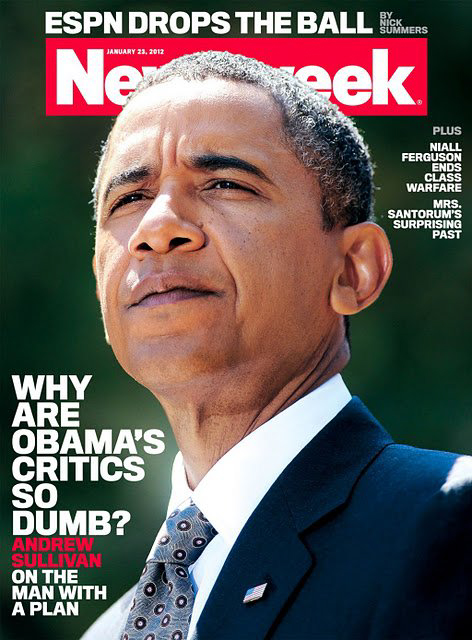
newsweekobamacover

This is no joke. It looks like Newsweek has allowed its collective editorial id to design the cover of the magazine’s newest issue.

Remember, there was a time when this was one of America’s newsmagazines of record. Not coincidentally, that was a time before Andrew Sullivan’s feature-length slanders were considered cover material. It’s becoming clearer every day why Newsweek only managed to fetch $1 when it went up for sale in 2010. Also becoming clearer? It was overpriced.


January 16th, 2012 at 2:06 pm
Eric Holder’s Rank Dishonesty Continues
Posted by Print

Politico has the story of Holder again crying wolf (actually, it’s worse than crying wolf) and playing the race card (sorry: more accurately, it’s worse than that; it’s flat-out race-hustling) about voter ID laws and other legitimate efforts to stop the voter fraud which has become such a staple of the deliberate efforts of pro-Democratic interest groups. This is especially a large issue in South Carolina, where the Justice Department has blocked a voter-ID law even though it tracks laws in Indiana and Georgia that the Supreme Court already has ruled are perfectly allowable under the Constitution. This is, as has become the norm under Holder, nothing less than sheer lawlessness from the Civil Rights Division of the Justice Department.

These people do not care about what the Constitution and laws actually say; they merely care about twisting the law to gain power. They are flagrantly anti-republican (small ‘r’) and anti-constitutionalist, and they must be stopped.


January 16th, 2012 at 9:40 am
Ramirez Cartoon: Obama’s Dream
Posted by Print

Below is one of the latest cartoons from two-time Pulitzer Prize-winner Michael Ramirez.

View more of Michael Ramirez’s cartoons on CFIF’s website here.


January 14th, 2012 at 12:42 pm
The High Hurdle of Romneycare
Posted by Print

At the American Spectator, I recommend reading Andrew McCarthy’s explanation about why Romneycare makes Mitt Romney a weak candidate against Barack Obama. Here, let me add a few more thoughts on the subject. I think this is McCarthy’s best paragraph in a piece full of good paragraphs:

[S]ome things are wrong everywhere. One such thing is a massive government infiltration into the private economy, one that coerces the purchase of a commodity (health insurance) as a condition of living in the state. For one thing, such an exercise in steroid statism establishes a rationale in law for government intrusion into every aspect of private life: If health care is deemed a corporate asset, then “bad” behavioral choices must be regulated, lest someone get more than his share. Romney portrayed Romneycare as a model, at least for other states, if not for the nation. But no free-market, limited-government conservative thinks this officious onslaught is a model to be emulated anyplace.

Here at CFIF I made a similar argument back in June, although not as well as McCarthy has now made it:

It doesn’t matter one bit if Mitt Romney’s “individual mandate” was imposed by a state instead of by the feds; either way, a government forcing people to buy a product the person doesn’t want, just by virtue of living and breathing within the government’s jurisdiction, is a government without any real limits whatsoever.Tyranny is tyranny at any level.  By Romney’s logic, it would be better still if your local township, rather than the state, could send police to oversee you filling out your insurance application and writing the check. Next stop: SWAT teams to escort you to the hardware store to buy widgets. Federalism is, of course, an important principle. Using states as “laboratories of democracy” is a good and practical idea. But federalism should never be an excuse for despotism. What’s wrong is wrong. It’s not a matter of practicality but of morality writ large.

McCarthy goes on to note this:

There is no serious person who doubts that Romneycare was the building block for Obamacare: The experts who helped design the former were consulted in the creation of the latter. Yet Romney continues to insist that Romneycare is a smashing success, one he suggests he’d do again without hesitation.

It still baffles me that Romney’s opponents haven’t yet made this case successfully in the debates.


January 13th, 2012 at 1:35 pm
Video: Want to Protect American Jobs? Start by Fighting Internet Piracy
Posted by Print

In this week’s Freedom Minute, CFIF’s Renee Giachino debunks the misinformation by opponents of the Stop Online Piracy Act (SOPA) and discusses the immediate need for Congress to pass legislation to crack down on foreign rogue websites that are dedicated to stealing U.S. intellectual property.


January 13th, 2012 at 12:07 pm
This Week’s Liberty Update
Posted by Print

Center For Individual Freedom - Liberty Update

This week’s edition of the Liberty Update, CFIF’s weekly e-newsletter, is out. Below is a summary of its contents:

Lee:  Poll: By 2-to-1, Americans Fear Second Obama Term
Hillyer:  Supreme Court Saves Religious Liberty from Obama
Senik:  Is Mitt Romney the Second Coming of John Kerry?
Ellis:  Politicizing Lawsuits for Electoral Gain

Freedom Minute Video:  Want to Protect American Jobs? Start by Fighting Internet Piracy
Podcast:  Battle Brews over “Recess” Appointments
Jester’s Courtroom:  A Fruit Suit

Editorial Cartoons:  Latest Cartoons of Michael Ramirez
Quiz:  Question of the Week
Notable Quotes:  Quotes of the Week

If you are not already signed up to receive CFIF’s Liberty Update by e-mail, sign up here.


January 13th, 2012 at 8:56 am
Podcast: Battle Brews over “Recess” Appointments
Posted by Print

In an interview with CFIF, Fox News contributor Cherylyn Harley LeBon, a member of the national advisory council of the Project 21 black leadership network and president and CEO of KLAR Strategies, discusses President Obama’s constitutionally suspect decision to make “recess” appointments to the Consumer Financial Protection Bureau and National Labor Relations Board when the Senate was in pro forma session.

Listen to the interview here.


January 12th, 2012 at 3:15 pm
Reverse Class Warfare Won’t Work for Romney
Posted by Print

Following our recent blog symposium on Mitt Romney’s shortcomings as an effective defender of market economics, this clip from his appearance yesterday on the Today Show is worth watching:


The problem with Romney’s “envy” approach is that it’s a mirror image of precisely the kind of class warfare he’s (rightly) accusing President Obama of. It’s just not going to hold water in a time of economic distress for any Republican — let alone a fantastically wealthy ex-businessman — to attempt to swat away his opponents by claiming they resent his wealth and that of those similarly situated. Romney should instead be making the case for broad-based prosperity — the sort of democratic capitalism Ashton advocated yesterday. Attacking the motives of his opponents instead of rebutting their assertions makes him seem both aloof and unprepared for the debate to come.


January 11th, 2012 at 6:38 pm
The January Dirge for Romney’s November Continues
Posted by Print

Ashton and Quin both point out deficiencies of Mitt Romney’s that go far beyond the narrow attack on Bain I referenced in yesterday’s post. And they’re both right.

Quin says my rhetorical suggestions for Romney would only help so much. Quite so. One Ricochet member asked, in response to my post, if I could come up with a speechmaking salvo that could save Romney from the taint of his misbegotten Massachusetts healthcare experiment. My response: “As Romney found during his time in the private sector, some turnaround jobs are too much for anyone to salvage.”

I’ll just add one factor to Ashton and Quin’s delineation of Romney’s liabilities: he seems unable to connect with voters. This is a man, remember, who was won only one election in his life–and even that occurred in the context of a three-way race where Romney was unable to win a simple majority. As I’ve argued in a previous column, Romney is bedeviled by many of the same shortcomings that hindered John Kerry’s presidential bid: patrician aloofness, a sense that he’ll say or do anything to curry favor with the electorate, and a total lack of the capacity to inspire.

I’ve feared for some time that 2012 will be a mirror image of 2004, with a weak incumbent squeaking by a challenger who earned the nomination by seeming slightly more viable than the other candidates in a mediocre field. Unfortunately, that’s starting to look like exactly how this race is playing out.


January 11th, 2012 at 3:08 pm
Romney’s Achilles Heel
Posted by Print

I agree wholeheartedly with both Ashton and Troy that Romney does a poor job defending/advocating democratic capitalism and that Troy’s approach to what Romney should say is a good one. I also agree with Ashton that Romney, alas, is always going to have a tough time making that sort of case, because experientially and temperamentally (and maybe philosophically) he isn’t prone to that sort of approach. He really is easy to demonize (from the left)as a corporate raider, which makes him much more vulnerable to such charges in a general election campaign where the opponent has $800 million and is playing for a different set of voters than he is vulnerable to the charge in a GOP contest where the attack is rightly seen as perhaps scurrilous, and at least rhetorical overkill. Gingrich and Perry right now are doing Obama’s work for him — and it will make Romney all the more vulnerable in the fall.

Yes, if Romney tried language like Troy’s, it would help. But only so much. The sad reality is that he’s the perfect foil for Obama, both as plutocrat and as yet another Republican dynastic legatee. If he gets the nomination, he will be a weak general-election candidate because of it.

Tags: , , ,

January 11th, 2012 at 2:55 pm
Ramirez Cartoon: The Department of Wishful Thinking
Posted by Print

Below is one of the latest cartoons from two-time Pulitzer Prize-winner Michael Ramirez.

View more of Michael Ramirez’s cartoons on CFIF’s website here.


January 11th, 2012 at 2:20 pm
Can Romney Defend Democratic Capitalism?
Posted by Print

I’m glad to see the Wall Street Journal’s editorial page echoing Troy’s advice to Mitt Romney to get out in front of the Bain-bashing and make a full-throated defense of free market capitalism.  But as both Troy and the Journal seem to allude to, Romney doesn’t appear capable or willing to make the case for democratic capitalism; the kind of market economy that emphasizes equal access and opportunities instead of guaranteed outcomes.

The way I’m using the term, democratic capitalism disdains the unfairness many perceive in the crony capitalism of Obama’s Solyndra deal, and in the bailouts of companies deemed too big to fail.  Americans don’t like it when public employee unions get tenure protections and better benefits than the private sector.  People feel cheated when General Electric pays no federal income taxes thanks to loopholes only the wealthy like Warren Buffet can exploit.  For the free market to work, people have to trust it, and right now Wall Street, the White House, and many other entrenched special interests from unions to rent-seeking businesses are making everyday Americans think the capitalistic system they’ve been sold is far from democratic.

In a sense, democratic capitalism is at the heart of Sarah Palin’s appeal.  Her entire career in Alaska was built around taking down entrenched interests enriching themselves at the expense of a fair system.  She exposed a corrupt state oil and gas commission; disrupted the state GOP’s patrician good old boys club by defeating an incumbent governor; and won a fight with a major oil company over its ability to exploit Alaska’s natural wealth without sharing some of it with residents.  These were the accomplishments that made her a maverick and put her on John McCain’s vice presidential radar.  When Palin was toying with a presidential run this time around, she gave a major speech blasting distortions of the economy that make the market less fair, and ultimately, less free.  Better than anyone to date, Palin communicates the Tea Party’s angst over Big Government into a larger narrative about the dangers posed by any segments of society that threaten the democratic element in America’s form of capitalism.

Now, I’m not saying that Mitt Romney is a foe of democratic capitalism.  What I’m saying is that he doesn’t appear comfortable articulating his understanding of the free market in a message that applies equally to executives and frontline workers.  That’s probably because he’s never been a frontline worker.  Of course, he’s worked hard – graduating with honors from Harvard law and business schools demands it – but as the son of an auto executive and governor whose first job out of graduate school was telling CEO’s how to fix their companies, Mitt Romney has never experienced capitalism from the factory floor.  That means he will have a hard time explaining the virtues of capitalism to people near the destructive end of capitalism’s creativity.

Fairly or not, if Romney is the nominee liberals will savage him as a member of the 1% who made millions replacing people with technology and exporting many of the remaining jobs overseas.  Conservatives who favor the free market should hope that Romney discovers how to articulate the democratic element of capitalism soon and well.  He could start by reading Troy’s excellent remarks as soon as possible.


January 10th, 2012 at 11:24 pm
How Romney Beats the Rap on Bain
Posted by Print

Regular readers know that I’m far from the biggest Mitt Romney supporter in the world. That being said, the criticisms of his time at Bain Capital leveled by fellow candidates Newt Gingrich, Jon Hunstman, and Rick Perry have been shockingly opportunistic and intellectually dishonest, particularly for self-proclaimed advocates of free market capitalism (they’ve also ignored the more salient criticism — the numerous instances in which Bain lived off the taxpayer).

Over at Ricochet, I have a proposed rhetorical response for Romney. The whole’s thing here, but here’s a sample:

I would remind my opponents – as I would remind President Obama – that work is a form of public service. Our ability to make money is directly tied to our ability to provide something of value to our fellow man. But sometimes when the customer’s needs change or when we lose ground to our competitors, we have to make changes. We don’t choose these circumstances. As a matter of fact, we hate these circumstances. But, like many Americans that are struggling today, we accept the things that we cannot change, we make the hard choices, and we persevere. That is never an easy task. And unfortunately, sometimes people lose their jobs as a result. But what, I wonder, do my opponents think the alternative is?  If a company on the brink of failure has no choice but to let a few employees go now or to see all of their jobs disappear eventually, what should they do?

Those are the kind of painful choices that people face in the real economy. And I find it telling that that concept is foreign to my opponents. They’re not foreign to the American people – because they’re living through them every day. You can talk to anyone who’s ever sat behind a manager’s desk – whether it’s in a corner office or a corner store – and they’ll tell you that there’s nothing that they hate more than having to fire someone. Americans take pride in their work. Losing a paycheck hurts. But losing your sense of dignity hurts more. My experiences in business didn’t make me enjoy firing people. It made me loathe the politicians in Washington for whom those people are nothing more than statistics on a spreadsheet.


January 10th, 2012 at 1:41 pm
Why Is Romney Seen as Electable?
Posted by Print

Just by way of analysis, not meaning to be pro- or anti-Romney’s candidacy — but can anybody give me even a halfway convincing explanation for why the commentariat thinks that Mitt Romney is so much more electable than some of the other GOP candidates? (And no, polls don’t count: Polls aren’t actual analysis, and head-to-head polls for next fall mean absolutely nothing at this stage of a race other than a rough sense of name ID. If they did, Jimmy Carter would have beaten Ronald Reagan by 32 points.)

Usually, at this level, past performance is as good an indicator as anything else. Well, Romney’s past electoral performance is decidely weak. In 1994, as Rick Santorum was pulling an upset to win a Senate seat in Pennsylvania, Romney was getting crushed by Ted Kennedy — in a race where Kennedy actually was seen, even three weeks out, to be far more vulnerable than usual, because the tawdriness of his nephew’s late-1991 rape trial (and his role therein) combined with the overall tawdriness of his long-running behavior, combined with a nationwide revolt against Democrats, made Massachusetts voters unusually open (according to all sorts of polls and focus groups) to replacing him. But, again, Romney got absolutely crushed.

In 2002, Romney won the governorship; in 2006, he chickened out of running for re-election; and in 2008, despite all sorts of financial advantages, he found a way to lose the Republican nomination fairly decisively to a seriously underfunded John McCain, losing a long string of individual primaries in the process.

So, overall, his electoral record is 1-2 — or, if you count each state in 2008 as a separate contest, which might not be exactly fair, he’s something like 2-17.

Add last week’s Iowa result, where he underperformed again (and earned exactly six FEWER votes than he earned in 2008), and you have a candidate who just doesn’t seen to be able to deliver on Election Day.

By contrast, Rick Perry famously has never lost an election (but then again, he hasn’t exactly had as tough a row to hoe in Republican-friendly Texas, and barely won re-election for governor in 2006 over an underfunded Democrat). Rick Santorum, running every single time in battles that were uphill or (once) no better than 50-50 shots (i.e. in districts or a state that was not friendly to Republicans), has won four out of five elections, and outperformed other Republicans in his state in almost every case in doing so. (For instance, in 2000 he won PA by four points while GW Bush was losing it by 5; in 2006, even in losing, he lost by less than the GOP candidate for governor that year did.)

Newt Gingrich, Jon Huntsman, and Ron Paul aren’t really easy to categorize, because they either come for slam-dunk Republican states (Huntsman) or they haven’t run in anything bigger than a congressional district (Gingrich, although as a national proxy candidate he helped Dole lose in 1996 and the GOP lose House seats in 1998), or their candidacies are so sui generis (Paul) and their electoral history so odd (Paul again, running for president on the Libertarian ticket once) that it makes comparisons difficult. But it’s clear that none of those three has shown any reason for anybody to believe they can compete very well on a national stage, and Perry’s performance so far this year indicates he perhaps wasn’t prepared for national issues.

Which leaves, again, Santorum, having won four of five elections and overperformed so far on the presidential stage, and Romney, having so far lost two of three elections and badly underperformed on the presidential stage. So it makes no sense at all to assume that Romney is more electable in the fall against Barack Obama’s $800 million.