April 14th, 2014 at 11:10 am
“Sons of Fannie Mae”: WSJ Shares Our View of Current Fannie/Freddie “Reform” Legislation in Senate
Posted by Print

For weeks, CFIF has detailed the hazard presented by two proposed Senate bills – Johnson/Crapo and Warner/Corker – claiming to offer home finance “reform” of Fannie Mae and Freddie Mac.

It was therefore refreshing to see The Wall Street Journal reach the same conclusion this morning in its opinion piece entitled “Sons of Fannie Mae.”  While reform of Fannie and Freddie is indeed critical, the latest attempt from Senators Tim Johnson (D – South Dakota) and Mike Crapo (R – Idaho) isn’t the answer.  “The bad news,” it reads, “is that the Senators want to replace Fan and Fred with multiple private mortgage bond issuers that would each also have a  taxpayer guarantee.”

It continues:

While Johnson-Crapo claims to end Fan and Fred’s “affordable housing” requirements, the bill is larded with provisions to encourage and subsidize loans to non-creditworthy borrowers while driving up the price of housing.  The bill includes a new 0.1% tax on federally insured mortgages that will be distributed to housing slush funds across the bureaucracy.”

The bill also promises to continue subsidizing mansions that don’t need help:

On that point, Johnson-Crapo also ensures that the universe of loans eligible for subsidies will continue to grow.  Under their proposal, the FMIC could raise the size of mortgages eligible for federal insurance as home prices rise.  But it bars the agency from ever lowering this so-called conforming loan limit.  Guess what would happen the next time a President runs for re-election?

According to the National Association of Realtors, February’s median sales price of an existing U.S. home was $189,000.  Yet Fannie and Freddie offer mortgages up to $417,000 across the country and in high-cost areas they run as high as $625,500.  That means that with 20% down a borrower can get taxpayer help when paying more than $780,000 for a house.  In most places that’s called a mansion.

Beyond the obvious reasons wealthy buyers don’t need subsidies, the “jumbo” market for mortgages above the conforming limits has been thriving.  At times in the last year jumbo rates have been lower than conforming rates and even now are within four-tenths of a percent.”

Fortunately, the piece ends on a high note, highlighting superior alternative legislation from Congressman Jeb Hensarling (R – Texas):

Some of our friends say the political window to kill Fannie and Freddie is closing, and Johnson-Crapo is the only vehicle that can do so because it is the only one that has White House support.  We’re not so sure.  Texas Rep. Jeb Hensarling has a better reform in the House, and a GOP Senate might be able to cut a better deal next year.  The Senate should go back to the drawing board and come up with a reform that doesn’t use the demise of Fan and Fred to create a dozen mini-me replacements that could grow to become the same monsters.”

Well said.


April 11th, 2014 at 2:44 pm
IRS’s ‘Big Brother’ ObamaCare Enforcement Coming into View
Posted by Print

As Tax Day approaches, consider the bright side – at least there’s no ObamaCare form you have to fill out.

That changes next year.

“According to the agency, the IRS plans to include a specific line on the 1040 forms for taxpayers to ‘self-attest’ whether they purchased insurance,” reports Fox News. “It will most likely include a worksheet for taxpayers to calculate how much they owe – essentially either a flat penalty or a percentage of their income.”

Next year the penalty is either $95 or 1 percent of your income, whichever is greater.

The IRS plans to confirm whether taxpayers are telling the truth about purchasing insurance by getting enrollment records from insurance companies.

So along with increased paperwork, we can all look forward to a greater amount of government surveillance into our insurance (and eventually our health) records.

All in the name of helping us. Thank you, Big Brother.


April 11th, 2014 at 1:10 pm
Liberty Update
Posted by Print

Center For Individual Freedom - Liberty Update

This week’s edition of the Liberty Update, CFIF’s weekly e-newsletter, is out. Below is a summary of its contents:

Senik:  The “Equal Pay for Equal Work” Myth
Lee:  From the NAACP to Mozilla: Anonymity and First Amendment Freedom
Ellis:  Obama’s Medicare Politics Show Ryan Is Right on Policy

Video:  Will Labor Unions Take Over College Football?
Podcast:  Actions Speak Louder than Words: Obama’s Threat Against Russia’s Aggression in Ukraine
Jester’s Courtroom:  This Lawsuit Is Gnarly, Dude

Editorial Cartoons:  Latest Cartoons of Michael Ramirez
Quiz:  Question of the Week
Notable Quotes:  Quotes of the Week

If you are not already signed up to receive CFIF’s Liberty Update by e-mail, sign up here.

Tags:

April 11th, 2014 at 7:11 am
Video: Will Labor Unions Take Over College Football?
Posted by Print

CFIF’s Renee Giachino takes aim at the recent National Labor Relations Board ruling allowing college football players at Northwestern University to unionize.


April 8th, 2014 at 4:43 pm
Ramirez Cartoon: Titanic ObamaCare
Posted by Print

Below is one of the latest cartoons from two-time Pulitzer Prize-winner Michael Ramirez.

View more of Michael Ramirez’s cartoons on CFIF’s website here.


April 8th, 2014 at 12:44 pm
Why the NCAA Should Defend Against Athlete Unionization
Posted by Print

Timothy Lee, CFIF’s Senior Vice President of Legal and Public Affairs, discusses what is wrong with the NLRB’s regional ruling that scholarship football players are employees and eligible to form a union.

Listen to the interview here.


April 7th, 2014 at 7:12 pm
Tech Industry May Cut a Deal on Immigration, Killing Gang of Eight Bill
Posted by Print

With the Senate’s Gang of Eight bill dead-on-arrival in the House of Representatives, the tech industry may be ready to break ranks and cut a deal.

So far, Silicon Valley – one of the wealthiest segments backing comprehensive immigration reform – has held out hope that their goal of expanding H-1B visas for foreign-born workers will come to fruition when House Republicans finally get around to passing the Senate’s bill.

But with the Gang’s bill looking less and less likely to get even a vote in the House, immigration’s tech supporters are exploring other options. The announcement came in the form of an op-ed published by the leader of Compete America, the industry’s immigration-focused political action committee. In it he called on both houses of Congress to pass the SKILLS Act, which would give Compete everything it wants, but would also leave its members with no real reason to stay in Washington pushing for the rest of the Senate’s bill.

That possibility drew a swift rebuke from Senate Majority Whip Dick Durbin (D-IL), who wrote in a letter to Compete America, “I am troubled by recent statements suggesting that some in the technology industry may shift their focus to passage of stand-alone legislation that would only resolve the industry’s concerns.”

The daylight emerging between the tech industry and its comprehensive immigration reform allies presents an opportunity to House Republicans, says Byron York. “If the House were to pass H-1B expansion, the GOP would win support from at least some in the tech world. And Democrats would be standing in the way of admitting more high-skilled workers into this country.”

Liberals like Durbin know that the only way to legalize a controversial pathway to citizenship is to hold hostage popular reforms like expanding the H-1B visa pool. This turn of events may be just what House Republicans need to make that ploy crystal clear.


April 7th, 2014 at 2:47 pm
This Week’s “Your Turn” Radio Lineup
Posted by Print

Join CFIF Corporate Counsel and Senior Vice President Renee Giachino today from 4:00 p.m. CDT to 6:00 p.m. CDT (that’s 5:00 p.m. to 7:00 p.m. EDT) on Northwest Florida’s 1330 AM WEBY, as she hosts her radio show, “Your Turn:  Meeting Nonsense with Commonsense.”  Today’s guest lineup includes:

4:00 CDT/5:00 pm EDT:  Myron Ebell, Director, Center for Energy and Environment at the Competitive Enterprise Institute – United Nation’s Flawed Report on Climate Change;

4:30 CDT/5:30 EDT:  Robert Zarate, Policy Director of the Foreign Policy Initiative – Responding to Russia’s Aggression against the Ukraine and What’s Next?;

5:00 CST/6:00 pm EDT:  Timothy Lee, CFIF’s Senior Vice President of Legal and Public Affairs – Why the NCAA Should Defend Against Athlete Unionization;  and

5:30 CDT/6:30 pm EDT:  Sally Pipes, President, CEO and Taube Fellow in Health Care Studies at the Pacific Research Institute – Assessing ObamaCare Four Years After Its Passage.

Listen live on the Internet here.   Call in to share your comments or ask questions of today’s guests at (850) 623-1330.


April 5th, 2014 at 9:15 pm
Bipartisan Support for Repealing the Employer Mandate?
Posted by Print

It sounds like there may be a growing bipartisan consensus to repeal ObamaCare’s onerous employer mandate.

“Republicans don’t like the mandate because they oppose the idea of government telling private sector entities what to do, but they also don’t support the lack of tax incentives for individuals who don’t pay for health care through an employer,” says The Street. For their part, “[s]ome Democrats don’t mind dumping the employer mandate because they would prefer to move away from businesses making health insurance decisions for individuals.”

The employer mandate is poised to hit small and growing businesses especially hard, since employing 50 full-time workers – defined as working 30 hours or more a week – triggers requirements to offer costly ObamaCare-compliant insurance plans.

This creates an obvious incentive to cut hours for people already at the margins, in effect robbing them of extra work and extra pay. Because of this liberal pundits like Ezra Klein have called for the full repeal of the employer mandate (and deplored the politically-motivated delays that have made ObamaCare’s implementation so arbitrary).

Of course, repealing the employer mandate isn’t a painless option. While it would no doubt free countless human resources directors from nimbly trying to anticipate the next extra-legal maneuverings of the Obama administration, it would also be a huge hit on ObamaCare’s financial scorecard.

“If you take [the employer mandate] out the congressional budget score looks a lot worse,” one academic supporter of ObamaCare tells The Street. That’s because the buck for subsidizing health insurance would move from private employers to the public treasury via a massive migration to ObamaCare exchanges. The individual mandate, remember, would be still be in effect. If that happens, expect ObamaCare’s price tag to soar.

So while it may be tempting for Republicans to ally with Democrats and vote to repeal the employer mandate, doing so could be used to charge the GOP with willfully spiking federal spending. Better, it seems, to just get rid of the whole law and start afresh.


April 4th, 2014 at 1:15 pm
Report: ObamaCare to Increase Large Employer Costs Up to $186 Billion
Posted by Print

A new study by the American Health Policy Institute demonstrates that when it comes to ObamaCare’s disruption of the health insurance industry, the worst is yet to come.

The study looks at 100 large employers – defined as employing 10,000 workers or more – to estimate the direct and indirect costs of complying with ObamaCare’s costly mandates. (Due to extra-legal delays by the Obama administration, the employer mandate will go into effect starting in January 2015.)

When factoring in all of the direct mandates and fees – for example, covering children up to age 26 and accepting all enrollees regardless of preexisting conditions – as well as indirect costs – such as medical device companies and insurers passing on compliance costs to businesses in the form of higher prices – the total cost of complying with ObamaCare will be between $4,800 – $5,900 per employee. The net cost of ObamaCare for all large employers is projected to range from $151 billion to $186 billion.

Large employers employ about 52 million American workers, or about one-third of the nation’s workforce. You don’t have to be a Harvard-trained CFO to realize that companies “have a significant incentive to make fundamental changes to their health offerings” because of ObamaCare. The most obvious choice is to pay the $2,000 per employee penalty for not offering health insurance, and let employees try their luck on an ObamaCare exchange.

ObamaCare advocates insist that the law isn’t designed to separate workers from their health insurance, but the incentive structures buried within it tell a different story. Skeptics can be forgiven if the implementation phase looks like a coordinated effort first to get people into government-run exchanges, and eventually, under government-run health care.

H/T: Daily Caller


April 4th, 2014 at 12:01 pm
Latest Jobs Report Confirms Desperate Need for U.S. Corporate Tax Reform
Posted by Print

April 1 marked an important milestone in America.  Not because it was April Fools’ Day, but because it marked the second anniversary of the United States claiming the inglorious title of the developed world’s highest corporate tax rate.

The U.S. hasn’t achieved comprehensive tax reform since 1986.  Ronald Reagan was early in his second term as President, Michael Jordan was still five years away from his first NBA title and Pixar animation studios first opened.  Over the ensuing three decades, however, our international trading partners and competitors have accomplished reform, particularly in their corporate tax codes.  As a result, America’s 39% rate unfortunately stands as the world’s highest.

Americans can rightfully claim, “We’re number one” in many areas, but it’s simply unacceptable that the highest corporate tax rate remains one of them.  It constitutes a continuing drag on business growth, job creation and wage increases.  And as yet another disappointing jobs report today confirms, we cannot afford to maintain the status quo.  Numerous studies show that a lower corporate tax rate creates jobs and economic growth, so we must shift our current strategy away from government bailouts, welfare and unemployment checks, and more toward restructuring the tax code and empowering the private sector to hire.  Our world becomes increasingly interconnected each day, and we simply cannot cede competitiveness to other nations whose tax codes are far more appealing to new businesses.  The U.S. spent the 20th century building an economy that was the strongest and most powerful in the world, but lack of action on tax reform jeopardizes that global standing.

Moreover, this isn’t a partisan issue.  Republicans and Democrats, including Barack Obama himself, agree that it has been too long since we have undertaken comprehensive tax reform.  Accordingly, there’s no excuse for further delay.

Let’s not let another three decades pass us by without corporate tax reform.  Let’s instead achieve a code that actually encourages businesses to grow and hire workers.


April 4th, 2014 at 10:28 am
Liberty Update
Posted by Print

Center For Individual Freedom - Liberty Update

This week’s edition of the Liberty Update, CFIF’s weekly e-newsletter, is out. Below is a summary of its contents:

Ellis:  Paul Ryan Is Ready for a Promotion
Lee:  Activist Demands Imprisonment for “Climate-Change Liars”
Senik:  Democrats, The Party of Superstition

Podcast:  Economics Through Lens of Film and Popular Culture
Jester’s Courtroom:  Lawsuit Calls Bluff and Rakes Plaintiff Through Coals

Editorial Cartoons:  Latest Cartoons of Michael Ramirez
Quiz:  Question of the Week
Notable Quotes:  Quotes of the Week

If you are not already signed up to receive CFIF’s Liberty Update by e-mail, sign up here.


April 4th, 2014 at 9:27 am
Podcast: The Rise of Green Politics
Posted by Print

In an interview with CFIF, Rupert Darwall, finance and public policy expert, discusses the politics of climate change, how green politics made Europe vulnerable to Putin, and his book, Global Warming: A Short History.

Listen to the interview here.

Tags:

April 3rd, 2014 at 3:58 pm
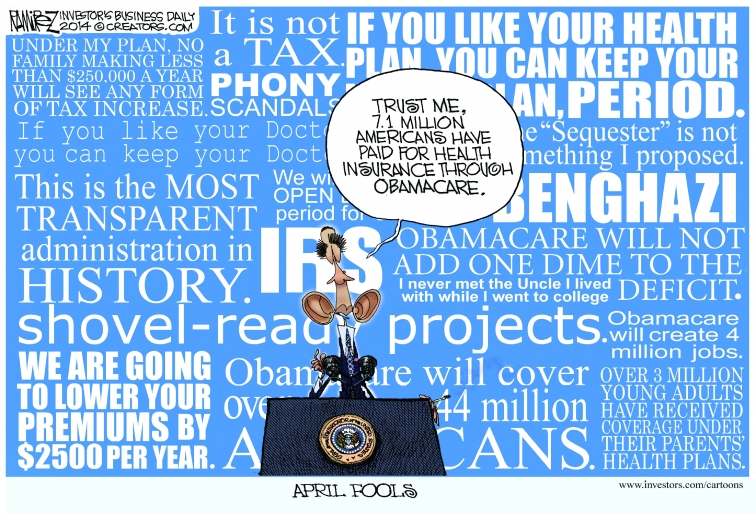
Ramirez Cartoon: April Fools
Posted by Print

Below is one of the latest cartoons from two-time Pulitzer Prize-winner Michael Ramirez.

View more of Michael Ramirez’s cartoons on CFIF’s website here.


April 1st, 2014 at 6:48 pm
ObamaCare Promotion Driving Up Medicaid Applications
Posted by Print

“According to a recent study by Avalere, the average application rate [for Medicaid] has increased 27 percent among non-expansion states and 41 percent for those expanding,” writes Angela Boothe of the American Action Forum.

For example, Tennessee – a state that chose not to expand its Medicaid program under ObamaCare – is still experiencing severe pressure on its budget due to high numbers of people trying to enroll. Though only the beginning of April, the Volunteer State has already enrolled the maximum number of people it projected to cover for the year. Adding to the pressure on state budget writers is the reality that by refusing to expand Medicaid under ObamaCare – which covers 100 percent of the increased costs until 2017 – part of the expense for covering the new enrollees falls on the state. If you work in a non-Medicaid state agency in Tennessee, beware bean counters wielding knives.

The Avalere report highlights the fact that ObamaCare creates a unique burden for non-expansion states like Tennessee. Because of the controversial health law’s media saturation, millions of people are aware that they are probably eligible for some sort of government assistance to purchase health coverage. Of these, many are discovering that they already qualify for Medicaid, even before ObamaCare was enacted. The awkward situation for states like Tennessee is that ObamaCare is still expanding Medicaid, just without any extra financial help.

If non-expansion states like Tennessee continue to see record Medicaid enrollment increases this year, don’t be surprised if anti-ObamaCare governors and legislatures start to rethink their opposition to expansion. Of course, as I’ve explained elsewhere, it would be a serious mistake to swap a three-year federal bailout for decades of increased costs by expanding Medicaid on ObamaCare’s terms. But for desperate lawmakers looking for a quick fix, ObamaCare’s “free money” may be too tempting to pass up.


March 31st, 2014 at 6:20 pm
IRS Compliance Nightmare Looms as ObamaCare Site Crashes Ahead of Deadline
Posted by Print

This morning Healthcare.gov – the federal ObamaCare website serving citizens in 34 states – went down for four hours, stymieing customers from accessing or completing their applications for insurance.

NBC News reports that people unable to log onto the website were put in a “queue,” meaning they would be notified by email when they could resume the enrollment process.

But with the deadline to begin an application (supposedly) ending at midnight, what will happen to people unable to return to their computer screens after the lengthy delay? Last week’s extension to mid-April only covers people who start the process for enrolling by the end of March. If other commitments – say family or work responsibilities – don’t allow an applicant to return, what then? How will federal regulators distinguish between people who never tried to use Healthcare.gov and those that did, but for various reasons beyond their control couldn’t finish?

If history is any guide, don’t expect the feds to make a distinction. More likely, the response sometime soon will be a blanket extension for enrollment that allows anyone – without precondition – to complete the process.

Then it will be the IRS whose head will spin. When it comes to enrolling on an ObamaCare exchange, the carrots are the subsidies and the sticks are the fines. Any adult that goes without health insurance for three consecutive months is subject to a fine of $95 or 1 percent of her annual income, whichever is higher. And since that fee gets levied at next year’s tax filing, it will be the IRS’ job to sort out who is subject to the penalty.

That is, as soon as the political operatives in the Obama administration decide when enrollment really, really – no really we’re serious this time! – ends.


March 29th, 2014 at 7:52 pm
Latest ObamaCare Delay an Attempt to Hold Down Rate Spikes?
Posted by Print

Megan McArdle posits three reasons why the Obama administration extended the enrollment deadline for purchasing insurance through Healthcare.gov, the federal ObamaCare exchange.

The most interesting, and to my mind most plausible, is that pushing the deadline into mid-April will make it more difficult for insurers to calculate next year’s premiums.

“Extending open enrollment, which is essentially what they’re doing, would then be a desperate play to get more young, healthy customers into the exchanges, and perhaps to make it a bit harder for insurers to raise rates,” writes McArdle. “In some states, insurers have to file preliminary rate increases in May. And thanks to this latest extension, they won’t have final data to back up any requests for a premium hike.”

Originally, the Obama administration estimated it needed 40 percent of enrollments to be from young and healthy people to avoid rate spikes the following year. With the current mix stuck at only 25 percent, insurers are signaling that prices will go up next year to cover the likely costs of insuring an older and sicker population than anticipated.

But with this extension the Obama administration is putting insurers in a bind. Do they assume the 25 percent number will hold and justify rate increases to state regulators using that assumption? Or do they wait and see if a last-ditch push to inflate the number of young and healthy enrollees reaches the magic 40 percent threshold?

The dilemma for the insurance companies is just the most recent example of how bending the law for one group punishes another. True, many people won’t mind that insurance carriers are the ones holding the bag this time, but that just underscores the growing lack of resistance to arbitrary regulation. Today, it’s unpopular insurance companies. Tomorrow, it’s you.


March 29th, 2014 at 2:09 pm
The Obama-Ryan Double Standard
Posted by Print

“Is something less true if a white person says it about black people?”

That was the question liberal comedian Bill Maher asked on his show in relation to Paul Ryan’s recent comments about the link between poverty and culture.

Just prior Maher read a quote which he attributed to Ryan “about how lazy kids are these days and how they need to aspire to be more than ‘ballers’ and ‘rappers,’” reports Mediaite. But then Maher revealed he was quoting Michelle Obama – not Ryan.

The point Maher made was that black political figures get a pass for speaking hard truths on certain issues while their white counterparts do not.

Rich Lowry gives even more examples of this double-standard by quoting then-Senator Barack Obama.

Imagine the reaction from liberals if Ryan had said the following instead of the current president: “We know that more than half of all black children live in single-parent households… We know the statistics – that children who grow up without a father are five times more likely to live in poverty and commit crime; nine times more likely to drop out of school and twenty times more likely to end up in prison.”

Anyone who follows politics knows that had Ryan said this, the statement and the (completely unmerited) backlash that would greet it would likely define and limit the rest of his career. Aside from Barack Obama’s speechwriter at the time, no one else probably remembered he ever made these remarks until Lowry unearthed them.

The irony of the identity politics double-standard is that neither Barack Obama nor Paul Ryan has been able to speak truth to power and get results. Instead, Obama is ignored while Ryan gets flayed for motives he doesn’t have. The only way to break the logjam is for the president to defend Ryan’s diagnosis, even if he doesn’t agree with the House Budget chairman’s remedy.

Certainly then America would sit up and listen.


March 28th, 2014 at 7:14 pm
The Party of Science Goes Full Luddite
Posted by Print

From The Hill:

The Food and Drug Administration isn’t ready to embrace mandatory labeling regulations for foods made with genetically engineered ingredients, despite an aggressive push from lawmakers and advocates who cite health concerns.

Testifying before a House panel, FDA Commissioner Margaret Hamburg told lawmakers this week that the agency remains comfortable with a 1992 policy decision concluding that food made with genetically modified organisms — or GMOs — is not materially different from other products.

“We have not seen evidence of safety risks associated with genetically modified foods,” Hamburg said during a House Appropriations Committee hearing to assess the FDA’s 2015 budget request.

She said the FDA is working on fresh guidance backing a voluntary system for GMO labeling, an approach critics regard as insufficient.

Rep. Nita Lowey (D-N.Y.) criticized the FDA’s unwillingness to impose mandatory labeling requirements, saying the action is the least the government can do to give consumers more information about the food on their dinner table.

“It’s beyond me that we can’t have accurate labeling,” Lowey told Hamburg at the hearing. “The labeling can’t hurt anybody but it’s possible that the lack of adequate labeling could, of course.”

Actually, neither of those statements are true. The labels could hurt people and the lack of labeling won’t.

First let’s get some basics out of the way. What qualifies as a “genetically modified organism”? Have a purebred dog in your house? That’s one. A rose bush in your garden? Yep, that too. In essence, any living being that has been bred for certain traits is a genetically modified organism. What the critics are upset with are industrial processes by which companies can cultivate these traits in the lab instead of breeding for them over the course of generations.

So, is there a reason to be concerned? Over to the Competitive Enterprise Institute’s Gregory Conko, writing in the Washington Examiner earlier this week:

The primary thing that makes genetic engineering unique is the power and precision it gives us to make those changes and then test for safety afterward. It has also given us food that is both safer for our families and better for the environment. Plants with a built-in resistance to chewing insects, for example, have allowed farmers to use millions of gallons less pesticide every year.

Dozens of the world’s most prestigious scientific bodies, including the National Academies of Science, the American Medical Association and the World Health Organization, have studied genetic engineering for more than 30 years and concluded that such foods are at least as safe as, and often safer than, conventionally bred ones.

The other thing that makes genetically modified plants different is they are subject to intense scrutiny by three different regulatory agencies in the U.S. alone. It takes an average of five to 10 years to develop and test a crop for consumer and environmental safety. This is followed by an additional two to four years of review by the Food and Drug Administration, Department of Agriculture and Environmental Protection Agency. And because most American farmers will not plant genetically modified crops they cannot export to global markets in Europe, Asia and South America, the wait is even longer in order to secure approval overseas.

The regulatory costs alone for testing and getting approval for a genetically modified plant variety average more than $35 million. By the time a new crop makes it to market, its safety has been confirmed by regulators in dozens of countries.

In 30 years of testing and commercial use in more than two dozen countries, genetically modified foods have caused not a single sniffle, sneeze or bellyache. This outstanding safety record is why the FDA does not require blanket labeling of such foods. It does, however, require labeling any time a food differs from its conventional counterpart in a meaningful way – such as a reduction in nutrients, the introduction of an allergen, or even a change in taste or smell.

The science here is overwhelming — and has a decades-long track record. That’s part of what makes the labeling idea such a bad one. Proponents often brush the evidence aside and claim that, even if the produce is safe, consumers should know what’s in their food (though, in many cases, what’s in it is no different with GMOs than organics). But that’s not cost-free. There’s the price, of course, of actually producing the labeling, but the bigger potential cost is the loss of business that would occur if GMO labeling became pervasive.

The point of labeling as a tool of regulation is to increase consumer knowledge. In this area, however, it’s likely that labeling would only fuel ignorance. The public is already poorly informed about GMOs. Mandating they be labeled — which gives the appearance of a warning — would only fuel fears that have no basis in science.

Those who care the most about GMOs are those who are already eating organic foods — foods, it should be noted, that go out of their way to market themselves as an alternative to GMOs. In other words, the market has already solved their problem. There’s no compelling reason — as a matter of science or policy — for them to be allowed to brand the GMOs that feed hundreds of millions of Americans with a scarlet letter just because of their scientific illiteracy.


March 28th, 2014 at 11:18 am
WSJ Opinion Agrees: Thumbs-Down on Crapo/Johnson Housing “Reform” Bill
Posted by Print

We at CFIF have highlighted the grave flaws in two proposed Senate bills – Corker/Warner and Crapo/Johnson – that constitute defective efforts toward housing finance reform.

Instead of proposing sensible free-market answers that could benefit taxpayers while adhering to rule of law, the legislation does neither.  Rather, it reinforces the Obama Administration’s big-government overreach that disrespects our legal system and the people it seeks to protect.  And by creating yet another new federal agency to regulate the mortgage market, Crapo-Johnson uses similar mechanisms that Corker-Warner does.  In so doing, it maintains the same market uncertainty that Corker-Warner does, without any guarantee for future investments into the government-backed agency.

Further, the proposal continues to disregard investors’ rights – the community banks, pension funds and individuals that supported Fannie and Freddie, before, during and after the bailout.  Under Crapo-Johnson, those investors remain left out in the cold, their savings and retirement in limbo.  Meanwhile, taxpayers would remain on the hook because the full faith and credit of the U.S. government would backstop the newly-created entity under Crapo-Johnson.”

Writing in today’s Wall Street Journal, Graham Fisher & Co. managing director Josh Rosner cogently echoes our position.  Of particular note is the way in which Mr. Rosner highlights how the proposed bills offer the false promise of “bipartisanship”:

So why are legislators designing a new system that risks a fragile housing recovery, creates explicitly guaranteed supports for new government-sponsored enterprises, relies on phantom capital, and recklessly endangers the public?  Perhaps the answer is the housing industrial complex — that web of affordable-housing groups that want to deliver loans to “underserved” markets, lenders and other private participants that profit from higher mortgage volumes, and the politicians who like the illusion of homeownership.

As for those politicians, this bill provides something for everyone on both sides of the aisle.  The Republicans get to wipe out Fannie and Freddie, punishing their longtime Washington enemies for past political sins.  Meanwhile the Democrats can avoid future political attacks by hiding government support for housing in a new opaque system that looks remarkably like the one that failed miserably a few years ago.”

As Rosner concludes, and as we agree:

The Johnson-Crapo bill reinstates a model in which private players profit from public government support.  If it becomes law, we will have failed to create a sustainable system of building home equity, even among the most at-risk, lower-income borrowers.  We will also have failed to fulfill the real American dream of homeownership.”