March 12th, 2014 at 11:10 am
HHS Discovers One ObamaCare Deadline It Can’t Delay
Posted by Print

And it just so happens to be the most crucial.

With only 4.2 million of the original 7 million Obamacare exchange enrollees confirmed, officials at the Department of Health and Human Services were asked yesterday whether they would extend the March 31 deadline.

“We have no plans to extend the open enrollment period,” responded an HHS official, according to the Weekly Standard. “In fact, we don’t actually have the statutory authority to extend the open enrollment period in 2014.” (Emphasis added)

Of course, none of the controversial Obamacare delays are rooted in the law’s statutory text. When pressed for an explanation of how the enrollment deadline is different from the extra-legal delays of the individual mandate, employer mandate, small business exchange, Cadillac tax and thirty other extensions, the HHS spokespeople had no credible response.

The question remains, though, Why not extend the enrollment period in order to get more sign-ups? My guess is that broadening the enrollment timeline would quickly destroy the Obama administration’s ability ever to impose another deadline. As we saw last week with the second yearlong delay allowing non-compliant individual plans to continue, once an exception is made the firmness needed to impose a new drop-dead-date disintegrates. Rules become subject to whim not reason.

And make no mistake, if the Obama administration folds on this deadline the whole logic of Obamacare crashes and burns. If there is no penalty for non-enrollment then there is an incentive for each person to wait until he or she gets sick before buying health insurance. To participate on an Obamacare exchange an insurance company must accept whoever wants to buy a plan. Insuring sick people at the point of sale is no longer insurance since every purchaser needs the service immediately. For Obamacare to work as designed, however, the law and its insurance company partners need a majority of people paying for benefits only a minority will access.

That’s the real reason the Obama administration won’t delay the March 31 enrollment deadline. It can’t afford to.


March 10th, 2014 at 4:33 pm
California Lawmakers Agree to Raise Gas Prices 40 Cents-Per-Gallon
Posted by Print

With California’s tax policy, the only certainty is that consumers will lose money.

The latest example is the growing fight over whether to include fuel distributors in the Golden State’s controversial global warming regulatory scheme. Doing so would subject them to the same cap-and-trade system applied to industrial facilities, and could add between 12 – 40 cents-per-gallon to fuel purchases within the next year. The leading alternative would opt for a flat 15 cent-per-gallon carbon tax, which grows to 40 cents by 2029.

In short, California lawmakers have agreed that gas should cost an additional 40 cents-per-gallon. They’re just torn over how long to wait before imposing it on taxpayers.

This is what passes for deliberation in a state dominated by tax-and-spend liberals.

No wonder the middle class is fleeing in droves.


March 10th, 2014 at 2:58 pm
Today’s “Your Turn” Lineup
Posted by Print

Join CFIF Corporate Counsel and Senior Vice President Renee Giachino today from 4:00 p.m. CDT to 6:00 p.m. CDT (that’s 5:00 p.m. to 7:00 p.m. EDT) on Northwest Florida’s 1330 AM WEBY, as she hosts her radio show, “Your Turn: Meeting Nonsense with Commonsense.”  Today’s guest lineup includes:

4:00 CDT/5:00 pm EDT:  Cameron Seward, Heritage Foundation Program Manager – President Obama’s Budget;

4:30 CDT/5:30 EDT:  Shona Holmes, Canadian Healthcare Refugee – ObamaCare and Patient Rights;

5:00 CDT/6:00 pm EDT:  Bruce Herschensohn, Political Commentator, Professor at Pepperdine University School of Public Policy and CFIF Board Member – The Situation in Ukraine and Foreign Policy; and

5:30 CDT/6:30 pm EDT:  Troy Senik: FLOTUS and Food Labels and Why is the Middle Class Leaving California.

Listen live on the Internet here.   Call in to share your comments or ask questions of today’s guests at (850) 623-1330.


March 10th, 2014 at 9:16 am
Ramirez Cartoon: The Obama Budget
Posted by Print

Below is one of the latest cartoons from two-time Pulitzer Prize-winner Michael Ramirez.

View more of Michael Ramirez’s cartoons on CFIF’s website here.


March 7th, 2014 at 11:00 am
Liberty Update
Posted by Print

Center For Individual Freedom - Liberty Update

This week’s edition of the Liberty Update, CFIF’s weekly e-newsletter, is out. Below is a summary of its contents:

Senik:  On Foreign Policy, An Unteachable President
Lee:  Obama’s 2015 Budget Rejects Compromise, Cements Disastrous Legacy
Ellis:  Honest Medicare Reform Impossible So Long as President Refuses to Follow the Law

Podcast:  Understanding the Federal Debt Ceiling
Jester’s Courtroom:  McMental Anguish

Editorial Cartoons:  Latest Cartoons of Michael Ramirez
Quiz:  Question of the Week
Notable Quotes:  Quotes of the Week

If you are not already signed up to receive CFIF’s Liberty Update by e-mail, sign up here.


March 7th, 2014 at 8:39 am
Why It’s Getting Harder to be a Liberal
Posted by Print

In an interview with CFIF, Robert Knight, Senior Fellow at the American Civil Rights Union, discusses the growing list of issues and failures liberals are trying to spin for the Obama Administration, from ObamaCare to foreign policy, and why it’s getting harder every day to be a liberal.

Listen to the interview here.


March 6th, 2014 at 10:59 am
STELA Reauthorization: An Opportunity for Pro-Market Reform
Posted by Print

On December 31, 2014,the Satellite Television Extension and Localism Act (STELA) is set to expire.  The House Energy and Commerce Subcommittee on Communications and Technology is in the process of reauthorizing the law, and that provides a critical opportunity for pro-market reform by modernizing anachronistic regulations like retransmission consent agreements and must-carry provisions of the 1992 Cable Act.

So what is STELA, and why should conservatives and libertarians care?

Well, when the Cable Act became law in 1992, the prevailing concern was that cable operators might somehow employ monopoly power to block local broadcast stations in their home areas.  Accordingly, the Act tipped the scales in favor of broadcasters by granting them the right to guaranteed carriage or the right to compel cable operators to pay stations for consent to retransmit their broadcasts to local subscribers.  STELA, enacted in 2010 and due to expire at the end of this year, essentially maintained many of those outdated rules.

Today, more than two decades later, the television marketplace is much more competitive and no longer resembles the 1992 state of affairs.  Consumers now possess innumerable options in channel selection and the means to access them, from cable to fiber optics to online to multiple satellite and cable providers.  Yet despite that evolution, the government-imposed advantage for broadcasters remains.  Multi-channel video programming distributors (MVPDs) like cable, satellite and fiber providers are prohibited under current outdated regulations from disconnecting service during sweeps week, but broadcasters remain free to do the same thing during such events as the World Series in which the local team is playing.  Thus, broadcasters maintain government-created negotiating power through the retransmission consent rules, and are guaranteed a place on cable companies’ basic tier.  That tipping of scales has resulted in consumers suffering service disruptions and cost increases.

Fortunately, the opportunity has arrived for Congress to do something about it, and allow greater negotiating balance and a more even playing field.   As part of STELA reauthorization, Congress can at the very least jettison the prohibition against MVPDs disconnecting service during sweeps week if necessitated by a negotiating impasse with intransigent broadcasters, as well as broadcasters’ government-granted right to placement on cable companies’ basic tier, which it appears ready to do.

The federal government simply shouldn’t be playing favorites or tipping the scales in an industry as dynamic as this, and STELA reauthorization provides the perfect opportunity to correct those existing defects.


March 5th, 2014 at 9:08 pm
Ramirez Cartoon: The Red Line Part II
Posted by Print

Below is one of the latest cartoons from two-time Pulitzer Prize-winner Michael Ramirez.

View more of Michael Ramirez’s cartoons on CFIF’s website here.


March 4th, 2014 at 6:05 pm
Newest ObamaCare Delay Further Politicizes Medicine
Posted by Print

The Hill is reporting that the Obama administration will extend for an additional year the ability of insurance companies to offer consumers plans that do not comply with Obamacare requirements. The current one-year extension is set to expire in October of this year, about a month before the 2014 midterm elections.

It is universally acknowledged that the reason for the extended extension is so that Democrats up for reelection can avoid having to explain to voters why the cheaper insurance plans they like are being canceled and replaced with more expensive options.

As one insurance industry source told The Hill, “I don’t see how they could have a bunch of these [cancellation] announcements going out in September, [n]ot when they’re trying to defend the Senate and keep their losses at a minimum in the House. This is not something to have out there right before the election.”

When the legality of a person’s health insurance depends on the timing of a political campaign, it’s obvious that health care has become politicized.

But while subjecting millions of Americans’ insurance plans to the expediency of a political party is certainly bad, the fact that no year seems to be a good year to fully implement Obamacare offers something like a silver lining. The whole point of terminating non-compliant insurance plans between October 2013 and January 2014 was to inflict maximum damage a year before voters went to the polls. The thinking was that other issues would eventually overshadow the anger and price spikes, allowing Democrats to avoid the consequences of entrenching their favorite policy.

Going forward, it’s hard to see how the Obama administration won’t become addicted to its own avoidance behavior. Though barred from seeking a third term in office, Obama will be under enormous pressure from Hillary Clinton and other Democratic presidential candidates, as well as members of Congress, to continue delaying enforcement until after the 2016 elections. After all, letting Obamacare go into effect will provide Republicans with a perfect campaign issue. Why not keep it off the table?

However, if that’s the tack they take it paves the way for another GOP line of attack – If Obamacare is too horrid to live with before an election, it certainly can’t be tolerated after.

After years of politicizing medicine by not enforcing its own law, the Obama administration may succeed in convincing Americans that Obamacare isn’t worth the pain it will inflict.


March 3rd, 2014 at 1:42 pm
ObamaCare’s War on Work
Posted by Print

Up to 38% of people who qualify for Obamacare exchange subsidies may have to pay some or all of the money back to the IRS. That’s because the amount of subsidy dispensed is based on a sliding scale. As income rises, the amount of subsidy decreases. In practice, many people who currently qualify for a subsidy could wind up paying back the amount if they earn just a little bit more in income.

“At biggest risk are people who annual household income put them near the thresholds where the Obamacare subsidies make steep declines,” explains AEI expert Scott Gottlieb. “These cliffs are steepest for those people who earn 150% of the federal poverty level (family of four earning $35,000 in annual household income); 250% (a family of four earning about $55,000 annually); and 400% (a family of four earning about $95,000 annually).”

The upshot of this is that people may become much more sensitive to family budgeting since their financial stability depends on which side of the subsidy wall they fall. The downside of course is that we’re likely to start seeing people decline job promotions and salary hikes to avoid becoming a net loser at tax time.

As I’ve noted before, Obamacare’s War on Work is just beginning.


February 28th, 2014 at 2:37 pm
Michelle Obama: New Food Labels Will Help Counteract the Fact That America’s Moms are Morons
Posted by Print

As a veteran of a speechwriting shop or two, I’m amazed that no one in First Lady Michelle Obama’s office thought to reel in the remarks that she made yesterday about the new FDA nutritional labeling guidelines that I blogged about yesterday. Here’s how the First Lady described the hellish odyssey of a mother in the supermarket under the current regime:

So there you stood, alone in some aisle in a store, the clock ticking away at the precious little time remaining to complete your weekly grocery shopping, and all you could do was scratch your head, confused and bewildered, and wonder, is there too much sugar in this product? Is 50 percent of the daily allowance of riboflavin a good thing or a bad thing? And how on Earth could this teeny little package contain five whole servings?

This stream of questions and worries running through your head when all you really wanted to know was, should I be eating this or not? Is this good for my kids or not? And if it is healthy, how much of it should I be eating? But unless you had a thesaurus, a calculator, a microscope, or a degree in nutrition, you were out of luck. So you felt defeated, and you just gave up and went back to buying the same stuff you always buy.

I’m not sure who these mothers are who find themselves overmatched by the grocery store, but it seems to me they probably need more help than just better labels on food. For the rest of us — all of whom seem capable of acquiring foodstuffs without an epistemic shutdown — this remains a $2 billion exercise in irrelevancy.


February 28th, 2014 at 10:11 am
Video – Comcast-Time Warner Merger: Antitrust Hysteria
Posted by Print

In this week’s Freedom Minute, CFIF’s Renee Giachino discusses the irrational antitrust hysteria by critics of Comcast’s proposed purchase of Time Warner Cable and explains why their concerns are baseless in fact and reality.


February 27th, 2014 at 7:09 pm
Obama Administration Forcing Food Companies to Spend $2 Billion to Change Fonts
Posted by Print

Following on Ashton’s post below, there’s yet another Obama Administration initiative that will reach deep into the pockets of the food industry.

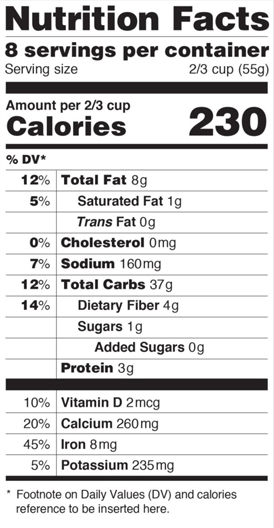
As Politico notes, the FDA is overhauling the labeling requirements for nutritional information on consumer products. The new labeling requirements will more conspicuously display calorie counts, change the definitions of serving sizes, and mandate the description of added sugars. Unsuprisingly, this push is being spearheaded by the First Lady’s office (which invites the question of who empowered Mrs. Obama to do anything in the lawmaking department).

There’s certainly some limited utility to this nutritional information, though I imagine it probably would have emerged (albeit perhaps in a slower fashion) from market demand as Americans became increasingly diet conscious. That said, these changes are incredibly minor. Here, courtesy of Politico, is what the current labels look like by comparison with the new ones:

Current Label

Current Label

Proposed Label

Proposed Label

Now, you may be thinking “What’s the harm?” And that’d be a reasonable response if this was a cost-free exercise. According to the FDA, however the cost to the food industry to make this change will run around $2 billion. That, by the way, is enough to finance about 150,000 lap band surgeries.

It says something remarkable about the Obama Administration’s failure to engage in even the most basic cost/benefit analysis that that would be a less crazy way to tackle this supposed problem.


February 26th, 2014 at 5:29 pm
ObamaCare Menu Regulations Could Decrease Food Options
Posted by Print

“Tucked deep in the Affordable Care Act is language requiring all restaurants with at least 20 locations to list nutritional information alongside each and every item on the menu,” writes Peter Doocy at Fox News.

The purpose is to inform customers about the nutritional value of a menu item before ordering.

This regulation hits made-to-order eateries particularly hard, since in practice the restaurant would have to provide customers with things like calorie counts on-the-fly – a nearly impossible task for places like Domino’s where up to “34 million different pizza combinations [are] available at the chain, when all crusts and cheeses and toppings are factored in.”

To make matters worse, the cost of compliance will fall on franchisees; i.e., the small business owners most at risk under the new regulation.

Domino’s and other groups are pushing for a solution that would deem restaurant owners compliant if they provide the nutritional information online or through an app.

But if that fails, it’s easy to see eateries cutting back on menu options and clamping down on substitutions. “Have-it-your-way” may soon become “Talk to the FDA.”

If the proposed nutritional rule goes into effect as-is, Americans can add food to the growing number of health-related choices – including doctors, hospitals and insurance plans – that are being reduced thanks to Obamacare.


February 25th, 2014 at 11:47 am
Homeland Security Hearing Should Emphasize Intellectual Property Protections and Stopping Piracy
Posted by Print

At 10:00 a.m. tomorrow, the House Homeland Security Committee will hold a hearing with new U.S. Department of Homeland Security (DHS) Secretary Jeh Johnson entitled “The Secretary’s Vision for the Future – Challenges and Priorities.”  The hearing provides a perfect opportunity for Chairman Michael McCaul (R – Texas) and his committee to emphasize America’s commitment to Intellectual Property (IP) protections, and to ensure that combating IP theft – both the anti-counterfeiting operations and efforts to stop online IP piracy – remain on the front burner.

Correctly and justifiably, many divisions and agencies within the Department focus on national security, but it would also be useful for the Committee members to discuss others that have a role in our economic well-being.  A large and diverse coalition of businesses recently came together to write Secretary Johnson, stressing upon him the importance of protecting American ingenuity and our competitive edge by reinforcing the need for strong enforcement of IP.  American companies continue to create the world’s most innovative goods and products, and fully two-thirds of all U.S. exports come from industries that depend on the recognition of strong IP rights.

Unfortunately, whenever creators succeed in building brands that consumers come to trust, there will in turn be nefarious characters who seek ill-gotten profit from someone else’s good name and hard work.  Fake consumer products, medicines, apparel and other goods can be found online, and unsuspecting shoppers end up with inferior, even dangerous products from unknown sources both domestic and abroad.  Consequently, absent significant effort by U. S. enforcement agencies, those knock-off goods can end up in hurting both the purchaser and the company unfairly being copied.  Whether manifested by state-sponsored theft of U.S. military technology, Eastern-bloc crime bosses using revenue of fake goods to fund their syndicates or simply domestic swindlers trying to scam consumers, U. S. policy makers and officials need to do what it takes to stop the bad guys to help ensure fair play as well as our safety.

Emphasizing that point at tomorrow’s hearing will provide an important step in that path.


February 24th, 2014 at 2:23 pm
After ObamaCare: More Insurance, Less Health?
Posted by Print

Pay now or pay later.

That’s the choice facing millions of Americans required by Obamacare’s individual mandate to select a health insurance plan through a state or federal exchange.

Insurance companies like Aetna, Humana and Blue Cross and Blue Shield who are participating on various exchanges report that the most popular choices among consumers are middle-of-the-road “silver” plans that typically offer moderate premiums but high deductibles and coinsurance.

Deductibles require policyholders to pay all of the cost for medical care up to  a certain threshold before the insurance company assumes responsibility, while coinsurance commits the policyholder to paying a certain percentage for the cost of medication. (Co-pays, on the other hand, are capped at a flat amount.)

The increased costs are likely to reduce the number of doctor and hospital visits as consumers become choosier. “When deductibles and co-payments are high, patients tend to think twice about their health care purchases, making them more likely to shop around for the best deal,” says health policy expert Bruce Japsen.

Indeed, basic economic theory teaches that knowing the price of something impacts a person’s behavior significantly. But while this may help people who would otherwise overuse health care to scale back, it can – and most likely will – have the effect of convincing people to underuse necessary treatment options for fear of the cost. Thus, we could end up with more people covered by health insurance but a more unhealthful population.

One of the key policy battles on the horizon is how to harness this new transparency in health care prices. Liberals will likely want to subsidize health care until they can socialize the entire industry. Conservatives will be predisposed to favor a market-based solution. But simply repealing Obamacare and its disastrous tax on medical devices, among others, and saying “let the market figure it out” won’t be enough – especially in a campaign context.

Some conservatives may favor working within the system to incent both consumers and health care companies to better align need and cost. Others may prefer to explore deregulating parts of the industry, such as allowing physician assistants and qualified nurses to do more of the work of a doctor while still under supervision (perhaps remotely via technology). These and other ideas need to be deliberated on intensely now so that conservatives aren’t caught off-guard when the electorate is ready for an Obamacare alternative. If not, we’ll all pay dearly for lacking a consensus at the moment we need it most.


February 21st, 2014 at 5:24 pm
Contra Sebelius, ObamaCare Already Killed at Least 33,000 Jobs
Posted by Print

“There is absolutely no evidence – and every economist will tell you this – that there is any job loss related to the Affordable Care Act [i.e. Obamacare],” Kathleen Sebelius said earlier this week.

The Health and Human Services Secretary was responding in part to a report by the Congressional Budget Office estimating that President Barack Obama’s signature domestic policy will result in 2.5 million job losses by 2024.

The only explanation that renders Sebelius’ statement (barely) plausible is her phrasing in the present tense: “no evidence… that there is any job loss related to” Obamacare. Sebelius is talking about the present, while the economists at the CBO are projecting into the future.

But even this generous reading won’t survive the fact that Obamacare has already killed 33,000 jobs in the medical device industry, according to the Advanced Medical Technology Association.

Thanks to a 2.3 percent excise tax on each medical device sold since January 2013, industry members report shedding 14,000 jobs, with an additional 19,000 openings left vacant.

The biggest losers were research and development branches, and manufacturing. Regarding the latter, 10 percent of companies surveyed said they moved their plants overseas.

These numbers show just how democratic is Obamacare’s impact on jobs. R&D positions are some of the highest paid in a firm, while manufacturing jobs can range from low- to middle-income.

On the bright side, to date the medical device tax has netted the federal government a cool $3.8 billion, so at least Secretary Sebelius has some extra money to funnel through Medicaid and Obamacare exchange subsidies.

Somehow though, decreasing the number of jobs and increasing the amount of tax revenue doesn’t seem like a long-term formula for success.

Maybe an economist should tell Madame Secretary.


February 21st, 2014 at 11:09 am
CFIF TechNotes
Posted by Print

The tech policy arena in recent days has understandably been dominated by two issues in the news – the proposed Comcast/Time-Warner Cable merger and the refusal of Net “Neutrality” proponents to allow that pernicious campaign to finally die a justified death.

Regarding the Comcast/Time-Warner  Cable merger, the Heritage Foundation’s James Gattuso offers one of the better primers.  He rightly criticizes the anti-merger hyperbole, and notes that the agreement is actually a sign of increased competition, not diminishing competition:

To begin with, these companies do not compete with each other.  Comcast and Time-Warner Cable (not to be confused with Time-Warner, the media firm from which TWC was hived off in 2009) operate in geographically distinct cable TV franchises around the country.  They do not overlap.

Moreover, while they are the largest and second-largest cable TV firms nationally, that metric is largely meaningless.  The paid television marketplace includes many other competitors, ranging from telecommunications firms such as Verizon and AT&T to satellite providers such as DIRECTV, to a growing band of Internet TV providers such as Netflix and Apple TV.  It’s a diverse marketplace, in which Comcast and TWC together serve barely 30 percent of subscribers. (In fact, Comcast has pledged to divest cable systems to keep the share below that figure). “

The Wall Street Journal provided the same reassurance, confirming that “a merged Comcast and TWC still has plenty of competition”:

[U]nlike the markets for beer, air travel and wireless, cable companies don’t compete with each other.  They have local franchises and compete against telephone, wireless and satellite companies.  So there’s no market overlap between systems owned by Comcast and those of Time Warner Cable.  Comcast, which is dominant in Philadelphia, will get millions of new customers in New York and Los Angeles.  But how can dominance in one geographic region give Comcast new pricing power in a different area?”

And the following day, the  Journal’s Holman Jenkins takes a nice swipe at the toxic un-dead specter of Net “Neutrality” as it relates to the proposed merger:

But standing in the way is the tired concept of ‘net neutrality,’ beloved by regulators and mau-mau groups but never enacted by Congress and frequently questioned by the courts. Yet now, thanks to America’s deranged merger approval process, Time Warner and Comcast risk having just such rules imposed on them (and no one else) as extortion for regulators approving their deal.”

With federal overregulation already exacerbating what has been the most sluggish economic recovery in recorded U.S. history, and with the American public listing big government as the nation’s foremost threat, the bottom line is that bureaucratic interference via Net “Neutrality” or in the private proposed merger of Comcast and Time-Warner remains a bad idea.

On a different and more optimistic note to end the week, however, Notre Dame philosophy professor Don Howard and the Manhattan Institute’s Mark Mills anticipate the upcoming arrival of self-driving automobiles, so long as overactive government regulators referenced above don’t spoil the party:

The self-driving-car solution is clear.  Congress should pre-empt Nhtsa and the trial lawyers and pass a National Autonomous Vehicle Injury Act.  The Fords and Nissans and Googles and Qualcomms should voluntarily create an Autonomous Vehicle Event Reporting System.  And industry players should also create a National Autonomous Vehicle Compensation System.  (Vaccine compensation is funded with a de minimis tax on each dose.)  Last November, Nhtsa Administrator David Strickland told Congress that ‘in addition to the devastation” that “crashes cause to families, the economic costs to society reach into the hundreds of billions of dollars.  Automated vehicles can potentially help reduce these numbers significantly.’

That potential has already been realized, whether regulators understand it or not.  If the human toll from highway accidents were a disease and we knew there was a cure, it would be immoral not to marshal every corner of government and industry to deploy it.”

So allow the private sector to move forward, whether through voluntary mergers or technological innovation, beyond the interference of overzealous government regulators.  What a novel concept.


February 21st, 2014 at 11:00 am
Liberty Update
Posted by Print

Center For Individual Freedom - Liberty Update

This week’s edition of the Liberty Update, CFIF’s weekly e-newsletter, is out. Below is a summary of its contents:

Lee:  Liberal 9th Circuit: Second Amendment Rights not Limited to One’s Home
Senik:  Problems at the Obama Library [Satire]
Ellis:  White House Mulling More ObamaCare Extensions Ahead of Midterms

Podcast:  Is Climate Change Alarmism Actually Harming the Environment?
Jester’s Courtroom:  Fan Mail Leads to Lawsuit

Editorial Cartoons:  Latest Cartoons of Michael Ramirez
Quiz:  Question of the Week
Notable Quotes:  Quotes of the Week

If you are not already signed up to receive CFIF’s Liberty Update by e-mail, sign up here.

Tags:

February 21st, 2014 at 7:42 am
ObamaCare: Less Choice, Rising Premiums and Broken Promises
Posted by Print

In an interview with CFIF, Abigail MacIver, Florida Director of Policy and External Affairs at Americans for Prosperity, discusses how Americans are losing access to trusted doctors and facing higher premiums and deductibles, and why state lawmakers should be held accountable for ObamaCare.

Listen to the interview here.