Archive

Posts Tagged ‘economy’
July 19th, 2011 at 8:44 am
Ramirez Cartoon: U.S. Debt Abyss
Posted by Print

Below is one of the latest cartoons from two-time Pulitzer Prize-winner Michael Ramirez.

View more of Michael Ramirez’s cartoons on CFIF’s website here.

July 15th, 2011 at 6:19 pm
Why Not a Short-Term Deal?

Charles Krauthammer suggests (more a command, really) calling President Barack Obama’s bluff about a “long-term deal or nothing” on a debt default deal: a short-term deal that extends the negotiating clock instead.

The Republican House should immediately pass a short-term debt-ceiling hike of $500 billion containing $500 billion in budget cuts. That would give us about five months to work on something larger.

Why not?  Senate Republican Leader Mitch McConnell’s plan to give the president authority to raise the debt ceiling on his own just stokes an already imperial presidency.  What’s more, McConnell’s reservation of oversight to Congress by a 2/3 vote to block the president from raising the debt ceiling is constitutionally suspect because it sounds suspiciously like an impermissible legislative veto.  Since the Supreme Court has said that Congress can’t overrule Executive decisions once Congress delegates its authority, don’t be surprised if McConnell’s clever power switch gives unilateral discretion to a big-spending liberal president without any means of checking him.

Far better to go with Krauthammer’s suggestion since it keeps the focus on spending and the economy and relieves the pressure of a debt default while the parties get serious about specifics.

July 14th, 2011 at 10:23 pm
Boehner Already Softening on Debt Ceiling Sell-Out
Posted by Print

In a commentary published earlier this week, I chastised Senate Minority Leader Mitch McConnell for his “escape hatch” debt ceiling plan, which would allow President Obama to unilaterally raise the nation’s credit limit while giving Republicans the political cover of being allowed to vote against him. It would be a perfectly reasonable strategy if the imperative issue of the moment was GOP political tactics. It’s not, however. Rather, the issue of paramount significance is the nation’s economic future. By that measure, the McConnell plan — which allows more of the same limitless spending — is an utter failure.

In that same column, I praised Speaker of the House John Boehner’s resoluteness, as indicated by his holding the line against the president’s proposed tax increases. Yet only a few days later, the speaker already seems to be going wobbly. According to Politico:

Speaker John Boehner on Thursday left the door open to Senate Minority Leader Mitch McConnell’s last-ditch plan to raise the debt limit.

“I think it’s worth keeping on the table,” Boehner said.

McConnell’s plan would give President Barack Obama the power to raise the debt ceiling three times through 2012, unless Congress stops it with a two-thirds majority vote. Under that plan, Republicans could vote against raising the debt ceiling without risking default.

Shame on Boehner. Republicans have every right to look out for their political needs, but they must also work tirelessly to protect what’s left of the American economy. Obama’s “grand bargain” (flush with tax increases) meets neither standard. McConnell’s punt only satisfies the first.

Instead, Republicans should pass a debt ceiling increase relying solely on spending cuts. It would serve our economic needs by cutting the size of government and staving off fears of a default. And it would serve the GOP’s political needs by ensuring that a crisis could only come courtesy of Obama’s veto pen.

July 14th, 2011 at 9:28 am
Ramirez Cartoon: The Gov’t Credit Card Has Been Declined…
Posted by Print

Below is one of the latest cartoons from two-time Pulitzer Prize-winner Michael Ramirez.

View more of Michael Ramirez’s cartoons on CFIF’s website here.

July 13th, 2011 at 8:49 am
Ramirez Cartoon: Hurricane Obamanomics
Posted by Print

Below is one of the latest cartoons from two-time Pulitzer Prize-winner Michael Ramirez.

View more of Michael Ramirez’s cartoons on CFIF’s website here.

July 11th, 2011 at 9:47 pm
Gelinas: 3 Choices on Leftover Toxic Debt

City Journal’s Nicole Gelinas describes the Bush-era “TARP” bailout as a massive case of moral hazard.  With the financial sector able to fob off its bad debts to the American taxpayer while suffering almost no consequences, it’s no wonder the jobless rate is not recovering.

The politicians we elect have three choices—the same choices they had four years ago. They can admit that this debt isn’t worth much and allow the financial sector to bear the consequences. They can hope that the Fed tries to use inflation to raise the price of everything else, making the debt seem a lighter burden in comparison. Or they can maintain their silence, letting the financial sector take another half-decade or more to make enough money on new ventures so that it can finally admit what it should have admitted back in the fall of 2007: bad debt is never good. At least the Fed acknowledges this strategy: it says that it’s using “time” to manage toxic securities and “minimize disruption to the financial markets.” But prolonging government control of financial markets just prolongs investors’ uncertainty.

If Congress and President Obama, as well as the candidates who would like to succeed the president in 2013, maintain their silence, people should at least understand that the lousy jobs numbers are no mystery. They are the result of a policy that Washington has willfully chosen. As the Fed notes, the cost of this policy isn’t measured in dollars but in something more precious: time. Washington’s refusal to confront the debt problem is costing millions the most productive years of their lives.

July 11th, 2011 at 9:18 pm
Tea Party Presidential Candidates “On the Issues”

The Houston Chronicle (scroll to the bottom) has a helpful side-by-side chart comparing the positions of declared and presumptive GOP presidential candidates, all of whom lean in one way or another toward the Tea Party.  The line-up includes Texas Governor Rick Perry, Minnesota Rep. Michele Bachmann, Texas Rep. Ron Paul, and businessman Herman Cain.

Some highlights:

  • AZ Immigration Law: Bachmann and Cain support it; Paul has “some reservations,” and Perry thinks it “would not be the right direction for Texas”
  • Middle East Foreign Policy: Bachmann and Perry support Israel; Paul wants troop withdrawals from the Middle East; Cain is unequivocal: “You mess with Israel, you’re messing with the U.S.A.”
  • Economy: Bachmann, Perry and Cain all support tax cuts; Paul wants to go even farther: abolish the Federal Reserve and reestablish the gold standard

Here’s hoping for a substantive debate featuring all these candidates and their ideas.  America needs it.

July 8th, 2011 at 4:11 pm
Unemployment Rises: At What Point Do Obama and Liberals Get the Signal?
Posted by Print

Responding to this morning’s terrible unemployment report, President Obama mused, “We still have a long way to go and a lot of work to do.”

No, Mr. President.  That’s precisely what the nation fears.  We’ve already allowed you to go too far and do too much, but you’re apparently not getting the clue.

For the month of June, unemployment unexpectedly rose to 9.2% and added a negligible 18,000 jobs, far below the 150,000 that economists had expected.  That means the unemployment rate has risen from 7.8% when Obama signed his massive government spending “stimulus” to 9.2% over two years later.  Keep in mind that his administration promised at the time that the “stimulus” would cap unemployment at 8% in the fall of 2009, and be down to around 6.5% by now.  Instead, it rose all the way to 10.2% and has remained above 8% for a post-war record 29 consecutive months.

Ignoring that, Obama and liberal pundits like Ezra Klein appearing on MSNBC’s “Morning Joe” claimed that what we need is even more of the same.  At what point do they finally get the signal?

July 7th, 2011 at 1:11 pm
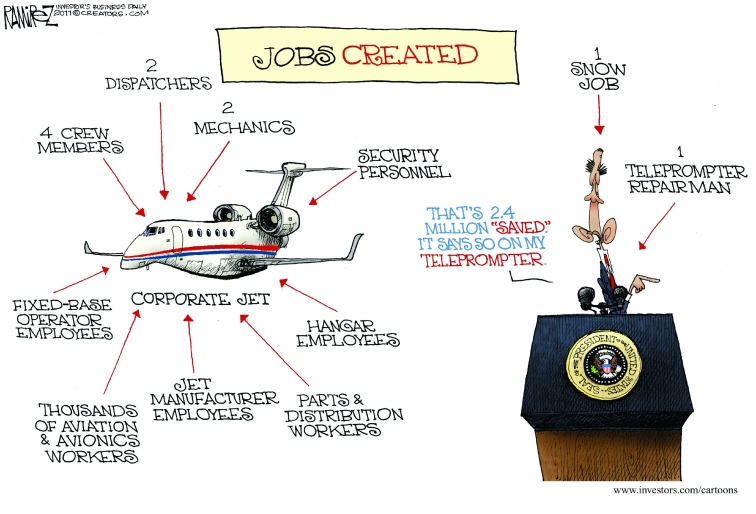
Ramirez Cartoon: Jobs Created
Posted by Print

Below is one of the latest cartoons from two-time Pulitzer Prize-winner Michael Ramirez.

View more of Michael Ramirez’s cartoons on CFIF’s website here.

June 23rd, 2011 at 11:06 am
Initial Unemployment Claims Rise, Fed Says “We’ve Done All We Can”
Posted by Print

So much for attempt number two on the “Recovery Summer” that the Obama Administration promised one year ago.

Today, the Labor Department announced that weekly initial unemployment claims jumped to 429,000, an increase of 9,000 from last week’s 420,000.  Even more ominously, Federal Reserve Chairman Ben Bernanke explained yesterday that the Fed has already done all it is prepared to do to increase growth, and expressed the same sort of cluelessness as Obama on why their “stimulus” has failed:

We don’t have a precise read on why this slower pace of growth is persisting.”

The Fed also issued “fairly significant” reductions in its 2011 growth forecast to 2.9% next year (down from a 3.3% growth expectation in April, and from 3.9% in January).  Another “Recovery Summer” like this, and Obama will be borrowing Jimmy Carter’s sweater for his own “Malaise Speech.”

June 3rd, 2011 at 4:17 pm
Ditching Obama’s “Bumpy” Road to Recovery

If you’ve ever had the misfortune of drifting off the highway, chances are you’ve been instantly reminded by the deep grooves on the other side of the white line.  When your car crosses over them a deep, sickening rattle shakes your vehicle.  It’s a warning that you’re about to leave the road and enter a crash zone.

Most people have to fight to urge to overcorrect.  Austan Goolsbee, President Barack Obama’s chief economist, would probably reclassify the loud death tones as just “bumps along the road” and keep driving.

That’s effectively what Goolsbee is doing by claiming that the nearly 80 percent drop in jobs created from April to May are just 200,000 or so “bumps” in the White House’s empirically indefensible road to recovery.

Like an absent-minded professor ignoring the warning signs of an impending car wreck, Goolsbee and Co. are driving the American economy off the road and into a ditch.  Unemployment is anchored at 9.1 percent.  The stock market is falling with every new round of bad economic news.  Rating agencies are downgrading America’s economic outlook because of its lack of fiscal responsibility.

There are two ways to stop bumping over the warning grades.  Either get back on the highway or leave the pavement entirely.  By sticking to his present course, President Obama is steering the nation’s economy into a serious wreck.

June 3rd, 2011 at 9:22 am
Obamanomics: Unemployment Rises to 9.1%
Posted by Print

This morning, the Labor Department announced that the U.S. unemployment rate climbed again to 9.1% this month, up from 9.0% in April.  Just as alarmingly, the net number of jobs created was only 54,000, down from 232,000 in April.  In addition to deteriorating from the previous month, both numbers fell well below the expectations of economists, who had anticipated a decline in the unemployment rate to 8.9%, and 160,000 net new jobs.  This also means that in the 27 months since Obama signed his unprecedented government spending “stimulus,” unemployment has only climbed from 8.2% to 9.1%, even though the Administration projected that he would have it down to 6.5% by now.  By way of comparison, in the same 27 months following the effective date of President Reagan’s tax cuts in January 1983, unemployment plummeted from 10.4% to 7.3%.  The facts speak volumes.

May 26th, 2011 at 2:14 pm
Ramirez Cartoon: Obama’s Irish Roots
Posted by Print

Below is one of the latest cartoons from two-time Pulitzer Prize-winner Michael Ramirez.

View more of Michael Ramirez’s cartoons on CFIF’s website here.

May 26th, 2011 at 10:57 am
Initial Unemployment Claims Rise Again
Posted by Print

This morning, the Labor Department announced that first-time unemployment claims rose again, from 414,000 last week to 424,000 this week.

As demonstrated by this Labor Department graph, weekly unemployment claims average approximately 300,000 during periods of economic normalcy.  One year ago, the number stood at 463,000 when the Obama Administration proclaimed the arrival of the “Recovery Summer,” yet it never dipped below 400,000 for the remainder of 2010.  We finally dipped into the high 300,000 range in February of this year – still an elevated level – but the number climbed back to 478,000 last month.

This is the Obama “stimulus,” over two years and $1 trillion of government spending later.

May 6th, 2011 at 1:39 pm
Too Few Taxpayers

Tim again hits a crucially important issue  in his column that ran yesterday. When fewer than half of the population pays income taxes, the balance tips in favor of freeloading. The Washington Times editorial Wednesday laments that half of the equation: Welfare, of various sorts, is out of control.

It’s no wonder that the latest Agriculture Department figures shows one out of every five households received food stamps in February. The assistance provided to 20.8 million homes – up 20 percent in the past year-and-a-half – came at an annual cost of $68 billion. Free lunches were handed out to another 18.4 million, leaving taxpayers with a bill for $12.8 billion…. Instead of punishing enterprise and subsidizing poverty, the country needs to restore the conditions that promote prosperity. America’s corporate tax rate – currently the second highest in the world – needs to be cut. We need to restrain federal spending by scaling back the freebies doled out to far too many people. That’s the best way to restart our economic engine.

Only policies that promote growth will put more people above the income line at which they pay income taxes. Taxes are not a good thing, but making enough money to pay taxes is. Unless people are paying at least a nominal rate of taxes, they will feel no compunction to support the sorts of policies that reduce the need for taxes in the first place. From what they can see in the immediate horizon, at least, they are not at all invested in the health of the private economy, but instead are invested in the idea of bigger government — because bigger government now costs them nothing, and probably subsidizes them directly.

Tim’s quote from Orrin Hatch was good:

“An increasingly smaller group of Americans is shouldering the burden for an increasingly larger group of Americans.”

This is a recipe for ultimate economic collapse.

Veronique de Rugy adds more at NRO. She notes massive empirical research that shows high levels of publicly held debt have the effedct of consistently lowering economic growth. She ends with a quote that itself contains a link to this paper. In that paper comes a line that restates my point: “What is fleeting in economics is politically popular, while what is enduring in economics is politically unpopular.” The author descrivbes this phenomenon as the “shortsightedness bias” inherent in politics. When a majority of the public freeloads, their short-sightedness bias will be in favor of more freeloading, more debt — and, against their long-term interest, less growth. That’s why tax rates should not be raised, but why the tax base must be widened.  Counterintuitively, the way to widen the base is to keep the rates low enough to promote the economic growth that lifts more people into income levels at which they pay taxes. And as more people pay taxes, deficits and debt start to decline. A government that encourages economic growth can therefore be a more stable government than one that tries to soak the rich. A broad tax base thus supports ordered liberty. High tax rates undermine it.

May 2nd, 2011 at 4:54 am
Ramirez Cartoon: The Debt Storm
Posted by Print

Below is one of the latest cartoons from two-time Pulitzer Prize-winner Michael Ramirez.

View more of Michael Ramirez’s cartoons on CFIF’s website here.

April 29th, 2011 at 4:25 pm
Gallup: 73%-22% Majority Blames Deficit on Too Much Spending, Not Insufficient Taxes
Posted by Print

Here’s more encouraging news:  Americans are “getting it” on the issue of federal deficits and debt.  According to a new Gallup survey, an overwhelming 73% to 22% majority blames excess spending for the deficit, not insufficient taxation.  Barack Obama and his liberal apologists seek to blame “tax cuts for the rich” and insufficient revenues as the problem.  But as illustrated by the Heritage Foundation’s newly-released 2011 Budget Chart Book, our budget would still be approximately balanced if spending merely returned to early 2000s levels.  Does any serious person contend that government was too small in the first half of the 2000s, that government didn’t spend enough, that the poor and hungry were somehow cast out on the cold streets, that bureaucrats went unpaid?  Of course not.  The problem is explosive spending growth.  Obama oversaw an 84% increase in domestic discretionary spending, including his failed “stimulus,” in just his first two years.

Fortunately, Americans see through his attempt to demand even more taxpayer dollars to feed the insatiable leviathan he hopes to enlarge.

April 29th, 2011 at 1:10 pm
It Takes People to Grow an Economy

The Wall Street Journal reports China’s controversial one-child policy will have disastrous effects on the country’s capacity for economic growth, a stunning rebuke to policymakers who argue that predetermining fertility rates is key to eliminating poverty.

Since the one-child-per-couple policy went into effect in 1980, over 400 million births have been prevented, decreasing the amount of poor people and thus the rate of poverty.  (Though since the policy applies to everyone, it has also reduced the amount of children born to middle class and wealthy families; i.e. those most likely to produce entrepreneurs and innovators.)

An informal advocacy group in China is trying to overturn the one-child policy because of a generational imbalance that threatens continued economic growth:

They say China’s elderly population is expanding rapidly as Mao-era baby boomers retire, putting new burdens on society to cover the cost of their retirement. At the same time, China’s labor force is due to start shrinking in 2016, reversing the demographic phenomenon of a widening pool of low-cost labor that powered a manufacturing boom over the past three decades.

It takes people to grow an economy.  If Chinese policymakers continue to eliminate entrepreneurs and workers from the economy, they will soon experience the same chilling effects of the demographic winter settling in over Western Europe and Japan.

April 22nd, 2011 at 2:08 pm
The Trouble with California in One Paragraph

John Fund gives an excellent distillation for the reasons California businesses are relocating en masse to Texas:

Andy Puzder, the CEO of Hardee’s Restaurants, was one of many witnesses to bemoan California’s hostile regulatory climate. He said it takes six months to two years to secure permits to build a new Carl’s Jr. restaurant in the Golden State, versus the six weeks it takes in Texas. California is also one of only three states that demands overtime pay after an eight-hour day, rather than after a 40-hour week. Such rules wreak havoc on flexible work schedules based on actual need. If there’s a line out the door at a Carl’s Jr. while employees are seen resting, it’s because they aren’t allowed to help: Break time is mandatory.

Indeed, California policymakers are enjoying an extended break from economic reality by focusing on everything else but job creation.

If the trend of 4.7 businesses a week abandoning California continues, pretty soon the great weather will be the only reason to visit the once Golden State.

April 15th, 2011 at 10:16 am
The Bush Administration Didn’t Create Your Record Deficits, Mr. Obama
Posted by Print

Observers like Charles Krauthammer are correct:  Barack Obama’s partisan budget attack this week was a “disgrace.”  Almost every sentence was tawdry, caustic or simply dishonest.

One suggestion early in Obama’s speech stood out because it is so easily refuted by simple numbers.  Namely, his latest attempt to scapegoat the Bush Administration and portray his own record deficits as somehow attributable to it:

We increased spending dramatically for two wars and an expensive prescription drug program -– but we didn’t pay for any of this new spending.  Instead, we made the problem worse with trillions of dollars in unpaid-for tax cuts -– tax cuts that went to every millionaire and billionaire in the country; tax cuts that will force us to borrow an average of $500 billion every year over the next decade.  To give you an idea of how much damage this caused to our nation’s checkbook, consider this:  In the last decade, if we had simply found a way to pay for the tax cuts and the prescription drug benefit, our deficit would currently be at low historical levels in the coming years.”

But take a look at the actual historical deficit data, with particular attention to 2007, which was the last year under a Republican Congress and White House.  That year’s deficit came in at $161 billion, which is one-tenth the size of Obama’s projected record $1.65 trillion 2011 deficit.  That 2007 deficit was also down from $378 billion in 2003, when the tax cuts, Iraq invasion and drug benefit occurred.  In his usual straw-man manner of argumentation, Obama mocked those who claim we can reduce our debt by eliminating “waste, fraud and abuse,” but what better way to characterize his latest un-presidential harangue?