Archive

Posts Tagged ‘health’
October 29th, 2012 at 6:45 pm
Obama Is Lying to Swing State Seniors

Avik Roy, an outside health care policy advisor to the Romney campaign, reminds us why you should never trust a clever lawyer or accountant:

Obamacare was cleverly designed such that its most politically toxic provisions wouldn’t go into effect until after the election. In addition, the Obama administration spent billions of unauthorized taxpayer dollars this year and last so that the impact of its cuts wouldn’t be felt until after the election.

2013: Tax increases and Medicare cuts

Over the next ten years, Obamacare cuts $716 billion from the Medicare program in order to fund its $1.9 trillion in new health spending over the same period. $156 billion of those cuts come from the market-oriented Medicare Advantage program, and those Medicare Advantage cuts start to kick in in 2013. 27 percent of all seniors are enrolled in Medicare Advantage, including 32 percent in Wisconsin and 36 percent in Ohio.

I hope the Romney campaign has been hammering home the part about the Obama Administration hiding the true cost of Obamacare from voters in swing states like Wisconsin and Ohio through aggressive direct mail and ad buys in those states because people need to know that before they decide whether to renew the incumbent’s contract.

For my part, a White House that deliberately hides the truth behind unauthorized spending and delayed implementation timelines is one that can’t be trusted; now or in the future.

October 19th, 2012 at 6:14 pm
Obamacare Failures in One Long, Hilarious Sentence

If you haven’t already seen it, the video of Illinois State Senate candidate Barbara Bellar’s single-sentence description of Obamacare is a hilariously accurate indictment of the Obama Administration that promoted it.

October 4th, 2012 at 9:12 pm
AARP Tries to Get Distance from Obama

Joel Gehrke of the Washington Examiner flagged a disingenuous statement from the AARP after President Barack Obama’s disastrous debate performance last night:

President Obama invoked AARP to defend his health care law last night, prompting the influential group to release a statement telling him not to do that again.

“While we respect the rights of each campaign to make its case to voters, AARP has never consented to the use of its name by any candidate or political campaign,” the group posted in a statement. “AARP is a nonpartisan organization and we do not endorse political candidates nor coordinate with any candidate or political party.”

The statement is disingenuous because, as I argued in a recent column, AARP stands to gain $2.8 billion if ObamaCare is implemented; an event foreshadowed in an email from a top AARP executive to the White House in 2009 that said, “we will try to keep a little space between us” on health care because AARP’s “polling shows we are more influential when we are seen as independent, so we want to reinforce that positioning…The larger issue is how best to serve the cause.”

AARP already made its choice.  If it wants its money, the group must support its patron, no matter how unpopular he is becoming.

September 20th, 2012 at 1:45 pm
ObamaCare: Taxing the Constitution

My column this week explains the logic behind an important new constitutional challenge to ObamaCare by the Pacific Legal Foundation, a non-profit property rights law firm.

In its lawsuit, Sissel v. Department of Health and Human Services, PLF argues that the Supreme Court did ObamaCare no favors when it saved the law from a Commerce Clause challenge by reinterpreting it as a constitutional exercise of Congress’ taxing power.

Instead, PLF argues, the Court merely exposed ObamaCare’s newly found taxing authority as an express violation of the Constitution’s Origination Clause, which requires all new tax bills to originate in the House of Representatives, not in the Senate as ObamaCare did.

Though simple and faithful to the Constitution’s text, PLF’s argument is nonetheless novel because some of the Supreme Court’s precedents indicate the Court will not seriously enforce the Origination Clause’s procedure.

But as liberal legal scholar Jack Balkin says in a blog for The Atlantic, Chief Justice John Roberts and his conservative colleagues may be open to rethinking those precedents:

In a previous essay for The Atlantic, I noted that even if a legal argument is currently “off the wall,” it may nevertheless become plausible if enough prominent people get behind it and vouch for it. Support by major political parties is probably the most important factor in quickly moving arguments from “off the wall” to “on the wall.” The challengers’ arguments in NFIB v. Sebelius got as far as they did because the unconstitutionality of Obamacare became virtually the official position of the Republican Party, and Republican politicians and affiliated media pushed the challengers’ claims over and over again. Repeated arguments by conservative politicians, media, and intelligentsia, in turn, probably affected the views of Republican-appointed judges and justices about how seriously to take the arguments.

Members of the media will no doubt ask legal scholars (such as yours truly) whether the PLF’s new constitutional challenge to Obamacare is likely to succeed on the merits. I’ve just given you my answer: not under existing law.

But if reporters have been paying attention to the events of the last two years, they should know that, at least where health care reform is concerned, the considered views of legal scholars are not the most important ones. The real question to ask is whether Republican politicians, right-wing talk radio, and Fox News will get behind the new challenge with the same degree of enthusiasm they had for the first legal assault on Obamacare. If they do, then the mainstream media will no doubt cover the controversy as it did before. If a conservative district court judge takes the arguments seriously, the game is on once more. And then, perhaps, Chief Justice Roberts, given a second chance, will change his mind — again.

September 7th, 2012 at 2:17 pm
Ryan’s Democratic Stand-In on Challenges of Prepping Biden

Rep. Chris Van Hollen (D-MD) told Roll Call what the biggest challenge is while preparing Vice President Joe Biden to debate Paul Ryan:

“I sit next to Paul Ryan in the Budget Committee day in and day out,” he said on his preparation for the role.”So, I know how he presents the Republican case.

“He presents a plan that’s bad for the country with a smile, so I think the challenge is dealing with presentation of the plan, explaining why the plan is bad for the country,” he added.

With all due respect to Rep. Van Hollen, his biggest challenge is helping Joe Biden explain how ripping out more than $700 million from Medicare to pay for ObamaCare is a better policy than Ryan’s idea to convert future Medicare benefits into a fiscally sustainable premium support voucher.

It would take all of Bill Clinton’s rhetorical sleight-of-hand to pull off that feat.  Instead, Van Hollen is working with the gaffe-prone Biden.

Good luck overcoming that handicap, Congressman.  You’ll need it.

August 9th, 2012 at 3:09 pm
An ObamaCare Exchange By Any Other Name…

God bless residents of the Pacific Northwest for casting rightful suspicion on ObamaCare’s state-based, federally-directed, health insurance exchanges:

Focus groups in Oregon expressed emotions about buying coverage that included “skepticism” and “frustration,” and some individuals and small businesses used “black hole” and other less-kind terms to refer to insurance, brand design firm Sandstrom Partners told the Oregon Health Insurance Exchange in a presentation made available by the exchange.

The word exchange “raises some suspicions of loopholes and fine print” and “implies current coverage may needed to be traded for something else,” wrote communications company GMMB in a presentation to the Washington State Health Benefit Exchange. Part of the problem, GMMB said, was that the word was “perceived as a verb and unfamiliar as a noun” and reminded people of the New York Stock Exchange or military exchange stores.

Washington state is leaning toward calling its program Washington HealthLink, as long as it doesn’t conflict with existing trademarks, and plans to use green and blue in its logo design because the colors are considered to be reassuring, said Michael Marchand, the state’s exchange director. The exchange’s board of directors will make the final decision on the name, he said.

Focus group participants had also been asked to consider HealthChoice but it “makes some wonder if Washington State is making the choice for them,” consultants and the exchange board concluded.

The Wall Street Journal article from which these excerpts are culled goes on to detail other stories of states trying to brand government-created “marketplaces” as something other than a first big step to government-run health care, but you get the point.

No matter what you call an ObamaCare exchange, it’s still an entry point for socialized medicine.

August 8th, 2012 at 7:32 pm
President’s ObamaCare Deception

Politico reports that in a campaign speech in Colorado today President Barack Obama framed his Patient Protection and Affordable Care Act (aka ObamaCare) this way:

“Let me tell you something, Denver, I don’t think your boss should get to control the health care that you get,” Obama told the crowd at a campaign stop in Colorado. “I don’t think insurance companies should control the care that you get. I don’t think politicians should control the care that you get. I think there’s one person to make these decisions on health care and that is you.”

What the President neglected to mention is that instead of employers, insurance companies, and politicians – and despite his comments about individuals – the constituency he really favors making health care decisions is the federal bureaucracy.

ObamaCare’s Medicaid expansion is intended to capture millions of Americans newly eligible for government coverage that will be – at least initially – cheaper than their current private provider.  The state-based, but federally-directed, health care exchanges are really just Trojan horse structures allowing HHS to seize control of the states’ traditional role in regulating health insurance whenever a state defies a federal prerogative.

And let’s not forget that the Independent Payment Advisory Board is empowered to act as a backdoor ration board, setting price caps on medical reimbursements that will distort the market and cause shortages.  In socialized systems like Britain and Canada long waiting times are the norm, as are denials of procedures in favor of pain management.

All of these elements – Medicaid expansion, federally managed health exchanges, and IPAB – empower one group: unelected, unaccountable bureaucrats.  To claim as the President does that private individuals will be the ones calling the shots on health care decisions is either foolish or deceptive, and I don’t think the man is lacking in smarts.

July 16th, 2012 at 1:04 pm
Best Case Scenario if ObamaCare Mandate Not Repealed

In my column last week, I outlined how ObamaCare’s Medicaid expansion is a way to sneak in socialized medicine by making it cheaper to accept government health insurance instead of paying for it (directly) oneself.

But the Medicaid expansion is only half of ObamaCare’s formula for moving most of America onto a federally-run health system.

The other half is made up of the so-called state-based health insurance exchanges that are subsidized (and regulated) by the federal government.  With the individual mandate in place, people that fail to qualify for Medicaid will most likely be forced into the exchanges.  (ObamaCare purposefully makes it cheaper for employers to pay a fine rather than cover employees.)

Writing in the New York Times on Saturday, Tyler Cowen, an economics professor at George Mason University, explains how to make the best of the very bad possibility that President Barack Obama is reelected and ObamaCare continues to be implemented, albeit with the inevitable cost overruns.

There is one way this might work: by limiting the subsidies for insurance. Note that the law itself mandates cuts if those subsidies exceed a certain percentage of gross domestic product by 2018. Most likely, the reform could not stop there, because the insurance cost burden for many Americans would feel intolerably high without the subsidies.

The next step, therefore, would lower costs by limiting the mandate to covering catastrophic conditions. Yet a further step would remove the mandate for noncatastrophic coverage, thus giving people more control over how much they want to spend on health care versus other priorities.

We would then have government-subsidized and mandated catastrophic insurance, and a freer market for other health care expenditures. We might even return to a health savings account approach on the noncatastrophic side.

That’s far from a perfect outcome, but it’s probably the most positive path that can be achieved.

Let’s hope it doesn’t come to that.

July 9th, 2012 at 5:45 pm
Would a President Romney Waive ObamaCare Rules?

Last Friday, the Obama Administration announced that Wisconsin and Washington joined 24 other states as recipients of No Child Left Behind waivers.

The Department of Education claims that Congress’ repeated failure to reauthorize NCLB since it became due in 2007 empowers it to exempt petitioning states from certain requirements in exchange for accepting new rules and policies dictated by the White House.

This links to a chart from Governing.com identifying each state’s waiver status.

Writing in an email commentary about the waivers, Lindsey Burke of the Heritage Foundation summarizes President Barack Obama’s justification of the waiver system as “necessary to provide relief to states that fear drowning in a cascade of sanctions that are forthcoming in 2014,” such as 100 percent of students being proficient in reading and math.

While I agree with Burke that states “should demand genuine relief from NCLB through congressionally approved options that fundamentally reduce federal intervention in education,” her summary of Obama’s justification for waivers got me thinking.

If Mitt Romney gets elected president with less than full (or consistent) control of Congress and can’t repeal ObamaCare, would he resort to granting waivers from its penalties “to provide relief to” individuals “that fear drowning in a cascade of sanctions”?

I certainly hope so.

David Harsanyi points out:

According to the Congressional Budget Office—which can only calculate the narrow data it’s given—the non-tax penalty on Obamacare’s non-mandate will affect 4 million people by the year 2016. Of those paying this ‘untax,’ 75 percent will make less than $120,000—breaking the president’s promise that those making under $250,000 would not have to pay a “penny” more in taxes, which, presumably, includes “shared responsibility payments.”

Anticipating Romney’s inauguration, I’ll go ahead and get in line to ask, “Mr. President, can I have a lifetime waiver from my ‘shared responsibility payment?’”

I think there’s a precedent…

July 7th, 2012 at 4:21 pm
IPAB Should Be Next ObamaCare Target

Wesley J. Smith reminds us why with ObamaCare’s individual mandate safe for now, conservative litigators should focus on striking down the Independent Payment Advisory Board, the unelected, unaccountable group of “experts” charged with controlling costs under ObamaCare.

There’s not much time left:

According to the terms of the Affordable Care Act, IPAB must submit its first draft recommendations to the health and human services secretary by September 1, 2013. Its first Medicare cost-cutting goals must become law by August 15, 2014.

Why did I write “must” become law” instead of “may”? IPAB’s unique “fast track” authority divests Congress of discretion regarding the amount of money to be cut from Medicare once IPAB has submitted its “advice.” Get a load of these legislative handcuffs:

  • By January 15, 2014, IPAB must submit a proposal to Congress and the president for reaching Medicare savings targets in the coming year.
  • The majority leaders in the House and Senate must introduce bills incorporating the board’s proposal the day they receive it.
  • Congress cannot “consider any bill, resolution, amendment, or conference report … that would repeal or otherwise change the recommendations of the board” if such changes fail to meet the board’s budgetary target.
  • By April 1, all legislative committees must complete their evaluation. Any committee that fails to meet the deadline is barred from further consideration of the bill.
  • If Congress does not pass the proposal or a substitute plan meeting the IPAB’s financial target before August 15, or if the president vetoes the proposal passed by Congress, the original Independent Payment Advisory Board recommendations automatically take effect.

Not only that, but Congress cannot consider any bill or amendment that would repeal or change this fast-track congressional consideration process without a three-fifths vote in the Senate. And to put the icing on the autocratic cake, implementation of the board’s policy is exempted from administrative or judicial review.

Unlike the rest of ObamaCare, IPAB cannot be repealed easily because its enabling statute “entrenches” it from being altered by later Congresses.  Thus, banking on a President Romney and a Republican Congress to get rid of it won’t work.

I’ve written before about the federal case in Arizona challenging IPAB.  It was on hold awaiting the Supreme Court’s decision on the individual mandate.  With the mandate redefined as a tax, the IPAB litigation will proceed, perhaps with a Supreme Court hearing as early as spring 2013.

Keep an eye on this one.  It’s easy to see how an unaccountable board of bureaucrats empowered to control costs could morph into a health care rationing board.

July 5th, 2012 at 1:35 pm
Roberts’ ObamaCare Decision a Job Creator?

It’s no secret that Chief Justice John Roberts’ opinion in the ObamaCare case last week is already helping President Barack Obama on the campaign trail by giving the unpopular law constitutional legitimacy.

But Fox News reports that Roberts’s opinion may also help the President make another boast: ObamaCare is a job creator.

Much bigger than the mandate itself are the insurance exchanges that will administer $681 billion in subsidies over 10 years, which will require a lot of new federal workers at the IRS and health department.

“They are asking for several hundred new employees,” Dorn said. “You have rules you need to write and you need lawyers, so there are lots of things you need to do when you are standing up a new enterprise.”

For some, though, the bottom line is clear and troubling: The federal government is about to assume massive new powers.

According to James Capretta of the Ethics and Public Policy Center, federal powers will include designing insurance plans, telling people where they can go for coverage and how much insurers are allowed to charge.

“Really, how doctors and hospitals are supposed to practice medicine,” he said.

The health department is still writing regulations, which can be controversial in and of themselves. One already written, for instance, requires insurance plans to cover contraception. It has been legally challenged by Catholic groups in a case likely to end up in the Supreme Court.

So, there are likely to be many more chapters to go in the saga of Obama’s health care law

And none of it would be possible without the Chief Justice.

June 28th, 2012 at 2:02 pm
SCOTUS Does Obama’s, Congress’ Dirty Work

There’s a lot to say about Chief Justice John Roberts’ opinion rewriting ObamaCare’s individual mandate as a tax in order to save the law from being ruled unconstitutional.  One of the best – and most succinct – analyses comes from the CATO Institute’s Michael F. Cannon:

The Supreme Court ruled that ObamaCare’s individual mandate is not constitutional under the Commerce Power, which was how Congress framed the mandate to avoid a political backlash from calling it a tax. Congress and the president swore up and down that the mandate was not a tax. Yet the Court upheld the mandate as a valid use of that disavowed taxing power. What Congress said the individual mandate is, the Court said is not constitutional. What Congress said the mandate is not, the Court ruled is constitutional. Everybody got that?

Where does that leave us?

The Supreme Court just enacted a law that Congress never would have passed.

The Court just told Congress it is okay to lie to the people to avoid political accountability.

June 27th, 2012 at 12:52 pm
ObamaCare Prediction: SCOTUS Kills Entire Law

Though we learned with the Arizona illegal immigration decision that tough questioning from justices does not mean a Supreme Court slap-down – indeed, Justice Sotomayor was particularly hard on the feds’ position but ultimately upheld its arguments, as did Justice Kennedy and Chief Justice Roberts – I’m betting (with Quin’s money, of course) that Justice Scalia’s quip about the page length of ObamaCare provides a window into tomorrow’s outcome.

During oral argument Scalia brushed aside the suggestion that should the Court rule the individual mandate unconstitutional it would need to reconstruct the law by piecing together the parts that are still valid.  Scalia’s response was, “You want us to go through 2,700 pages?  Is this not totally unrealistic… to go through one by one and decide each one?”

I think the Court will strike down the individual mandate because it forces Americans to participate in commerce, an unprecedented power grab by the federal government.  (Ironically, had the Obama Administration framed the penalty for not buying insurance as a tax, most constitutional scholars on the right and left agree the mandate would survive.  However, the reason government lawyers haven’t framed it that way is because Obama and the Democrats in Congress repeatedly and explicitly said no one’s taxes would go up if ObamaCare passed, meaning that calling the mandate a tax during litigation would likely make the entire law even less popular with the public.)

Because of all this, I think the Court will do everyone a favor by holding the individual mandate unconstitutional and finding that the rest of the law is not severable from it.  (Which is easy to do since in the rush of ramming the bill around the normal legislative process Congressional Democrats forgot to put in a simple severance clause that would let the rest of the law stand if the mandate falls.)

Thus, everyone gets a blank slate and the Court is not patching together a form of the health reform law that no one voted on or signed.

For what it’s worth, there’s my (or rather Quin’s) two cents.

June 15th, 2012 at 2:03 pm
Flow Chart Explaining How Supremes Could Rule on ObamaCare

ABC News put together a helpful graphic showing different scenarios of how the Supreme Court might rule.

A decision is expected sometime in the next two weeks.

April 30th, 2012 at 6:22 pm
Repeal Obamacare and Replace It with… Bushcare?

Avik Roy, a health policy expert at the Manhattan Institute, posits an interesting option for fiscal conservatives looking for something to replace Obamacare with, if Republicans capture Congress and the White House this November: Bushcare.

The Bush plan was formulated by the White House’s National Economic Council, under the leadership of Allan B. Hubbard. The core goal of the plan was to equalize the tax treatment of employer-sponsored and individually-purchased health insurance, without increasing the deficit. (As regular readers know, the fact that employers can purchase health insurance for their workers tax-free, whereas individuals can’t, is the original sin of the U.S. health-care system.)

Bush’s proposal sought to eliminate the unlimited tax break for employer-sponsored insurance, replacing it with a standard deduction for everyone. Under the plan, anyone—employed or not—who bought at least catastrophic insurance would not pay income or payroll taxes on the first $7,500 of their income, or the first $15,000 for a family plan.

The Bush plan’s numbers were designed with 2009 insurance prices in mind, and the tax-deduction thresholds would grow with CPI inflation. The Treasury Department estimated that the plan would lower taxes for 80 percent of those with employer-sponsored insurance, and increase taxes for the remaining 20 percent. It would have especially benefited the 18 million people who then bought insurance on their own, along with many of the uninsured, who would suddenly find health insurance to be significantly less expensive.

In contrast to Obamacare, however, the Bush plan would have turbocharged the market for consumer-driven health plans, tied to health savings accounts, because the most economically efficient use of the deduction would be to purchase a sufficiently generous consumer-driven plan that allowed individuals to put a maximal amount of money into HSAs. Obamacare significantly constrains the use of HSAs in its regulated insurance markets.

Among the criticisms of Bush’s health care proposal is that it “only” expanded health insurance coverage to an additional 11 million people.  Obamacare’s supporters claim – perhaps erroneously – that it would cover 33 million.  But even if we take the estimates at face value, there’s another number that’s arguably more important.

The cost of Obamacare’s 33 million newly covered citizens is agreed by all sides to be in the trillions of (new) dollars.  Bush covered 11 million for zero dollars in increased federal spending commitments.

Food for thought if the Republicans run and win on a platform to repeal and replace Obamacare.

April 24th, 2012 at 12:59 pm
How to Make Obamacare Exchanges a State Campaign Issue

In a presidential election year like 2012, it’s easy for national issues to crowd out state and local concerns at the ballot box.  But thanks to Obamacare’s costly mandate on states to create health insurance exchanges, fiscal conservatives running for state offices can easily make opposition to more government a central plank in their campaign platform.

According to Cato Institute scholar Michael F. Cannon, outside of the U.S. Supreme Court’s potentially striking down Obamacare’s individual mandate, the most important health policy battle to be waged is state government opposition to creating Obamacare’s state-based health insurance exchanges.

As I’ve written previously these exchanges are a subtle way to coerce states into spending millions of dollars to set-up a government-controlled, taxpayer-subsidized “market” for health insurance.  Thereafter, when Obama’s bureaucrats at HHS decide the state version isn’t performing exactly the way they want, Obamacare grants HHS the power to take over any state’s exchange and run it from Washington, D.C.  Thus, the bait-and-switch is yet another way for Obamacare to hide its impact on the federal budget deficit by shoving some of its start-up costs onto the states.

Cato’s Cannon outlines a different strategy, with talking points that to me seem ready-made for a state campaigner’s website:

Jobs. Refusing to create an exchange will block Obamacare from imposing a tax on employers whose health benefits do not meet the federal government’s definition of “essential” coverage. That tax can run as high as $3,000 per employee. A state that refuses to create an exchange will spare its employers from that tax, and will therefore enable them to create more jobs.

Religious freedom. In blocking that employer tax, state officials would likewise block Obamacare’s effort to force religious employers to provide coverage for services they find immoral — like contraception, pharmaceutical abortions, and sterilization.

The federal debt. Refusing to create exchanges would also reduce the federal debt, because it would prevent the Obama administration from doling out billions of dollars in subsidies to private insurance companies.

The U.S. Constitution. The Obama administration has indicated that it might try to tax employers and hand out those subsidies anyway — even in states that don’t create an exchange, and even though neither Obamacare nor any other federal law gives it the power to do so. If that happens, the fact that a state has refused to create an exchange would give every large employer in the state — including the state government itself — the ability to go to court to block the administration’s attempt to usurp Congress’s legislative powers.

A lower state tax burden. States that opt to create an exchange can expect to pay anywhere from $10 million to $100 million per year to run it. But if states refuse, Obamacare says the federal government must pay to create one. Why should states pay for something that the federal government is giving away?

Bye-bye, Obamacare. That is, if the feds can create an exchange at all. The Obama administration has admitted it doesn’t have the money — and good luck getting any such funding through the GOP-controlled House. Moreover, without state-run exchanges, the feds can’t subsidize private insurance companies. That by itself could cause Obamacare to collapse.

There is no reason a state should agree to spend millions of dollars laying the groundwork for a federal takeover of health care.  Fiscal conservatives running for office this cycle should articulate this argument well and often.

April 9th, 2012 at 5:24 pm
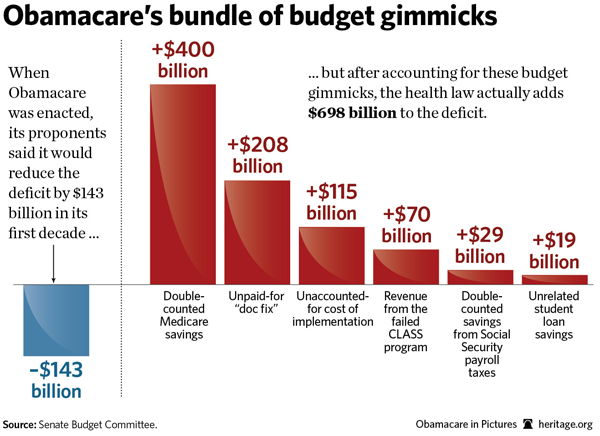
Chart: ObamaCare’s True Costs

The Heritage Foundation breaks down the numbers of what ObamaCare was promised to save, and what it actually costs:


Combine this spending monstrosity with the $787 billion stimulus bill and you’ve got nearly $1.5 trillion added to the federal deficit before any other Obama Era policy has been discussed.  Lard on the costs of EPA regulations, the uncertainty of Dodd-Frank’s implementation, and the specter of all the Bush tax cuts vanishing next January and it’s no wonder the American economy is stagnant.  The liberals in Washington, D.C. are spending and regulating us into oblivion.

January 26th, 2012 at 8:02 pm
More Pie-in-the-Sky Thinking From School Lunch Czars

The drive to force schoolchildren to eat healthier meals continues unabated, despite overwhelming evidence that serving adult-oriented meals increases kids’ use of junk food.  In today’s San Francisco Chronicle one local school district food advocate (yes, they exist) thinks that new federal rules mandating increased use of red, yellow and green vegetables and protein-rich legumes will result in a generation of kids yearning for spinach.

“Parents can now imagine their children coming home from school with a newfound love for spinach, sweet potatoes and whole-wheat spaghetti,” said Dawn Undurraga, staff nutritionist with Environmental Working Group, which works on public health issues, in a statement. “That’s a positive development that will have a lasting impact as they grow into strong, fit young adults.”

Would that it were so.  As a parent myself, I can vouch for the flights of fancy we sometimes entertain when junior’s decision-making process does not mirror our own.  On occasion I’ve tried to convince myself that maybe if I just eliminate sugar from my son’s diet he won’t want it anymore.  Of course, his taste buds and Grandma intercede and the game is up.  He knows that there’s a much better tasting alternative to the wheat-filled slag Dad is serving.  It is one thing for a parent to be paternalistic, but it’s quite another when public sector food bureaucrats (or “activists”) think they can socially engineer a kid to crave certain food.

Unfortunately for the Berkeley-based Ms. Undurraga, my column on the Los Angeles Unified School District’s failed food experiment points in the opposite direction.  According to reporting from the Los Angeles Times students confronted with mass produced health food are reacting in a way all too familiar:

For many students, L.A. Unified’s trailblazing introduction of healthful school lunches has been a flop. Earlier this year, the district got rid of chocolate and strawberry milk, chicken nuggets, corn dogs, nachos and other food high in fat, sugar and sodium. Instead, district chefs concocted such healthful alternatives as vegetarian curries and tamales, quinoa salads and pad Thai noodles.

There’s just one problem: Many of the meals are being rejected en masse. Participation in the school lunch program has dropped by thousands of students. Principals report massive waste, with unopened milk cartons and uneaten entrees being thrown away. Students are ditching lunch, and some say they’re suffering from headaches, stomach pains and even anemia. At many campuses, an underground market for chips, candy, fast-food burgers and other taboo fare is thriving.  (Emphasis mine)

What?  A black market for comfort food seething right below the pad Thai noodles and quinoa salads?!  Obviously, the next step is to confiscate the hamburgers and punish those responsible.  Perhaps Michelle Obama could be called in to force-feed yummy bowls of spinach until the little ones develop that “newfound love” of greens everyone is so eager to foist upon them.