Video: Would ObamaCare Kill Medical Innovation?
HT: reason.tv

The chorus of opposition to ObamaCare is growing louder among the ranks of medical academe. Dr. Jeffrey Flier, dean of Harvard Medical School, says ObamaCare would receive a “failing grade” at Harvard.
Our health-care system suffers from problems of cost, access and quality, and needs major reform. Tax policy drives employment-based insurance; this begets overinsurance and drives costs upward while creating inequities for the unemployed and self-employed. A regulatory morass limits innovation. And deep flaws in Medicare and Medicaid drive spending without optimizing care.
His conclusion:
In discussions with dozens of health-care leaders and economists, I find near unanimity of opinion that, whatever its shape, the final legislation that will emerge from Congress will markedly accelerate national health-care spending rather than restrain it. Likewise, nearly all agree that the legislation would do little or nothing to improve quality or change health-care’s dysfunctional delivery system.
The government can’t manage to control the laws of economics like it used to.
No surprise here, but according to a new study released by the non-partisan Center for Medicare and Medicaid Studies, the House health care bill will increase health care costs by $289 billion in the next ten years.
As much as the White House talked about “bending the health care cost curve” downward, the House health care bill, H.R.3962, does the exact opposite.
For some reason the Administration can’t understand that more government spending on health care without commensurate gains in supply leads to health care inflation, driving up costs for all consumers.
Other highlights from the report:
By calendar year 2019, the mandates, coupled with the Medicaid expansion, would reduce the number of uninsured from 57 million, as projected under current law, to an estimated 23 million under H.R. 3962.
The estimated effects of H.R. 3962 on overall national health expenditures (NHE) are shown in table 5. In aggregate, we estimate that for calendar years 2010 through 2019 NHE would increase by $289 billion, or 0.8 percent, over the updated baseline projection that was released on June 29, 2009… The NHE share of GDP is projected to be 21.1 percent in 2019, compared to 20.8 percent under current law.
Public spending would increase under H.R. 3962 as a result of the expansion of the Medicaid program and other Medicaid changes, less the net Medicare savings under the bill. Private expenditures would be higher as well…
This one is from James Capretta over at The New Atlantis, a technology and science journal, is a must read.
Capretta highlights why the federal government will never be able to truly “bend the cost curve” on health care.
Here is the link and a few highlights:
Obamacare is predicated on the assumption that the federal government has the knowledge, capacity, and will to drive greater efficiency in American health care. Inadvertently, White House Chief of Staff Rahm Emanuel has become an articulate spokesman for why that assumption is dead wrong.
Emanuel blames the limits of politics. “Let’s be honest,” Emanuel apparently stated in a recent interview. “The goal isn’t to see whether I can pass this through the executive board of the Brookings Institution. I’m passing it through the United State Congress with people who represent constituents.” That’s exactly right of course. But it’s also an indictment of the entire Obamacare enterprise. The health-care bills under consideration would hand over to the federal government nearly all power for organizing American health care. And yet there is not a shred of evidence that Congress or the administration can handle these tasks well.
The only way to slow the pace of rising costs without sacrificing quality is by building a functioning marketplace, with cost-conscious consumers driving the allocation of resources. The government must play an important oversight role in such a marketplace. But if we rely on politicians, or even commissions that answer to them, for cost control, what we will get is lower quality, not more efficiency.
HT: Greg Mankiw
Earlier this year IMS Health projected the American drug industry to contract slightly in the next few years, at a rate of 0.01 percent. In an updated report, however, the industry now stands to turn in healthy profits.
This change in good fortune is not because of a surging economy; it’s because of backroom deals with the White House and Congress. According to the report, the industry is expected to grow by 3.5% next year, and is set to rake in about $137 billion over the next four years.
Behind this paradox is the Obama Administration’s deal with the drug companies. IMS states that ObamaCare is actually going to “lead to higher priced brand [non-generic] products.”
So drug companies, the villain and devil-incarnate for much of the left-wing, will soon gain another $137 billion because of the Obama Administration? Wasn’t President Obama supposed to be the destroyer of all evil in the world?
These newfound profits might be surprising, but it comes as no surprise that former Representative Billy Tauzin leads PhRMA and still has plenty of political clout in Washington, D.C.
You might recall Tauzin, architect of the 2003 Prescription Drug Bill, who then bolted for his current cushy position at PhRMA.
What capitalism creates … crony-capitalism destroys.
HT: Huffington Post
This afternoon, thousands of protesters and activists marched on Capitol Hill yelling “Kill the Bill,” urging Representatives to vote against Speaker Pelosi’s massive $1 trillion government takeover of health care. There are some reports that entrances to the Capitol are clogged with taxpayers waiting to get their chance to lobby Congress directly.
The rally was prompted by Rep. Michelle Bachmann (R-MN), who labeled this week the “Super Bowl of Freedom” and called on the American people to join her in making a “House Call” to Members of Congress in opposition to ObamaCare. With House Democrats set to vote on Pelosi’s 1,990 bill on Saturday, the turnout today for Bachmann’s “House Call” was phenomenal.
Hat tip to FreedomWorks, the staff of which took some great pictures of the event seen below.
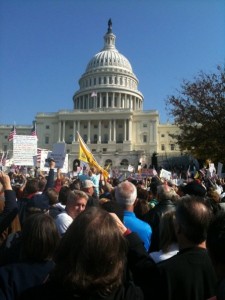

House Democrats announced today that a vote on Speaker Pelosi’s version of health care “reform” will be held on Saturday night at 6:00, likely when few people are watching. It is, after all, still college football season.
If the vote succeeds, the House will recess next week and then the ball will be in Senator Harry Reid’s court to pass the Senate’s version of reform. If Reid succeeds, the House and the Senate would meet in conference to reconcile the different provisions in each bill.
During the vote this weekend, the House will also likely vote on a new Republican alternative to ObamaCare. The Republican bill, 971 pages shorter than ObamaCare, contains provisions that allow consumers to shop across state lines for health insurance. The Republican alternative also allows small businesses to pool their health plans with other businesses, in an effort to drive down costs. You can read the alternative to ObamaCare here.
Make sure to call your representative this week at 202-224-3121 and tell them to vote “No” on H.R. 3962, Speaker Pelosi’s government-takeover of our health care system.
The Hill, a Washington-area newspaper, has a handy whip count of House members who are undecided on Speaker Pelosi’s attempt to takeover your health care. All of the members listed are Democrats but if you live in their district, please call 202-224-3121 and tell them to get off the fence and oppose ObamaCare.
If this ultra-liberal attempt at health care “reform” fails in the House, then it’s likely dead for the foreseeable future. Let’s keep it that way.
Call your representative at 202-224-3131 and tell them to vote “No” on H.R. 3962.
According to intrade.com, the online prediction market, Harry Reid’s (D-NV) announcement of a modified public option put the chances of ObamaCare’s passage on the ropes.
Earlier this month, markets gave the public option a 30 percent chance of passing before December 31, 2009. After Reid’s announcement of a “compromise” bill, the odds are now just 7.1 percent, according to intrade.
Let’s hope the market is right, as it usually is in all aspects of life. Call your Senator at 202-224-3121 and tell them to oppose Senator Reid’s pathetic attempt at health care “reform.”
Proponents of ObamaCare have couched their language in terms familiar to conservatives and libertarians: choice, option and freedom. We’ve been told that a ‘Public Option’ will be available to compete with private health care companies. White House officials want Americans to forget that more than 88 million patients could lose their private health care and be forced into the government option.
Peering into Harry Reid’s newest health care incarnation, which you can read here (with our commentary here), the new Senate health care bill is all about force, not choice. In the first 100 pages alone, there are dozens of examples of “requirements” on doctors, patients, states and the federal government.
Here is a brief snippet of what to expect. Of course, this represents just over 6% of the new mandates and regulations contained in the 1,502 page bill. Unfortunately, most of the language below is completely unintelligible.
1) Requiring that all new health benefits plans offered to individuals and employees in the individual and small group markets be qualified health benefits plans.
2) SEC. 2201. GENERAL REQUIREMENTS: New plans must be qualified health benefits plans. Each State shall provide that each health benefits plan which is offered in the individual or small group market within the State shall be a qualified health benefits plan.
3) An offeror of a plan shall not be treated as meeting the requirements of this subsection unless the plan also accepts, renews, or continues in force coverage of an individual who is eligible for enrollment in the plan by reason of their relationship to the named insured under the plan.
4) Each offeror of a health benefits plan shall establish annual and special enrollment periods meeting the requirements of section 2236(d)(2).
5) Each State shall establish 1 or more rating areas within that State for purposes of applying the requirements of this title.
6) The contribution amount for any plan year may be based on the percentage of revenue of each offeror or on a specified amount per enrollee and may be required to be paid in advance or periodically throughout the plan year.
7) An employment based plan meets the requirements of this paragraph if the plan—provides benefits appropriate for individuals between the ages described in subsection (a)(2)(C) and that are certified as so appropriate by the Secretary; implements programs and procedures to generate cost-savings with respect to participants with chronic and high-cost conditions; and provides documentation of the actual cost of medical claims involved and for which reimbursement is sought under this section.
8 ) Each State shall phase in the application of the insurance reform requirements under subpart 1 to grandfathered health benefits plans offered in the small group market within the State.
9) SPECIAL RULE FOR RATING REQUIREMENTS — A State law shall not be treated as offering more protection to consumers than the protection offered by such requirements if the State law imposes ratios that are greater than the ratios specified in section 2204(b).
10) Each State shall — require each offeror of a qualified health benefits plans offered through an exchange — to provide an internal claims appeal process; to provide notice in clear language and in the enrollee’s primary language of available internal and external appeals processes and the availability of the ombudsman established under section 2229(a) to assist them with the appeals processes.
11) PLAN REQUIREMENTS — An offeror meets the requirements of this subsection with respect to a qualified health benefits plan if the plan offers a benefits package that is uniform in each State in which the plan is offered and meets the requirements set forth in paragraph (3) the offeror is licensed in each State; the offeror meets all requirements of this title with respect to a qualified health benefits plan, including the requirement to offer the silver and gold levels of the plan in each exchange in the State for the market in which the plan is offered; and the offeror determines the premiums for the plan in any State on the basis of the ratings rules in effect in that State for the ratings areas in which it is offered.
12) The State provides that the amount of the monthly premium an eligible individual is required to pay for coverage under the standard health plan for the individual and the individual’s dependents.
13) The amount of the monthly premium an individual is required to pay under either the standard health plan or the applicable second lowest cost silver plan shall be determined after reduction for any premium credits and premium subsidies allowable with respect to either plan.
14) The Secretary shall each year conduct a review of each State program to ensure compliance with the requirements of this section.
15) INFORMATION REQUIRED TO BE PROVIDED BY APPLICANTS: An applicant for enrollment in a qualified health benefits plan offered through an exchange shall provide the information required by any of the following paragraphs that is applicable to an enrollee.
Larry Summers, Director of President Obama’s National Economic Council, has been a loyal ally to the administration and proponent of current health care reform proposals floating around Congress.
Summers has backed ObamaCare despite the many troubling provisions contained in House and Senate legislation, namely the individual health care mandate and the government-run public option.
Apparently, the economic views of Dr. Summers have changed in the current partisan environment. When he was an academic and cared more about economic externalities than political favoritism, he penned this paper critiquing individual mandates and government-run plans.
Here is an excerpt:
Note that a payroll tax on employers directed at financing health insurance benefits publicly would have the same employment displacement effects [translation: people lose their jobs] as a mandated health insurance program…. If policymakers fail to recognize the costs of mandated benefits because they do not appear in the government budget, then mandated benefit programs could lead to excessive spending on social programs. There is no sense in which benefits become “free” just because the government mandates that employers offer them to workers. As with value-added taxes, it can plausibly be argued that mandated benefits fuel the growth of government.”
“But those political promises were only good for as long as it took to get the mandate enacted into law.”
That was the observation of “neither politically or socially conservative” author and Massachusetts resident Wendy Williams, commenting this weekend upon her first-hand experience under that state’s mandatory healthcare “reform.” Readers should be forewarned – Mrs. Williams’s commentary generates visceral anger at the sanctimonious bureaucrats who would wrench control over our own health and family budget decisions. She describes how she and her husband rationally chose to purchase insurance through IBM, his former employer, only to be informed three years later that they’d be fined by the state because Massachusetts changed the rules to make their bare-bones catastrophic policy unpalatable. Accordingly, they were told to either purchase a pricier policy that they didn’t want, or pay another $1,000 each year to Massachusetts.
This directly contradicted the explicit promises of then-Governor Mitt Romney and then-Senator Ted Kennedy that middle-class residents would not find themselves taxed or otherwise penalized if state government healthcare reform was imposed.
Now, advocates of a federal healthcare mandate make the same promises to us. As they say about those who fail to learn from history…
In this week’s Freedom Minute, CFIF’s Renee Giachino discusses the massive tax hike on life-saving medical devices that Senate Democrats wish to pass as part of health care reform legislation.
If Democrats avoid the typical route for passing a bill and use the budget reconciliation process (requiring only 51 votes for final passage), then opponents of a government-run system will need to convince several Democrats that the current bills in Congress are complete garbage and must be opposed, even during cloture votes.
Good news has arrived and a reliably liberal voice on the Democratic side, Ron Wyden (D-OR), has stated that he will not vote for the Baucus Bill in its current form. Other Senators that should be persuaded in the same direction as Senator Wyden: Ben Nelson (D-NE), Evan Bayh (D-IN), Michael Bennet (D-CO), Robert Byrd (D-WV), Kent Conrad (D-ND), Byron Dorgan (D-ND), Tim Johnson (D-SD), Mary Landrieu (D-LA), Blanche Lincoln (D-AR), Mark Pryor (D-AR), Arlen Specter (D-PA), and Mark Warner (D-VA).
If you live in one of these states, call your Senator and let them know that you don’t support a government takeover of health care, individual mandates, employer mandates, higher taxes, or a reduction in your Medicare benefits. Here is the Senate switchboard number: 202-224-3121.
Here is the Wyden video:
This video, an interview with White House Senior Adviser David Axelrod, demonstrates how health care “choice” is fine for the White House, as long as the government chooses. People can choose the Public Option, but people cannot choose to purchase health insurance across state lines because the government makes it illegal. HT: Andy Roth.
Leftist author and weekly Wall Street Journal columnist Thomas Frank called CFIF out by name in his commentary last week, entitled “The Left Should Reclaim ‘Freedom.'”
Continuing his Wednesday morning habit of superficial analysis and juvenile critique, Frank attacked the previous weekend’s taxpayer march on Washington, D.C. that drew hundreds of thousands of everyday Americans. The opening sentence of Frank’s denunciation summarizes his angst well, as he stated, “[t]here are few things in politics more annoying than the right’s utter conviction that it owns the patent on the word ‘freedom.'” Nothing torments Frank more than the reality that everyday, middle-class Americans disfavor his leftist political agenda, so the taxpayer march had to be particularly painful for him.
He then identified CFIF by name in his futile attempt to justify reclamation of the term “freedom,” and engaged in his typical straw-man argumentation when he asserted, “that our ancestors could ever have understood freedom as something greater than the absence of the state would probably strike protesters as inconceivable.” First, Frank should take a moment to contemplate the difference between anarchists, who seek “the absence of the state,” and conservatives. And second, which “ancestor” does he cite as proof of his assertion? Thomas Jefferson? James Madison? Abraham Lincoln? John Locke?
No. Norman Rockwell. Now, we love Rockwell’s artistry as much as anyone, but one would think that even Frank could do better than that.
Paraphrasing Winston Churchill, we at CFIF can take pride in counting Thomas Frank amongst our antagonists.
Barack Obama isn’t going to “tax” Americans earning under $250,000 to help subsidize his healthcare overhaul – he’s merely going to “penalize” them, which is apparently something altogether different and palatable.
During this morning’s Obamapalooza tour of the Sunday talk shows (intentionally ostracizing Fox News Sunday, in a most un-Presidential fit of spite), a prevaricating Obama bizarrely insisted that his healthcare reform’s penalty provisions for those without insurance somehow do not amount to a “tax” on Americans earning under $250,000, but rather a justifiable “penalty.” Throughout a large portion of his interview with ABC’s George Stephanopoulos, the two battled over this topic, with a visibly frustrated Obama even reproaching Stephanopoulos for reading Merriam’s definition of “tax” – “a charge, usually of money, imposed by authority on persons or property for public purposes.”
Instead of honestly explaining why his plan doesn’t meet this simple definition, Obama descended into pettiness and replied, “George, the fact that you looked up Merriam’s Dictionary, the definition of tax increase, indicates to me that you’re stretching a little bit right now. Otherwise, you wouldn’t have gone to the dictionary to check on the definition.”
The reason that Obama resorted to this contortion of logic is that he solemnly and repeatedly promised throughout his campaign that he wouldn’t raise taxes on Americans earning under $250,000 by a single dime. Knowing that he cannot afford his own version of President George H. W. Bush’s “read my lips – no new taxes” broken pledge, Obama will apparently stop at nothing in his Orwellian campaign of distortion.
Is he lying? Or is he honestly confused? Who knows anymore. But uninsured Americans earning under $250,000 can rest assured that the money they’ll be forced to pay under ObamaCare isn’t a “tax,” it’s just a “penalty.”
How opposed is Senator Charles Grassley to the current version of health care reform being debated in Congress? So much so that he’s raising money based on his opposition to Obamacare.
Senator Grassley, once a leader in bipartisan talks, is now raising money and protecting his right flank by informing his constituents that the current version of the Obamacare would “turn over control of your health care decisions to a federal bureaucrat.”
Although there is no doubt that our health care system needs reform, Grassley’s revelation comes as somewhat welcome news, because it has been reported that Democrats are seeking to bypass traditional Senate rules and force “reform” through budget reconciliation, a process that does not require 60 votes.
However, Senator Judd Gregg, one-time Obama administration advocate, is now leading the fight against these tactics.
 CFIF Freedom Line Blog RSS Feed CFIF Freedom Line Blog RSS Feed CFIF on X CFIF on X CFIF on YouTube CFIF on YouTube |
