In this week’s Freedom Minute, CFIF’s Renee Giachino discusses how today, just as in the 1970s under President Carter, Americans are worried about the nation’s future. And just as in the 1970s, our current president doesn’t seem to grasp that his policies are causing the anxiety. Giachino explains, “The American people need a pick-me-up in the short term. In the longer run, we’ll have to wait for the ultimate mood enhancer: The 2012 election.”
The budget compromise reached between Congressional leaders and the White House a few weeks ago has been analyzed, dissected and commented upon exhaustively. While the “deal” may have averted a government shutdown, it ended up being a disappointment to taxpayers, who were overwhelmingly demanding meaningful spending cuts this year.
In an attempt to help the American people better understand what transpired, Mike Bates of 1330 AM WEBY, Northwest Florida’s Talk Radio, prepared and recently read the following analysis of the “deal” on the air.
The Budget Agreement is Nothing to Celebrate
The “government shutdown” was avoided when Republicans and Democrats in Washington agreed to a budget compromise to cut $38.5 billion from the proposed $3.8 trillion budget.
Though it’s been touted by both parties and the press, this is no cause for celebration. Why not?
A few quick facts:
Our national debt is $14.2 trillion.
This year’s budget calls for $3.8 trillion in spending.
Our government will borrow $1.6 trillion to do this.
That means we are borrowing 42 cents of every dollar we spend.
We are spending $1.6 trillion dollars more than we are taking in.
The Republicans wanted to cut $45 billion from the budget.
The Democrats wanted to cut $33 billion from the budget.
The Republicans and Democrats were arguing over $12 billion.
They agreed to cut $38.5 billion.
Few people comprehend how bad our nation’s finances are. Just how much is a trillion dollars?
If you laid one trillion one-dollar bills end to end, it would extend from the Earth to just past the Sun. It would stretch to the moon 394 times. And that trillion dollars would wrap around the Earth 3787 times. But money is not understood as a measurement of distance.
If you spend one dollar every second, it would take you 32,000 years to spend one trillion dollars. But money is not a measurement of time.
Money is a measurement of value. So I broke down the budget into terms we can all understand.
A husband and wife have accumulated debt of $373,684.
They have a household income of $58,000.
They plan to spend $100,000 this year.
So they’ll have to borrow $42,000 to do this.
That means they are borrowing 42 cents of every dollar they spend.
One spouse proposed that they cut $1184 from the budget.
The other spouse proposed that they cut $868 from the budget.
The husband and wife were arguing over $316.
They agreed to cut $1013.
How long can that couple keep borrowing and spending like that? How long can our government keep borrowing and spending like that?
The budget agreement is nothing to celebrate.
But wait! It gets worse. Within a week of the budget deal, the Congressional Budget Office announced that the actual savings of the claimed “$38.5 billion” in cuts could be as little as $352 million. If that turns out to be true, the couple above just saved a pathetic nine dollars and twenty six cents.
The Center for Individual Freedom (“CFIF”) is pleased to announce that award-winning columnist Quin Hillyer has joined CFIF as a Senior Fellow. Mr. Hillyer comes to CFIF from The Washington Times, where he has spent the past two years as Senior Editorial Writer.
For CFIF, Hillyer will continue his role as an “investigative columnist” on public policy issues, with special focus on matters legal, regulatory and budgetary. He will work from both Mobile, Alabama – extending CFIF’s reach to a number of different sites across the country – and at CFIF’s headquarters in Alexandria, Virginia. Hillyer also will remain a Senior Editor at The American Spectator.
“CFIF is thrilled to have Quin join our team,” said CFIF President Jeffrey Mazzella. “He brings an incredible depth and breadth of knowledge which will prove invaluable as CFIF continues expansion of public policy advocacy and coverage.”
One year after the explosion aboard the Deepwater Horizon oil rig in the Gulf of Mexico, CFIF’s Renee Giachino discusses the need for the federal government to stop dragging its feet in allowing truly injured parties on the Gulf Coast to be made whole. Furthermore, Giachino implores the Obama Administration to stop standing in the way of developing our much-needed oil resources in the Gulf.
In an interview with CFIF, Hadley Heath, Policy Analyst for the Independent Women’s Forum, discusses the “Full Story on ObamaCare” and why women will be disappointed when they learn the truth about government involvement in the health care system.
Noting that one of the few areas where government continues to enforce inequality is in America’s public schools, CFIF’s Renee Giachino discusses the fight for school choice and calls it “the greatest civil rights issue of our generation.”
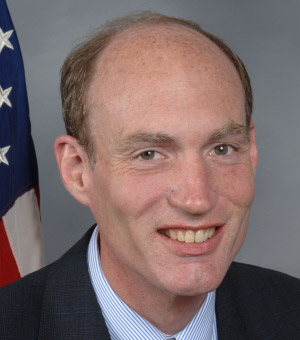
In an interview with CFIF, U.S. Representative Thaddeus McCotter (R-MI) discusses his book, “Seize Freedom! American Truths and Renewal in a Chaotic Age,” and what concerned citizens and committed conservatives can do to put an end to the simplistic solutions and false comforts of ideologues.
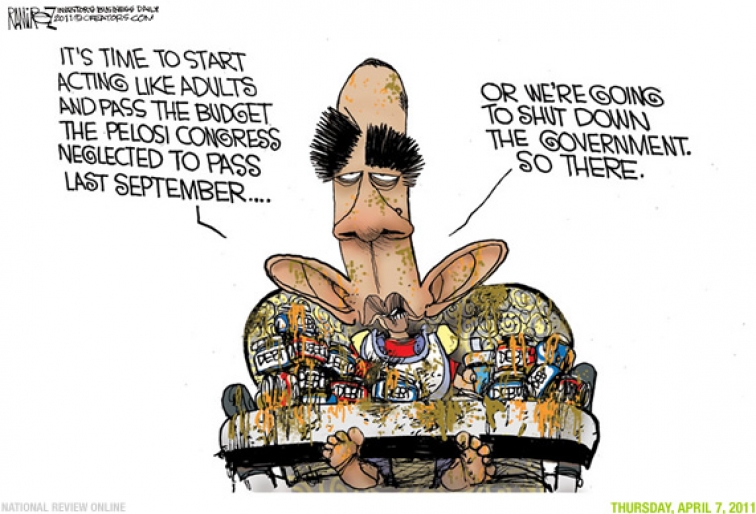
Two-time Pulitzer Prize-winning cartoonist Michael Ramirez illustrates Obama’s posturing on the ongoing congressional budget negotiations and the pending government shutdown.
View more of Michael Ramirez’s cartoons on CFIF’s website here.
In this week’s “Freedom Minute,” CFIF’s Renee Giachino makes the case for conservative optimism. Giachino points to the continued public backlash against ObamaCare, the growing movement against government excess, and widespread opposition to Cap-and-Trade and Net Neutrality, among other big government regulations, as evidence that the nation is committed to restoring to America’s founding limited-government principles.
In an interview with CFIF, Megan Brown, a Litigation and Appellate partner at Wiley Rein LLP in Washington, D.C., discusses the highly publicized Walmart Sex Bias lawsuit and other pending cases before the Supreme Court of the United States.











 CFIF Freedom Line Blog RSS Feed
 CFIF on X
 CFIF on YouTube