Below is one of the latest cartoons from two-time Pulitzer Prize-winner Michael Ramirez.

View more of Michael Ramirez’s cartoons on CFIF’s website here.
Below is one of the latest cartoons from two-time Pulitzer Prize-winner Michael Ramirez.

View more of Michael Ramirez’s cartoons on CFIF’s website here.
Earlier this month, the United States Postal Service (USPS) released its latest financial report for the first quarter of the 2018 fiscal year, and its latest loss amounted to $540 million. Considering the USPS’s pronounced downward fiscal trends over many years, this issue maintains paramount importance in the effort to reform government and restore fiscal sustainability.
By way of background, the USPS continues to operate under the 2006 Postal Accountability and Enhancement Act (PAEA). Since that time and despite the PAEA’s mandates, however, the Postal Service’s leadership has not emphasized fiscal accountability by any measure whatsoever. Since the start of 2007, losses accumulated by the USPS now amount to $65.6 billion.
With such immense losses detailed by the USPS, it’s indefensible that federal regulators and lawmakers haven’t meaningfully demanded that it control its costs. Without any clear direction to reign its spending, the Postal Service’s expenses from all operations have grown precipitously from $66.3 billion in total costs in 2014 to $70.5 billion spent in 2017.
Fortunately, the arrival of the Trump Administration last year prompted a campaign of close review and positive restructuring of many facets of the federal government. In that continuing effort, the USPS, with such severe fiscal problems, offers an ideal entity to address in 2018.
Indeed, during the holiday season President Trump touched on one key postal management issue that deserves particular focus this year – the USPS’s arrangement to undercharge Amazon for completing a large segment of its deliveries. While the Amazon deal certainly translates to higher package volumes, USPS has a responsibility to the taxpaying public to ensure that it’s making enough to cover its rising costs.
As the costs of providing traditional letter mail service remain relatively flat, the USPS’s rising outlays have been driven through the pursuit of a variety of experimental products areas. That includes attempts to enter specialized markets like weekend package deliveries, same-day deliveries, and also handling groceries. Therefore, returning the USPS to a stable fiscal state depends heavily on simplifying what the organization is doing and maintaining an emphasis on core competencies. Additionally, lawmakers and regulators can only help make these determinations if the USPS is forthright about the financial health of each individual line of service.
Accordingly, CFIF urges for a sensible approach where leaders in Congress and the Administration call for much greater transparency from the USPS. The agency’s past attempts to grow its footprint and duplicate services already available to consumers has not been a recipe for success. Identifying where the USPS remains profitable and where it loses money must ultimately become a more simple and straightforward process, and the time for reform is now.
The so-called consumer groups involved, along with certain media outlets and Members of Congress, scream every chance they get that the internet as we know it is in serious danger of ceasing to exist unless the Obama-era Title II regulatory stranglehold is restored – never mind that the Title II utility-style regulatory scheme, not imposed until 2015, makes the internet weaker, not stronger.
At the end of the day, this entire fight is about how to enforce practical internet policy. With the imposition of Title II, the Obama-Wheeler FCC granted unprecedented government authority and mother-may-I control over the free marketplace, diminishing industry investments in the process. The current FCC, under Chairman Ajit Pai’s leadership, rightly decided to restore sanity to internet policy, prioritizing free market principles and light-touch regulation – the way it was practiced for decades under bipartisan administrations.
The light-touch approach is how the internet thrived and will continue to remain truly free and open. It’s also how to protect America’s position as a global innovation leader.
This latest effort by Senate Democrats to hit the reverse button and go back to the investment-killing Title II scheme via a Congressional Review Act (CRA) vote serves zero legitimate policy purpose. It’s nothing more than a political stunt. After all, if they truly wanted to get serious about cementing the principles of “net neutrality,” they would come to the table and work with Republicans on a sustainable legislative solution, something they have refused time and again to do.
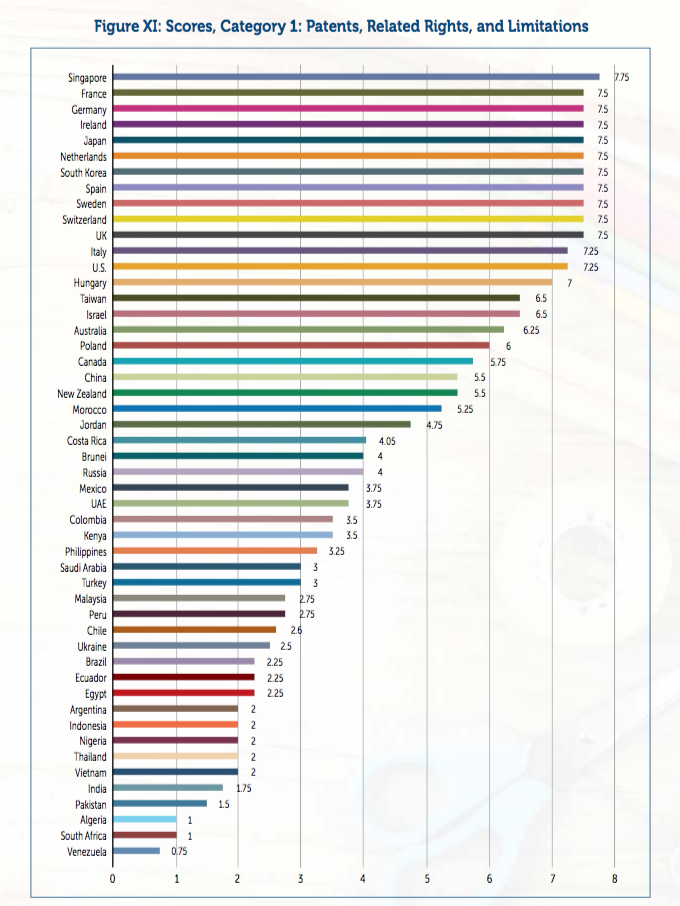
As we’ve constantly stressed, America’s history of leading the world in protecting intellectual property (IP) explains our status as the most inventive, creative and prosperous nation in human history perhaps more than any other factor. That includes patent protection, where the U.S. has traditionally led the world. Unfortunately, over the past eight years the U.S. has surrendered that status and plummeted to 12th in the U.S. Chamber of Commerce’s annual ranking of patent protections.
.

U.S. Falls to 12th
.
Obviously, many of the nations that now surpass us compete with us for jobs, investment and companies looking to innovate. It’s therefore critical that we pass the STRONGER Patents Act currently before Congress, which CFIF enthusiastically supports, to restore our status as the world’s leader in patent protection lest we continue to lose ground.
Earlier this week, we continued our efforts to highlight how Elon Musk and SpaceX have propelled American space exploration from the private sector. In that vein, UnbiasedAmerica illustrates vividly how this month’s SpaceX Falcon Heavy launch also means significant savings for U.S. taxpayers over equivalent predecessors:
.

SpaceX Success
Quick: Name some areas in which government outperforms its private sector counterpart.
Give up? Don’t be too hard on yourself. It’s difficult, even impossible to recall any.
That includes space technology.
Last week, Elon Musk’s SpaceX launched the most powerful rocket in the world, the Falcon Heavy, as reported by The Wall Street Journal:
Space Exploration Technologies Corp. successfully launched the Falcon Heavy rocket Tuesday on its initial test flight, marking another coup for founder Elon Musk… With throngs of spectators on hand, the closely held Southern California company defied industry critics by flying the world’s most powerful rocket since U.S. astronauts landed on the moon almost five decades ago. The 230-foot rocket, which featured 27 engines with the combined thrust of some 18 Boeing Co. 747 jumbo jets, climbed into clear skies at 3:45 p.m. local time. It carried a Tesla roadster as a dummy payload and publicity stunt.”
Importantly, the article notes that cost-efficiency stands among the Falcon Heavy’s paramount accomplishments:
Large, reusable rockets such as the Falcon Heavy are ideal for deep-space transport from a cost perspective, according to Howard McCurdy, a space historian who teaches at American University. ‘That’s where the heavy-lift design truly shines,’ he said before the launch. Given President Donald Trump’s official policy of combining federal and private assets to explore the Moon, Mr. McCurdy called the SpaceX rocket ‘a very important step in that direction… SpaceX has revolutionized the launch business by vertically integrating operations, slashing prices and reusing the main engines and lower stage of its existing workhorse rockets, the Falcon 9 fleet.”
Additionally, SpaceX’s success marks further progress in remedying a problem that we at CFIF have highlighted for some time: the dangerous and embarrassing U.S. reliance upon Russian rocketry to continue our space program.
So congratulations to Mr. Musk and SpaceX. Going forward, it offers cause for optimism and yet another example of private sector success and superior efficiency.
Join CFIF Corporate Counsel and Senior Vice President Renee Giachino today from 4:00 p.m. CDT to 6:00 p.m. CDT (that’s 5:00 p.m. to 7:00 p.m. EDT) on Northwest Florida’s 1330 AM WEBY, as she hosts her radio show, “Your Turn: Meeting Nonsense with Commonsense.” Today’s guest lineup includes:
We at CFIF have long advocated greater fairness for musical performers in securing fairness for their performance rights.
Under byzantine laws, artists receive just compensation whenever their post-1972 recordings are played, but in many cases not for their pre-1972 recordings. That’s an indefensible and arbitrary artifact that has persisted far too long. Why should Neil Diamond receive payment whenever “America” is played, but not classics like “Solitary Man?”
Fortunately, the opportunity to correct that unfairness has arrived. Even better, legislation to correct the existing flawed system arrives alongside other music legislation that galvanizes the coalition to finally correct the situation. As a result, a broad coalition of music organizations representing everyone from songwriters, composers, performers, publishers and labels support three new pieces of legislation, as summarized cogently by the Recording Industry Association of America (RIAA):
The Music Modernization Act would be the most significant update to music copyright law in over a generation, and represents unprecedented compromise across all aspects of the music industry. The bill reforms Section 115 of the U.S. Copyright Act to create a single licensing entity that administers the mechanical reproduction rights for all digital uses of musical compositions – like those used in interactive streaming models offered by Apple, Spotify, Amazon, Pandora, Google and others. It also repeals Section 114(i) and, consistent with most federal litigation, utilizes random assignment of judges to decide ASCAP and BMI rate-setting cases – two provisions that will enable fairer outcomes for songwriters and composers.
The CLASSICS Act (Compensating Legacy Artists for their Songs, Service, & Important Contributions to Society Act) would benefit artists and music creators who recorded music before 1972 by establishing royalty payments whenever their music is played on digital radio. SoundExchange would distribute royalties for pre-1972 recordings played by Internet, cable and satellite radio services just as it does for post-1972 recordings. Currently, only sound recordings made after 1972 receive payments from digital radio services under federal law.
The AMP Act (Allocation for Music Producers Act) for the first time adds producers and engineers, who play an indispensable role in the creation of sound recordings, to U.S. copyright law. The bill codifies into law the producer’s right to collect digital royalties and provides a consistent, permanent process for studio professionals to receive royalties for their contributions to the creation of music.”
Unfairness has persisted too long in America’s system of compensating musicians for performance of their songs. The emerging coalition coalescing around these key pieces of legislation, which CFIF strongly urges all members of the House and Senate to support, and the White House to sign, allow a unified effort to finally bring reform in 2018.
We often hear lamentations regarding the shrinking U.S. middle class, and toxic prescriptions from people like Senator Bernie Sanders on how to “save” it. Courtesy of American Enterprise Institute, using U.S. Census data, that shrinkage has actually been a largely positive thing:

Middle Class Moves Up
It’s another testament to how America remains the Land of Opportunity, and that Ronald Reagan’s famed optimism remains applicable today.
Are wealthier Americans paying their “fair share” of taxes?
No. Assuming that one measures “fair share” as a rough equivalency between income earned and income taxes paid, wealthy Americans pay far more than their fair share, as helpfully illustrated by the Tax Foundation:
.

"Fair Share?"
.
An instructive myth-versus-fact visual when it comes to public assumptions regarding corporate profits, courtesy of AEI:
.

Myth Versus Fact: Corporate Profits
.
Since World War II, the U.S. economy has averaged 3.3% growth per year. Under Barack Obama, we never even hit 3%, instead averaging below 2%. His apologists rationalized that “secular stagnation” had made 3% an unattainable goal, but both quarters under President Trump have already averaged over 3%. So like clockwork, leftists attempt to credit Obama for something they claimed was no longer possible:
.

.

View more of Michael Ramirez’s cartoons on CFIF’s website here.
In last week’s Liberty Update, we highlighted how when even The New York Times acknowledges how Trump Administration policies have turbocharged the sluggish economy he inherited, the debate over whether the economy benefits from more federal regulation or less federal regulation is won. This is the same Times that features far-left economist Paul Krugman, who predicted upon Trump’s election that markets would crash and “never” recover.
Well, we’re happy to highlight how the slow surrender march at the Times continues under the headline “Companies Are Handing Out Bonuses Thanks to the Tax Law. Is It a Publicity Stunt?” Their snarky addendum is understandable coming from them, but their introduction acknowledges reality:
.
The big corporate tax break that became law last month is great news for companies and their investors. But what about employees? How much of the corporate windfall will go to workers via higher wages?
Since President Trump signed the $1.5 trillion tax cut into law on Dec. 22, nearly 20 large companies have announced some form of bonus or wage hike for their employees.”
.
It proceeds to list some of those companies, including AT&T, Comcast, Southwest Airlines, American Airlines and others.
In last week’s Liberty Update feature we noted how their January 1 story admitted that the good economic news it detailed occurred before the tax reform legislation had even passed. Now that it has, we’re glad to see that the Times at least continues its sudden trend of acknowledging reality.
Today’s guest lineup includes:
4:00 CDT/5:00 pm EDT: Marc Scribner, Senior Fellow at the Competitive Enterprise Institute: Infrastructure Spending and Drones;
4:15 CDT/5:15 pm EDT: Dr. Susan MacManus, Professor in Political Science at the University of South Florida: 2018 Legislative Session and Business Incentives;
4:30 CDT/5:30 pm EDT: Tzvi Kahn, Senior Iran Analyst at the Foundation for Defense of Democracies: Iran;
4:45 CDT/5:45 pm EDT: Pete Sepp, President of National Taxpayers Union: The Days Following Tax Reform;
5:00 CDT/6:00 pm EDT: Michelle Minton, Senior Fellow at the Competitive Enterprise Institute: Trump Marijuana Policy;
5:15 CDT/6:15 pm EDT: Jarrett Stepman, Editor for the Daily Signal at The Heritage Foundation: Fake News; and
5:30 CDT/6:30 pm EDT: Raheel Raza, President of the Council for Muslims Facing Tomorrow and Clarion Project Advisory Board Member: Trump’s Decision on Jerusalem.
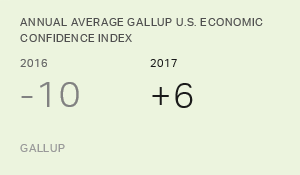
In our weekly Liberty Update, we highlight how in just one year, the deregulatory Trump economic bump is now so inescapable that even The New York Times acknowledged it in its January 1, 2018 edition. Given that consumer spending accounts for approximately two-thirds of the U.S. economy, Gallup’s annual average U.S. economic confidence index is similarly illustrative. For 2016, despite years of supposed prosperity under Barack Obama, the index stagnated at -10. In just one year since Trump’s deregulatory and lower-tax administration began? Already +6 for the year, the first time in over a decade:
.

Instant Trump Bump
.
Below is one of the latest cartoons from two-time Pulitzer Prize-winner Michael Ramirez.

In a letter sent to Ambassador Robert E. Lighthizer, United States Trade Representative, the Center for Individual Freedom joined with a coalition of 25 organizations to urge strong intellectual property protections for any renegotiated NAFTA deal.
The letter, which was organized by the American Conservative Union, can be read by clicking here.