August 18th, 2010 at 5:53 pm
Immanuel Kant, Anti-Semite?
Posted by Print

For decades, philosophy buffs have argued over whether Adolf Hitler’s appropriation of Friedrich Nietzsche was a logical extension of the German philosopher’s work or a bastardization of his core themes. Now, a new wrinkle in the debate about how philosophy informs international affairs comes courtesy of the Middle East Forum’s Daniel Pipes (full disclosure: Dr. Pipes was a professor of mine in graduate school) writing in today’s Jerusalem Post.

In a piece titled “Lion’s Den: Immanuel Kant vs. Israel”, Dr. Pipes argues that the post-nation state ideology advanced by the legendary Prussian philosopher Immanuel Kant in his 1795 work “Perpetual Peace” is now being used to advance a new paradigm of perpetual war against Israel. In relevant part:

Under the old nation-state paradigm, the lesson of Auschwitz was “Never again,” meaning that a strong Israel was needed to protect Jews.

The new paradigm leads to a very different “Never again,” one which insists that no government should have the means potentially to replicate the Nazi outrages. According to it, Israel isn’t the answer to Auschwitz. The European Union is.

That the old-style “Never again” inspires Israelis to pursue the Western world’s most unabashed policy of self-defense makes their actions particularly appalling to New Paradigmers.

Need one point out the error of ascribing Nazi outrages to the nation-state? The Nazis wanted to eliminate nation-states. No less than Kant, they dreamed of a universal state. New Paradigmers mangle history.

The lesson — in Israel’s case, as in all others — is simple. As the monopoly of legitimate force, government is a necessary evil requiring the vigilance of free citizens to keep it in check. In order to protect human liberty and maintain responsiveness to the citizenry, that means government should be as limited and decentralized as possible. And nothing is more threatening to that goal than the “benevolent” internationalism envisioned by Kant, the United Nations, and all their fellow travelers on the post-nationalist left.


August 18th, 2010 at 3:57 pm
German Tycoon Calls U.S. Tax Deductions for Charity “Unacceptable”
Posted by Print

According to German shipping tycoon Peter Kramer, “the state” should control private charitable donations and “determine what is good for the people,” not the individuals making those charitable donations.  In an interview with Der Spiegel, regarding the Warren Buffett/Bill Gates Giving Pledge, Kramer ripped America’s tax deductions for charitable gifts and demanded, “what legitimacy do these people have to decide where massive sums of money will flow?”

I find the U.S. initiative highly problematic.  You can write donations off in your taxes to a large degree in the U.S.A.  So the rich make a choice:  Would I rather donate or pay taxes?  The donors are taking the place of the state.  That’s unacceptable. It’s all just a bad transfer of power from the state to billionaires.  So it’s not the state that determines what is good for the people, but rather the rich want to decide.  That’s a development that I find really bad.  What legitimacy do these people have to decide where massive sums of money will flow?  In this case, forty superwealthy people want to decide what their money will be used for.  That runs counter to the democratically legitimate state.”

Call us crazy, but don’t alarms sound when a creepy German demands that the state “determines what is good for the people?”  Meanwhile, as noted by economist Mark Perry on his blog Carpe Diem, citizens of Kentucky outstrip Germans in the best indicator of economic wellbeing, gross domestic product (GDP) per capita.

Mr. Kramer, perfect your own supposed workers’ paradise before you attempt to lecture Americans.


August 18th, 2010 at 2:47 pm
City of Bell Corruption Impacting Other Cities
Posted by Print

In a year or two, we may look back on the City of Bell public employee compensation scandal as the modern day equivalent of Upton Sinclair’s The Jungle.  Both stories showed the general public how bad a particular industry behaved, and prompted serious, far-reaching reforms.

The chief villain in the Bell fiasco (so far) is its former city manager Robert Rizzo.  At the time of his resignation, Rizzo was making close to $800,000 a year, and due to earn hundreds of thousands of dollars a year from his public employee pension.  Now that he’s retired, the pension is kicking in – and so are taxpayers in cities that share Bell’s pension pool.

That means that Hesperia, CA, is on the hook for $80,000 of Rizzo’s estimated $600,000 a year pension (not to work!), even though it fired Rizzo after his four year stint ended in 1992.  Taxpayers in Rancho Cucamonga will be paying $160,000 of the bill, with Bell and other cities who never even hired Rizzo chipping in the rest.

And remember, the estimated $600,000 is owed to Rizzo – by law – every year for the rest of his life.  After being fired by at least two of the cities that hired him.  Insane.  Public employee pension reform may not be a “sexy” issue on the campaign stump, but it is certainly a topic that is sure to get people’s attention during this era of runaway government spending.

The Bell scandal may be the the last, best chance to reign in the power of the public employee unions before they ruin the American economy.


August 17th, 2010 at 2:02 pm
The Tea Party Movement’s Cliff’s Notes
Posted by Print

Nearly 25 years ago, Thomas Sowell wrote “A Conflict of Visions: Ideological Origins of Political Struggles”, perhaps the single best volume on the fundamental philosophical differences between modern liberals and classical liberals (the progenitors of today’s libertarians and most conservatives). If your summer schedule doesn’t allow time for Sowell’s 350-page treatise (and it should), then you could do worse than turning to today’s Wall Street Journal.

Today’s edition of the Journal’s opinion section carries a piece entitled “A Tea Party Manifesto” by former House Majority Leader Dick Armey and FreedomWorks President and CEO Matt Kibbe (authors of the new book “Give us Liberty”). Contained therein is the best concise distillation of how Sowell’s conflict is playing out in Tea Party America:

The many branches of the tea party movement have created a virtual marketplace for new ideas, effective innovations and creative tactics. Best practices come from the ground up, around kitchen tables, from Facebook friends, at weekly book clubs, or on Twitter feeds. This is beautiful chaos—or, as the Nobel Prize-winning economist F.A. Hayek put it, “spontaneous order.”

Decentralization, not top-down hierarchy, is the best way to maximize the contributions of people and their personal knowledge. Let the leaders be the activists who have the best knowledge of local personalities and issues. In the real world, this is common sense. In Washington, D.C., this is considered radical.

The big-government crowd is drawn to the compulsory nature of centralized authority. They can’t imagine an undirected social order. Someone needs to be in charge—someone who knows better. Big government is audacious and conceited.

It’s a war of voluntarism and freedom on one side against coercion and statism on the other. The Tea Party crowd should prepare for battle. Armey and Kibbe will provide the ammunition (as will other Tea Party authors, like CFIF’s own Ashton Ellis). Come November, it will  be time to take to the field.


August 17th, 2010 at 11:54 am
Bell City Council Illegally Raised Taxes; Increases Tea Party Sentiment
Posted by Print

The Tea Party movement is going viral.  As reported earlier, the City of Bell, CA is now Exhibit A in corrupt government.  Thousands of the majority Hispanic population in Bell protested outside city hall after it was revealed that the city council raised local property taxes 50% beyond the legal limit.

Here’s a spot-on analysis of how the Tea Party movement’s call for limited – and constitutional – government is starting to bubble up in a growing number of communities.

When people wonder why the Tea Party and other grassroots political movements start, this is a great example.  Government at any level that grows haughty, insular, and corrupt generates a reaction towards accountability and more modest models of governance.  I’m certain that the protesters in Bell don’t see themselves as part of the Tea Party movement, but the two have more similarities than differences.  They’re angry at the local model of big government arrogance and at having their pockets picked — especially considering the relatively low average household income in this Southern California community, at just under $30,000.

H/T: Hot Air Blog


August 17th, 2010 at 11:47 am
Video: “Those Voices Don’t Speak For the Rest of Us”
Posted by Print

Below is the latest video from the Republican Study Committee, which contrasts Ronald Reagan with the “leadership” in Washington, D.C. today. 


August 17th, 2010 at 10:03 am
Ramirez Cartoon: “It’s a Freedom of Religion Thing”
Posted by Print

Below is one of the latest cartoons from two-time Pulitzer Prize-winner Michael Ramirez.

View more of Michael Ramirez’s cartoons on CFIF’s website here.


August 16th, 2010 at 5:41 pm
Liberals Turning on Obama
Posted by Print

The New Republic’s John Judis is out today with a feature-length article titled, “The Unnecessary Fall,” a blow-by-blow recounting of how Barack Obama missed his opportunity to define his presidency in populist terms.  To Judis, the greatest betrayal of liberal America’s would-be Messiah is the latter’s failure to engage in confrontational politics.

Why has the White House failed to convince the public that it is fighting effectively on its behalf? The principal culprit is clearly Barack Obama. He has a strange aversion to confrontational politics. His aversion is strange because he was schooled in it, working as a community organizer in the 1980s, under the tutelage of activists who subscribed to teachings of the radical Saul Alinsky. But, when Obama departed for Harvard Law School in 1988, he left Alinsky and adversarial tactics behind.

The young lawyer who returned to Chicago and won a seat in the Illinois state Senate in 1996 practiced a very different style of politics. Obama’s principal accomplishments in Springfield were bills restricting lobbying and requiring videotaping of confessions in potential death penalty cases. He was not a typical blue-collar, bread-and-butter Chicago Democrat, but the kind of good government liberal that represents the upscale districts of the city, seeing in politics a higher calling and ill at ease with (although not in open opposition to) the city’s Democratic machine. He was also a post-racial politician who eschewed the hard-edged, angry rhetoric of Jesse Jackson. (That, too, is oddly reminiscent of Carter, who partly campaigned in 1976 as the white Southern antidote to George Wallace’s angry racial populism.)

Obama carried this outlook into the U.S. Senate, into his campaign for the presidency, and then, into the presidency itself. He is a cerebral, dispassionate, post-partisan; he wants to “end the political strategy that has been based on division,” to “turn the page” on the culture wars of the 1960s and the partisan battles of the 1990s. During the campaign, his aides jokingly referred to him as the “black Jesus.” While he can tolerate and even brush aside conflict, he is reluctant to actively foment it. “In a time of crisis, we can’t afford to govern out of anger,” he declared in February 2009. During his campaign and his first year in office, he held to a blind faith in bipartisanship, even as the Republicans voted as a bloc against his legislation. He is, perhaps, ill-suited in these respects for an era of bruising political warfare.

Ignoring Judis’ laughable attempt to paint Obama as a disappointed bipartisan, there’s nothing special about this era that makes politics any more or less “bruising.”  Leading is always tough.  As Judis indicates, maybe Obama isn’t.


August 16th, 2010 at 5:06 pm
More Money, More Gold?
Posted by Print

With the Federal Reserve announcing it will increase the supply of paper money (i.e. dollars), it is once again time to consider the merits of (re)adopting the Gold Standard to help regulate the value of our nation’s currency.  Gold Standard 2012, a project of the American Principles Project, has a helpful video:


August 16th, 2010 at 1:59 pm
The Unstoppable Bomb
Posted by Print

I’ve been writing in this space for months now that Western policymakers who believe Iran can be contained or deterred by conventional methods once it goes nuclear are deluding themselves. As I wrote in a commentary nearly a year ago:

In the 1930s, Winston Churchill – virtually alone – called for swift action to remove Hitler before he could wreak havoc.  What was the source of his clarity? Churchill simply understood that Hitler meant what he said in “Mein Kampf” and was developing the capacity to act on it. Meanwhile, the rest of Europe’s political sophisticates believed that Hitler’s rhetoric was purely for domestic consumption – a tool used to exploit the grievances of the demoralized Weimar Republic.
 
Today, a similar debate rages over Ahmadinejad and the mullahs whose regime he leads.  But the sincerity of their beliefs should be in doubt to no one.  The Iranian President is a man who, during his tenure as the mayor of Tehran, ordered the city’s streets widened in anticipation of the return of the Twelfth Imam, a figure who accompanies the apocalypse in Shiite Islamic theology. The American left would call for the head of any mayor in the United States who wanted to widen Main Street to prepare for the return of the Christ. Yet they apparently think a similar figure in the world’s biggest hotbed of religious fundamentalism can be expected to be a benign wielder of nuclear launch codes.

In the new issue of Commentary, the Wall Street Journal’s Bret Stephens, in a piece entitled “Iran Cannot be Contained”, comes to the same conclusion from a different angle, rebutting those who think that because containment worked on the Soviet Union it can work on the Iranian regime:

… The most important difference between the Soviet Union and Iran may be ideological. A credible case can be made that Communism is no less a faith than Islam and that Iran’s current leadership, like Soviet leaders of yore, knows how to temper true belief with pragmatic considerations. But Communism was also a materialist and (by its own lights) rationalist creed, with a belief in the inevitability of history but not in the afterlife. Marxist-Leninist regimes may be unmatched in their record of murderousness, but they were never great believers in the virtues of martyrdom.

That is not the case with Shiism, which has been decisively shaped by a cult of suffering and martyrdom dating to the murder of Imam Husayn—the Sayyed al-Shuhada, or Prince of Martyrs—in Karbala in the seventh century. The emphasis on martyrdom became all the more pronounced in Iran during its war with Iraq, when Tehran sent waves of child soldiers, some as young as 10, to clear out Iraqi minefields. As Hooman Majd writes in his book The Ayatollah Begs to Differ, the boys were often led by a soldier mounted on a white horse in imitation of Husayn: “the hero who would lead them into their fateful battle before they met their God.” Tens of thousands of children died this way.

The martyrdom mentality factors into Iran’s nuclear calculus as well. In December 2001, former Iranian President Akbar Hashemi Rafsanjani—a man often described as a moderate and a pragmatist in the Western press—noted in his Qods (Jerusalem) Day speech that “if one day, the Islamic world is also equipped with weapons like those that Israel possesses now, then the imperialists’ strategy will reach a standstill because the use of even one nuclear bomb inside Israel will destroy everything. However, it will only harm the Islamic world. It is not irrational to contemplate such an eventuality.”

We are, quite simply, running out of time.  We can try to ignore reality, but reality won’t return the favor.


August 16th, 2010 at 10:32 am
Latest Survey of Economists: No More “Stimulus,” Extend Tax Cuts for Everyone
Posted by Print

The latest survey of 53 economists by The Wall Street Journal offers a clear message.  Namely, no more government “stimulus,” and extend the soon-to-expire Bush-era tax cuts for everyone, not just those earning under $250,000 annually.

Of 48 polled economists, 30 flatly rejected calls for any form of additional fiscal or monetary “stimulus.”  Only 6 economists encouraged more Obama-Reid-Pelosi style fiscal stimulus, only 5 suggested additional monetary stimulus from the Federal Reserve and just 7 suggested both.  On the issue of taxes, fully 32 of the polled economists called for extending all of the current lower tax rates, in a sharp rebuke to Obamanomics.  Only 3 economists supported an end to the Bush-era tax cuts, and only 11 agreed with Obama and Timothy Geithner in their campaign to raise taxes on those individuals and small businesses reporting income over $250,000.  Unlike Obama and Geithner, economists recognize the destructive effect that raising taxes on individuals and small businesses in the top income segments will have.

As Stephen Stanley of Pierpoint Securities summarized, “the economy needs government to get out of the way.”  Well said.


August 13th, 2010 at 3:44 pm
From the “You Can’t Make This Stuff Up” File: Maxine Waters Blames Bush for Ethics Charges
Posted by Print

At some point, Americans’ outrage over the nonsense spewed upon us by desperate Washington, D.C. liberals becomes twisted amusement.  Today, Representative Maxine Waters (D – California) managed to pull the “race card” and “blame Bush” card in one preposterous swoop.

Representative Waters now finds herself the defendant against Congressional ethics charges that she improperly offered special assistance to OneUnited, a bank on whose board her husband had served.  At the time, her husband owned $350,000 in OneUnited stock, which was threatened by the financial downturn and would stand to benefit from federal dollars.  Speaking to reporters to rationalize her behavior, Waters claimed that she was compelled to do what she did because the Bush Treasury Department wasn’t responding to her satisfaction:

The question at this point should not be why I called Secretary [Henry] Paulson, but why I had to.  The question at this point should be why a trade association representing over one hundred minority banks could not get a meeting at the height of the crisis.”

Waters apparently hasn’t received the memo that “the race card is maxed out.”


August 13th, 2010 at 2:19 pm
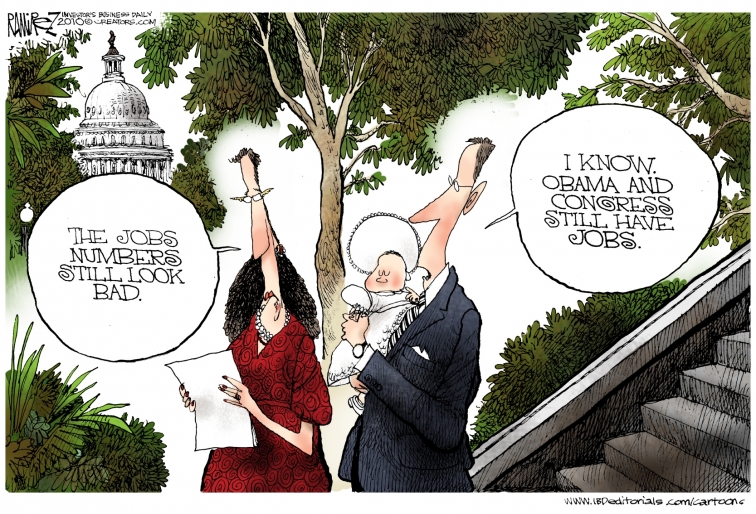
Ramirez Cartoon: The Jobs Numbers Still Look Bad…
Posted by Print

Below is one of the latest cartoons from two-time Pulitzer Prize-winner Michael Ramirez.

View more of Michael Ramirez’s cartoons on CFIF’s website here.


August 13th, 2010 at 12:13 pm
This Week’s Liberty Update
Posted by Print

This week’s edition of the Liberty Update, CFIF’s weekly e-newsletter, is out.  Below is a summary of its contents:

Lee:  Why We’re Boiling Over: Federal Salaries Now Twice That of Private Sector
Senik:  Message to Congress: Don’t Just Do Something, Stand There!
Ellis:  Investment Fund Shows That Betting Against Congress is a Great Way to Make Money

Freedom Minute Video:  A Volt Out of the Blue
Podcast:  CFIF Contributing Editor Discusses “Field Guide for Patriot Activists”
Jester’s Courtroom:  Seven-Year-Old’s Lemonade Stand Shut Down for License Violation

Editorial Cartoons:  Latest Cartoons of Michael Ramirez
Quiz:  Question of the Week
Notable Quotes:  Quotes of the Week

If you are not already signed up to receive CFIF’s Liberty Update by e-mail, sign up here.


August 13th, 2010 at 11:21 am
August 13, 1981: President Reagan Signs Tax Reduction Act
Posted by Print

On this date in 1981, President Ronald Reagan signed the Economic Recovery Tax Act of 1981 at his Rancho del Cielo property in Santa Barbara, California.  Sponsored by Congressman Jack Kemp (R – New York) and Senator William Roth (R – Delaware), the bill amended the Internal Revenue Code in order “to encourage economic growth through reductions in individual income tax rates, the expensing of depreciable property, incentives for small businesses, and incentives for savings.”

Did it ever.

By reducing tax rates and unleashing American dynamism, the U.S. witnessed two consecutive years of remarkable growth.  For the eight quarters spanning 1982 and 1983, we saw gross domestic product (GDP) growth of 5.1%, 9.3%, 8.1%, 8.5%, 8.0%, 7.1%, 3.9% and 3.3%.  Compare that to our current cyclical recovery, in which the Obama-Pelosi-Reid agenda of higher spending, regulation and taxation has subdued our rebound to 1.6%, 5.0%, 3.7% and 2.4% (soon to be revised downward to an estimated 1%).  Obama, Pelosi and Reid like to claim credit for our inevitable cyclical recovery from the last downturn, but the truth is that they’ve only managed to stifle it while adding trillions to our debt.

They should instead take a trip down memory lane and correct course according to the crystal clear Regan example.


August 13th, 2010 at 9:55 am
Video: A Volt Out of the Blue
Posted by Print

In this week’s Freedom Minute, CFIF’s Renee Giachino discusses President Obama’s recent praise of Chevrolet’s new taxpayer-subsidized electric car – the Chevy Volt – as the first step towards realizing his vision for a clean energy economy.  Calling it “the perfect metaphor for the Obama Administration,”  Giachino says the Volt “costs too much, does too little, and can’t live up to the media hype.”


August 12th, 2010 at 9:15 pm
White House Aides Should Learn This Is Not the Time to Complain About Too Much Work
Posted by Print

Victor Davis Hanson has some terrific commentary at National Review Online drawing out the distinctions between the well-paid, over-worked White House aides recently profiled by the New York Times, and the everyday Americans grinding it out during the Great Recession.

The Times wants to draw a sympathetic portrait of the heroic Obama cadre that suffers so much on our behalf. These are six-figure jobs that wear out one’s hands on the Blackberry, true, but serve as valuable stepping-stones to even higher-paying corporate jobs. And this is still a recession. This raise-the-bar griping will not go down well with the coal worker in Montana, the welder on a 30-story scaffold, or the oil worker offshore (e.g., it is not as if a Blackberry is going to blow up in one’s hands, or an acoustical tile is going to fall and crush one in the West Wing). It is all too reminiscent of the various explanations we’ve heard for why Michelle’s Costa del Sol sojourn was an understandable and much-needed refresher before the more arduous odyssey ahead on Martha’s Vineyard.


August 12th, 2010 at 8:58 pm
Defense Secretary Gates Taking Heat for Proposing Common Sense Military Cuts
Posted by Print

Maybe this was one of the reasons Robert Gates decided to stay on as Defense Secretary when Barack Obama became president.  Faced with budget deficits and needing funding for two wars, Gates is setting his sights on reducing the waste, fraud and abuse in military bureaucracy and contracting.

Rest assured, the Gates cuts will not imperil soldiers in the field.  In an eye-opening column by Ralph Peters, the Defense Secretary’s war on waste is an admirable contribution to the government-wide belt-tightening that needs to be done.  Peters highlights five key targets:

  1. A reduction in the amount of overpaid contractors currently making up 39% of the Defense Department workforce
  2. Pink slips for an overabundance of senior brass and staff
  3. Eliminating redundant information technology offices
  4. Curbing expensive self-studies that provide little value
  5. Closing the Joint Forces Command, an ineffective inter-branch agency with no mission

According to Peters, Gates can prove there’s bite to his bark if he can get JFCOM closed despite the howls from its Virginia-based congressional delegation.

Stay tuned.


August 12th, 2010 at 7:17 pm
Bibi Redux
Posted by Print

Back in March, after his speech to AIPAC, I offered the notion that Israeli Prime Minister Benjamin Netanyahu was the last statesman left in the Western world.

Unfortunately, nearly six months later, nothing much has changed. Iran continues to develop its nuclear capacity, the United States continues to toothlessly chide the mullahs, and Israel continues to gird itself for a task that is only palatable in light of the alternative: to attack the regime in Tehran rather than to risk annihilation at its hands. Throughout all the world, only one man is treating this threat with the gravity it deserves. That man is the Prime Minister of Israel.

Netanyahu is tough, smart, and morally courageous: three things that you don’t see much of in politics these days. He deserves your respect and should gain even more of it in light of George Will’s profile of him in today’s Washington Post. From the coda of a piece that begs to be read in its entirety:

Arguably the most left-wing administration in American history is trying to knead and soften the most right-wing coalition in Israel’s history. The former shows no understanding of the latter, which thinks it understands the former all too well.

The prime minister honors Churchill, who spoke of “the confirmed unteachability of mankind.” Nevertheless, a display case in Netanyahu’s office could teach the Obama administration something about this leader. It contains a small signet stone that was part of a ring found near the Western Wall. It is about 2,800 years old — 200 years younger than Jerusalem’s role as the Jewish people’s capital. The ring was the seal of a Jewish official, whose name is inscribed on it: Netanyahu.

No one is less a transnational progressive, less a post-nationalist, than Binyamin Netanyahu, whose first name is that of a son of Jacob, who lived perhaps 4,000 years ago. Netanyahu, whom no one ever called cuddly, once said to a U.S. diplomat 10 words that should warn U.S. policymakers who hope to make Netanyahu malleable: “You live in Chevy Chase. Don’t play with our future.”


August 12th, 2010 at 6:23 pm
Podcast: CFIF Contributing Editor Discusses “Field Guide for Patriot Activists”
Posted by Print

Interview with Ashton Ellis, co-author of “Refounding America: A Field Guide for Patriot Activists.”  Ashton discusses the all-in-one guidebook for American first principles, successful activist strategies and how to peacefully change the federal and state governments throughout America to restore values, principles, honor and integrity.

Listen to the interview here.