
Say you’re a career civil servant who’s looking for a way to package old wine in a new wine skin. You don’t have the budget for hiring hot marketing talent or revamping your website. What to do? Invite a flock of twitterers to tweet about your work. Of course, this strategy is probably a bit easier to implement if you’re a NASA scientist offering prime seating at a shuttle launch in exchange for good publicity in the form of electronic sentence fragments. If nothing else, it will probably be a better show than watching a delivery of supplies to the International Space Station. To be sure, transparency in government is usually a good thing, but do we really need to spend taxpayer money sharing footage of the space equivalent of a trucker delivering goods to a grocery store?
There’s an old legal adage that ignorance of the law is not a defense. On the other hand, since the earliest days of our Republic the U.S. Supreme Court has refused repeated invitations to create crimes using so-called “federal common law.” The reasoning behind the Court’s reluctance goes like this. In a nation of laws – not men – people should have some kind of notice about what is and is not legally permissible. Punishing someone after the fact for an act that was legal (or, if you prefer, not illegal) at the time it was carried out is akin to the types of political prosecutions conducted under the Stuart kings of England. Allowing federal judges to apply broad principles of justice to specific facts alleged by the government to be criminal, even though there is no specific prohibition in print, is hardly an improvement. An example of how important this notice notion is to our civil order can be found in the Ex Post Facto Clause of the U.S. Constitution.
What’s the point? Today the U.S. Supreme Court agreed to hear its third appeal in the last year regarding the meaning (and in one case, perhaps the constitutionality) of the federal crime of “honest services” fraud. The Wall Street Journal’s Law Blog contains a quick synopsis of the appeals involving former Enron executive Jeffrey Skilling, Canadian newspaper mogul Conrad Black, and the class action law firm Milberg. A more extended discussion can be found at the Scotusblog website. Both are well worth the read.
In essence, critics of honest services fraud claim that it has been:
“…invoked to impose criminal penalties upon a staggeringly broad swath of behavior, including misconduct not only by public officials and employees but also by private employees and corporate fiduciaries…Without some coherent limiting principle to define what ‘intangible right of honest services’ is, whence it derives, and how it is violated, this expansive phrase invites abuse by headline-grabbing prosecutors in pursuit of local officials, state legislators, and corporate CEOs who engage in any manner of unappealing or ethically questionable conduct.”
And that’s just Justice Antonin Scalia’s view. For those interested in having readily available, clearly stated criminal laws, the Supreme Court’s decisions in these cases will be eagerly anticipated.
Congress almost enjoys wasting time and money. When they’re not orchestrating a wholesale takeover of the health care industry, they’re naming post offices or introducing worthless bills.
Take H.R. 2811, introduced by Rep. Kendrick Meek (D-FL). The legislation would “include constrictor snakes of the species Python genera as an injurious animal.” This is not a joke. Not only does Rep. Meek waste our money but he apparently enjoys making the Congressional Budget Office (CBO) suffer. The CBO put a price tag on the bill and estimated that it will not significantly impact federal spending. Hurray.
Maybe Rep. Meek saw this movie too many times?
Washington Times – Sen. Graham Endorses Climate Bill
Political Wire – Specter Staring at Fatal Re-Election Numbers
Washington Post – Health Care Winners and Losers
WSJ – Sen. Graham Puts Democrats on the Spot
The Hill – Health Care Fatigue Spreads on Hill
NY Times – The Battle in Virginia
Politico – Rangel Probe Taking its Toll
Washington Times – An Administration of Radicals
Federal Debt: $11.920 trillion
From the chatter on the Internet and in the newsrooms you’d think Maine Senator Olympia Snowe’s vote in favor of the Baucus health care “reform” bill out of committee is newsworthy. According to the Associated Press, Snowe’s “Yes” turns a starkly divided blue-red, 13-10 vote into a 14-9 “bi-partisan” shocker. To wit:
But Snowe’s decision gave the vote a significance that transcends partisan divisions. For months, congressional Republicans have been virtually unanimous in denouncing the Democratic bills as an unwarranted expansion of government influence.”
So, even though “for months” congressional Republicans have been “virtually unanimous” in criticizing Democrats’ plans to overhaul American health care, one Senate Republican voting “aye,” constitutes a landmark in bi-partisanship? Hardly. Even Snowe acknowledges that she’s only voting for this version of the health care bill, and remains undecided about the inevitable modified version(s) still to be written.
The real story here is how Snowe managed to dominate an event that would have had exactly the same effect had she been fly fishing today. Snowe’s vote isn’t about switching sides in a policy debate, or answering history’s call. It’s about solidifying her standing as a moderate to be negotiated with when Democrats need Republican cover for passing liberal legislation. Although Baucus failed to get a true bi-partisan bill out his committee, he did succeed in snaring a token R. One hopes an enterprising reporter at one of the Washington dailies will keep a close eye on the next few Appropriations bills to see how much Maine just benefited from its Senator selling her (qualified) support.
The Senate Finance Committee just approved Sen. Max Baucus’ version of health care “reform.” The vote was 14-9, with all Democrats voting for the bill. The only Republican voting for the bill was Olympia Snow (R-ME).
The bill will now be reconciled with the Health, Education, Labor, & Pensions (HELP) Committee bill.
The New York Times carries a very interesting piece this morning on the influence that Secretary of State Hillary Clinton and Secretary of Defense Robert Gates have had on the Obama Administration’s foreign policy. In a nutshell, they’ve kept it from total insanity.
According to the Times’ Mark Landler and Thom Shanker, the dynamic duo were responsible for preventing the public release of further prisoner abuse photos, as well as for shepherding the decision to pursue a counterinsurgency strategy in Afghanistan. While the two are woefully behind the curve on Iran (as I noted of Gates here), they still represent the toughest line in the administration.
What’s troubling about all this, however, is the piece’s (unsourced) prognostication of where Clinton and Gates will end up on the current debate over Afghanistan:
Now, as President Obama leads yet another debate on whether to deploy tens of thousands of additional troops there, the secretary of state and the secretary of defense will once again constitute a critical voting bloc, the likely leaders of an argument for a middle ground between a huge influx of soldiers and a narrow focus aimed at killing terrorists from Al Qaeda, according to several administration officials.”
“That swing vote would put them at odds with the bare-bones approach still being pushed by Vice President Joseph R. Biden Jr., as well as the most aggressive military buildup recommended by the American commander in Afghanistan, Gen. Stanley A. McChrystal.”
On this one, Clinton and Gates are taking a dangerous turn. Playing for a tie in Afghanistan is the worst of all possible worlds. While the so-called “Biden Plan” mistakenly applies a counterterrorism strategy to a counterinsurgency problem, at least it doesn’t escalate without the resources necessary for victory. Clinton and Gates are looking for a middle way … but in Afghanistan the options are go big or go home.
Despite expressing “concerns” about the Baucus “health care reform” bill, Senator Olympia Snowe (R-Maine) announced she will vote “yes” today in the Senate Finance Committee.
Psssst… Want to see Al Gore undressed?
Then watch this video. After foolishly agreeing to participate in a Q&A during a gathering of “environmental journalists,” Gore didn’t expect to find himself exposed by questions pointing out the myth that is man-made global warming alarmism. But exposed he was, by Irish film producer and director Phelim McAleer. Predictably, Mr. McAleer’s microphone was quickly silenced, but not before he made Al Gore sweat and puff. Coming at the end of a week in which even the BBC openly wondered “What Happened to Global Warming?,” it just wasn’t a very good week for poor Al Gore.
There has been a great deal of debate over the relationship between tort reform (capping non-economic damages in lawsuits) and health care.
Well, the Congressional Budget Office (CBO) has provided some research to support the notion that tort reform would actually cut health care costs and reduce the budget deficit.
[I]mplementing a typical package of tort reform proposals nationwide would reduce total U.S. health care spending by about 0.5 percent (about $11 billion in 2009). That figure is the sum of a direct reduction in spending of 0.2 percent from lower medical liability premiums and an additional indirect reduction of 0.3 percent from slightly less utilization of health care services…. Enacting a typical set of proposals would reduce federal budget deficits by roughly $54 billion over the next 10 years, according to estimates by CBO and the staff of the Joint Committee of Taxation.”
It is straightforward logic that taxes discourage production and investment. But judging by their latest bright idea to tax financial transactions, Democrats such as Barney Frank and their Big Labor overlords either don’t understand this or simply don’t care.
Fresh off a worldwide crisis from which it hasn’t even yet recovered, the financial industry is hardly the sector that tax-hungry liberals should attempt to further cripple. This is particularly true in an era when market participants can relocate operations almost anywhere in the world, as the past decade’s out-migration from the United States has shown. Ignoring this, liberals are now proposing a tax of 0.1% to 0.25% on almost every form of financial transaction. So how exactly is this supposed to help America’s financial industry recover?
Worse, the proceeds would be directed toward (you guessed it) ObamaCare or more futile “stimulus” spending, despite warnings from economists about the negative consequences for markets. “I was one of the ones who suggested the idea,” says Congressman Frank.
Which, come to think of it, is almost argument enough for any sane person to oppose this bizarre new proposed tax-grab.
Courtesy of the Washington Post, this illustrates that in spite of massive spending, in spite of new mandates and in spite of new insurance regulations, an average family of four could still end up paying over one-fifth of their income on health care costs under the Baucus Bill.
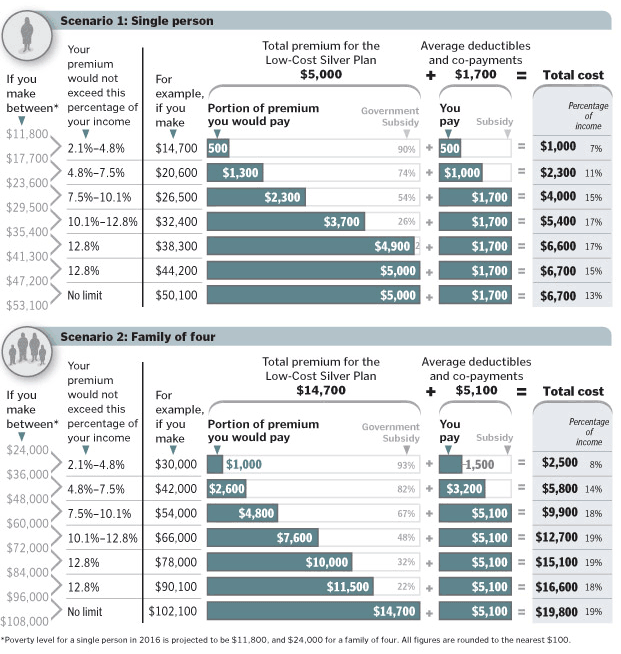
The Senate Finance Committee will vote today on the latest version of health care “reform,” the Baucus Bill. Senator Baucus is expected to strike the gavel around 10:00 am (EST), with a vote expected later in the afternoon.
Make sure to call your Senator and tell them to vote “No” on the Baucus Bill. The Congressional Switchboard number is 202-224-3121.
Here are the members of the Finance Committee, Senators that could decide the fate of health care in the U.S.
Associated Press – Dems Scramble after Warning from Health Insurers
WSJ – Senate Finance Committee to Vote on Health Care Bill
Washington Post – Can Deeds Come Back in VA?
Political Wire – Sen. Reid’s Re-election Now a Toss Up
WSJ Editorial – Health Care Industry Learns the Price of Appeasing Congress
National Review Online – ObamaCare Dissected
NY Times – Congress Split on Effort to Tax Health Plans
Federal Debt: $11.915 trillion
Well, it only took the Obama administration a half-day to find folks to trash an insurance industry study that calculates much higher health care insurance premiums under the Baucus version of ObamaCare.
“I really don’t think it’s worth the paper it’s written on,” AARP Executive Vice President John Rother said, according to the Associated Press.
That couldn’t be the same AARP that sees nothing distressing in Medicare cuts of $500 billion or of significant cuts to Medicare Advantage under the Baucus plan, could it? The AARP that sells insurance that will competitively benefit from cuts in Medicare Advantage? The AARP that sells tons of stuff to seniors by making those seniors believe that AARP is their lobbyist while laughing all the way to the bank?
From today’s Washington Post distinguishing the Iraq troop surge from General McChrystal’s request for more ground forces in Afghanistan:
It’s important to remember that the crucial, lasting element of the surge in Iraq was not the influx of troops but getting Sunni tribes to switch sides, by offering them security, money and a place at the table. U.S. troops are now drawing down and yet – despite some violence – the Sunnis have not resumed fighting because Prime Minister Nouri al-Maliki is courting their support.”
So, according to Zakaria, courting Afghanistan’s Pashtuns will take the same kind of subsidies and sympathy extended to Iraq’s Sunnis. Fair enough. But how about that security thing? Does Zakaria really believe that – all other things being equal – applying only two of the three prongs of the Sunni pacification strategy to the Pashtuns will yeld exactly the same results? Especially when the prong he omits is the one that guarantees the persuasive effect of the other two? If there has been any lesson learned from America’s foreign policy dealings it is that nations – like individuals – need both carrots and sticks to inspire lasting changes.
We’ve seen this sort of reliance on “soft power” yield results before. Former President George W. Bush rode tractors with Vladimir Putin, looked into his soul, and then listened attentively as his buddy invaded and annexed a democratic country in neighboring Georgia. For over a decade State Departments under both Democrats and Republicans shipped consumer goods to North Korea while that country exploded nuclear bombs and fired rockets toward Hawaii. In both cases, the only defense for such subsidies is the active presence of American troops in Eastern Europe and South Korea. Take away the threat of an immediate response from the world’s premier fighting force and suddenly our subsidies become tribute; our sympathy, kowtowing.
Russia and North Korea understand this. So too do Iraq’s Sunni leaders. Are the Pashtuns any different?
CFIF’s Renee Giachino discusses McDonald v. City of Chicago, a case currently before the Supreme Court that could determine once and for all whether the right to keep and bear arms is a “fundamental” right.
With the Senate Finance Committee set to vote tomorrow on Senator Max Buacus’ $839 billion “health care reform” bill, the health insurance industry is out with a new study warning that the legislation will dramatically increase health insurance premiums for U.S. families.
The study, commissioned by America’s Health Insurance Plans (“AHIP”) and prepared by PricewaterhouseCoopers, “makes clear that several major provisions in the current legislative proposal will cause health care costs to increase far faster and higher than they would under the current system,” said AHIP President and CEO Karen Ignagni. “Between 2010 and 2019 the cumulative increases in the cost of a typical family policy under this reform proposal will be approximately $20,700 more than it would be under the current system.”
Those provisions in the Baucus bill analyzed by the study include:
- Insurance market reforms coupled with a weak coverage requirement,
- A new tax on high-cost health care plans,
- Cost-shifting as a result of cuts to Medicare, and
- New taxes on several health care sectors.
The White House and Congressional proponents of “reform” immediately responded with a typical “shoot-the-messenger” reaction. They have yet to substantively dispute the study’s actual findings.
President Obama loves the Mayo Clinic. President Obama loves Medicare. But the Mayo Clinic doesn’t love Medicare.
The Arizona Republic reported on Friday that,
One of the Mayo Clinic’s two family-medicine practices in Arizona soon will stop accepting Medicare, leaving thousands of patients to pay out of pocket for routine doctor’s visits or find a new physician. … Hospital officials called the new policy a ‘two year pilot program’ and said Thursday that the changes are necessary because of low Medicare reimbursement rates.”
Does anyone recall that one of the provisions of “health care reform” is to reduce Medicare reimbursements to doctors even further? Medical insurance that doctors won’t take just doesn’t seem like a healthy reform.
 CFIF Freedom Line Blog RSS Feed CFIF Freedom Line Blog RSS Feed CFIF on X CFIF on X CFIF on YouTube CFIF on YouTube |
