Archive

Posts Tagged ‘budget’
April 19th, 2011 at 2:14 pm
Quick Primer on Debt Ceiling Debate

The Washington Post has a helpful – and short – explanation of the debt ceiling debate, along with some interesting facts.  *My comments in ( )

  • Prior to 1917, Congress had to approve borrowing each time it came up (meaning that WWI combined with Progressive Era big spending made raising the debt much easier)
  • Members of Congress will most likely wait use July 8th as the drop-dead date (unfortunately, federal pensioners will see government contributions to their retirement funds halted when the U.S. passes the real deadline on May 16th)
  • The debt ceiling was less than $1 trillion in the 1980s, then $6 trillion in the 1990s; today it stands at $14.6 trillion and rising (and no, simple inflation is not the reason – it’s spending increases)
  • The budgets presented by President Barack Obama and Rep. Paul Ryan would both require a raise in the debt ceiling (Obama by $2.2 trillion; Ryan by $1.9 trillion)

Read the entire synopsis here.
April 19th, 2011 at 1:55 pm
Will Republicans Blink First on Debt Ceiling?

Byron York of the Washington Examiner says that although many Republicans will be tempted to let the debt ceiling debate go down to the wire, most of them will eventually vote to raise it.

The bottom line is, the debt ceiling issue won’t be settled before an extended game of chicken, one in which Republicans will undoubtedly win some concessions but will, in the end, have to give in.

With the Tea Party still licking its wounds after a much less-than-expected cut in current federal spending, don’t be surprised if raising the debt ceiling becomes the issue upon which many activists base their support for Republican members of Congress.

April 16th, 2011 at 5:52 pm
Return of Supply-Side Economics?

The Economist explains how “The Party of No” is most unified around the theme of being anti-Keynesianism.  Keynesianism teaches that government can grow the economy by spending tax dollars to stimulate consumption (i.e. demand).

Rep. Paul Ryan (R-WI) and other Republicans supporting his “Path to Prosperity” budget argue that cutting taxes gives individuals more money to save and invest in production (i.e. supply), the increase of which creates more jobs.

Not all GOP-ers are sold on Ryan’s revived supply-side theory.  Instead, they prefer to focus on spending cuts as a matter of principle.  Come election season, it isn’t likely that voters will support merely cuts.  They’ll want a vision of what the extra money in their pockets can do.

If recent history is any guide, I suspect Paul Ryan will emerge as the main spokesman for the positive vision of limited government.

April 15th, 2011 at 10:16 am
The Bush Administration Didn’t Create Your Record Deficits, Mr. Obama
Posted by Print

Observers like Charles Krauthammer are correct:  Barack Obama’s partisan budget attack this week was a “disgrace.”  Almost every sentence was tawdry, caustic or simply dishonest.

One suggestion early in Obama’s speech stood out because it is so easily refuted by simple numbers.  Namely, his latest attempt to scapegoat the Bush Administration and portray his own record deficits as somehow attributable to it:

We increased spending dramatically for two wars and an expensive prescription drug program -– but we didn’t pay for any of this new spending.  Instead, we made the problem worse with trillions of dollars in unpaid-for tax cuts -– tax cuts that went to every millionaire and billionaire in the country; tax cuts that will force us to borrow an average of $500 billion every year over the next decade.  To give you an idea of how much damage this caused to our nation’s checkbook, consider this:  In the last decade, if we had simply found a way to pay for the tax cuts and the prescription drug benefit, our deficit would currently be at low historical levels in the coming years.”

But take a look at the actual historical deficit data, with particular attention to 2007, which was the last year under a Republican Congress and White House.  That year’s deficit came in at $161 billion, which is one-tenth the size of Obama’s projected record $1.65 trillion 2011 deficit.  That 2007 deficit was also down from $378 billion in 2003, when the tax cuts, Iraq invasion and drug benefit occurred.  In his usual straw-man manner of argumentation, Obama mocked those who claim we can reduce our debt by eliminating “waste, fraud and abuse,” but what better way to characterize his latest un-presidential harangue?

April 14th, 2011 at 12:21 pm
Daniel Webster’s Devil Making a Comeback?

Roll Call reports deposed congressman Alan Grayson (D-FL) sent out a characteristically inflammatory email to supporters yesterday accusing Republican budget cutters of murder:

Grayson complained in his email that Republican budget cuts would “kill” 70,000 children by cutting immunization programs that could put children at risk. Of course, Grayson became infamous for extreme rhetoric in general and specifically for suggesting the GOP health care plan was for citizens to “die quickly.”

“I would very much prefer to see these children alive,” Grayson wrote.

The voters of Florida’s 8th District mercifully substituted state legislator Daniel Webster for the toxic Grayson.  If the latter gives Orlando residents another chance, let’s hope they make the same decision in 2012.

April 13th, 2011 at 5:15 pm
Quick Side-by-Side of Ryan & Obama Budget Plans

Now that President Barack Obama has formally responded to House Budget Chairman Paul Ryan’s Path to Prosperity, the New York Times offers a helpful (if very brief) side-by-side comparison of the two.

In a nutshell, the differences can be seen in the two sides’ cuts to domestic discretionary spending.  Ryan’s plan cuts $1.6 trillion over ten years.  Obama would cut $600 billion.

Don’t say next year’s elections won’t offer a choice of visions…

UPDATE:  For a more detailed side-by-side comparison, care of the House Budget Committee, click here.

April 13th, 2011 at 4:50 pm
Greece: When Good Men Do Nothing

A sobering column by a Greek politician in today’s Wall Street Journal shows that Stalin-style Communism is making a comeback in a nation teetering on the edge of financial meltdown.  The breakdown in policing has led to countless acts of violence – including murder – that go unpunished:

Many argue that Greece’s disintegration is the unavoidable consequence of the government’s attempt to enforce fiscal austerity. This seems doubtful. This meltdown can be seen as the product of the totalitarian left’s open attempt to exploit the economic crisis and destroy Greece’s existing democratic and economic institutions. What we are witnessing is not a descent into chaos, but a descent into organized lawlessness. Sowing pandemonium and forcing Greece to default will, according to Greek Stalinists’ analysis, bring the revolution nearer.

What makes the situation worrisome is not so much the political strength of this movement. After all, the Communist Party and the Coalition of the Radical Left together claim no more than 13% popular support.

The problem, rather, lies with the political and ideological passivity of the parties that do represent Greece’s broader middle classes. The tolerance these democrats have shown toward their totalitarian counterparts has allowed the latter to play a leading role in shaping Greek public discourse. Do they imagine the favor would be returned if the Coalition of the Radical Left were in charge?

Unless Greece’s political elite realizes the seriousness of what’s happening and acts now to re- establish the rule of democratic law, their efforts to deal with Greece’s economic problems will have been in vain.

April 11th, 2011 at 12:19 pm
Bring On the Ideology

The Wall Street Journal reports that President Barack Obama’s upcoming speech about how to balance the budget will include tax increases along with cuts to programs like Medicare and Medicaid.

The call for higher taxes on America’s job creators will solidify the decision facing voters next year.  The Democrats want more money, while the Republicans want less government.

If there is a positive aspect about the president showing his true tax-and-spend colors, it’s that ideology – how serious people frame reality and their decisions about it – is now front and center in politics.

Rep. Paul Ryan (R-WI) and the GOP want lower taxes and private sector growth.  President Obama and the Democrats want to spend taxpayer money into an ever-growing share of GDP.

Let the debate begin.

April 9th, 2011 at 12:39 pm
Colorado 8th Graders Sealed Budget Deal

Listening to President Barack Obama’s post-budget deal remarks it was jarring to hear the Commander-in-Chief say that the group most benefited from a budget deal was…a group of Colorado 8th graders visiting the nation’s capitol next week.

Apparently, visiting a national monument trumps military personnel getting their paychecks on time.  No doubt a child’s field trip is important, but it pales in comparison to making sure soldiers and their families can make mortgage payments and buy food.  If Obama can’t correctly identify which of the two is more important, it shows just how clueless (or careless) he is about governing priorities.

April 8th, 2011 at 8:21 pm
GOP Ready to Win Budget Fight?

NRO‘s Robert Costa has a great interview with Rep. Tom Price (R-GA) on the GOP Policy Committee chairman’s advice to colleagues:

“It is hard to remember that we are the minority party here in Washington,” Price says. “We run one-sixth of the federal government, and the person with the ace of spades, who can trump everything, is the president. If he wants it shut down, he’ll shut it down. My gut sense tells me that’s what he wants, and so we’ll have a shutdown, since the president wants to shut it down.”

Price believes that the GOP is ready to win the fight. “I think people understand that House Republicans have been the responsible body in all of this; that we are ones who have passed a bill to fund the government for the remainder of this fiscal year; that we are the ones who came up with a solution to keep this thing rolling, to keep our troops funded; and that our greatest ally in the Middle East has the resources it needs,” he says. “We are doing the right thing by standing our ground; that’s what we got elected to do.”

Let’s hope the GOP budget negotiators heed Price’s words and stand their ground.

April 8th, 2011 at 7:44 pm
Kudlow Lauds Ryan’s Budget Plan

Larry Kudlow has the best summary thus far on the importance of Rep. Paul Ryan’s (R-WI) pro-growth budget proposal:

The key point is not the actual numbers, but the direction of the numbers. Spending is coming down.

Trend lines are important in politics and in finances.  With Ryan’s budget plan, Tea Partiers may have found the details guy they need to make their rhetoric into reality.

April 8th, 2011 at 10:35 am
Obama: I Will Veto Bill Ensuring Paychecks to Military
Posted by Print

Shouldn’t America ensure that its military personnel and their families continue to receive paychecks, regardless of whether budget negotiations result in a deal or a federal shutdown? Barack Obama apparently doesn’t think so.

As bargaining continued yesterday, House Speaker John Boehner (R – Ohio) introduced legislation that would keep the government open one additional week and maintain military funding through the end of 2011 so that members of the armed forces would continue to be paid.  The House quickly passed that bill, including 15 Democratic votes.  Obama, however, grotesquely promised a veto, bizarrely labeling it a “distraction.”

Frankly, this entire debate wouldn’t be necessary if the preceding Congress overwhelmingly controlled by Obama’s own party had simply passed a 2011 budget.  But for the first time since the inception of the Budget Act, they simply abdicated that basic responsibility.  Regardless, our military is stretched thin across the globe, and many families live paycheck-to-paycheck.  This obviously isn’t of paramount concern to a president who clearly seems to welcome a government shutdown.

This is one of the most shameful and pathetic episodes in an already shoddy presidency.

April 7th, 2011 at 10:01 am
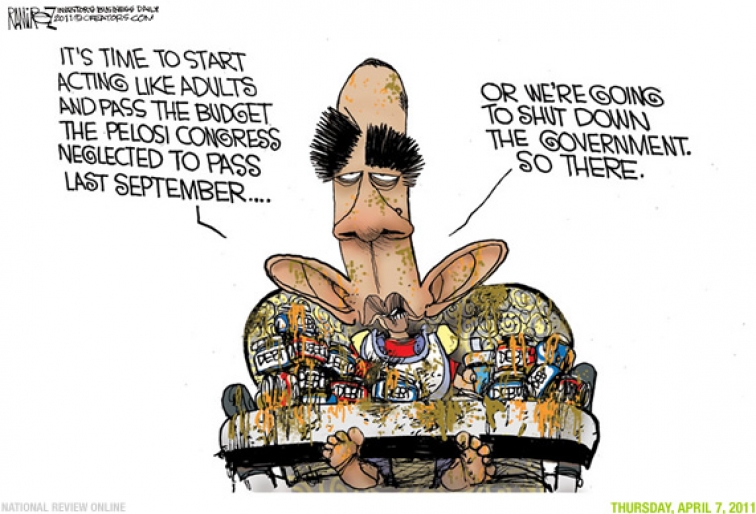
Ramirez Cartoon – Obama: Time to Start Acting Like Adults…Or We’re Going to Shut the Government Down
Posted by Print

Two-time Pulitzer Prize-winning cartoonist Michael Ramirez illustrates Obama’s posturing on the ongoing congressional budget negotiations and the pending government shutdown.

View more of Michael Ramirez’s cartoons on CFIF’s website here.

April 5th, 2011 at 1:19 pm
FCC Commissioner Clyburn Thinks Government Should Enter the Communications Business, Too
Posted by Print

In this era of bureaucratic overreach and unsustainable spending and deficits, should government also enter the business of competing against private communications service providers?  Doesn’t it already have its hands full?

We at CFIF think so.  In fact, we testified last month before the North Carolina legislature on behalf of thousands of supporters and activists across that great state in support of H.B. 129, which would restrain government bureaucrats from unfairly competing against private providers of communications services.   And with good reason.  From Taiwan to Australia, from Chicago to Houston, and inside North Carolina itself, the history of public broadband is without exception one of failure.  Every single public broadband project of which we’re aware has failed to so much as break even.  Ultimately, taxpayer bailouts become necessary as government endeavors lose money and require constant upgrades to keep pace with evolving technology.  Moreover, government broadband boondoggles undermine the billions of dollars invested in private network improvement and expansion, and discourage future private investment.  After all, why risk one’s capital to compete against governments that can manipulate the rules and go to taxpayers for bailout?  Inevitably, poorer service and layoffs in the vibrant tech sector result.  Rural communities particularly suffer.

But none of that logic seems to matter to Democratic FCC Commissioner Mignon Clyburn.   In a statement Monday, Clyburn attacked the North Carolina’s sensible legislation and defended the concept of government entering yet another portion of the private sector.   Perhaps that’s not surprising, considering Clyburn’s vote last December to impose so-called “Net Neutrality” in the face of two-to-one public opposition, a unanimous Court of Appeals decision that the FCC didn’t possess such authority and condemnation from bipartisan groups in Congress.

Predictable or not, however, it is critical that Americans at the federal, state and local level vocally oppose the sort of government tech sector overreach that she advocates.

April 5th, 2011 at 9:48 am
The Ryan Budget Plan

Today,  Budget Committee Chairman Paul Ryan and the House Republican majority are introducing their much-anticipated 2012 budget plan.  The bold proposal — “The Path to Prosperity” — is refreshingly comprehensive in addressing the nation’s debt crisis and promoting economic prosperity.  According to Congressman Ryan:

For starters, it cuts $6.2 trillion in spending from the president’s budget over the next 10 years, reduces the debt as a percentage of the economy, and puts the nation on a path to actually pay off our national debt. Our proposal brings federal spending to below 20% of gross domestic product (GDP), consistent with the postwar average, and reduces deficits by $4.4 trillion.

A study just released by the Heritage Center for Data Analysis projects that The Path to Prosperity will help create nearly one million new private-sector jobs next year, bring the unemployment rate down to 4% by 2015, and result in 2.5 million additional private-sector jobs in the last year of the decade. It spurs economic growth, with $1.5 trillion in additional real GDP over the decade. According to Heritage’s analysis, it would result in $1.1 trillion in higher wages and an average of $1,000 in additional family income each year.

Furthermore, Ryan’s budget cuts taxes and strengthens to the social safety net with commonsense reforms to Medicare and Medicaid and by advancing the discussion to sure up Social Security for future generations.

Simply put, the proposal is a real and comprehensive solution to a grave spending and debt crisis that threatens America’s future.  Failure to act to right the nation’s fiscal ship, and now, is no longer an option.  The Path to Prosperity budget deserves serious consideration, not the partisan politics as usual that has already begun.

Read more details on Ryan’s budget plan here.  For the complete plan, click here (.pdf).

April 4th, 2011 at 3:03 pm
Paul Ryan Unveils Budget Proposal, Obama Unveils Political Campaign
Posted by Print

This week provides a stark contrast between a leader actually willing to risk political capital, versus a man who now seeks four more years of politics-as-usual.

On the one hand, we have House Budget Committee Chairman Paul Ryan (R – Wisconsin).  Tomorrow, Congressman Ryan will unveil a federal budget proposal that reduces spending by $4 trillion over the coming ten years, provides pro-growth tax reform and caps runaway federal spending.  All without reducing Social Security benefits by a single penny for anyone already receiving them or over 55 years of age, along with Medicare reform that will save it from its catastrophic fate if nothing is done.  Congressman Ryan knows full well that by offering budget leadership, Democrats will possess a “political weapon” to use against him, even if it means that “they will have to lie and demagogue” to do so.  But instead of shrinking, he has chosen leadership.

On the other hand, we have the President of the United States.  The purported leader of the Free World.  The most powerful man on Earth.  The man who formed a blue-ribbon deficit commission, then proceeded to ignore it.  Instead of making sure that a Congress dominated by his own party could even manage to pass a 2011 budget, instead of offering decisive world statesmanship amid worldwide crises and instead of providing leadership in averting a national debt catastrophe, Obama instead focused on unveiling his 2012 reelection campaign this week.  Instead of offering a plan, the AWOL Obama will apparently just sit back and attack Paul Ryan’s.

So there you have it.  One man seeks to cut spending by $4 trillion, and the other man seeks to spend $1 billion getting himself reelected.

April 1st, 2011 at 4:30 pm
Speaker Boehner: Don’t Sacrifice Amendment Defunding “Gainful Employment Rule” in House/Senate Budget Negotiations
Posted by Print

As the House and Senate enter budget negotiations, House Speaker John Boehner and Majority Leader Eric Cantor must not sacrifice the Kline Amendment de-funding the Obama Education Department’s so-called “Gainful Employment Rule” on the altar of false compromise.

The Gainful Employment Rule, which sets arbitrary bureaucratic formulas for federal student loan repayment, is a transparent attempt by the Obama Administration to cripple private career colleges.  And the tale of its creation is a long, sordid one.  First, there were allegations of insider trading between Education Department officials and short-sellers with a financial interest in seeing career colleges’ stock prices fall.  Then, the the Government Accountability Office (GAO) had its sting operation against career colleges exposed as defective, ultimately forcing its retraction.  These allegations are serious enough that separate investigations were commenced in the Senate and House.

Fortunately, a bipartisan group in the House of Representatives voted to de-fund any enforcement of the Gainful Employment Rule in budget bill H.R. 1.  In an era of intense party acrimony, the fact that opposition to the Gainful Employment Rule attracted strong bipartisan agreement speaks volumes.  Now, it’s a matter of Speaker Boehner holding strong on de-funding implementation of the rule, rather than offering it as “trade bait” to Senate Democrats.  Please don’t allow the Kline Amendment de-funding the Gainful Employment Rule to become a casualty of politics as usual, Speaker Boehner.

April 1st, 2011 at 1:38 pm
Rubio Charts Own Course with Tea Party

Freshman Senator Marco Rubio (R-FL) is taking a much more traditional approach than colleague Rand Paul (R-KY) when it comes to proving his Tea Party credentials.  Paul continues to thumb his nose at the GOP establishment by founding the Senate’s Tea Party caucus, and feeding speculation he may run for president in 2012.

Rubio didn’t join the Senate Tea Partiers, and until recently has been publicly silent about his immediate intentions.  That changed with a recent column in the Wall Street Journal demanding major budget changes.

Interestingly, Paul is building a national brand while Rubio focuses on few – but profound – policy statements.  In an age of 24 hour media, Rubio’s statesmanlike approach could be an indication of very good things to come.

March 31st, 2011 at 5:41 pm
Tea Party’s Lesson from Budget Fight: Go Bigger Next Time

Bloomberg reports that the rumored $33 billion in cuts being negotiated by House Speaker John Boehner (R-OH) and Senate Majority Leader Harry Reid (D-NV) is looking like the key number both sides are working towards.  For perspective, that’s $28 billion less than the House of Representatives passed a few weeks ago, and $67 billion less than Republicans promised during last year’s mid-term elections.

When the $61 billion cut was passed, Tea Party-backed legislators accepted the reduction under the assumption that half a loaf is better than nothing at all.  Now, the loaf is down to a third, and activists are having none of it.

Whatever sum gets approved, it’s a sure bet the Tea Party and the members of Congress friendly to it won’t forget the importance of starting the cut threshold even higher next time.  At this rate, don’t be surprised if the 2012 battle cry is, “$500 Billion in Cuts or Fight!”

March 28th, 2011 at 12:51 pm
Defense Department: Stop Wasting Critical Dollars on Duplicate F-35 Engine
Posted by Print

The Pentagon doesn’t want it.  The Senate has voted it down.  The House has voted it down.  The Bush White House sought to stop it.  The Obama White House has sought to stop it.

Yet the unnecessary duplicate engine for the new F-35 Joint Strike Fighter refused to die, riding the wave of Washington, D.C. pork-barrel political force.

Fortunately,  the Defense Department has ordered General Electric and Rolls-Royce to stop wasting dollars on a second engine for the F-35.

Pratt & Whitney serves as the main producer of the F-35 engine, but forces in Congress perpetuated the wasteful General Electric and Rolls-Royce second engine.  Although both the House and Senate have voted to end the second engine and allocate those precious defense dollars on more critical needs, the project kept going because the previous Congress never passed a 2011 budget.  That left the Defense Department to operate on continuing resolutions based on the fiscal 2010 appropriations.

It’s an embarrassing illustration of wasteful Beltway politics, and a reminder of what we who favor fiscal sanity must continually overcome.  Fortunately, the Defense Department just provided an assist in that effort.