Archive

Author Archive
June 20th, 2012 at 1:45 pm
Federal Government Creating Green Jobs … at $12 Million a Pop
Posted by Print

Further evidence that the Obama Administration’s green jobs fetish defies all logic, economic or otherwise, comes from this report from CNS News:

An Obama administration green jobs grant program that spent $11 billion lacks a verifiable job-counting system and likely created only a fraction of the jobs it claims, according to a staff report by the House Energy and Commerce Committee.

While Energy Secretary Steven Chu said the grants “created tens of thousands of jobs,” the government’s own National Renewal Energy Laboratory estimates it created 910 direct jobs.

The House report criticized even those numbers, saying: “The job creation numbers that exist for Section 1603 are based on models, not actual data from completed projects. Neither Treasury nor DOE have turned over actual jobs data on the Section 1603 grants program to the committee.”

In the spirit of generosity, let’s assume the 910 number is correct. At $11 billion, that comes out to well over $12 million per job. A ludicrous amount to be sure, but also one that comes with an enormous opportunity cost. Scroll down the page to Ashton’s post on the cost-effectiveness of Washington D.C.’s Opportunity Scholarship program and you’ll find that the whole thing (which the Obama Administration has consistently targeted for elimination) could be funded at the cost of less than two of those green jobs.

The character of this administration can be defined by its priorities. Does anything more need to be said than that they would rather slip millions of taxpayer dollars to tech firms who haven’t so much as worked up a business model than to poor children in the inner city? Hope indeed.

June 19th, 2012 at 2:39 pm
Democratic Governor Deals Blow to Obamacare
Posted by Print

God bless New Hampshire, an outpost of sanity in otherwise deep-blue New England. In keeping with the Granite State’s strongly libertarian political culture, New Hampshire’s legislative Republicans led a charge to prevent the state from implementing a health insurance exchange program under Obamacare. The result: the state’s Democratic governor buckled. From the state’s free-market think tank, the Josiah Bartlett Center for Public Policy:

Governor John Lynch this morning signed legislation blocking implementation of a health insurance exchange in New Hampshire. The Obama Administration has been urging states to set up exchanges under the Patient Protection and Affordable Care Act, known as ObamaCare.

Lynch has supported setting up a New Hampshire exchange, including the proposal in his State of the State address in February. Senate legislation setting up an exchange, SB 163, won Committee approval in January before stalling on the Senate floor. Opponents argued that a state-run exchange would put New Hampshire taxpayers on the hook for the costs of administering much of the federal health care law, while giving the state little flexibility from federal mandates.

New Hampshire’s state motto — perhaps the nation’s most iconic — is “Live Free or Die.” It’s nice to know that those are more than just words on a license plate.

h/t: Adam Freedman at Ricochet

June 18th, 2012 at 4:10 pm
Scenes from a McCain Presidency
Posted by Print

The margin of victory in the 2008 presidential race was so wide — and the election of Barack Obama so historic — that we rarely stop to imagine what it would have been like were we now well into the third year of John McCain’s presidency.

Needless to say, we’d be better off on a wide variety of fronts. McCain, a consistent fiscal hawk, not only wouldn’t have indulged in a record-setting debt binge like Barack Obama, he may well have made a serious run at entitlement reform. And as a stalwart advocate for a strong national defense, it seems overwhelmingly obvious that McCain would have taken a harder line with Iran than the “diplomacy at all costs” approach embraced by the Obama Administration.

In other areas, however, McCain would have been an utter nightmare. Can anyone imagine how one of the namesakes of the McCain-Feingold political speech law would have reacted to the Supreme Court’s Citizens United decision? Based on this report from the New York Times, it may have been even worse than Obama:

In his 2010 State of the Union address, President Obama roundly criticized the Supreme Court’s Citizens United decision, arguing that it had “reversed a century of law.” That practically sounds like a hymn of praise compared to what Senator John McCain had to say on “Meet the Press” this weekend. He called Citizens United: “arrogant, uninformed, naïve.” …

“I think there will be scandals associated with the worst decision of the United States Supreme Court in the 21st century,” he said. Referring to the justices on the Court, he added, “I just wish one of them had run for county sheriff.”

This was on the heels of McCain criticizing casino magnate Sheldon Adelson’s contributions to Republican causes, saying that the fact that he owns a gaming facility in Macau could mean that “foreign money is coming into American political campaigns.”

This serves as one more reminder that, as McCain himself essentially told us four years ago, he’s basically an economic illiterate. Someone with foreign business interests donating to a political campaign is subversive of the integrity of domestic elections? Does Merrill Lynch, McCain’s biggest donor in 2008, only invest in domestic entities? Does Fed-Ex, another major donor, only ship within the 50 states? Since the obvious answer is no, how was McCain able to escape the corrupting influence of foreign money?

The point here is not to hammer those companies; quite the contrary. They were completely within their rights to give political donations, as is Adelson. The point is that McCain’s fetish for regulating political speech is both hypocritical and inimical to a free society. Giving government the power to regulate what free citizens may say about the government (and when and where they may say it) is a fundamental threat to liberty.

On this one front, at least, we can be happy that McCain was never able to bring the powers of the White House to bear.

June 14th, 2012 at 11:59 am
Kyl vs. Jindal — The Tiebreaker
Posted by Print

Quin makes a characteristically impressive case for why either Jon Kyl or Bobby Jindal would be great vice presidential choices for Mitt Romney. As my column last week made clear, I’m a Kyl man, but I’m certainly not immune to the charms of Jindal, one of the most effective Republican governors in the nation (for proof, see my recent praise for the education reforms Jindal is implementing in Louisiana).

Still, I think Kyl is the superior choice for Team Romney. Here are a few reasons why:

1. Capitol Hill Experience — With Romney never having held elected office in Washington, having a Vice President with preexisting influence and relationships in the Beltway would go a long way towards advancing his agenda. Jindal isn’t exactly a Washington unknown — he spent just under two years as an Assistant HHS Secretary in the Bush Administration and had a two-term stint in the House — but his background pales in comparison to Kyl, who’s been a member of Congress for 25 years. And with Kyl currently serving as Republican Whip in the Senate — the position responsible for counting votes — his skill set is uniquely suited for helping Romney get legislation through Congress.

2. Foreign Policy Experience — Kyl has become a major figure on foreign policy in recent years, leading Republican opposition to both the New START Treaty and the Law of the Sea Treaty (both of which he has been right on, IMHO). Jindal has no commensurate experience. For Romney, who is also a foreign policy neophyte (and whose foreign policy pronouncements — identifying Russia as the nation’s largest security concern and threatening a trade war with China, for instance — have been dotty at times), having someone of Kyl’s stature would flesh out the ticket in the area where the presidency confers the greatest power — and requires the greatest responsibility.

3. Playing the Number Two Role — Let’s stipulate up front that neither Kyl nor Jindal are electrifying speakers. Neither is going to bring to the ticket anything as energizing as Chris Christie’s blue collar pugnaciousness or Marco Rubio’s stirring eloquence. But while Kyl is steady and workmanlike, Jindal can come across awkward and uncomfortable in public appearances. This was famously the case with his 2009 response to President Obama’s speech to a joint session of Congress, a speech so widely panned that it’s thought to have delayed whatever presidential ambitions Jindal may have had by at least one election cycle. And while he hasn’t had a moment that bad since, Jindal can still be halting and uncomfortable when he appears on national television.

Personally, I’m inclined to give the guy a break on this. It’s obvious when you’re watching him that Jindal’s awkwardness is a function of his precociousness. This is the nice kid who’s always been the smartest in his class but has never quiet figured out social cues. That earnestness, however, will make it tough for him to play the traditional attack dog role of the number two on the ticket. Kyl, on the other hand, while hardly a demagogue, would be very effective employing the same strategy as Dick Cheney did as a vice presidential candidate — using his age and gravitas to dismiss Obama as callow and incompetent.

4. The Future — My own preference is for the vice presidency as a sort of emeritus post, reserved for senior statesmen whose presidential ambitions either (a) never existed or (b) are exhausted. That also prevents the VP’s political interests from clashing with those of the president, a situation which has caused many an unsettled White House in years past. Ideally, I’d like it to be a terminal position, which makes sense for Kyl, who is retiring from the Senate this year and has forsworn any further electoral ambitions.

Jindal, by contrast, just turned 41 and has a bright future ahead of him regardless of whether he gets tapped for the post or not. His current gubernatorial term lasts through January 2016, which would line him up well for a presidential run should Romney lose. Alternately, he could run against Democrat Mary Landrieu when her seat in the U.S. Senate comes up in 2014. In the interest of retaining Jindal as one of the party’s main leaders well into the future, these options seem preferable to me to marooning him in the vice presidency, which more often than not — barring presidential death or departure — puts an end to one’s career in elected office.

Regardless of whether you support Jindal, Kyl, or someone else, there’s one thing that has to be admitted about the veepstakes: Unlike this year’s presidential race, there’s an embarrassment of riches.

June 13th, 2012 at 2:59 pm
We Feel Your Pain … We’re Just Not Going to Do Anything About It
Posted by Print

Read between the lines and you’ll see that that’s the message democratic strategists are pushing on President Obama’s reelection team. Here’s how The Daily Caller‘s Stephen Elliot reports the advice being given by Democracy Corps’ James Carville and Stan Greenberg:

The current campaign is focused on success in the economic recovery, but Carville’s group says the strategy is “wrong” and “will fail.” The only reason Obama is keeping up in the campaign is because voters perceive Romney as “out of touch with ordinary people.”

The authors recommend that Obama show more empathy for the struggles of the middle class. “These voters want to know that he understands the struggle of working families and has plans to make things better,” according to the report.

… “These voters are not convinced that we are headed in the right direction…and the current narrative about progress just misses the opportunity to connect and point forward,” continues the report.

In tests done as part of the focus groups, Obama campaign ads that highlight job growth and economic recovery during the last four years did not even win over voters who already supported Obama.

That last line is telling: if even Obama’s most fervent admirers aren’t buying his pitch on the economy, just imagine how turned off all-important swing voters will be in the fall. Are we really to believe that they’ll be brought back to the fold just because Obama all of a sudden becomes “empathetic,”acting as if he stays up nights worried about people who’ve been forced to start buying generic brand breakfast cereals?

Let me register a radical sentiment: I give no more of a damn about whether the president sympathizes with my economic plight than I do whether my plumber is moved by the hardship I have to endure when there’s not enough hot water. In both cases, the sentiment is the same: fix the problem and then leave me well enough alone. My suspicion is that the rest of the country is increasingly feeling the same way. We’ll see in November.

June 12th, 2012 at 2:20 pm
Colleges and Car Dealerships
Posted by Print

Following on to Tim’s excellent post earlier this week about the cost of higher education, this observation by the American Enterprise Institute’s Norman Ornstein bears noting:

Colleges have become a bit like car dealers, where the sticker price does not reflect the actual cost to most buyers. Some can afford to pay the full boat, helping the colleges maintain their budgets, while others can get deep discounts.

And colleges, under this theory, keep their prices up to match their competitors because a lower tuition would be seen by many prospective students and parents as a reflection of lower quality compared to their peers.

Many economists also point out that federal subsidies for higher education are themselves a contributing factor in increasing college costs.

The economic prescription for reforming higher ed is the same that could be applied to health care, k-12 education, or any other sector of the economy that is co-mingled with the government: greater price transparency, fewer subsidies, lower barriers to entry, and more competition. This isn’t terribly complex stuff. In fact, it should be intuitive to anyone who’s ever studied basic economics. Alas, the dismal science is about the only component of a college education that’s not getting a fair shake these days.

June 11th, 2012 at 2:20 pm
Religious Liberty Under Fire
Posted by Print

While the media seems to have moved on from the firestorm over religious liberty that was kicked off by Obamacare’s contraception mandate earlier this year (a fight that is now making its way through the courts), the threat to freedom of conscience only continues to grow. In today’s DC Examiner, Tim Carney looks at some of the troubling developments throughout the nation:

Last week, New Mexico’s Supreme Court ruled that the state government can force a wedding photographer to shoot a gay wedding, even though she holds the view that marriage is between one man and one woman — and even though New Mexico doesn’t perform same-sex marriages.

… Is a baby sitter still free to choose which families she’ll work for? Can a doctor still choose which procedures she’ll perform? Actually, a Michigan court has already answered that one, saying an in-vitro fertilization clinic violated a woman’s rights by refusing her IVF on the grounds of her being unmarried.

… This is how the culture war generally plays out these days: The Left uses government to force religious people and cultural conservatives to violate their consciences, and then cries “theocracy” when conservatives object.

One aspect of this fight that bears highlighting: one need not share the gay marriage or IVF views of the people targeted in these cases to understand the threat to fundamental freedoms. In fact, one need not even be religious.

At the heart of all of this is that government at all levels is increasingly trying to constrain freedom of association — the right to say “get lost and leave me alone.” And when the government takes away your right to say “no”, few other freedoms have any meaning.

June 7th, 2012 at 1:19 pm
Bill Clinton’s Id Endorses Romney
Posted by Print

For a man who successfully campaigned for the presidency twice, you have to marvel at Bill Clinton’s lack of message discipline (or any discipline, for that matter). During the 2008 presidential campaign, Bill was a consistent thorn in Hillary’s side, what with his pronouncement that Barack Obama was “playing the race card” against him and his characterization of the presentation of Obama’s record as “the biggest fairy tale I’ve ever seen.”

Back then, the pop psychoanalysis of Clinton was that he couldn’t handle the idea of Hillary in the White House, occupying the spotlight that was rightly his, and was thus subconsciously serving up self-destructive rhetoric to dampen her prospects for beating Obama. This theory wasn’t particularly plausible given the Clintons’ joint lust for power and the fact that it violated Occam’s Razor — which would have instructed us that Clinton is simply impulsive and egotistical.

In 2012, the analysis seems to have become inverted. Last week, Clinton praised Mitt Romney’s time at Bain Capital on CNN, calling his record “sterling.” Then, earlier this week, he told CNBC that there is nothing much wrong with private equity, that the country is in “recession,” and that the Bush tax cuts should be extended, even for high earners (he’s walked back that latter part since). Putting Clinton back on the couch (never a safe place to be with the former president), the armchair shrinks are now speculating that Clinton’s eruptions owe to a desire to undermine Obama and set the stage for another Hillary presidential run in 2016.

Allow me to offer another, less convoluted thesis. Clinton knows that his presidency was historically inconsequential. Apart from his impeachment scandal, the only notable occurrence of his time in office was the expansion of the economy — not small ball to be sure, but also largely the product of co-opting Republican ideas on spending and deficit reduction, balanced budgets, welfare reform, tax cuts, and free trade. Still, it’s what Clinton hangs his hat on and it gives him an opportunity to sneer at Obama’s economic shortcomings, a pastime he no doubt has enjoyed ever since candidate Obama gave the Clinton Administration’s legacy short shrift during the 2008 campaign. So, if you’re Bill, why not take your affection for the business world out for a spin every once in a while just to rub it in Barack’s face?

Clinton’s habit of repeatedly undermining Obama is not evidence of a Freudian ego orchestrating a brilliant Machiavellian plot to install his wife back in the White House; It’s simply the product of an id that has broken its leash, relentlessly and uncontrollably attempting to establish Clinton as the alpha dog of the modern presidency. As we should all know by now, the former president is motivated more by desire than by reason.

This is not the work of a grand strategist. This is a sort of cry for help from a man so insecure that he needs constant validation even after eight years in the White House. He is to be pitied.

June 6th, 2012 at 2:36 pm
Europe: In For a Penny, In For a Pound
Posted by Print

Pity our poor friends in Europe. They just can’t seem to stomach the lesson that the faltering state of the continental monetary union has made all but impossible to ignore. Rather than making a clean break from the common currency, it now appears that the smart set wants to double down. This item, appearing earlier this week in the Wall Street Journal, is nothing short of chilling in its implications:

Germany is sending strong signals that it would eventually be willing to lift its objections to ideas such as common euro-zone bonds or mutual support for European banks if other European governments were to agree to transfer further powers to Europe.

If embraced, the move would deepen in fundamental ways Europe’s political and fiscal union and represent one of the boldest steps taken by the bloc since the euro was launched. Germany has never before been willing to discuss the conditions it believes necessary to move toward assuming common risks within the euro zone. Now, although the end may be a long way off, it appears willing to discuss those conditions.

“The more that other member states get involved with this development and are prepared to give up sovereign rights to get European institutions more involved, the more we will be prepared to play an active role in developing things like a banking union,” a German official familiar with the discussions told The Wall Street Journal. “You can’t have one without the other.”

Translation: the Europeans are seriously considering throwing the car in reverse and seeing just how far they can push the speedometer. It’s true that an economic union without a matching political consolidation was always doomed to fail (the practical effect has been Southern Europe living off the North), but the move towards a true United States of Europe brings to mind James Madison’s observation from Federalist #10 about destroying liberty in order to cure the problem of political faction: the cure is worse than the disease.

A continent-wide government will destroy all pretense of national sovereignty throughout Europe, leaving the bureaucrats of Brussels to steer a bold new course that will vanquish the national character of some of the world’s proudest nations, perpetuate a failing economic model, and cede previously democratic powers to unelected technocrats.

Let us pray that Europe doesn’t go down this road. If it does, the burden of Western leadership will fall even more disproportionately on American shoulders than it does already.

June 5th, 2012 at 1:23 pm
Will a Backdoor Cap and Trade Plan be One of Obama’s Last Acts in Office?
Posted by Print

Those who believe that it’s in the best interest of the nation for Barack Obama’s presidency to terminate next January have been feeling their oats a bit lately. As Jennifer Rubin noted yesterday at the Washington Post’s “Right Turn” blog:

Whatever you think is the cause of the economic doldrums, it has now dawned on the Democrats and the press that Obama could lose this thing.

Quite so. But even if one indulges in the most optimistic projections for November, there’s a danger in getting too comfortable. There could be mischief brewing for the lame duck congressional session following the presidential election. As Conn Carroll reports in the Washington Examiner:

At a Senate Foreign Relations Committee hearing Wednesday, [Senator John] Kerry announced that he would not be submitting the United Nations Conventions on the Law of the Sea [LOST] for a vote before the November election. Instead, Kerry intends to hold a series of hearings before the election, building the case for passage, before pushing the treaty in a lame-duck session. This is the exact same game plan Kerry executed to pass the New START treaty during the 2010 lame duck…

…If the Senate approves LOST this December, any country that believes itself harmed by global warming could force the U.S. into binding arbitration, most likely in front of the Annex VII Arbitral Tribunal, LOST’s default dispute resolution forum.

Any judgment from that tribunal would be final, unappealable, and immediately enforceable in U.S. federal court. In 1982, a similar arbitration body forced Canada to set hourly caps on their sulfur dioxide emissions, causing industry to spend millions on mitigation efforts. A LOST tribunal could set similar caps on U.S. carbon emissions, triggering trillions in economic damage.

Cap and trade, of course, was Obama’s other major first-term initiative besides Obamacare, but when the politics surrounding the former issue became toxic — and congressional Republicans hit back hard on the cap and trade plan — the administration backed off. But is anyone willing to bet that Obama’s sense of fair play will prevent him from backdooring through the policy in the dying days of his administration?

If so, you’d have to believe that a president who has no compunctions about stripping fundamental religious freedoms through administrative fiat, who’s already busy promising the Russian government that he’ll “have more flexibility” on missile defense when he doesn’t have to face the American electorate again, and who has already flirted with extralegal methods for enacting international carbon reduction would suddenly be stricken by conscience after facing the sting of rejection from the voters.

Those odds don’t look good. Which is why conservatives need to remain on guard until the day Obama departs for Chicago.

June 4th, 2012 at 1:00 pm
Obama’s Walesa Snub Puts Liberals to the Test
Posted by Print

American liberals need to be thinking abut 1975. That was the year that President Gerald Ford denied Russian dissident and staunch anti-communist Alexander Solzhenitsyn an audience at the White House, a snub to all those who defended freedom against the depredations of the Soviet Union throughout the world.

Despite the fact that Ford was a Republican president (albeit an unelected one), the conservative movement (to its credit) disowned him on the issue. By the following year, the indignity that Ford forced upon the author of The Gulag Archipelago was one of the many reasons that conservatives were looking to deny the incumbent president renomination. So why is this germane to liberals? Because of this passage, courtesy of Matthew Kaminski at the Wall Street Journal, which Tim also highlighted in his column last week:

Among this year’s 13 recipients of the Presidential Medal of Freedom, Mr. Obama posthumously honored Jan Karski. As a member of the Polish underground during World War II, Karski was the first to provide eyewitness evidence of the Nazi extermination of Jews in occupied Europe…

The Poles wanted Lech Walesa to receive the medal on Karski’s behalf, but the White House nixed the choice. Last year, during Mr. Obama’s visit to Poland, the hero of Solidarity refused to attend a large gathering to meet the younger leader. Mr. Walesa felt entitled to a tete-a-tete. Administration officials told Polish journalists that Mr. Walesa’s presence was too “political” for this week’s occasion. Poles read something else into it: Mr. Obama holds grudges.

Lech Walesa was leading the fight for the freedom of  the Polish people back when Barack Obama was still sashaying around his New York apartment in a sarong, scribbling pretentious, adolescent musings to one of his composite girlfriends. Walesa deserved the one-on-one in Poland. And he deserved the stage in the East Room of the White House last week for the Medal of Freedom Ceremony.

As for Barack Obama, he deserves the rebuke of all those who esteem freedom, but especially his fellow liberals. If they can’t bring themselves to have a moment similar to the one conservatives had in 1975 — one in which principle trumps partisanship — they will have revealed their supposed affection for human rights to be little more than election year pablum.

May 31st, 2012 at 12:07 pm
On Evil and Limitations: The Situation in Syria
Posted by Print

Throughout the year, I’ve repeatedly been critical here at CFIF of the atrocities occuring in Bashar al-Assad’s Syria and the feckless Western response they’ve engendered. What I haven’t done, however, is called for regime change.

There’s a reason for that. In the hornet’s nest that is the Middle East, even regimes seemingly superlative in outright evil (such as Assad’s Syria and Gaddafi’s Libya) can’t be displaced with any certainty that the successor regime will be better. Writing for the Texas-based private intelligence firm Stratfor (of which he is and founder and CEO), George Friedman gives an excellent summary of why that is, using Egypt and Syria as examples:

What was misunderstood [in the West] was that while there was in fact a democratic movement in Egypt, the liberal democrats who wanted a Western-style regime were not the ones exciting popular sentiment. What was exciting it was the vision of a popularly elected Islamist coalition moving to create a regime that institutionalized Islamic religious values.

Westerners looked at Egypt and saw what they wanted and expected to see. They looked at Egyptians and saw themselves. They saw a military regime operating solely on brute force without any public support. They saw a mass movement calling for the overthrow of the regime and assumed that the bulk of the movement was driven by the spirit of Western liberalism. The result is that we have a showdown not between the liberal democratic mass and a crumbling military regime but between a representative of the still-powerful regime (Shafiq) and the Muslim Brotherhood.

If we understand how the Egyptian revolution was misunderstood, we can begin to make sense of the misunderstanding about Syria. There seemed to be a crumbling, hated regime in Syria as well. And there seemed to be a democratic uprising that represented much of the population and that wanted to replace the al Assad regime with one that respected human rights and democratic values in the Western sense. The regime was expected to crumble any day under the assaults of its opponents. As in Egypt, the regime has not collapsed and the story is much more complex.

Syrian President Bashar al Assad operates a brutal dictatorship that he inherited from his father, a regime that has been in power since 1970. The regime is probably unpopular with most Syrians. But it also has substantial support. This support doesn’t simply come from the al Assads’ Alawite sect but extends to other minorities and many middle-class Sunnis as well. They have done well under the regime and, while unhappy with many things, they are not eager to face a new regime, again likely dominated by Islamists whose intentions toward them are unclear. They may not be enthusiastic supporters of the regime, but they are supporters.

It’s long past time that those of us in the West allow the Jeffersonian reveries that accompanied the genesis of the Arab Spring to fade. In most nations in the region, we are faced with one of two choices: secular dictatorships or Islamist totalitarianism. In general, the former will be preferable to the latter, though only marginally less despicable. In Syria, the brutality of the Assad regime — combined with its alliance with Iran — makes the situation virtually unnavigable.

These are loathsome choices. But that fact shouldn’t lead us to the delusion that they are false ones.

May 30th, 2012 at 1:08 pm
Greek Liberals’ Economic Recovery Plan: Lie to the Rest of Europe
Posted by Print

It’s almost hackneyed at this point to evoke Greece as a warning sign to the rest of the Western World; as a promise of what’s in store should the artificial decadence of the welfare state completely strangle individual initiative in developed nations. Yet there’s a reason that California on the Aegean is always the cautionary tale of choice: when it comes to outright political absurdity, the birthplace of democracy is constantly outdoing itself. The most recent example — which has to be read to believed — comes courtesy of James Angelos reporting in the Wall Street Journal:

Greece’s radical left party has upended the country’s politics with an idea as simple as it is seductive: Athens can renege on the deals it made in exchange for a bailout, and still remain in the euro.

Greece’s future, and possibly that of Europe’s monetary union, may depend on how many Greeks buy into the idea.

The Coalition of the Radical Left, known as Syriza, is competing with Greece’s conservative New Democracy to become the biggest party in Parliament in June 17 elections that could send further shock waves through Europe …

Syriza leader Alexis Tsipras, a 37-year-old former Communist youth activist, promises that despite its dire financial straits, Greece can halt austerity programs, restore social spending and nevertheless continue to receive the payments from the euro zone and the International Monetary Fund that keep it from bankruptcy.

The repeated warnings to the contrary from Europe and the IMF are simply efforts to blackmail Greece into doing what they want it to do, Mr. Tsipras says.

A few facts about Greece to consider in light of Mr. Tsipras’s demagoguery. This is a nation where public employees have no compunction about taking monthly paychecks 14 times a year (yes, you read that right: 14) and where tax evasion is so widespread that it’s estimated that 30 percent of the national economy is in the black market. And now the proposed solution from one of the nation’s two major political parties is to welch on a deal with the rest of the continent?

Greece is experiencing an economic crisis, to be certain. But it looks increasingly like that is only a symptom of a deeper moral crisis.

May 29th, 2012 at 12:53 pm
The New Math of Alternative Energy
Posted by Print

In a recent commentary piece here at CFIF, I noted how the green energy initiatives that President Obama has repeatedly sold as the cure for the nation’s economic ailments have been shown to lead to economic ruin in places like Spain. For those who still doubt that a similar outcome will result stateside, this piece of representative math, courtesy of the Heritage Foundation’s David Kreutzer, should give pause:

In a speech at a wind-turbine blade manufacturer in Iowa, President Obama called for extending two sets of subsidies that turn energy economics upside down and force higher costs on consumers and taxpayers.

The first extension is for the production tax credit (PTC), which is set to expire at the end of the year. It provides wind-energy producers with a subsidy of about 40 percent of the wholesale cost of electricity. So, when a wind-energy producer sells $50 worth of electricity, Uncle Sam adds another $20 for a total revenue of $70 to the producer.

The second extension is for the Advanced Energy Manufacturing Credit—originally funded in President Obama’s “stimulus” bill. This 30 percent credit cuts the cost of $100 worth of equipment to just $70.

So there you have it. Fifty dollars of actual revenue is bumped up to $70 with the PTC and $100 of costs are cut to $70 after the special tax credit. That is, $50 = $100 after taxpayers make up the difference.

Imagine for a moment if the federal government was proposing to use taxpayer dollars to double the incoming revenue of major Wall Street investment firms. It would rightly be denounced as the worst kind of crony capitalism. So why should the reaction be any different when that money is going into windmills?

May 24th, 2012 at 1:46 pm
Alan Simpson, Genius
Posted by Print

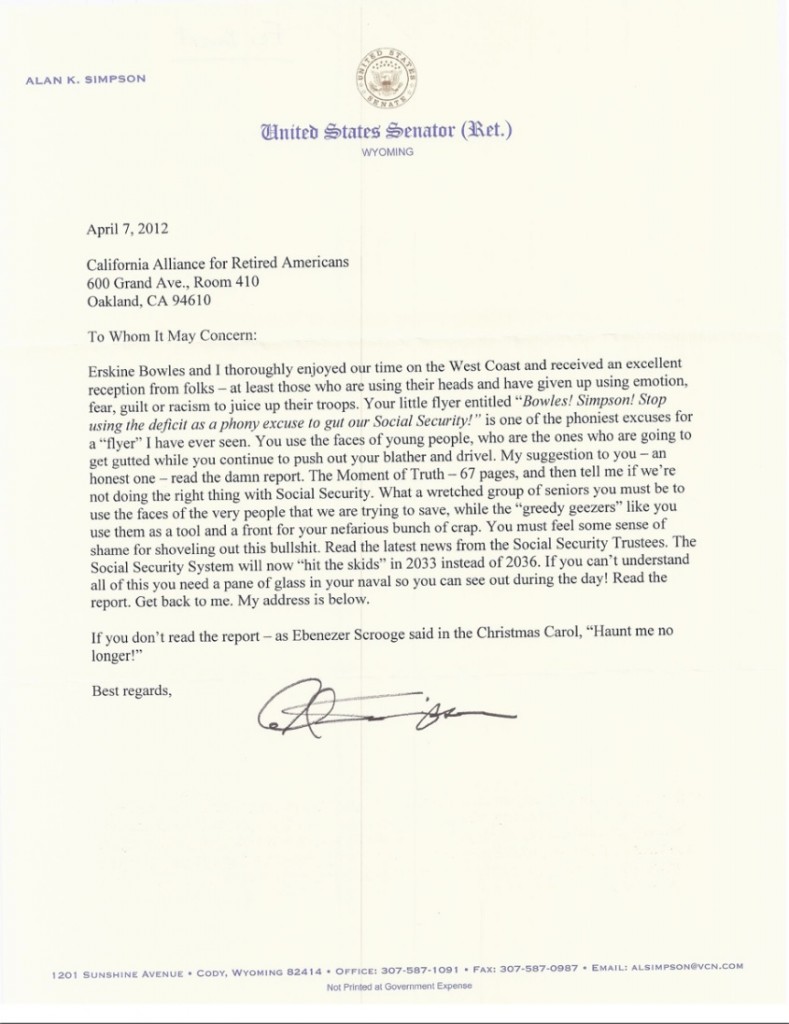
I don’t always agree with former Wyoming Senator Alan Simpson, who has a tendency to embody some of the worst traits of the GOP’s squishy center. That fact makes it doubly delightful when Simpson uses his always-unvarnished style in service of solid principles, as he did in a recent letter responding to a group protesting him in California (warning: there are a few bits of salty language). Here it is in all its glory:

SimpsonLetter

Tags:
May 23rd, 2012 at 1:34 pm
A Sign the End is Near
Posted by Print

I think we can all agree that this is probably the death rattle of American liberty. From the Washington Examiner:

President Obama’s eco-friendly EPA inked a green partnership deal with high-octane NASCAR Monday to promote recycling and environmentally-friendly products to the sport’s millions of fans.

According to the Environmental Protection Agency, NASCAR will encourage fans to buy “sustainable concessions” at races, expand the use of “safer chemical products,” conserve water, reduce waste, promote recycling, push products approved by the EPA that have a small enviro footprint and encourage suppliers to get an “E3 tuneup” aimed at promoting sustainable manufacturing.

Yes, you read that right: NASCAR. Civic religion of the red states. Featuring cars that reach speeds around 200 MPH, with fuel economies as low as two miles per gallon.

We’ve gone ’round the bend, ladies and gentlemen. All we can hope is that someday this will be included in the chronicles of the last, delusional days of the Obama Administration.

May 22nd, 2012 at 12:28 pm
To Get More Federal Money, States Claiming Volunteer Organizations are a Form of Welfare Spending
Posted by Print

One of the great triumphs of the federal welfare reform legislation passed in the mid-1990s was an insistence that states lay down tough work requirements for welfare recipients as a condition of receiving federal assistance. Though the fact is little publicized, however, another provision of the law allows states to substitute increased welfare spending for the work requirements and still receive money from Washington. That, of course, is an invitation to mischief, as reported by CNSnews, quoting Congressman Geoff Davis

“Many States have scoured their budgets to find other current program spending–such as for Pre-K, child care, and after school programs–they could report as TANF [welfare] spending,” Davis said at a hearing on Thursday. “Others began counting third-party spending–such as assistance offered by food banks and Boys and Girls clubs–as TANF spending.  One State even apparently found a way to count the value of volunteer hours by Girl Scout troop leaders as State TANF ‘spending.’

This is, by the way, all entirely legal under the law as written.

This is a worthwhile reminder: even legislation as noble as federal welfare reform is only as strong as those charged with carrying it out. The right laws are deeply important. But so are the right lawmakers.

May 17th, 2012 at 3:41 pm
The Case for Green Jobs: America Should be More Like Bankrupt Countries
Posted by Print

At a time when Spain is in the news because it lingers on the edge of a full-blown economic meltdown, it’s instructive to remember that this is the country that’s supposed to be the model for the green jobs revolution that President Obama continually claims will help revitalize the American economy. Over at The Blaze, the American Enterprise Institute’s Kenneth Green looks at the factual case and finds it far from compelling:

Now, to the empirical evidence. When talking about our bold green energy future, President Obama held up Spain as an example of what America should be doing. Spain invested heavily in wind power and other types of renewable energy. Alas, after studying the Spanish Experience, Professor Gabriel Calzada Álvarez and colleagues at Spain’s Universidad Rey Juan Carlos found if America followed Spain’s example, for every renewable energy job that the U.S. managed to create, the U.S. should expect a loss of at least 2.2 traditional jobs on average. And they found that green jobs are costly: each green job created in Spain’s effort cost about $750,000, and only one in 10 of the new green jobs were permanent. Doing the math on that, creating even 3 million new green jobs would cost $2.25 trillion. Even in a time where the trillion is the new billion, that’s a lot of money.

Indeed it is. But the money isn’t the real issue. Any “jobs plan” that entails a net loss in jobs shouldn’t be taken seriously by anybody, let alone the President of the United States. If green jobs really are the future of the economy, then sufficient market demand will arise to compel their creation. If, as is far more likely, they are simply a progressive fantasy financed at taxpayer expense, they deserve to have their grip on the public purse shaken as abruptly as possible.

May 16th, 2012 at 12:48 pm
Forget Obama’s Energy Scarcity — More Oil in Three U.S. States than Rest of the World Combined
Posted by Print

President Obama’s views on energy have always been defined by a sense of false scarcity. This is the man, after all, who told Oregon voters in 2008, “We can’t drive our SUVs and eat as much as we want and keep our homes on 72 degrees at all times.”; who constantly invokes the fact that “the U.S. has only 2 percent of the world’s oil supplies” (an utterly misleading statistic that would be irrelevant even if it were literally true); who admitted to wanting the price of coal “to necessarily skyrocket”; and who hired an Energy Secretary who longs to see American gasoline prices reach the stratospheric levels of Europe.

Testifying before the House Science Subcommittee on Energy and Environment last week, Anu Mittal, Director of Natural Resources and Environment at the Government Accountability Office delivered some stunning news about the amount of oil shale available in the Mountain West.

Here’s how CNSNews reports the story:

“USGS estimates that the Green River Formation contains about 3 trillion barrels of oil, and about half of this may be recoverable, depending on available technology and economic conditions,” Mittal testified.

“The Rand Corporation, a nonprofit research organization, estimates that 30 to 60 percent of the oil shale in the Green River Formation can be recovered,” Mittal told the subcommittee. “At the midpoint of this estimate, almost half of the 3 trillion barrels of oil would be recoverable. This is an amount about equal to the entire world’s proven oil reserves.”

Read that again. If less than half of this oil shale is recoverable, it still represents an amount equal to that available in the rest of the world. By extrapolation, that means that as future extraction methods become more technologically sophisticated (and more economical) we could be talking about a grand haul equal to more than double current global reserves. And that’s only in Colorado, Utah, and Wyoming — not in the other 47 states.

There are huge policy implications here because of the simple fact that most of this shale occurs on federal lands. That means that getting this material out of the ground will require a proactive effort from government. The current President — who likes to boast about record oil production without noting that the vast majority of it is coming from private land — is not the person to kick start this new era of energy abundance. One more reason to send him packing in November.

May 15th, 2012 at 1:41 pm
GOP Establishment About to Take Another Hit in Nebraska?
Posted by Print

As the 2012 election cycle has progressed, one of the growing memes on the left has been that the Tea Party has lost a lot of the anti-establishment momentum it had in 2010, when it was responsible for electing U.S. Senators like Wisconsin’s Ron Johnson, Kentucky’s Rand Paul, and Florida’s Marco Rubio. The pundits have been a little quick on the trigger finger.

Last week, 35-year Senate veteran Richard Lugar went down to defeat in Indiana at the hands of the Tea Party candidate, State Treasurer Richard Mourdock, a race that we chronicled at length here at CFIF. Today, voters heading to the polls in Nebraska may deliver a similar shock to the GOP establishment.

The establishment choice, state Attorney General Jon Bruning, has been under fire for exactly the kind of crony capitalism that has come to define Tea Party distaste for business as usual. It was long thought that State Treasurer Don Stenberg — who enjoyed the support of Jim DeMint’s Senate Conservatives Fund, FreedomWorks, and the Club for Growth — would be the conservative alternative to Bruning. But in recent days, Bruning’s numbers are falling without Stenberg’s rising proportionately.

The reason is a third candidate, State Senator Deb Fischer, who has recently emerged from relative obscurity thanks to endorsements from Sarah Palin and Congressman Jeff Fortenberry. According to recent polling, there’s a very real possibility of Fischer pulling off an upset of epic proportions and walking away with the nomination. And while Stenberg’s supporters aren’t happy to see their man failing to close, they’re already suggesting that Fischer would be an acceptable alternative to Bruning and the business as usual he represents.

We’ll have to watch the polls tonight to see how this thing resolves, but one thing’s for sure: even the worst-case scenario for Tea Partiers (a narrow win by Bruning) would send a powerful message to the GOP establishment in Washington: the Tea Party is here to stay.