June 29th, 2012 at 6:28 am
Ramirez Cartoon: I’m A Big Fat Liar
Below is one of the latest cartoons from two-time Pulitzer Prize-winner Michael Ramirez.

View more of Michael Ramirez’s cartoons on CFIF’s website here.

Below is one of the latest cartoons from two-time Pulitzer Prize-winner Michael Ramirez.
View more of Michael Ramirez’s cartoons on CFIF’s website here.
I discuss this bizarre decision here.
I further note that I was almost right in my final prediction, below.
Especially: “ I think this is going to be one of those horribly fractured decisions where observers have trouble making heads or tails of everything. I think there may even be concurrent pluralities rather than a simple majority on at least a couple of the questions presented to the court. In the end, though, I do — yes, I do — expect the mandate in this particular form, applied in this particular way, to be adjudged at least partially unconstitutional.”
Indeed, the MANDATE was found unconstitutional, but the penalty it carried, treated as a tax, was not. And on the Medicaid issue, there were indeed shifting pluralities rather than a single majority. So I was right on the style of the opinion — although not on the substance of just how the court would find a way to muck it up beyond ordinary understanding.
There’s a lot to say about Chief Justice John Roberts’ opinion rewriting ObamaCare’s individual mandate as a tax in order to save the law from being ruled unconstitutional. One of the best – and most succinct – analyses comes from the CATO Institute’s Michael F. Cannon:
The Supreme Court ruled that ObamaCare’s individual mandate is not constitutional under the Commerce Power, which was how Congress framed the mandate to avoid a political backlash from calling it a tax. Congress and the president swore up and down that the mandate was not a tax. Yet the Court upheld the mandate as a valid use of that disavowed taxing power. What Congress said the individual mandate is, the Court said is not constitutional. What Congress said the mandate is not, the Court ruled is constitutional. Everybody got that?
Where does that leave us?
The Supreme Court just enacted a law that Congress never would have passed.
The Court just told Congress it is okay to lie to the people to avoid political accountability.
In a disappointing decision, the U.S. Supreme Court has upheld ObamaCare’s individual mandate forcing all Americans to buy health insurance as constitutional. Chief Justice John Roberts joined the four liberal justices on the Court to rule that the mandate stands under Congress’ taxing authority.
Okay, it’s time for me to weigh in, now that everybody else has so thoughtfully risen to my challenge to put their predictive skills on the line. I see we run the gamut from total victory against the whole law to a doleful prediction that the mandate will stand.
Well, count me in the mushy middle. After going back and forth and around and around on this subject for months, I just can’t tell where my own analysis — and my own wish for a defeat of ObamaCare — ends and my assessment of each of the justices’ proclivities begins.
But here’s what I have come up with: I think this is going to be one of those horribly fractured decisions where observers have trouble making heads or tails of everything. I think there may even be concurrent pluralities rather than a simple majority on at least a couple of the questions presented to the court. In the end, though, I do — yes, I do — expect the mandate in this particular form, applied in this particular way, to be adjudged at least partially unconstitutional. In other words, the court will leave open the possibility that such a mandate in theory could be within the federal government’s powers, but just not THIS mandate in this form. But I think a majority may not agree on what the remedy for this abuse is, and will come up with some Rube Goldberg way of punting the ultimate decision back to lower courts or to Congress.
Meanwhile, the challenge to the Medicaid provision will fail, 6-3.
If I am right, perhaps we should be thankful for even tiny victories. But I say: “Ugh!”
With an overabundance of subtle and contradictory points of evidence rendering a cold, rational prediction nearly impossible, mine is entirely intuitive. Unfortunately, I have been disappointed too many times already in my lifetime to expect a good result. Twenty years ago, for example, I was a college student disgusted by the Court’s refusal to overturn Roe v. Wade (regardless of one’s view of abortion specifically, Roe is a judicial monstrosity) while it had the perfect opportunity and basis for doing so. In subsequent years, I’ve endured such indefensible decisions as Kelo, with the seemingly more rare positive decision like Heller, the monumentally important Second Amendment case.
To me, anything less than an unequivocal, categorical rejection of ObamaCare’s individual mandate on the basis of the Constitution’s commerce clause is a loss. To allow the federal government to coerce activity, in order to in turn rationalize regulating behavior not only eviscerates the concept of limited federal powers, renders the text of the Constitution meaningless. From that point forward, it’s simply a matter of arguing degree, not kind. We become a nation of men, not of laws. Of judges arbitrarily deciding from that point forward which governmental intrusions get a pass and which don’t. Honestly, I will be satisfied so long as the Court rules the individual mandate unconstitutional, even if the remainder of the law stands. As economists say, what cannot continue will not continue. And without the individual mandate, ObamaCare cannot and will not continue, at great (and justified) political cost to Obama himself and those who support the law.
At any rate, my bottom line is that I intuitively do not trust enough justices to make the correct decision. I predict that a majority will concoct some way to allow the individual mandate to survive on the absurd “logic” that healthcare is a “special” category of commerce. And even if they overturn the individual mandate, I suspect that they’ll do so on an “as applied” basis, meaning that the seal is broken.
Congressional staffers are buzzing about a terrifically insightful National Journal piece from a week ago that has still attracted too little mainstream notice, explaining how if any part of ObamaCare is thrown out by the Supreme Court, the budgetary “scoring” problems that would be caused (for the Congressional Budget Office) are so complicated that they could hamstring implementation of what’s left of the law — but also hamstring efforts to fix any holes caused by the law’s unraveling. Basically, CBO could be looking at a law whose budgetary effects are essentially “unestimatable.”
My sources say the administration’s own argument — that if the mandate is struck down, so should the rest of Title 1 of the Affordable Care Act, but none of the rest of it — could effectively put itself (the administration itself) into a box, paint it into a corner, or whatever other cliche you want to use. As Margot Sanger-Katz and Meghan McCarthy of National Journal reported:
Washington’s top health economists, including those at the Congressional Budget Office, say that position could lead to an even more complex breakdown of the law’s interlocking provisions than just losing the mandate. CBO declined to comment for this story, and the White House also declined to comment on whether it is worried about complications that might result from its position.
But several congressional staffers said that CBO has been asked to score the scenario, and the office demurred, saying it’s too difficult to game out the consequences. According to economists, the scenario is not just complicated, but also potentially expensive—and could lead the estimated $461 billion in insurance tax credits through 2021 to balloon.
This all gets very complicated, and it goes even beyond what National Journal so well described, but this bears serious watching. Stay tuned. The administration really could be in for “heap big trouble.”
I’ll join the scrum on this one, though in a much less organized fashion than either Ashton or Quin. Insulated as it is from direct political pressure, the Supreme Court’s actions are always much harder to predict than those of the other two branches, so I’ll offer a few thoughts rather than predictions:
Though we learned with the Arizona illegal immigration decision that tough questioning from justices does not mean a Supreme Court slap-down – indeed, Justice Sotomayor was particularly hard on the feds’ position but ultimately upheld its arguments, as did Justice Kennedy and Chief Justice Roberts – I’m betting (with Quin’s money, of course) that Justice Scalia’s quip about the page length of ObamaCare provides a window into tomorrow’s outcome.
During oral argument Scalia brushed aside the suggestion that should the Court rule the individual mandate unconstitutional it would need to reconstruct the law by piecing together the parts that are still valid. Scalia’s response was, “You want us to go through 2,700 pages? Is this not totally unrealistic… to go through one by one and decide each one?”
I think the Court will strike down the individual mandate because it forces Americans to participate in commerce, an unprecedented power grab by the federal government. (Ironically, had the Obama Administration framed the penalty for not buying insurance as a tax, most constitutional scholars on the right and left agree the mandate would survive. However, the reason government lawyers haven’t framed it that way is because Obama and the Democrats in Congress repeatedly and explicitly said no one’s taxes would go up if ObamaCare passed, meaning that calling the mandate a tax during litigation would likely make the entire law even less popular with the public.)
Because of all this, I think the Court will do everyone a favor by holding the individual mandate unconstitutional and finding that the rest of the law is not severable from it. (Which is easy to do since in the rush of ramming the bill around the normal legislative process Congressional Democrats forgot to put in a simple severance clause that would let the rest of the law stand if the mandate falls.)
Thus, everyone gets a blank slate and the Court is not patching together a form of the health reform law that no one voted on or signed.
For what it’s worth, there’s my (or rather Quin’s) two cents.
Tom Goldstein, who has argued 25 cases before the U.S. Supreme Court, bucks conventional wisdom with his latest prediction regarding the High Court’s ObamaCare ruling tomorrow.
Over at SCOTUSblog, a site he co-founded, Goldstein writes:
[I]n the end, based on the entire mix of information I have, I think the mandate will not be struck down tomorrow. (Neither I, nor anyone else, has any inside information.) My prediction includes the possibility that there will not be a single majority opinion for the theory on which the mandate is upheld, and even the thin possibility that the Court will not have a majority to find the mandate constitutional.
As to the other major ObamaCare questions before the Court, Goldstein predicts:
Far less important, I expect the principal opinion will be written by the Chief Justice; a majority of the Court will find it has jurisdiction; and the challenge to the Medicaid expansion will be rejected.
Goldstein does acknowledge that most Supreme Court observers disagree with his prediction and that his own confidence in it “isn’t overwhelming.” Coming from such a well-respected and brilliant legal mind, Goldstein’s prediction isn’t reassuring either.
Here’s to hoping that Goldstein is misreading this one.
As Troy Senik and I both have expressed strong support for the idea that Arizona’s Jon Kyl should be on Mitt Romney’s short list for vice president, it is worth watching this interview Kyl did on Fox News Channel the other night. The key thing isn’t the particular substance of the discussion, but whether or not Kyl comes across well: Does he communicate his point well, clearly, and understandably? Does he come across as reasonable, competent, knowledgeable, and likeable, all at the same time? The answers to those questions are all “yes.”
There are all sorts of ways a presidential campaign can use a running mate. One of the best is to let the top of the ticket hammer home one strong message, again and again, as the main theme of the campaign, while assigning the VP candidate the role of raising and carrying several secondary issues to continually put the opponent on the defensive and to distract the opposing campaign from its message of the day.
With Arizona being ground zero for the immigration-policy battle, and with Kyl occupying a moderate or middle ground as being critical enough of Obama’s lack of enforcement to satisfy hard-liners but open enough to fair-minded appreciation of some immigrants’ interests that he won’t scare off Hispanic voters, he could well carry the immigration message well as Secondary Issue Number One. As an expert on military and foreign affairs, he could make up for Romney’s lack of experience there and blast the heck out of Obama on those issues, making defense/fo-po Secondary Issue Number Two. With his experience on the Judiciary Committee, he could make judges and Justice Department corruption and politicization (Fast and Furious, Black Panthers, etcetera) Secondary Issue Number Three. Few potential running mates are as well equipped to carry multiple issues against Obama as Kyl is.
C’mon, my Fellows: Weigh in! Which way will the high court go tomorrow?
The always astute Ed Whelan weighs in here.
Specifically, the fact that Justice Scalia read his dissent from the bench in the Arizona immigration case leads me to believe that the Court will invalidate the individual mandate by a 5-4 vote……
There was a time when Jeffrey Rosen was a thoughtful center-left court analyst, with a constitutional interpretive philosophy clearly to the left of Madisonian/conservative textualists but nonetheless willing to give credit where due to conservative jurists and to recognize their arguments and their consistency even when he disagreed with them. Well, for years it has been clear that those days are long gone, and that Rosen barely maintains the veneer of thoughtful and fair-minded analyst while actually going far down the road that columnist E.J. Dionne long ago traversed, into full-time partisan hackery.
Witness Rosen’s new analysis of the Supreme Court’s ruling on the Arizona immigration case. It is couched throughout in terms of “giving credit where due” to conservative justices. But that stance is just a pose. Look more closely, and you’ll see that he gives credit only when the conservatives agree with him. If they agree with him, then they are showing an ability to be “modest and nuanced in tone and substance” while demonstrating a “vision of bipartisan nationalism.” But he warns that if they don’t agree that the ObamaCare individual mandate is perfectly constitutional, then they will suddenly appear “partisan and unrestrained” and will have violated their “previously expressed judicial philosophies.”
In other words: Agree with me, and you are wonderful. Disagree with me, and you have switched in three days from being wonderful to being a vicious, partisan, right-wing hypocrite.
This, and so much else that he writes in this piece, is pure and utter hogwash.
Rosen’s entire frame of reference is skewed, and give absolutely no credit to the actual interpretive philosophies in use on the right. There is no such thing as a “vision of bipartisan nationalism” in conservative jurisprudence. What is at play isn’t a results-oriented “nationalism” — which, of course, contradicts many other instance where Roberts and even Anthony Kennedy have stood firmly for state authority vis-a-vis the national government — but instead an honest attempt to apply the original public meaning of the Constitution’s or legislation’s words to the case before them.
How, pray tell, would it violate Roberts’ “previously expressed judicial philosophy” for him to rule the mandate unconstitutional? After all, it’s not as if Roberts hasn’t recognized limits on Congress’ interstate commerce powers before. Remember when he decided the Commerce Clause powers did not extend to protection of a “hapless toad (that), for reasons of its own, lives its entire life in California”? And of course Kennedy has recognized Commerce Clause limits both in U.S. v. Lopez and U.S. v. Morrison. As this new question of a different type of extension of those powers presents an unprecedented question — because the federal power assertion is itself unprecedented — there is no reason at all to believe that it would violate these justices’ philosophies or to show an engagement in partisan shenanigans for Roberts and Kennedy to rule against the mandate. Likewise, although conservatives would be hugely (and rightfully) disappointed and even angry if Roberts and Kennedy go the other way, that doesn’t mean conservatives would be right in suddenly finding Roberts to be a sell-out; it would just mean that he applies the law to these particular facts differently than we do.
But for Rosen, who invents a jurisprudence of “bipartisan nationalism” that is alien in form and substance to everything conservative jurists believe, a judge’s motives or intellectual integrity can be credited or discredited, or both in the same week, completely dependent on whether or not they agree with his conclusions based on a jurisprudential approach that doesn’t even exist.
What a crock.
Okay, to all my fellow…er, my fellow Fellows of CFIF: Last chance to get in your updated predictions on how the Supreme Court will rule on ObamaCare.
I’ll see what you come up with before I reveal my hand (gee, isn’t that clever of me?) — but I WILL offer this outside-the-box scenario as a remote but not entirely-out-of-the-question possibility. To wit:
We could see a typical Kennedy “split the baby” sort of decision: the mandate unconstitutional, on narrow and tentative grounds, with a remand to lower courts to decipher some Delphic question from Kennedy about how best to separate the mandate from the rest of the law.
The good news — and this would be a stunner — is that I think there is a small chance that if Kennedy doesn’t just split the baby, but slices into about four pieces, then Justice Sotomayor might concur in part that “as applied,” the mandate is unconstitutional. If so, that would mean that while the end result could be quite a muddle and the size of the victory (in law, not politics) would be very small, the POLITICAL upshot would be huge in that even a small acknowledgement by an Obama appointee that the mandate went too far would take away some of the ability for Obama to bash the court as a campaign issue.
Granted, most people now think that Roberts, not Kennedy, will write the main decision, based on who has written what other decisions when, during this term. But it would be perfectly feasible for Roberts to write a plurality opinion rather than a majority one, while Kennedy wrote a concurrence with the narrow result of ruling this mandate unconstitutional (and Sotomayor joining in part) — so that the narrow result would have a majority, but the major reasoning would have only a plurality, with Kennedy’s concurrence actually being controlling in terms of what happens next (e.g. some sort of weird remand).
Of course, maybe somebody piped some bath salts into my room and I’m hallucinating. This is all too complicated by half. It’s probably just what happens when I/we have too much time to speculate.
On the other hand, the high court has done weird things like this before. With Kennedy in the mix, anything is possible.
Below is one of the latest cartoons from two-time Pulitzer Prize-winner Michael Ramirez.
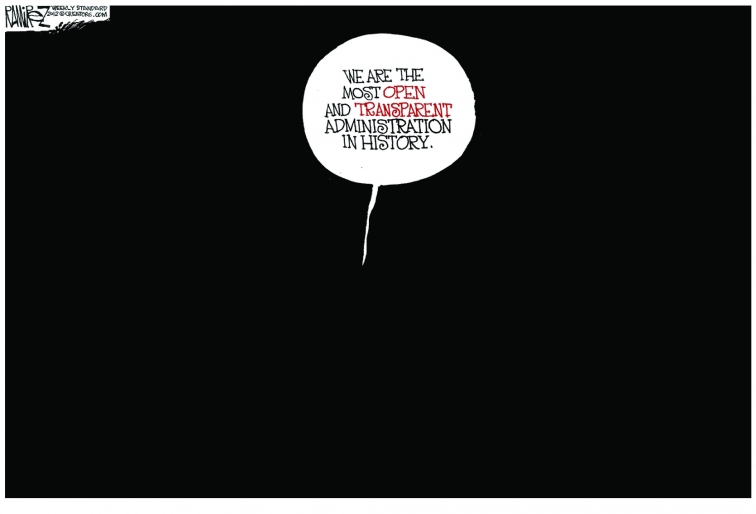
View more of Michael Ramirez’s cartoons on CFIF’s website here.
Last week, here on the blog, I went to town on Senator John McCain for what I viewed as his asinine, borderline incoherent rants about Citizens United specifically and money in politics generally. At the time, I noted offhandedly that while McCain has always been horrible on the issue of political free speech he has much to recommend him in other areas. Happily, only a week later, he’s in the news for one such virtue : his opposition to wasteful spending.
McCain was on the warpath against the waste in the Senate’s version of a farm bill passed late last week, going so far as to produce a top 10 list for Twitter of the most egregious proposed expenditures. The items:
#1 – Creates new USDA office to inspect catfish. FDA already inspects catfish, so this one’s a real bottom-feeder.
#2 – $200 mil Market Access Program promoting brands overseas. Example: Holding “liquor mixology demonstrations” in Russia.
#3 – $25 million to study health benefits of peas, lentils and garbanzo beans. Pretty sure they’re healthy.
#4 – Subsidies for mohair (AKA goat wool), which have cost taxpayers $20 million+ since 1954
#5 – New subsidy for popcorn producers. Yes, popcorn subsidies – after popcorn prices rose 40% in recent yrs.
#6 – $10 million to establish new USDA program to eradicate feral pigs. Talk about pork!
#7 – $15 million to establish a new grant program to “improve” the U.S. sheep industry. A ba-a-a-a-a-a-d idea.
#8 – $700 million for “Ag and Food Research Initiative” funding grants to research pine trees in FL & study moth pheromones
#9 – $40 million in grants from USDA to states to encourage private land owners to use land for bird watching or hunting
#10 – $200 million for “Value Added Grant Program” often used to give grants to wine producers (& cheese makers too) “
All jokes his.
Thanks to McCain, some of the provisions (like the catfish inspection) were stricken from the bill. We’ll have to wait for the legislation to be finished to see how bad the final damage is, but we already know this: the outcome will be better than it would have been had John McCain not been part of the process. For that (and for his statement, quoted in the New York Times over the weekend, that he is ““hard-pressed to think of any other industry that operates with less risk at the expense of the American taxpayer”), he deserves our thanks.
Now if only he’d shut up about campaign finance reform …
Previously, I’ve agreed with Charles Krauthammer’s concerns about unmanned aerial vehicles (UAVs or drones) being allowed into domestic airspace because of the threat to privacy from so-called “eyes in the sky.”
Now, Todd Humphreys, a professor at the University of Texas at Austin, is showing how tech savvy terrorists can, and very likely will, exploit a “gaping hole” in the government’s flight security structure.
Last Tuesday, in the barren desert of the White Sands Missile Range in New Mexico, officials from the FAA and Department of Homeland Security watched as Humphrey’s team repeatedly took control of a drone from a remote hilltop. The results were every bit as dramatic as the test at the UT stadium a few days earlier.
DHS is attempting to identify and mitigate GPS interference through its new “Patriot Watch” and “Patriot Shield” programs, but the effort is poorly funded, still in its infancy, and is mostly geared toward finding people using jammers, not spoofers.
According to Humphreys, “Spoofing [a drone’s GPS receiver] is just another way of hijacking a plane.”
For about $1,000 and with a little bit of technical training a terrorist could take control of any civilian-operated drone and wreck havoc. Without a human pilot at the controls, the drone’s onboard computer will simply follow whatever commands it is given, regardless of where they originate.
And while some terrorists may be interested in taking over surveillance drones for intelligence gathering purposes, the real danger is if a drone as large as a cargo plane – which FedEx plans to use when domestic drones are approved – is overtaken and flown into planes carrying people or into crowded buildings.
As Humphreys says, “In 5 or 10 years you have 30,000 drones in the airspace. Each one of these would be a potential missile used against us.”
So not only would a terrorist hacker not need to buy a drone in order to fly one, he wouldn’t even need to go through an invasive TSA screening to reenact the 9/11 tragedy.
Because of pressure from the military and drone manufacturers, Congress is requiring the Federal Aviation Administration to fast-track regulations as part of the FAA’s reauthorization act. Significant rules that will impact every American are to be conceived, written, and finalized within weeks of each other, and an entire regulatory scheme is mandated to be implemented in less than a year.
If you think that kind of statutory mandate translates into greater bureaucratic efficiency, think again.
The time-crunch – and the deliberate lack of oversight from Congress by pushing the rule writing onto an agency – means that everyday Americans will not be privy to the decision making process that will dramatically impact their safety in the air and on the ground.
Congress needs to rein itself and this process in. With arguably illegal waivers being given to certain groups to avoid provisions of ObamaCare and No Child Left Behind, we’ve seen how arbitrary and capricious federal regulators can be when it comes to expedited rulemaking. There’s no reason to expect a more coherent approach from an FAA trying to balance competing interests like privacy, profit, and public safety on an irrational deadline.
We need open debate and deliberation from our elected officials about the costs and benefits of domestic drones. If Congress won’t engage the issue because it’s too politically painful, then the American people shouldn’t suffer a lapse in safety and privacy because their representatives would rather pass the buck than take responsibility.
Somewhat lost amid today’s Supreme Court ruling on Arizona’s SB 1070, the Court reinforced First Amendment free speech rights as affirmed in Citizens United v. Federal Election Commission. In fact, the Court did so without the need for full review, oral argument and exhaustive written briefing. Demonstrating in this instance that brevity is the soul of sound jurisprudence, the Court in American Tradition Partnership v. Bullock overturned a Montana Supreme Court decision favoring a ban on political speech that flatly contradicted Citizens United. The single-page majority opinion is notable for its cogency:
A Montana state law provides that a “corporation may not make . . . an expenditure in connection with a candidate or a political committee that supports or opposes a candidate or a political party.” Mont. Code Ann. §13–35–227(1) (2011). The Montana Supreme Court rejected petitioners’ claim that this statute violates the First Amendment. 2011 MT 328, 363 Mont. 220, 271 P. 3d 1. In Citizens United v. Federal Election Commission, this Court struck down a similar federal law, holding that “political speech does not lose First Amendment protection simply because its source is a corporation.” 558 U. S. ___, ___ (2010) (slip op., at 26) (internal quotation marks omitted). The question presented in this case is whether the holding of Citizens United applies to the Montana state law. There can be no serious doubt that it does. See U. S. Const., Art. VI, cl. 2. Montana’s arguments in support of the judgment below either were already rejected in Citizens United, or fail to meaningfully distinguish that case.
The petition for certiorari is granted. The judgment of the Supreme Court of Montana is reversed.
It is so ordered.”
The First Amendment, the Constitution itself and free speech have been vindicated.
Over the weekend, Newsday’s Lane Filler had a terrific editorial piece on one of the absolute worst trends in modern American politics: Government’s growing tendency towards preventing failure (read: insulating people from the consequences of their actions).
But as Filler correctly points out, this trend isn’t just limited to big financial firms on Wall Street. We only pay special attention to “too big to fail” because it’s a relatively new development. In many ways, our entire social contract has come to be defined by the same ethos. An excerpt:
Every social program, as much good as it might do, strikes a blow against moral hazard. Unemployment insurance, which many people have received for as long as two years during the current recession, helps folks get through tough times, but economists agree it also keeps some of them from taking jobs. Few people would take $300 per week to trim hedges if they can get $300 per week to not trim hedges while they wait for a wage offer they can actually live, or even better, thrive, on. Take away the $300, though, and that bad job starts to look better. Extended unemployment benefits aren’t the only reason there are 3.4 million unfilled jobs in the United States, but they are a reason.
Let people know that if their income is low enough, the government will give them food, and they won’t have nearly as much inclination to earn food money as they would if they were down to carpet-lint soup. Provide shelter to those who can’t provide their own, and folks feel less desire to hustle for housing than they would if an underpass in Cleveland were their winter home.
As Filler goes on to note, the same criticism applies to Social Security and Medicare, both of which provide far more in benefits than beneficiaries ever pay in.
None of this, of course, is to argue against a basic safety net. But as many conservative wags have been noting of late, the safety net is coming to look a lot more like a hammock.
Failure, uncomfortable as it often is, is the finishing school of success. Having weakened its instructive powers, we should not be surprised to find ourselves living in a nation of adolescents.
Join CFIF Corporate Counsel and Senior Vice President Renee Giachino today from 4:00 p.m. CDT to 6:00 p.m. CDT (that’s 5:00 p.m. to 7:00 p.m. EDT) on Northwest Florida’s 1330 AM WEBY, as she hosts her radio show, “Your Turn: Meeting Nonsense with Commonsense.” Today’s guest lineup includes:
4:00 (CDT)/5:00 pm (EDT): Sally Pipes, President and CEO of Pacific Research Institute: Obamacare and SCOTUS;
4:30 (CDT)/5:30 pm (EDT): Quin Hillyer, fellow at CFIF: Florida Voter Fraud and the Department of Justice;
5:00 (CDT)/6:00 pm (EDT): Joel Arends, Chairman of Veterans for a Strong America: Obama Shamelessly Politicized the Bin Laden Killing; and
5:30 (CDT)/6:30 pm (EDT): Slade O’Brien, state director for Florida Chapter of Americans for Prosperity: Five for Florida – Real Solutions for a Better Florida.
Listen live on the Internet here. Call in to share your comments or ask questions of today’s guests at (850) 623-1330.
 CFIF Freedom Line Blog RSS Feed CFIF Freedom Line Blog RSS Feed CFIF on X CFIF on X CFIF on YouTube CFIF on YouTube |
