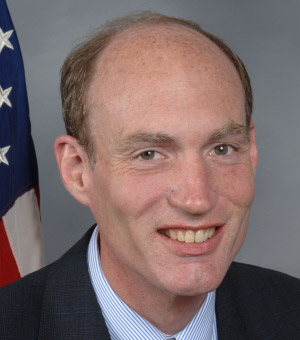
Sen. Kay Bailey Hutchison (R-TX) calls the next fiscal fight – raising the statutory debt limit when it’s reached in May – “Armageddon” and the most important policy decision of most members’ careers.
Check out her explanation here.
Sen. Kay Bailey Hutchison (R-TX) calls the next fiscal fight – raising the statutory debt limit when it’s reached in May – “Armageddon” and the most important policy decision of most members’ careers.
Check out her explanation here.
Listening to President Barack Obama’s post-budget deal remarks it was jarring to hear the Commander-in-Chief say that the group most benefited from a budget deal was…a group of Colorado 8th graders visiting the nation’s capitol next week.
Apparently, visiting a national monument trumps military personnel getting their paychecks on time. No doubt a child’s field trip is important, but it pales in comparison to making sure soldiers and their families can make mortgage payments and buy food. If Obama can’t correctly identify which of the two is more important, it shows just how clueless (or careless) he is about governing priorities.
The (British) Guardian promotes an interesting theory about the 2012 electoral cycle: maybe Republicans should focus more on winning the Senate than the presidency. Here’s the rationale:
And here’s more potential bad news: in 2014, another 20 Senate Democrats are up for re-election, compared to just 14 Republicans. That means over two successive election cycles, 43 Democrats – 80% of those currently in office – must defend their Senate seats, compared to just 24 Republicans. Could the GOP end up with a 60-vote super-majority of its own, just two years before laying siege to the White House in a post Obama contest?
The strategy doesn’t explicitly cede the presidential campaign to President Barack Obama, but it does acknowledge that the current crop of likely GOP presidential contenders don’t include the exciting names conservatives want (e.g. Mike Pence, Chris Christie, John Thune).
Consequently, don’t be surprised if conservative activists and donors spend their time and money electing more senators like Rand Paul and Marco Rubio instead of backing whichever compromise candidate emerges with the presidential nomination.
NRO‘s Robert Costa has a great interview with Rep. Tom Price (R-GA) on the GOP Policy Committee chairman’s advice to colleagues:
“It is hard to remember that we are the minority party here in Washington,” Price says. “We run one-sixth of the federal government, and the person with the ace of spades, who can trump everything, is the president. If he wants it shut down, he’ll shut it down. My gut sense tells me that’s what he wants, and so we’ll have a shutdown, since the president wants to shut it down.”
Price believes that the GOP is ready to win the fight. “I think people understand that House Republicans have been the responsible body in all of this; that we are ones who have passed a bill to fund the government for the remainder of this fiscal year; that we are the ones who came up with a solution to keep this thing rolling, to keep our troops funded; and that our greatest ally in the Middle East has the resources it needs,” he says. “We are doing the right thing by standing our ground; that’s what we got elected to do.”
Let’s hope the GOP budget negotiators heed Price’s words and stand their ground.
Larry Kudlow has the best summary thus far on the importance of Rep. Paul Ryan’s (R-WI) pro-growth budget proposal:
The key point is not the actual numbers, but the direction of the numbers. Spending is coming down.
Trend lines are important in politics and in finances. With Ryan’s budget plan, Tea Partiers may have found the details guy they need to make their rhetoric into reality.
The Maryland House followed the state Senate’s lead last night and passed a bill giving illegal immigrants in-state tuition rates for community colleges. After graduating from a two-year school, beneficiaries would then be eligible for in-state tuition at four-year universities.
Maryland: so generous, it’s criminal.
This week’s edition of the Liberty Update, CFIF’s weekly e-newsletter, is out. Below is a summary of its contents:
Lee: Obama Launches 2012 Campaign, Chants of “Four More Years!” Conspicuously Absent
Ellis: The End of Eric Holder
Ellis: Liberal Attacks Misfire on Ryan Budget Plan
Freedom Minute Video: School Choice: The Next Great Fight for Civil Rights
Podcast: Congressman McCotter Charts Path of Truth and Renewal for America
Jester’s Courtroom: Haircut Policy Nets Lawsuit
Editorial Cartoons: Latest Cartoons of Michael Ramirez
Quiz: Question of the Week
Notable Quotes: Quotes of the Week
If you are not already signed up to receive CFIF’s Liberty Update by e-mail, sign up here.
Shouldn’t America ensure that its military personnel and their families continue to receive paychecks, regardless of whether budget negotiations result in a deal or a federal shutdown? Barack Obama apparently doesn’t think so.
As bargaining continued yesterday, House Speaker John Boehner (R – Ohio) introduced legislation that would keep the government open one additional week and maintain military funding through the end of 2011 so that members of the armed forces would continue to be paid. The House quickly passed that bill, including 15 Democratic votes. Obama, however, grotesquely promised a veto, bizarrely labeling it a “distraction.”
Frankly, this entire debate wouldn’t be necessary if the preceding Congress overwhelmingly controlled by Obama’s own party had simply passed a 2011 budget. But for the first time since the inception of the Budget Act, they simply abdicated that basic responsibility. Regardless, our military is stretched thin across the globe, and many families live paycheck-to-paycheck. This obviously isn’t of paramount concern to a president who clearly seems to welcome a government shutdown.
This is one of the most shameful and pathetic episodes in an already shoddy presidency.
Noting that one of the few areas where government continues to enforce inequality is in America’s public schools, CFIF’s Renee Giachino discusses the fight for school choice and calls it “the greatest civil rights issue of our generation.”
In an interview with CFIF, U.S. Representative Thaddeus McCotter (R-MI) discusses his book, “Seize Freedom! American Truths and Renewal in a Chaotic Age,” and what concerned citizens and committed conservatives can do to put an end to the simplistic solutions and false comforts of ideologues.
Listen to the interview here.
Two-time Pulitzer Prize-winning cartoonist Michael Ramirez sums up U.S. energy policy under the Obama Administration.
One would think the Federal Communications Commission (FCC) had learned its lesson by now.
In the past calendar year, the FCC’s extralegal power grabs have brought judicial rebuke from a unanimous Court of Appeals for the D.C. Circuit, widespread public opposition and rare bipartisan Congressional condemnation. But instead of internalizing those lessons, the FCC has once again endeavored beyond its legal authority by voting to impose data roaming mandates on private wireless carriers. In a correspondence to the FCC, CFIF set forth the ways in which its latest rogue action is not only without legal foundation, but also unwise as a matter of public policy.
First, Section 332 of the Communications Act explicitly states that private mobile service providers “shall not be treated as a common carrier for any purpose under this Act.” By requiring wireless providers to forcibly enter agreements with other wireless carriers and allow non-customers to roam on their data networks, the FCC has violated that express provision.
Second, a vibrant market for data roaming agreements already exists, meaning that this FCC action is unnecessary. Carriers large and small already engage in very high rates of partnership, including Rural Cellular Association (RCA) members. These agreements cover 3G and even 4G networks, contrary to extremists’ claims. Indeed, numerous smaller carriers currently advertise nationwide broadband data coverage despite possessing relatively narrow license areas, meaning that they already have secured data roaming agreements. Further, the prices negotiated in roaming agreements continue to decline.
Third, the FCC’s bureaucratic intrusion into this realm will have the perverse effect of discouraging new investment and job creation in this cutting-edge sector. After all, the FCC’s mandates will create incentives to piggyback on other networks rather than invest in new ones. Carriers must be able to differentiate themselves and compete against counterpart carriers in the free market, which the FCC’s proposed mandates will undercut. As data use continues to increase and smart phones impose new demands on network capacity, the inevitable result will be congestion, delay, fewer jobs and less investment.
Today’s FCC vote thus exceeds its legal authority and undermines new investment, while ignoring the fact that data roaming agreements are already prevalent. It merely provides the latest evidence that the rogue FCC must be brought back to Earth, whether via Congress or the courts.
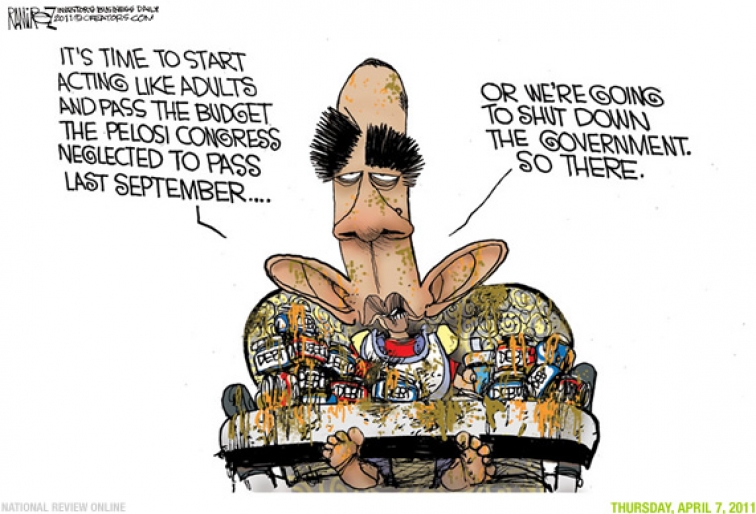
Two-time Pulitzer Prize-winning cartoonist Michael Ramirez illustrates Obama’s posturing on the ongoing congressional budget negotiations and the pending government shutdown.
View more of Michael Ramirez’s cartoons on CFIF’s website here.
His crypto-candidacy is only a few weeks old, but, as Politico reports, Donald Trump is already making big waves in the race to the be the next Republican presidential nominee:
Donald Trump is a force to be reckoned with on the national political stage, according to a new poll on Wednesday night.
The NBC/Wall Street Journal poll shows Trump tied for second place with Mike Huckabee, both at 17 percent, and leading the GOP pack among Tea Party supporters.
Those are huge numbers for someone who was completely absent from presidential chatter just a few months ago (of course, universal name recognition doesn’t hurt).
Let’s stipulate that the odds favor Trump’s flirtations being nothing more than some extremely sophisticated guerilla marketing. That being said, one has to wonder where the source of his appeal lies. The safest bet? Trump is popular because he is unafraid to speak his mind, directly and unapologetically. That’s a rare trait in an age where most politicians are driven by fear of losing the next election rather than hope for governing before then. To the extent that it’s present in other GOP comers — whether in the iron will of Chris Christie or the intellectual honesty of Paul Ryan — it seems to be a gene characteristic of those who won’t be running for president in 2012.
GOP White House hopefuls should take note. There’s a Trump-shaped vacuum in this presidential field.
Two bills before the Texas legislature, H.B. 259 and H.B. 3675, propose new and unwarranted taxes on satellite television providers. This period of high unemployment and economic uncertainty is no time to be raising taxes in the first place. But here’s the kicker: those two bills would essentially tax thin air.
H.B. 259 and H.B. 3675 would impose taxes on something satellite television providers don’t even use – the physical public right of way. Obviously, reasonable people could understand why entities that actually use the public right of way under city streets or along physical power lines must help maintain those rights of way. Since satellite video doesn’t even traverse any physical right of way, however, H.B. 259 and H.B. 3675 constitute a tax on thin air. Moreover, Texas already taxes video services, so imposing yet another entirely new tax upon physical rights of way that satellite providers don’t even use makes these two bills even more manifestly unfair. Additionally, it is estimated that only 10% of right of way taxes actually go to maintenance, with 90% of collected revenues diverted to general city funds. In other words, these two proposed bills are a transparent money grab.
We at CFIF have therefore sent a letter of to the House State Affairs Committee to assert our opposition on behalf of 17,000 activists and supporters in the state of Texas. But you can also help by contacting them as well via this link.
Make it clear to these legislators that now is not the time to raise taxes, especially when what’s being taxed is nothing more than thin air.
View more of Michael Ramirez’s cartoons on CFIF’s website here.
In this era of bureaucratic overreach and unsustainable spending and deficits, should government also enter the business of competing against private communications service providers? Doesn’t it already have its hands full?
We at CFIF think so. In fact, we testified last month before the North Carolina legislature on behalf of thousands of supporters and activists across that great state in support of H.B. 129, which would restrain government bureaucrats from unfairly competing against private providers of communications services. And with good reason. From Taiwan to Australia, from Chicago to Houston, and inside North Carolina itself, the history of public broadband is without exception one of failure. Every single public broadband project of which we’re aware has failed to so much as break even. Ultimately, taxpayer bailouts become necessary as government endeavors lose money and require constant upgrades to keep pace with evolving technology. Moreover, government broadband boondoggles undermine the billions of dollars invested in private network improvement and expansion, and discourage future private investment. After all, why risk one’s capital to compete against governments that can manipulate the rules and go to taxpayers for bailout? Inevitably, poorer service and layoffs in the vibrant tech sector result. Rural communities particularly suffer.
But none of that logic seems to matter to Democratic FCC Commissioner Mignon Clyburn. In a statement Monday, Clyburn attacked the North Carolina’s sensible legislation and defended the concept of government entering yet another portion of the private sector. Perhaps that’s not surprising, considering Clyburn’s vote last December to impose so-called “Net Neutrality” in the face of two-to-one public opposition, a unanimous Court of Appeals decision that the FCC didn’t possess such authority and condemnation from bipartisan groups in Congress.
Predictable or not, however, it is critical that Americans at the federal, state and local level vocally oppose the sort of government tech sector overreach that she advocates.
Britain’s Telegraph says General David Petraeus may be nominated to replace CIA Director Leon Panetta, after the latter is tapped to become Secretary of Defense when Robert Gates retires.
If that happens, President Barack Obama will have kept not only former President George W. Bush’s people, but also his rationale for staffing key national security posts. Gates’ last government job before Defense Secretary was as CIA Director. Air Force General Michael Hayden led the CIA under Bush before Panetta took over.
Despite his campaign rhetoric, President Obama has continued the war in Afghanistan, and reversed himself on civilian trials for Guantanamo Bay detainees. Now, it looks like the current president is adopting the staffing rationale of his predecessor too.
Somewhere in Texas, I’m sure former President Bush is flattered.
In the must-watch video below, House Budget Committee Chairman Paul Ryan lays out his 2012 budget proposal and the consequences should Congress fail to act now to restore the nation’s fiscal sanity.
The Wall Street Journal reports that India’s explosive growth in college graduates isn’t translating into employment for millions of newly minted degree holders. The biggest problem: lack of critical thinking and communication skills.
To compensate, companies are spending large sums of money coaching graduates into employability. According to one Indian business executive, the problem is the credential mentality infecting education:
“How are you able to change the mind-set that knowledge is more than a stamp?”
Sound familiar? American higher education too is tempted to treat knowledge-building as a service rather than a task. When students are treated like customers, the link between effort and reward is broken. The result is a certification that doesn’t translate into employment.
With half of India’s 1.2 billion population under the age of 25, up to a million new workers a month are estimated to join the labor force over the next decade. If India continues down the path of graduating young people without critical thinking skills, those workers – and the growing Indian economy – will be in serious trouble.